
When I was a child, give it up was a phrase used to admonish someone’s unruly behaviour, usually mine. It was a playful and gentle reminder that sometimes what you’re doing isn’t working and it may be time to move on. I still find myself saying it inwardly whenever I catch my persistence having the opposite effect to the one I intended.
As you might expect, its meaning has changed over the years. What was once a jovial rebuke now sits much more gently in my consciousness. Give it up has become an invitation to draw the specific into the cosmic; an acceptance that there are things beyond my control. It is a willingness to go where the wind blows rather than always insisting on my own direction.
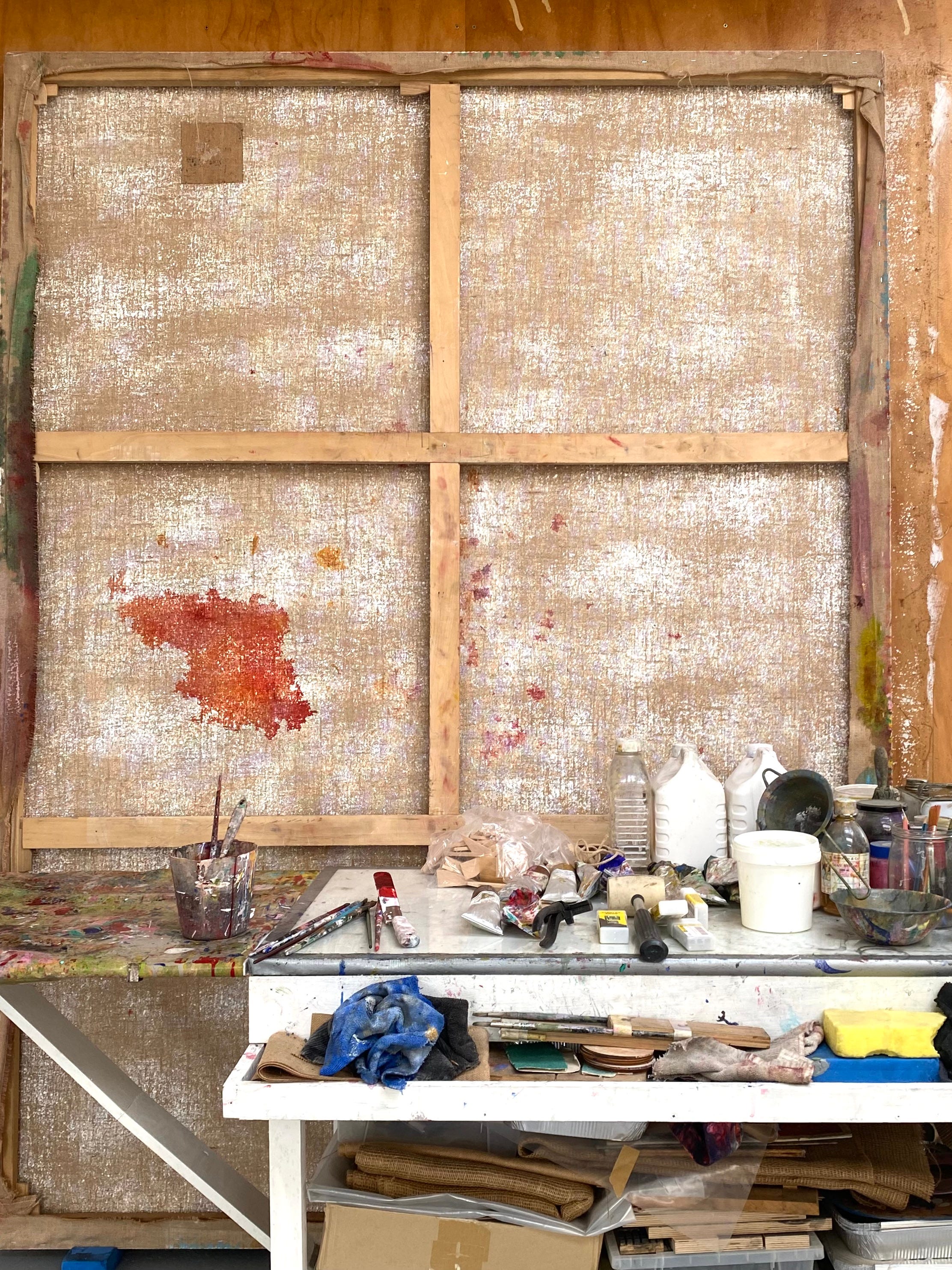
As an artist I know too well the deadening consequences of a stubborn creativity. In truth, I’m not even sure those two words belong together. The creative spirit has its own lightness, even when it is carrying great weight. Stubbornness belongs to the ego, not to creativity. Over the past few weeks I’ve found myself digging down into that wilfulness. I can usually recognise its arrival. My sense of colour begins to disappear. Everything looks harsh and uncommunicative. Surfaces stop coalescing, my curiosity fades, and yet my instinct is always the same: push harder. Keep going. Build ever greater edifices of painterly suffocation. It is precisely then that I need to hear those old words. Give it up. Lay aside whatever behaviour is creating this airlessness. Saying it, of course, is much easier than doing it.
I think what many religious traditions call grace is a continual giving up. Christians might recognise this as learning to live by the Holy Spirit. A gradual relinquishing of control. A realisation that if we are to move with the wind, we must first become sensitive to the slightest breeze. There is a profound joy in that experience. Perhaps it is what we now describe as flow.
Every virtue carries its corresponding temptation. My willingness to tolerate discomfort and persevere through difficulty so easily slips into a stubborn refusal to recognise when another way is calling. Persistence is indispensable to painting, but only if it remains flexible enough to listen.
The word sin comes from an ancient archery term meaning to miss the mark. Painting, at least for me, consists largely of missing the mark. Fortunately, that is where most of the learning happens.
As Richard Rohr writes:
“The soul is transformed not by perfection but by failure.”
There is an irony here. We cannot miss the mark unless there is first a mark to miss. Failure only matters because we are aiming at something real.
So what has this to do with making paintings? We slip so easily out of a state of grace. Once we hit the mark a few times we begin to believe we’ve mastered it. We’ve found our style. Our thing. Our method. This, I think, is one reason why selling art and making art are often uneasy companions. Markets require predictability – in form, content and timing. Painting asks for something altogether less manageable. It asks us to remain open to surprise, to failure, to continual transformation. It asks for a life that neither technique nor technology can produce on their own. The give it up I am describing here is not resignation. It is trust. It is an open awareness that relinquishes control without abandoning commitment. A way of being present to what is emerging rather than forcing what has already been decided.
The mystics of almost every tradition write passionately about this freedom. Not freedom from responsibility, but freedom from the tyranny of the self. It is, I think, something painters know well through the relationship between paint, imagination and what we might call soul. I realise those words may sound simplistic. They are not. Even the words artist and mystic are burdened with assumptions. By mystic I simply mean someone who has travelled as deeply as possible into reality. Someone who has moved beyond explanation, beyond technique, even beyond concepts, into a more direct encounter with what is.
The ancient Greeks understood truth in two complementary ways: logos and mythos. Logos resembles what we now think of as reason – analysis, explanation and practical understanding. Mythos addressed a different order of truth. It asked questions of meaning, purpose, relationship and belonging. As Karen Armstrong has argued, these were never intended to compete with one another. They answered different kinds of questions. Logos asks how; mythos asks why. Modern culture has become extraordinarily accomplished at logos while often neglecting mythos. The result is a world of astonishing technical achievement that sometimes struggles to answer why any of it matters. Art belongs to both.
Without mythos, logos risks becoming a world of mechanisms without meaning, where painting, music and poetry are reduced to entertainment, propaganda or expressions of the ego. Without logos, mythos drifts into fantasy untethered from experience. Painting, at its best, inhabits the fertile ground where the two meet.
To find that larger truth we must continually lift our eyes beyond the merely material, not to escape the world but to enter it more fully. We begin to recognise the relationships that bind self, others, nature and the cosmos together.
To give it up is not to surrender creativity but to surrender control.
Paint ceases to be merely pigment on canvas and becomes part of a conversation between body, imagination, memory and spirit. Words can only approximate what happens there. Concepts eventually reach their limit. The ego loosens its grip, and something more generous begins to emerge. Perhaps this is what painters are really practising, a deep participation in the world. A continual willingness to let go, to begin again, and to trust that what cannot be forced may nevertheless reveal itself.
Matthew Burrows
No posts
Comments
Nothing yet. Say the first thing.
Sign in to join the conversation.