
I remember a coworker of mine who was a Oneness Pentecostal (a non-Trinitarian Christian movement that believes God is a single divine person rather than a Trinity of distinct persons) objecting to the Christian belief in the Trinity. He said, “If Jesus is God, and the Father is God, who exactly was Jesus praying to? Was He talking to Himself? That doesn’t make any sense. Jesus is the Father manifested in flesh, not a separate divine person.”
I was about eighteen at the time, newly converted, and didn’t know how to respond. The objection seemed to make sense and rattled me a little. After all, my coworker was correct, throughout the Gospels there are multiple instances of Jesus praying.
In Gethsemane, He says:
“My Father, if it be possible, let this cup pass from me; nevertheless, not as I will, but as you will” (Matt. 26:39).
At His baptism:
“Now when all the people were baptized, and when Jesus also had been baptized and was praying, the heavens were opened” (Lk. 3:21).
Before raising Lazarus:
“Father, I thank you that you have heard me. I knew that you always hear me” (Jn. 11:41–42).
And in many other places throughout the Gospels, Jesus withdraws to pray to the Father. So, if Jesus is truly divine, what exactly is going on?
Once I better understood what the Church teaches about the Trinity, the answer became surprisingly simple.
Christians do not believe that Jesus is the Father. Nor do we believe that the Father, Son, and Holy Spirit are merely different masks or roles played by a single divine person. If that were the Christian view, then my coworker would have had a point.
Instead, the Church teaches that there is one God in three distinct divine persons: Father, Son, and Holy Spirit.
The Father is God.
The Son is God.
The Holy Spirit is God.
Yet the Father is not the Son, the Son is not the Spirit, and the Spirit is not the Father.
Here’s a helpful image to envision what the Chruch teaches:
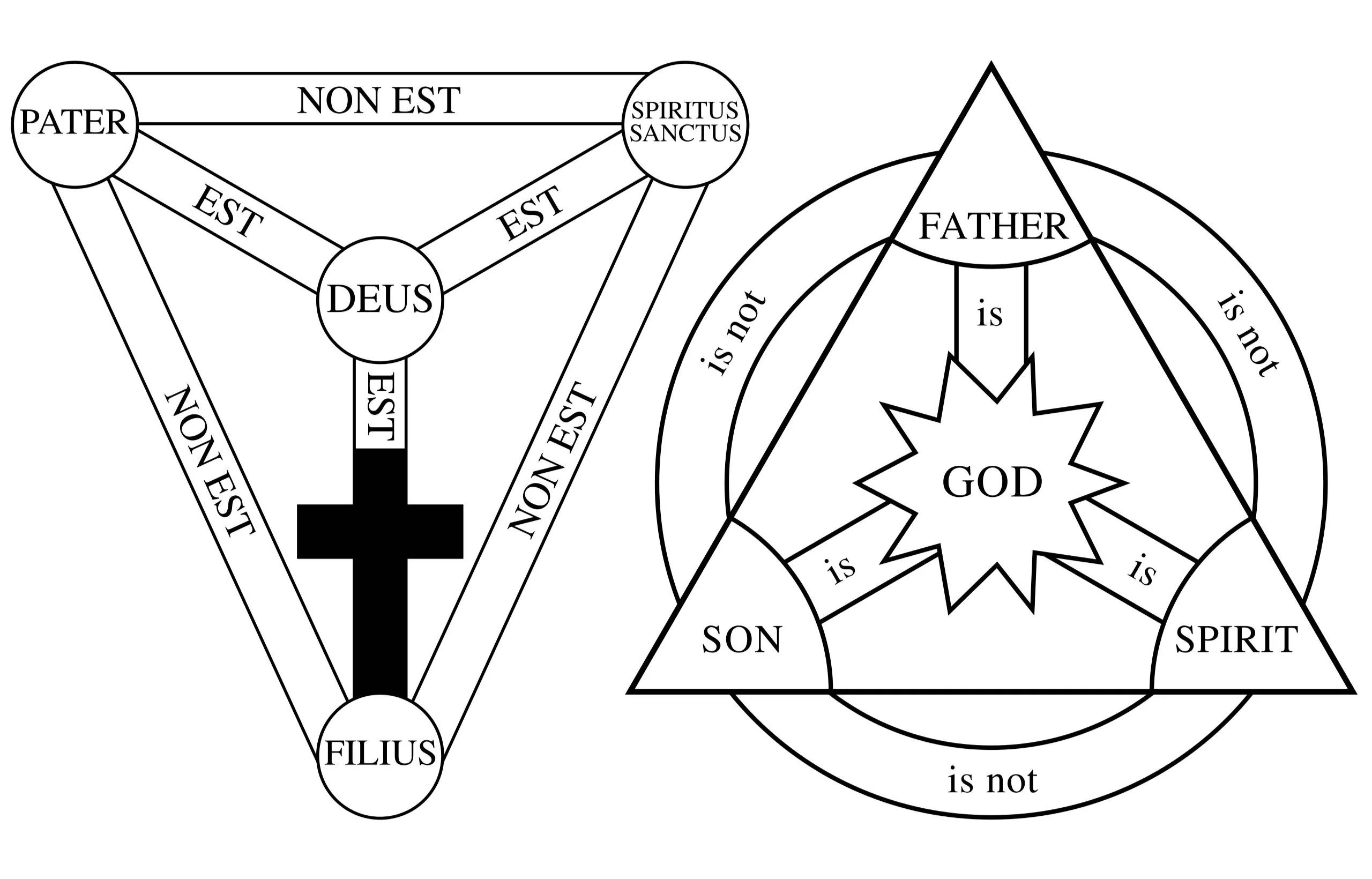
So when Jesus prays, He isn’t speaking to Himself. Nor do these prayers undermine His divinity. Rather, they reveal the eternal Son communing with the Father. That’s not a problem for the Trinity. It’s actually part of the doctrine itself.
Think of it this way: A son speaking to his father doesn’t disprove that both share the same human nature. Likewise, the Son speaking to the Father does not disprove that both share the one divine nature. Again, Christians don’t believe in three gods, but one God existing eternally as three persons.
The prayers of Jesus actually make far more sense within Trinitarian Christianity than outside of it.
They also make sense because of the Incarnation.
The eternal Son truly became man. He didn’t merely appear human. He took on a real human nature. He experienced hunger, fatigue, sorrow, temptation, and suffering. Since He became truly man, it was fitting that He would live a genuinely human life of communion with the Father.
Prayer isn’t merely about transferring information to God, as though God needed to be informed about things he doesn’t yet know. If that were the purpose of prayer, then prayer would be pointless for everyone, not just for Jesus. Jesus Himself says that “your Father knows what you need before you ask him” (Matt. 6:8). Prayer is about communion, love, obedience, worship, and relationship with God. And because the eternal Son truly assumed a human nature, He lived the perfect human life before the Father, which included prayer.
In doing this, He also gave us an example to follow.
Ironically, the passages where Jesus prays actually refute certain heresies rather than support them.
In fact, the passages where Jesus prays undermine the very error my coworker was defending. In the third century, a man named Sabellius taught that the Father, Son, and Holy Spirit were not truly distinct persons, but merely different modes or manifestations of one divine person. Modern Oneness Pentecostalism differs from ancient Sabellianism in certain ways, but both reject the idea that the Father and Son are eternally distinct divine persons.
But Christ’s prayers become strange under this view. If the Father and Son are merely different modes of one divine person, then Jesus’ prayers are no longer genuine communion between Father and Son, but something closer to a monologue.
The Trinitarian understanding makes much better sense of the text. Jesus prays to the Father because the Father and Son are genuinely distinct persons united in the one divine essence.
Far from disproving the Trinity, the prayer life of Jesus points directly to it.
No posts
Comments
Nothing yet. Say the first thing.
Sign in to join the conversation.