
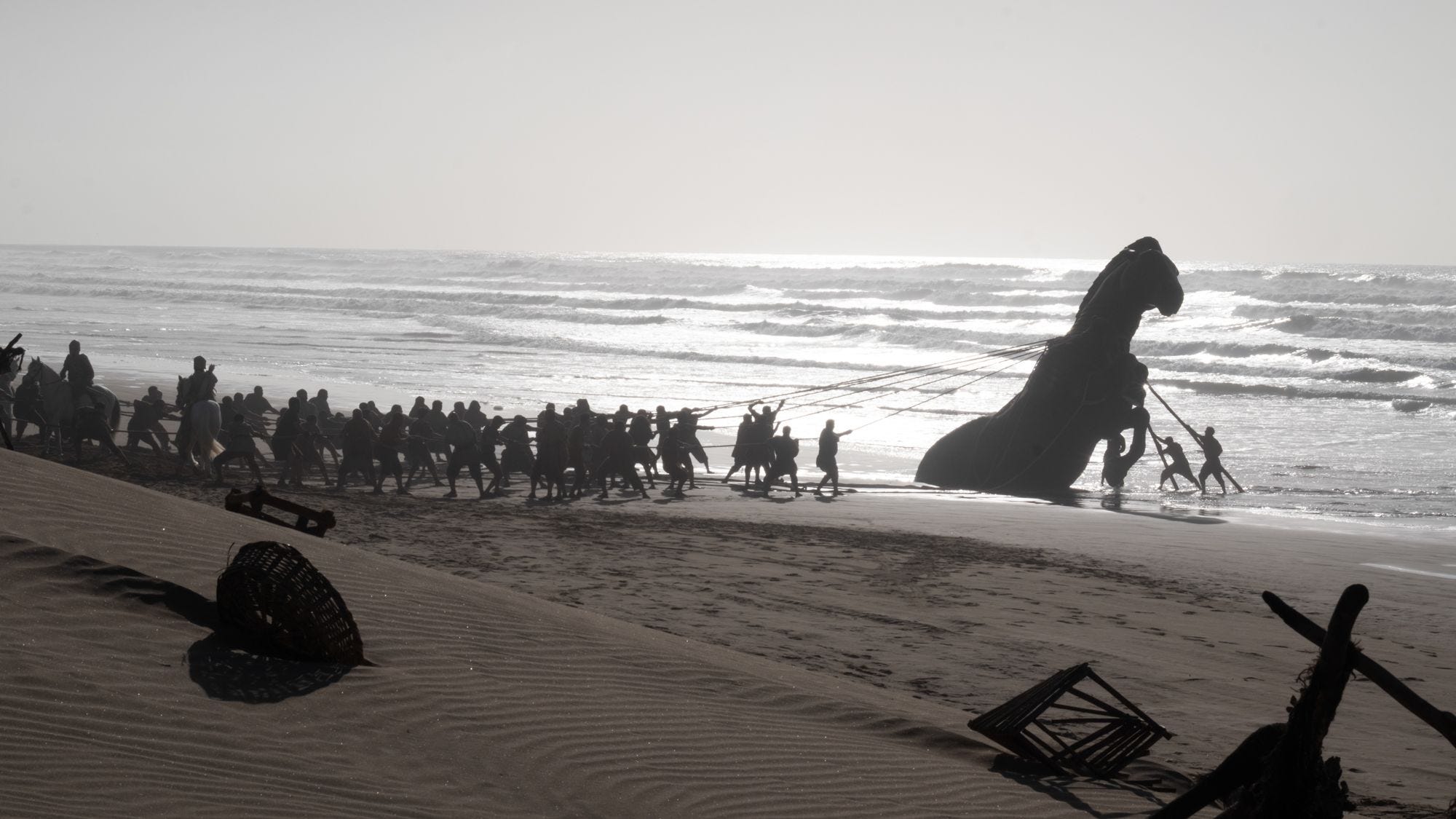
There’s a special law of relativity for storytelling: Time will make small tales taller but shrink epics to more modest dimensions. What was epic in one era will be a Tuesday in another.
In the millennia since Homer’s “Odyssey,” nature has been tamed, the one-eyed cyclopes driven extinct, and the gods abolished. Wars are no longer fought over stolen princesses. The vast horizons of Homer’s world, which took the hero 20 years to travel, now shrink to a pixel with a pinch of the fingertips on Google Maps. A travel planner would notice all the 1-star ratings for Circe’s restaurant and make other plans for lunch. Ithaca itself is reachable by a short flight from Troy. Odysseus could text the Penelope/Telemachus family group chat that he’s boarding for home but running a little late.
But the modern reader will still discover more to Homer’s “Odyssey” than memories of long-lost gods and monsters and of travails now avoided. Something in this old poem sticks to our ribs like a fatty dinner. Odysseus was a “complicated man,” as the classicist Emily Wilson controversially called him in her recent translation of Homer’s Odyssey, and aren’t we all? As the German ironist Heinrich Heine once wrote of the bloody little Odysseus that dwells inside all of us:
Mine is a most peaceable disposition. My wishes are: a humble cottage with a thatched roof, but a good bed, good food, the freshest milk and butter, flowers before my window, and a few fine trees before my door, and if God wants to make my happiness complete, he will grant me the joy of seeing some six or seven of my enemies hanging from those trees.
The primary task for modern readers of Homer’s “Odyssey” is to reckon with the sheer amount of death that follows Odysseus around and to assess what kind of hero this ancient hero really is.
The director Christopher Nolan’s major innovation in the new “Odyssey” film is to make tricksy, bloody, victorious Odysseus a repressed neurotic. This Odysseus is calm on the outside but all fucked up in the head from winning the great war, at the cost of losing not just a generation of men but the whole empire. (Very British.) He lands on Calypso’s island, and instead of being delayed because of a goddess’ seven-year sex spell, he medicates on anti-depressants until Calypso guides him out of self-exile through the restorative power of talk therapy.
And when I say that Nolan’s Odysseus is repressed, I mean repressed: I’m not the first to notice that, unlike the ancient poem, there’s no sex in the movie after the departure for Troy, even when Odysseus makes it home to pining Penelope. (The telling exception is when Clytemnestra murders a waiting Agamemnon in bed, leading the king of kings to tell Odysseus from beyond the grave to not do what he did. The erotic symbolism here is impossible to ignore.) After seeing the orgy of violence at the sack of Troy, it’s as if Nolan’s Odysseus goes chaste to start rebalancing the books on what Freud called the “economics of the libido,” those acts of self-denial that make polite society possible. Freud likened the controlling power of guilt to “a garrison in a conquered city,” which was embodied — literally — in Nolan’s moving scene with Odysseus’ ghost army in the fields of asphodel, led by an excellent Elliot Page as the betrayed Sinon.
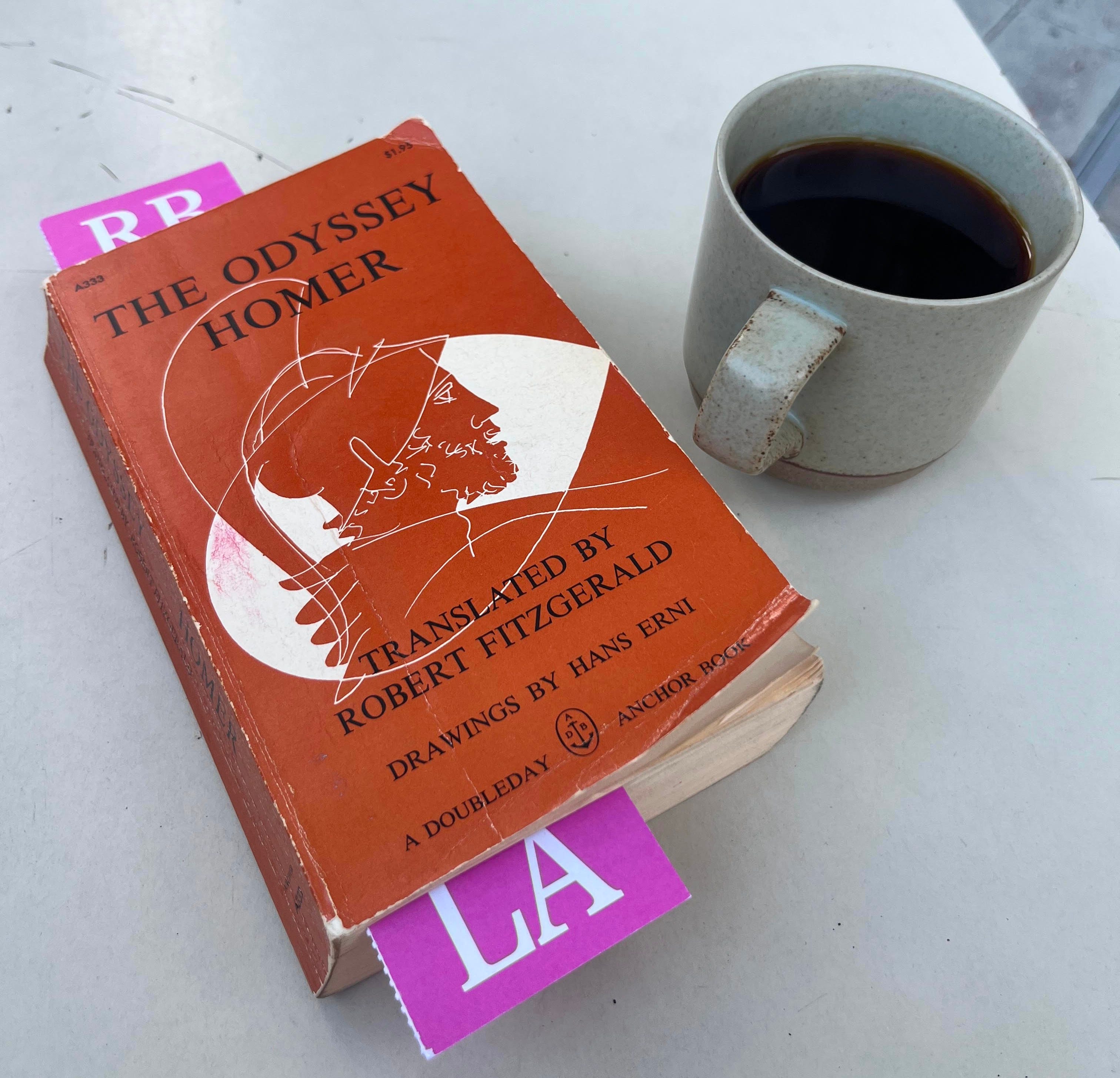
In the ancient poem, Homer’s Odysseus’ only has self-discipline when it comes to telling bigger and more ambitious lies; he otherwise exuberantly butchers every suiter and hangs every disloyal maid and aggrieves every powerful suitor’s family on Ithaca until finally the goddess Athena has to intervene to stop a civil war. “Must you have battle in your heart forever?” Athena asks Odysseus in the translation by Robert Fitzgerald, already knowing the answer. For the ancients, it was Atlas holding the world up on his shoulders; in Christopher Nolan movies, that burden falls on father figures. Nolan’s self-restraining Odysseus stops short of a full palace massacre and then flees his own country, doing only what duty, not passion, demands. This is the cinema of stiff upper lips.
Political philosophers across the ages have disagreed whether people are naturally good but get led astray by their societies, or if people are naturally nasty and need to be held in check. Nolan’s recent movies are about decaying civilizations and declining orders yielding men who loose anarchy upon the world, which is what makes him one of our foremost conservative artists working today. He’s a decline artist. Homer’s “Odyssey” is about the end of the Trojan War. Nolan’s “Odyssey” is about the end of the world.
No posts
Comments
Nothing yet. Say the first thing.
Sign in to join the conversation.