
A lot of people I know were bummed and conflicted about this year’s Fourth of July, which marked the 250th anniversary of the American Independence. I felt it too. The most personally wounding episode for me recently was watching birthright citizenship take a stiff challenge at the U.S. Supreme Court.
Almost all of my ancestors immigrated the U.S. in the 19th century seeking a better life, mostly found it, and many fought for it. Most of the military-aged men in my family enlisted with the Union during the Civil War, though a few chose the confederacy (and saw their wars end in ignominy). One of my Unionist ancestors who was too old to fight, George Gewinner, who immigrated from Bavaria in 1848, became a bandmaster in Lincoln’s armies instead and claimed to have played at Robert E. Lee’s surrender at Appomattox. Old George wasn’t a natural-born killer but a natural-born music teacher, and his immigrant contribution to American freedom was to teach the slavers what defeat sounded like. May he rest in honored glory.
But today, my own American citizenship rests not on my ancestors’ bloodlines or their military service but on the 14th Amendment won in law during Reconstruction: one of the great leveling amendments that bulldozed mistakes of history to clear way for the America of the future.
To be some other type of natural-born citizen other than a birthright citizen — to be what Vice President J.D. Vance ominously calls a “heritage American” — would make my citizenship a matter of property inheritance, like a title to a farm or a boat, passed down like chattel. It would shackle me with ancient privileges instead of modern rights. It would, in short, make me an aristocrat of a country whose great historical innovation was abolishing aristocracy.
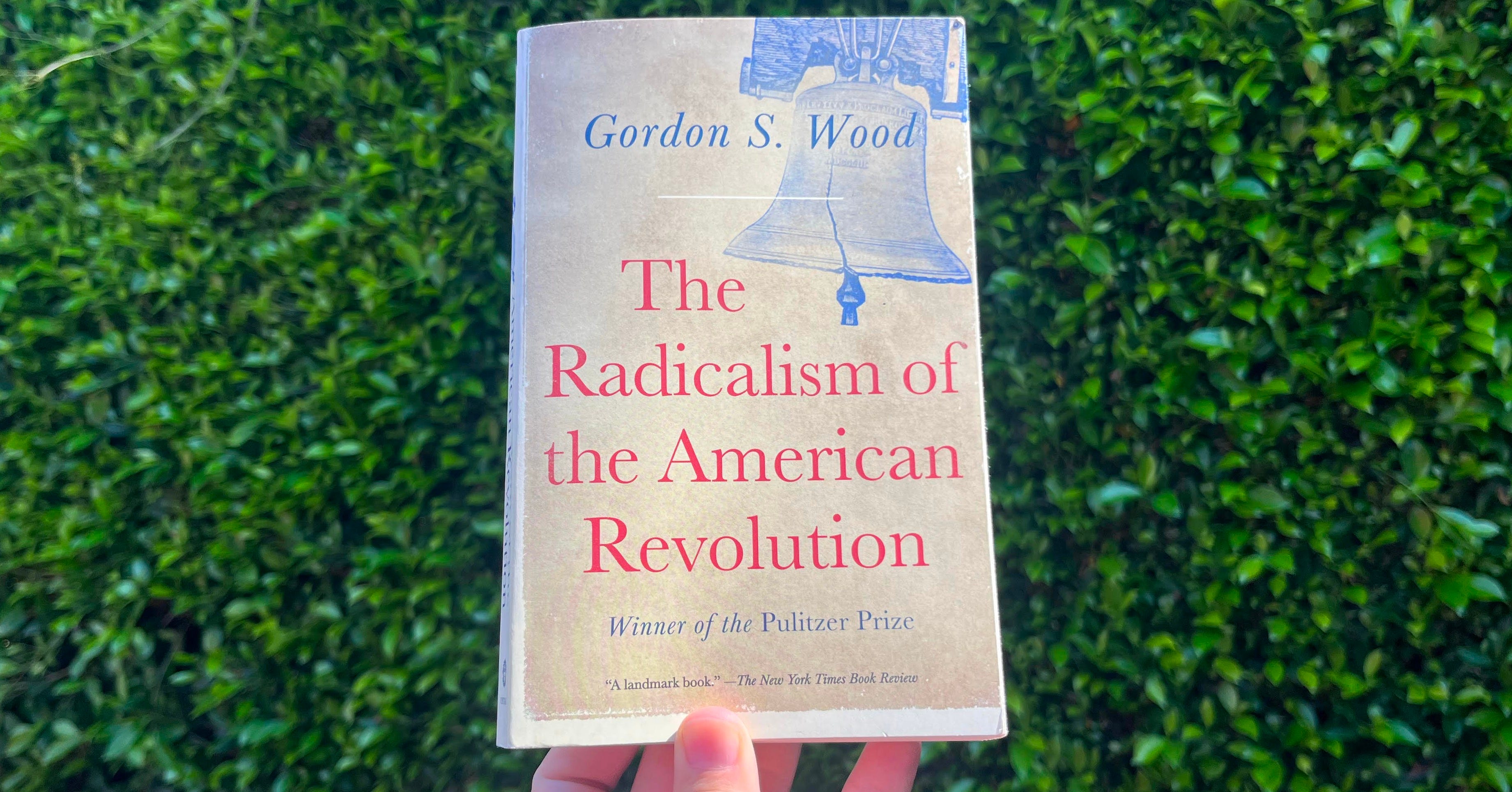
This holiday weekend, I’ve been reading Gordon S. Wood’s 1993 Pulitzer Prizee winning history book, “The Radicalism of the American Revolution,” which has broadened the way I’ve thought about American Independence.
One of the things I hadn’t appreciated before reading Wood’s history was the practically feudal character of American society before the Revolution. Servility smothered everything: the slaves in the fields, the indentured servants in the homes, the wives treated like the children of their husbands, the yeomen who doffed their hats to the gentlemen, the gentlemen who answered to Crown appointees of whatever quality, all of them bowing under a faraway King. Life in the American colonies was simple, poor, stupid and subservient.
Immigration changed everything in America. The population exploded. The explosion of commerce turned debt from a social obligation into an impersonal business tool. It got harder to keep servants. It got harder to disinherit disobedient kids and have it mean something. It got harder to control people moving from town to town. It got harder to control anybody. Even husbands and wives started getting their portraits painted standing at the same height, instead of with the man always standing at the top of the frame.
Republicanism infected the culture, both socially and as a literary phenomenon. The American gentry, although locally rich, were new money and had no noble titles to draw upon; they sought social legitimacy as adamant cosmopolitans who read ancient writers like Cicero and Tacitus to draw from Roman ideals about what the good life should look like. After winning the Revolutionary War, George Washington genuinely shocked the world when he took after the ancient general Cincinnatus and retired to his farm instead of becoming dictator for life. Here was something new.
Revolutionary republicanism quickly gave way to the revolutionary reality of American democracy, which set the stage for the next 250 years of national political life. Voters quickly elected a lot of pretty normal-looking guys to office instead of Latin-reading gentleman farmers. Political life turned out to be pretty grimy, full of electioneering, horse-trading and pork-barrel spending to appease local voters. Interest groups formed and started lobbying for favorable economic treatment instead of the universal public good. Local merchants had done fantastic business supplying the American, British and French armies during the war, and they wanted to keep the good times rolling. It turned out that Americans took a liking to working hard once it meant they got to buy more stuff and increase their pitiable standards of living.
The Founders’ republic was supposed to be disinterested, benevolent, Roman. Instead, the American democracy they created was practical, self-interested and fully modern. It would only be the first time that American inventors cooked up a popular product that got away from them. The Founders had made a country that was great for making money.
Freedom for all Americans would have to wait a few decades longer — “until all the wealth piled by the bondsman’s two hundred and fifty years of unrequited toil shall be sunk, and until every drop of blood drawn by the lash shall be paid by another drawn with the sword,” as Abraham Lincoln later put it. (The suffragists would need a while longer.) But the abolition of aristocratic culture by the American Revolution signed the death warrant for American slavery, Wood argues:
For a century or more the colonists had taken slavery more or less for granted as the most base and dependent status in a hierarchy of dependencies and a world of laborers. Rarely had they felt the need either to criticize black slavery or to defend it. Now, however, the republican attack on dependency compelled Americans to see the deviant character of slavery and to confront the institution as they never had to before. It was no accident that Americans in Philadelphia in 1775 formed the first anti-slavery society in the world.
To be an American and to know our history is to know its hypocrisies, inconsistencies, crimes and tragedies. It’s also to know our potential and when that potential is being frustrated. We go to work in that delta between what is owed and what is actually paid under the Declaration of Independence, the “promissory note to which every American was to fall heir,” as Dr. Martin Luther King, Jr. described it: that all men were created equal and entitled to the pursuit of life, liberty and happiness. Not just the aristocratic “heritage Americans.”
I’m not one for blind nationalism (which would have been totally alien to the Founders anyway) nor to hopeless pessimism, which never did anybody any good. When I was a local union president, we’d start Communications Workers of America conferences with the pledge of allegiance. When this group of troublemakers who knew better got to the ending part, promising “liberty and justice for all,” we added another word: “someday.”
No posts
Comments
Nothing yet. Say the first thing.
Sign in to join the conversation.