
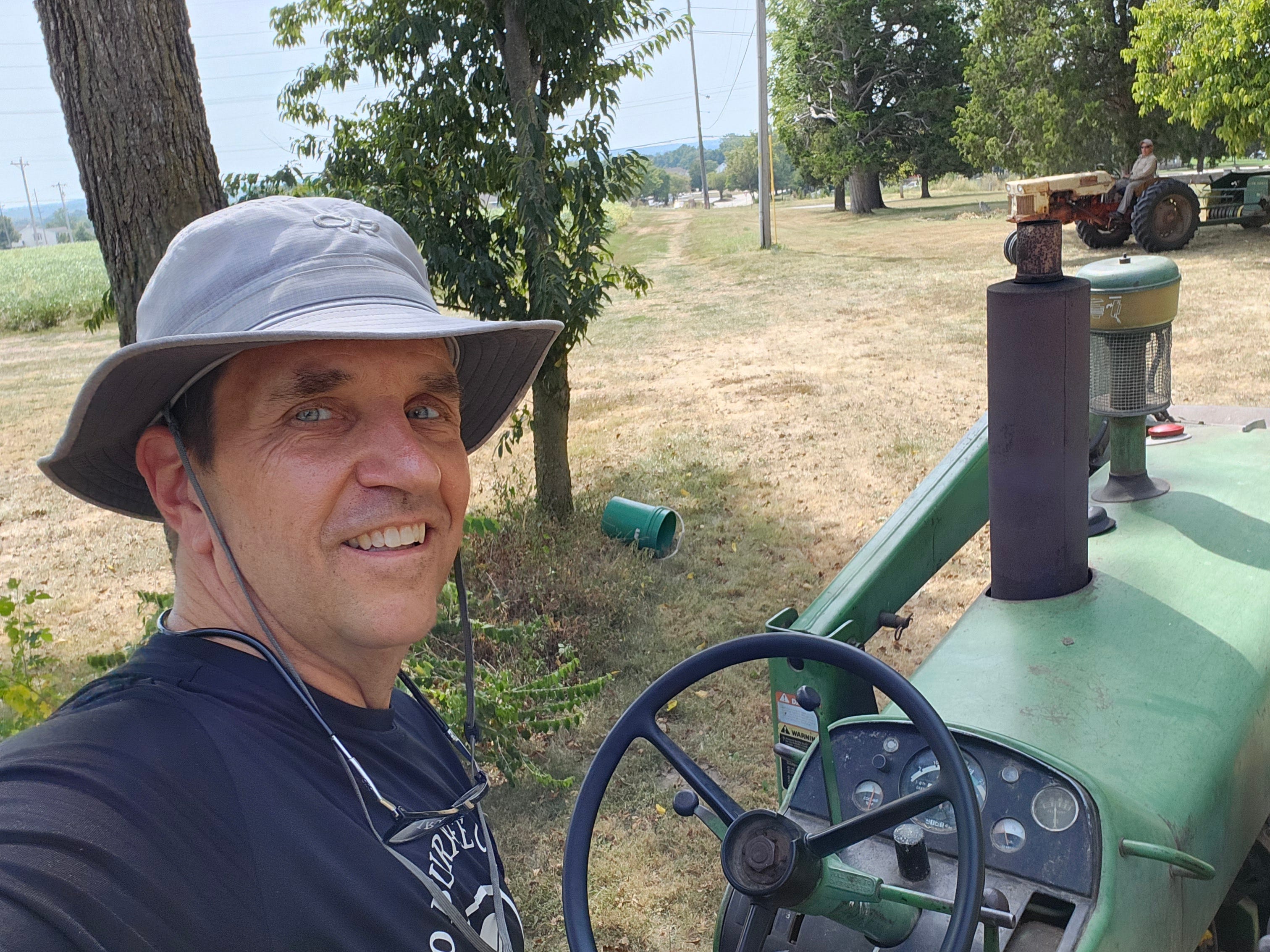
His name is Kim Bradsher, but we all call him Pay Day because of his fondness for that candy bar. One day, Pay Day put out a call to our workout group asking for help moving hay bales into his barn.
He asked the right people. Our workout group, a local chapter of an international organization called F3 (F3Nation.com), has an unofficial mantra when someone proposes a challenging workout, difficult race or arduous task on the farm: “That’s a terrible idea. What time should I be there?”
If there’s a more F3 principle than eagerly helping a friend no matter how unpleasant the task I haven’t heard of it. Really the worse it is the more we want to help. And so it was that five of us showed up even though the sun was brutal and the humidity was worse: the heat index soared into triple digits. Four of us (including me) were newbie farmhands. The fifth spent a summer in high school working on a farm and was nostalgic to do it again.
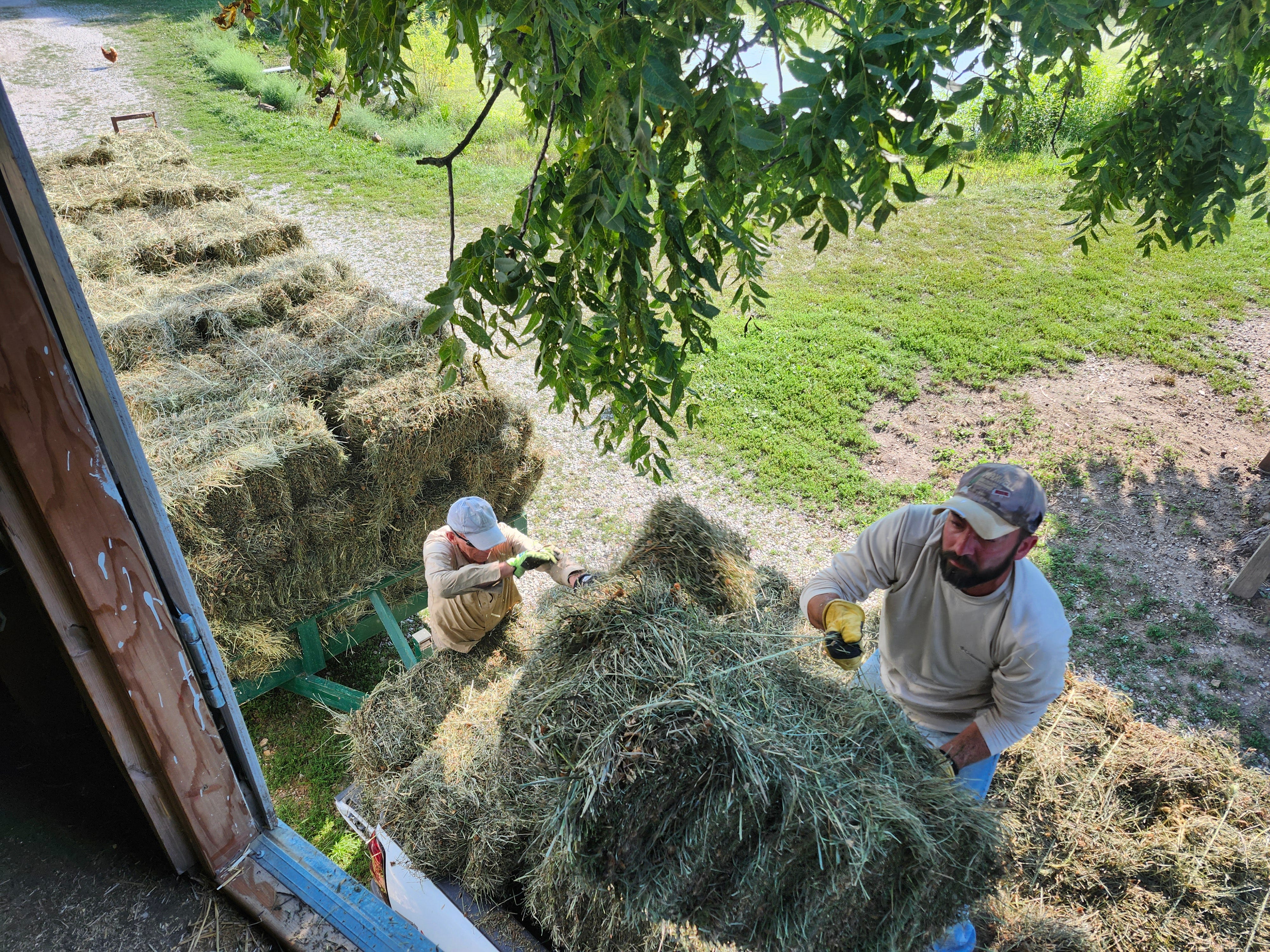
We arrived full of more energy than sense. Pay Day drove a pickup truck pulling a flatbed trailer in his front field. Like children conned into believing putting away their toys quickly was a game, we walked ahead of the truck and trailer, picked the bales up, and walked them back to load them on the trailer and truck. We eventually wised up and waited for the truck and trailer to get to us.
Each bale weighed 25 to 30 pounds. In another year they will have weighed 50 or heck maybe even 80. We filled the trailer and truck three times and threw all 300 of those bales into the second floor of Pay Day’s barn, where we then stacked them neatly.
Ha, no!
Us city boys couldn’t remember from one bale to the next which direction we should stack them, and even when we did remember, we couldn’t stack them neatly. The straw that was already in the barn stood symmetrically, like books on a shelf. Our hay, comprising grass, clover and alfalfa, was all cattywampus, like the notebooks strewn across my desk.
Pay Day’s wife, Rita—whose family has owned the farm for more than 130 years—set us, and our bales, straight.
From down below, where he was heaving the bales up, Pay Day told me not to let her lift any bales, and, up in the barn, I kept telling her not to, and she kept doing it anyway.
Did I mention she’s 67?
The “Dickherber farm,” as it’s known after Rita’s maiden name, is a local landmark. Pay Day and Rita turn part of it into a corn maze every fall. They sell hot chocolate and cider and take kids on hayrides. The farm is more or less open all the time for people to stop by and get a look at how it operates.
After bucking the hay, I returned when Pay Day needed help baling it. He taught me to drive a tractor. When it roared to life with me in the driver’s seat, something primal awoke deep in my chest. When I released the clutch and lurched forward, my heart rate soared. Soon it dropped. Soon I zenned out.
The sun roasted me and the tractor. I wore gloves because to touch that John Deere was to risk a burned hand. Finally I parked the tractor in the shade, and Pay Day directed me to stand in the back. He wanted me to watch the hay bale I had created as it entered the world.
It had gestated for only 20 minutes before the baler’s back end opened up and the hay plopped onto the ground. I felt like Tom Hanks in Castaway after he makes his first fire.
The farm is an increasingly isolated island in a sea of subdivisions, a tension everyone in this country feels day by day, year by year, decade by decade. St. Charles County (Missouri) had a population of 22,977 when Rita’s ancestors bought the farm in 1890. Now more than 400,000 people call the county home.
I have a good friend whose backyard abuts Dickherber farm. I’ve been to cookouts in his backyard many times, and the conversation always turns to how lovely it is to have a farm behind them—to look at, to listen to, to smell, especially when the hay has just been cut.
And then the conversation shifts to how much longer that will last, and what would be lost if there were houses there instead. I mentioned this to Rita as I was trying to stop her from carrying hay across the barn. She said she was born and raised there, her dad was born and raised there, so was his dad before him, and she has no plans to sell the place.
Hearing that made the hard work worth it.
And hard work it was. Drenched in sweat from the first bale, I drank more than two quarts of water. During one break, Rita filled our cups with a mysterious red drink. I drained mine and asked for more, and so did everyone else. Someone coaxed that magical elixir’s recipe out of her, and we all half-regretted to learn it was just Kool-Aid with heaping amounts of sugar and Stevia.
The Kool-Aid pitcher empty, we moved to a second field and removed the bales. “My favorite bale,” Pay Day said as the sun started to dip below the houses in the distance, “the last one.”
Well, the last one that day.
He kept going the next day, too.
Did I mention he’s 71?
Moving hay bales was invigorating, a hell of a workout, fulfilling, even fun. But I can say that because I never have to do it again if I don’t want to. There’s a huge gulf between get to and have to. I like bucking and baling hay when I “get to” do something new, when I “get to” help someone, when I “get to” drive a tractor. I wouldn’t like it if I “had to” do it.
I’ll go back if Pay Day needs help, not least because of how grateful he and Rita were when we were done. His eyes dancing, he reached out to shake my hand. He placed something in it: His namesake candy bar.
That thing was delicious.
All that was missing was red Kool-Aid to wash it down.
No posts
Comments
Nothing yet. Say the first thing.
Sign in to join the conversation.