
A version of this story appears in the latest issue of Missouri Life Magazine. They have been among my favorite clients over the years. Subscribe, follow and read!
The flash of white.
It never gets old.
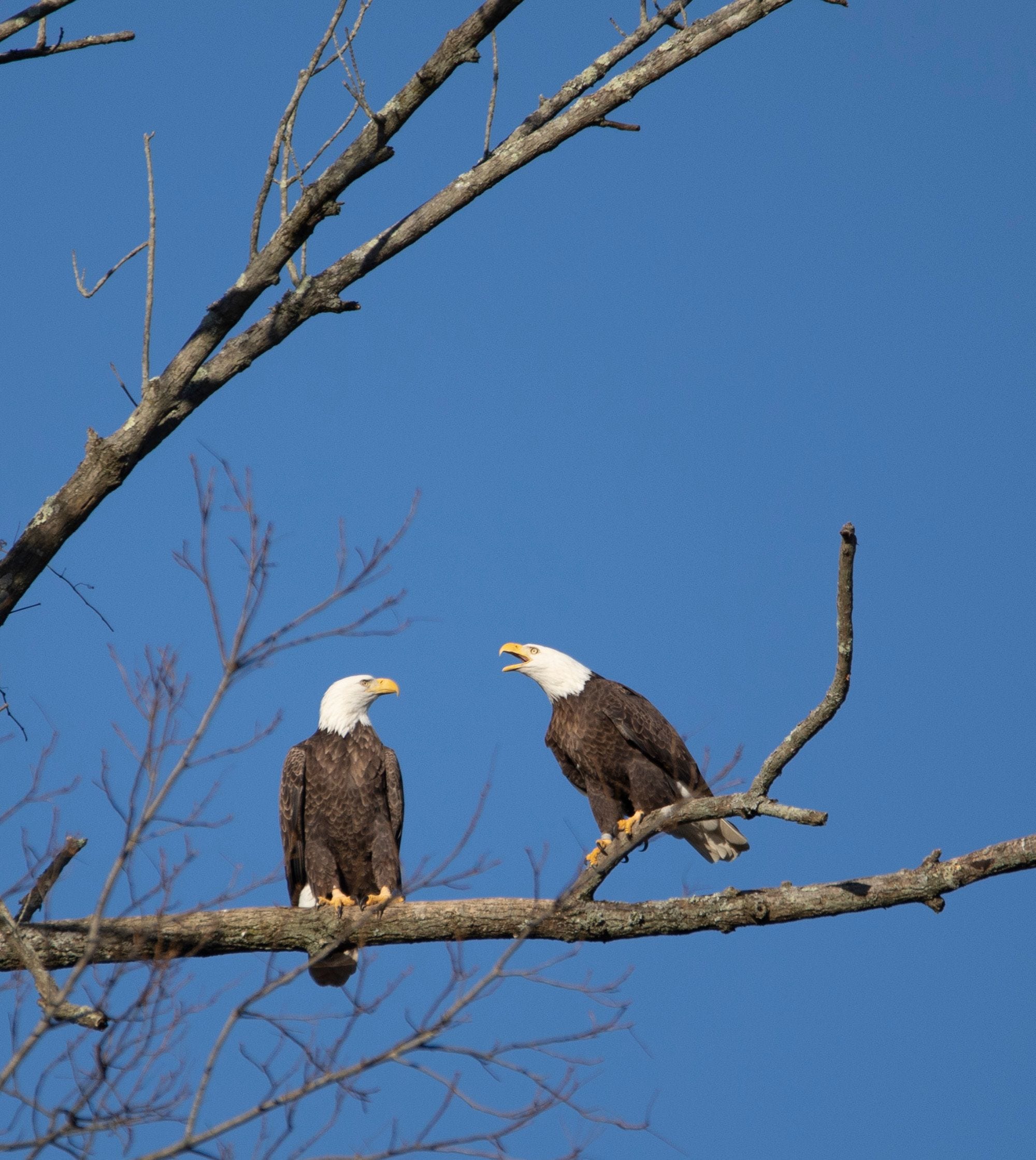
I see it on a male bald eagle’s head, perched on a tree above a gravel bike trail near Columbia on a warm spring day. Slightly lower, and in their nest, is the female—two flashes of white at once, jackpot!
It’s no surprise they’re together. Carol Weston, who has monitored this nest and seven others for eight years as part of the Missouri Department of Conservation’s Eagle Watch Program, says this couple is inseparable. They hang out together on trees up and down this trail.
I study the nest through binoculars, hoping to get a glimpse of eaglets. Weston peers through the view finder on her camera. She has spent so much time doing this she recognizes their behavior. After the male stirs on his perch—I didn’t even see him move—she predicts he’s about to take off.
Soon he soars toward us, his wings seemingly elongating, his beak getting bigger, sharper, yellower, the closer he gets. Suddenly he makes a U-turn and flies off into the distance. He turns right, and his white tail sparkles like a spaceship entering light speed before it blips invisible.
“DID YOU SEE THAT?!?!” I shout in delight.
Weston, a retired professor, mother of two and grandmother of one, smiles. I ask where she thinks he is going. “Sometimes I think they fly just to fly,” Weston says. “If I was a bird, I would soar just to soar.”
This summer, as the country turns 250, let’s celebrate our national bird for soaring just to soar, for being powerful, mysterious, beautiful, even elusive. And even more for how they have recovered, especially in Missouri, thus making this unforgettable morning possible.
Eagles all but disappeared from the Show-Me State for most of the 1900s. From 1981 to 1990, 74 young bald eagles were released into the state, and their population has climbed steadily since then.
They were removed from off the endangered list in 2007, and in 2018, Janet Haslerig, avian ecologist with the Missouri Department of Conservation, started the Missouri Eagle Watch Program, through which over 300 volunteers have monitored more than 690 nests of the nearly 1,400 documented in the state. Today there are 615 active nests (meaning adults, eggs and/or chicks have been observed in them.)
Volunteers agree to spend 10 hours a year documenting what they see when they visit the nests. Their payment is priceless immersion in these fascinating animals’ lives.
I spend a morning with Weston touring four nests, and I trade messages with volunteers responsible for dozens more. We all tell endless eagle sighting stories. One tells me about talking with eager-to-learn strangers near nests, to which I nod because Carol and I did that, too. Another calls his work scouting the nests an addiction, and that feels exactly right.
I have seen them at my church, up and down the Mississippi and Missouri rivers, on hikes, and on and on. As I was writing this story, I saw one three times near my house in St. Charles County.
I’m pretty sure he is new to the neighborhood. I try unsuccessfully to follow him to his nest. I bet the Eagle Watch volunteers could find his nest, and quickly. After years of observing them, Weston feels like she knows them, their habits, their comings and goings. “I’m so used to watching the intimate language of these birds,” she says.
She tries not to, but she can’t help but get emotionally attached, a sentiment echoed by other volunteers. We arrive at a nest Weston is excited for me to see because the eaglets are big enough that their heads will likely poke out of the top.
But when we arrive, there are no eaglets, no flash of white, no epic departure. The nest is empty.
Weston tries to stay hopeful. She tells me sometimes she’ll see an empty nest, worry, come back a few weeks later and find it full again. Not this time. The eaglets are gone, and so are the adults. She has known this pair for eight years, counted their young in each of those years, watched them grow and mature and leave the nest.
Now she mourns for them.
If the cost of seeing eagles’ great majesty over and over again, of experiencing the thrill of the flash of white, of watching these wild beasts soar just to soar is sometimes experiencing sorrow, that’s a price the Eagle Watch volunteers are willing to pay.
“When you see them against the sky, it’s awe inspiring,” Weston says. “I never get enough of it.”
No posts
Comments
Nothing yet. Say the first thing.
Sign in to join the conversation.