
I love working from home, and I love working on my own projects. I can take a break whenever I want to. I can work whenever the inspiration hits. If the inspiration isn’t there, I can take a walk, or head to a cafe. And I don’t miss the office politics one bit.
There are some things I miss about working with a team, or even working around other people, though. Bouncing ideas off of someone is sometimes a wonderful way to work out which ideas are good, and which… aren’t worth thinking too hard about.
Even if someone isn’t an expert in my field, or isn’t even familiar with what I’m working on, this can be helpful. In part, it’s the ‘rubber duck’ effect - just describing something out loud can help lead your brain to the right answer (there have even been scientific papers written about this: https://arxiv.org/abs/2301.06511).
I’ve found that modern AI’s can be a very effective rubber duck. They provide a sounding board for ideas, and while they don’t necessarily have the same context that a coworker does, they have been trained on a lot of information, so they are still able to suggest ideas I haven’t thought of.
Don’t get me wrong - they will not be able to give you a sure-fire marketing strategy that will make you millions. They will not be able to give you truly unique insights that no one has ever thought of. They won’t even be able to tell you whether something is a good idea or a bad idea. That’s not the point. The point is to give me a tool that will help me work out whether something is a good or a bad idea (although they’ll probably very excited and encouraging about all of them!).
If they can give me some ideas I might not have thought of, all the better.
Organizing these thoughts into an actionable plan, and making sure they get done is where systems like ChatGPT fall down here. In addition, it’s cumbersome to steer the conversation in certain directions, and to ignore others - if an idea is proposed that you know you don’t like, you need to tell this to the AI using words, and sometimes you need to repeat this frequently. This is where the idea for Brainstorm/AI originated.
Brainstorm/AI is my next app, due to be released in the next month. It’s intended to help focus your brainstorming sessions, to make eliminate the cumbersome nature of talking AI, and to focus these session at driving ideas and actionable tasks.
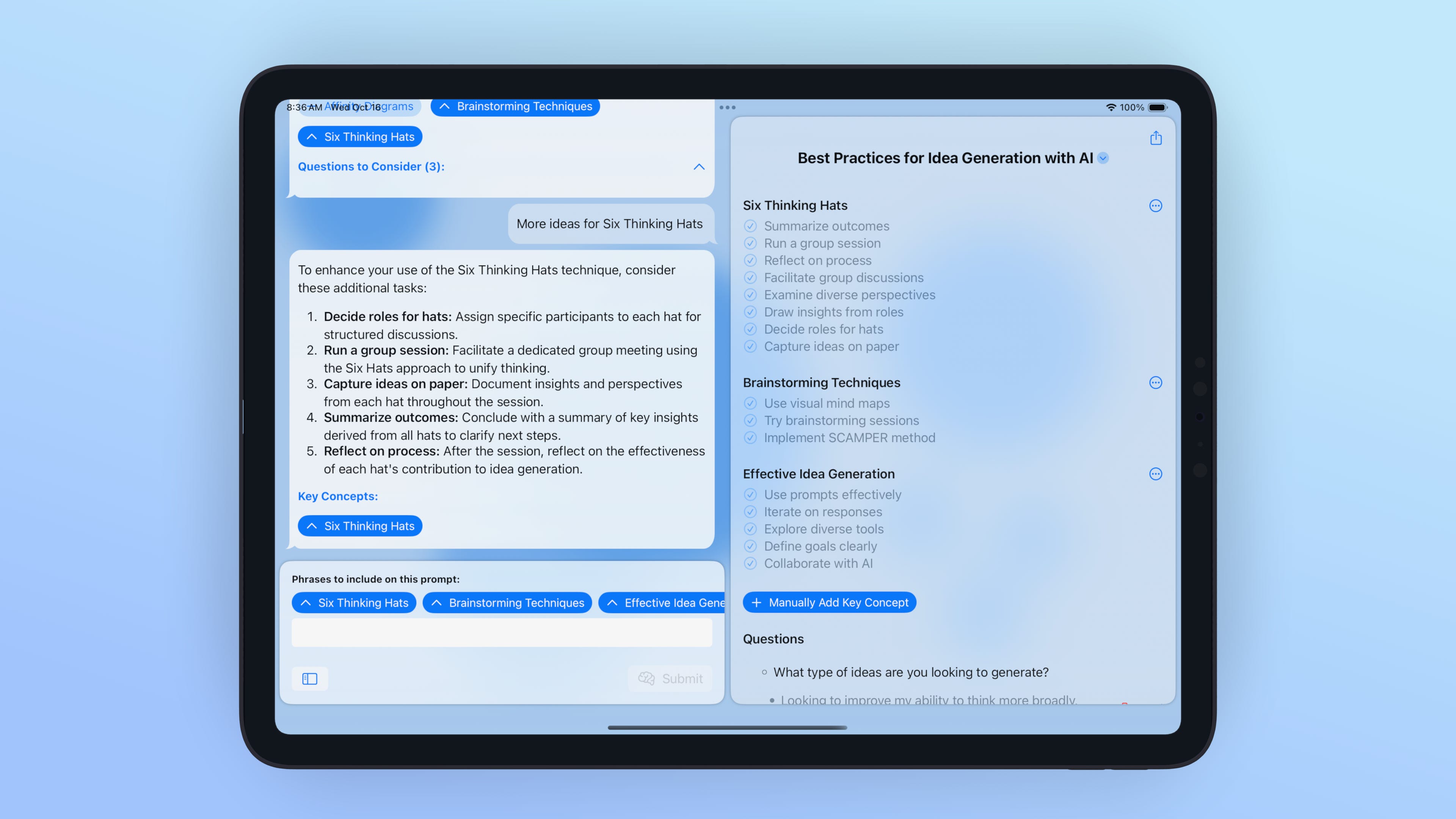
Like many AI systems, it starts with a prompt. Tell Brainstorm/AI what problem you need to solve, or what topic you want to generate ideas about, and you’ll be met with a typical friendly response to get you started — but it will also point out what it believes are ‘key concepts’ and ‘clarifying questions’.
These are key to helping reduce the cumbersome nature of working with AI — tap on a concept if you like it, and you want to continue pursuing ideas in this direction, and this will be sent along with every future prompt. Don’t like an idea? Long-press it, and ‘Down-vote’ the idea, and the AI will be told to ignore this concept with all future prompts.
Over the course of a brainstorming session, you’ll continue to be presented with new concepts, and you can up-vote or down-vote them to build up a roster of key ideas - this keeps the conversation laser focused, but also helps you to organize your thoughts for future reference. If you want to deep dive on a topic, you can even specifically highlight a smaller set of these phrases to dive into, helping the AI to focus on just one aspect of the conversation. You can even ‘Hear More’ about a concept with a single tap.
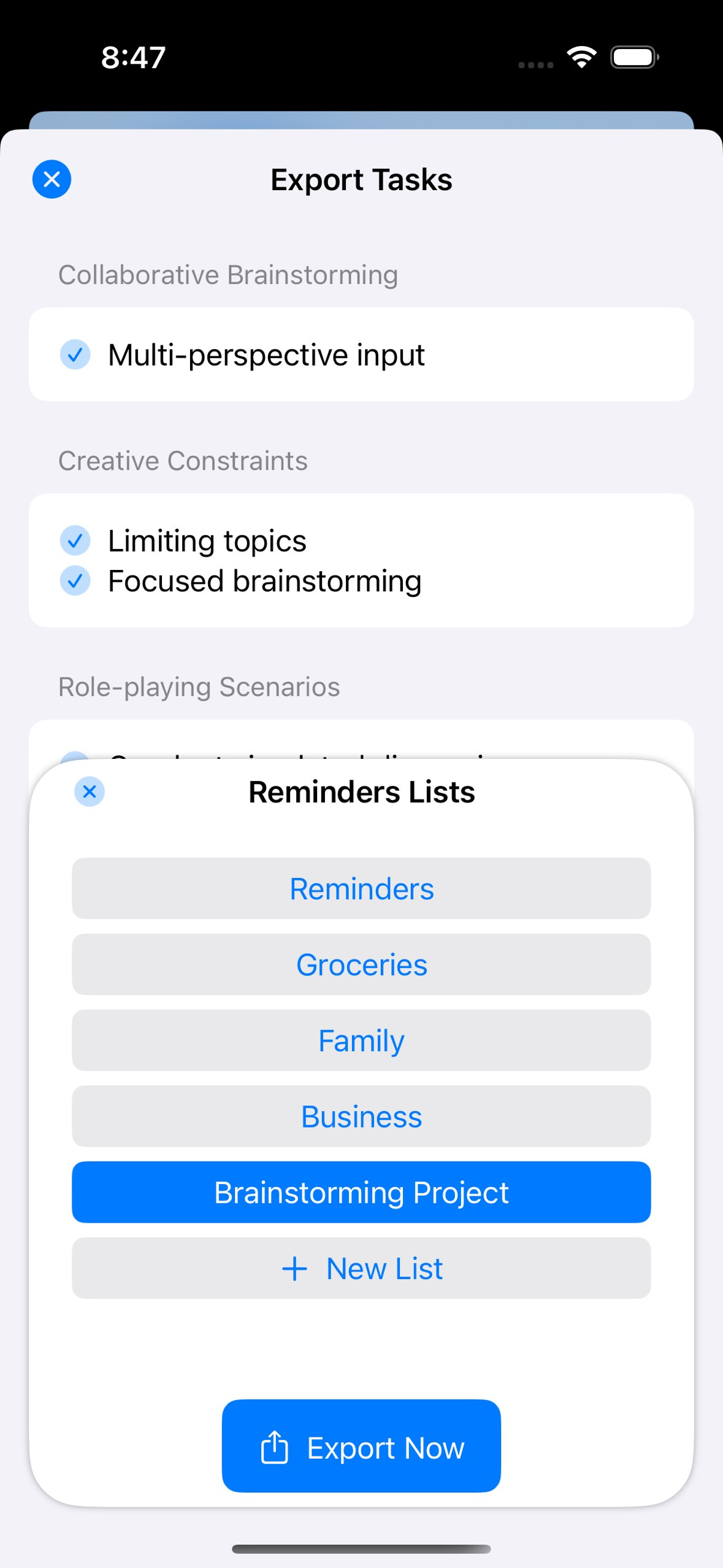
But ideas aren’t worth much if you can’t put them into action - Brainstorm/AI will help suggest actionable tasks that you can take against any of your key concepts, and can even export them to the Reminders app, where you can track your progress in any app that access that data.
How can I put this… my business needs to grow 😜. I’m currently between contracts, and while I love doing consulting work, even doing this for 50% of my time takes a huge amount away from what I can do to build my own apps, and build my business.
I’ve seen some growth from Bills to Budget, and earlier this year, had some nice success with my Calendar view release. I even had some ASO success for the first time, which was certainly exciting — but the reality is that Bills to Budget is in a super-competitive market, meaning that advertising is expensive, so the returns I get are small. While the app itself helps me pay my bills, the app is currently far from paying the bills (see what I did there?).
As for my HomeKit apps, I’m putting further development on hold for a bit to see what Apple will do here. The HomeKit API hasn’t changed in any appreciable way in years, and frankly, it’s become extremely buggy. The ecosystem has improved with the introduction of Matter, and the Home app has become more reliable (I still get ‘No Connection’ all the time, but they have become more rare), but what I see from an API perspective is much different. It’s hard to depend on this when building a business, and Apple has done a good job of letting us know that Indie HomeKit apps are not a priority.
One of the things I wanted to do when I went Indie a year and a half ago (🤯) was to experiment with new apps — Brainstorm/AI is my first foray in this direction.
Bills to Budget tends to be extremely opinionated - it’s literally built around the process that my family has used to manage our day to day finances. This doesn’t always fit with other people’s needs, and I’ve found that many users come in with plenty of very reasonable assumptions about how it works, only to be disappointed.
My intentions around Brainstorm/AI are much more fluid. Doing any kind of research around how to build a successful app, you’ll learn that it’s critical to listen to your customers, and leave room to build solutions for the problems that they’re having. This is, of course, incredibly obvious, but it’s been challenging for me with Bills to Budget, because I’ve come into it with so much opinion.
Don’t get me wrong - I think it’s really important for an app to approach a problem with a point of view. But leaving room to listen to my customers, and use that feedback to drive the product direction is one of the key changes I hope to make with Brainstorm/AI.
This means I’ll be building in ways to hear from the customer right from the start. I’ll be engaging with customers during my initial beta phase - which is open right now, incidentally - to get a sense of how things are working. I’ve included a means to help get feedback from users who are cancelling their subscription or uninstalling the app. I hope to include a roadmap that will allow customers to vote on items. I’ll be making it as easy as possible for customers to get in touch - and hopefully they will!
Exporting tasks to Reminders is just the start. I’d love to explore ways to group similar key concepts together, and make it as effective as possible to dive really deeply on certain areas, while leaving room to be able to come back up for air, and generate more general ideas when you’re done.
I’ve got some ideas on how key concepts could form a hierarchy, and I’d love to build in a sort of hybrid mind-mapping mechanism, or at least allow for concepts to be exported in a standard format that users can take to other tools.
I think it would even be interesting if the app itself were to develop into a task management system, rather than depending on import — these are all potential directions I think I could take, but first thing’s first. I need to get the app out there, I need to get customers using it, and I need to see what will be most useful for them.
Wish me luck!
No posts
Comments
Nothing yet. Say the first thing.
Sign in to join the conversation.