
Something happened to the wedding photography business.
Wedding photographers are going out of business in droves. It’s not just because of excellent camera phones.
And this is connected with an event that nobody in mainstream media wants to discuss honestly.
Because it goes against the narrative. Against what women are supposed to believe.
It starts with babies.
Women are not having babies.
Not just in America. Everywhere.
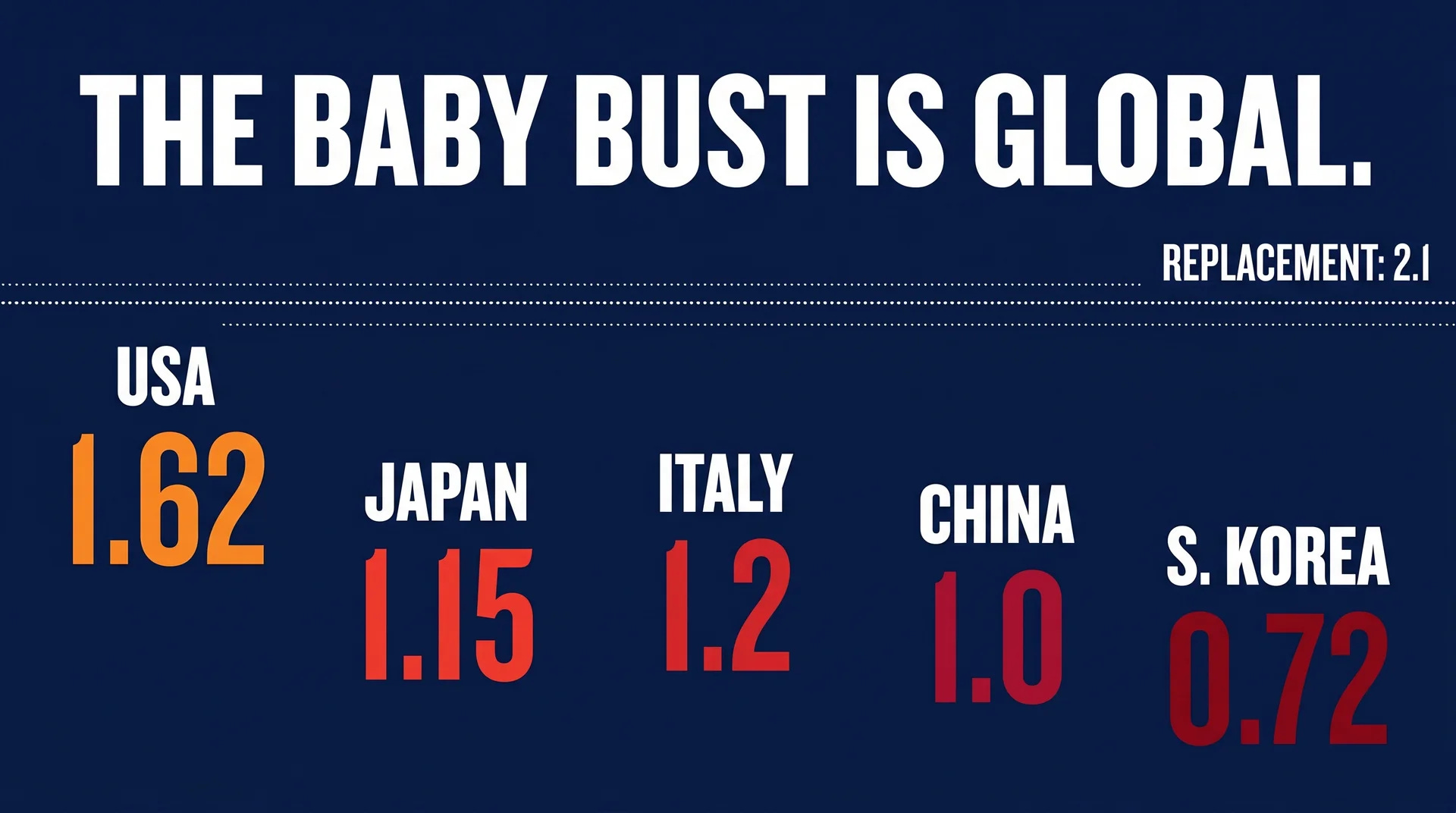
The US fertility rate in 2023 was 1.62 children per woman.
Replacement is 2.1.
South Korea is at 0.75. Japan is at 1.15.
Italy and Spain at 1.2. China at 1.0 or below. France just hit its lowest fertility rate since records began after World War 2.
This is not a blip. This is a civilization-level event happening in slow motion.
And it is probably hitting your family too.
You probably know a daughter, or a niece, or a friend’s daughter who is 36 and still single. A son who has a girlfriend but no marriage. Grandkids that have not arrived. Maybe in your own family.
This is not random.
This is part of a massive demographic shift that has been documented for decades and accelerated in the last 15 years.
Let me tell you what the best demographers actually say is going on. Because the mainstream story is mostly wrong.
I will also tell you which group of people have actually figured out how to reverse it. But I will get to that later.
You will hear a lot of explanations for why young women are not having babies.
Climate guilt. Student loan debt. Housing costs. The pill. Career ambition. Selfishness. Bad men. Bad economy.
Most of these are wrong.
The actual reason fertility has collapsed in almost every developed country is this.
Women are not getting married.
Or they are getting married so late that the biological window has nearly closed before they try.
Lyman Stone is a demographer at the Institute for Family Studies. He has done the actual math. His finding is striking.
Roughly 75 percent of the total fertility decline in America since 2007 is due to declining marriage rates.
Not declining within-marriage childbearing. Just collapse in marriage formation.
When married women in America today have kids, they have them at almost the same rate married women did 30 years ago.
The difference is that there are far fewer married women.
Married people still have babies. People who are not married mostly do not. Marriage rates have collapsed. Therefore birth rates have collapsed.
But marriage collapse is the real story.
Let me show you the actual numbers. Because they are worse than most people realize.
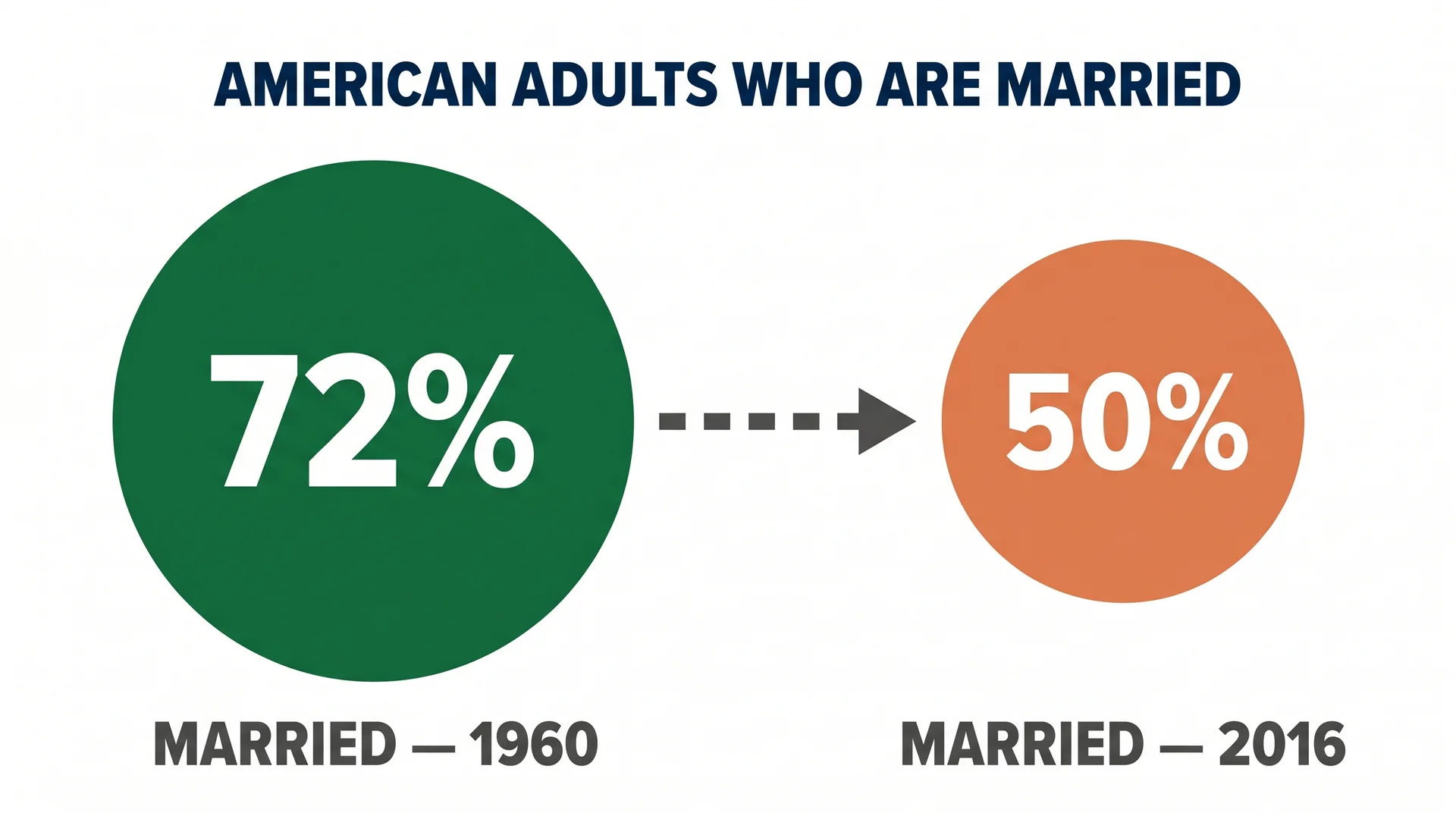
In 1960, 72 percent of all American adults were married. In 2016, only 50 percent were.
That alone is the story of American family life in three generations.
Married went from the default to a coin flip.
Among American adults aged 25 to 54 — peak marriage age — 67 percent were married in 1990.
In 2019 it was 53 percent.
Almost 40 percent of prime-age adults today are living without a spouse or a romantic partner of any kind. In 1990 it was 29 percent.
In 2021, twenty-five percent of American adults at age 40 had never married. A record high.
And look: the median age at first marriage in 1950 was 22.8 for men and 20.3 for women.
Today it is 30.2 for men and 28.4 for women.
That is eight years older. A whole biological window’s worth of delay.
The international picture is worse.
Japan in 2023 saw the first year with fewer than 500,000 marriages in ninety years.
South Korea is at the world’s lowest fertility rate, 0.72, and its marriages have collapsed in parallel.
Italy and Sweden have largely stopped getting married at all — Swedish cohabitation has replaced marriage as the normal pair-bond.
This is not slow erosion. This is the demolition of a 5,000-year-old institution in three generations.
And the fertility data is downstream of this.
If you want to understand why women are not having babies, you have to understand why women are not getting married.
And why men are not getting married. They are the same question.
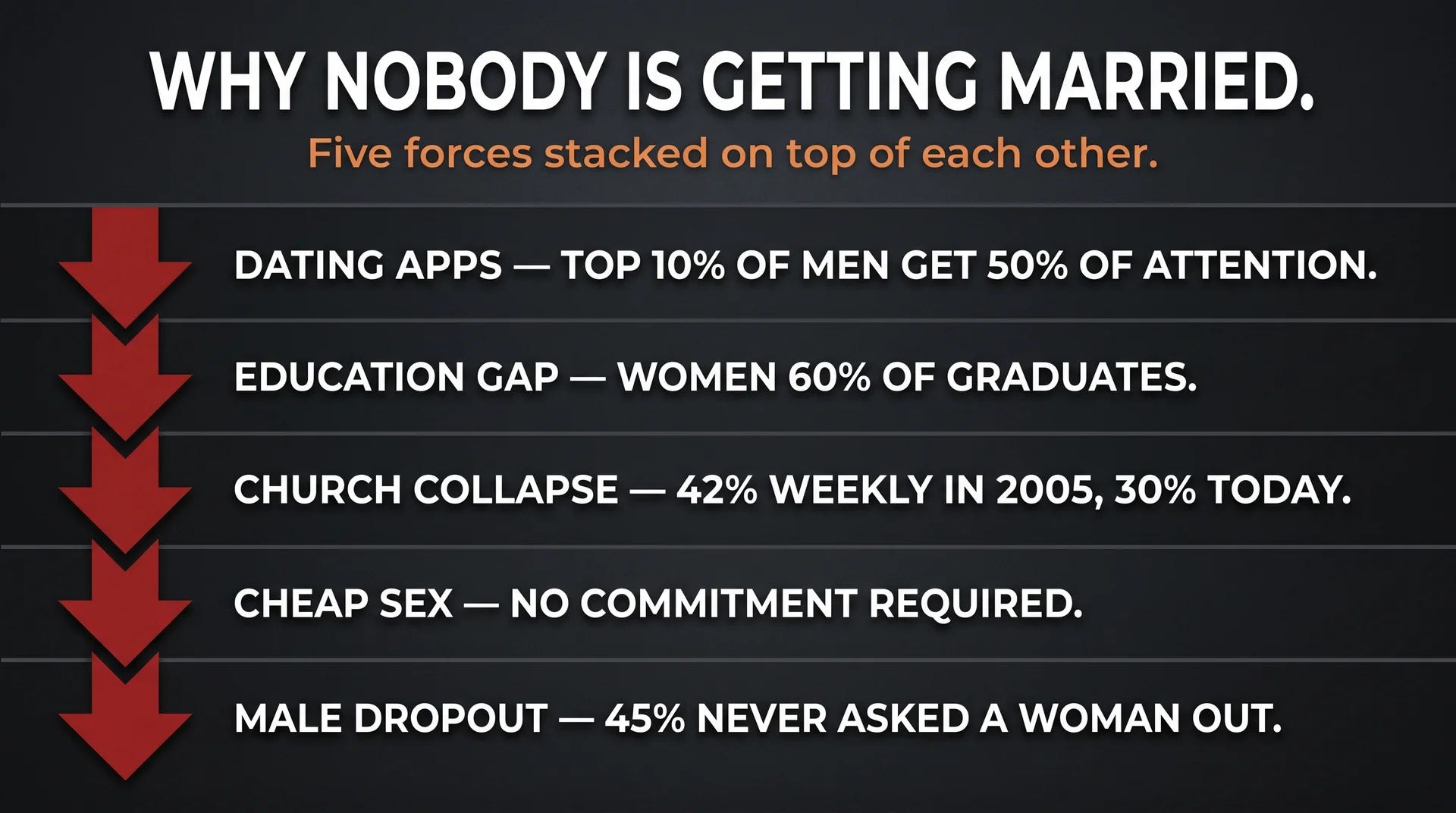
Dating apps are part of it.
Hinge published numbers showing that 50 percent of the female “likes” on the app go to the top 10 percent of male users.
Tinder is the same shape. Men match about 3 to 5 percent of swipes; women match about 50 percent.
So the apps are concentrating female attention onto a small fraction of high-status men. The rest of the men get almost nothing.
The average woman has hundreds of options on her phone that look more attractive than the average actual man she might meet at church or at work.
So the average woman waits for the high-status match. A guy who is also being chased by 100 other women and has no incentive to commit.
The Stanford sociologist Michael Rosenfeld documented this in 2019.
About 39 percent of heterosexual couples now meet online.
Meeting through friends, family, and church has collapsed since 1940.
Online dating overtook every other channel around 2013.
So we replaced a system that screened for compatibility and embedded couples in a community with a system that ranks people by superficial appeal.
And that lets the top 10 percent of men monopolize the top 50 percent of female attention.
This was not a good trade.
And K-12 education has been thoroughly feminized. When I was in public school we had many male teachers. Today there are very few, especially in elementary school. 30% of elementary school teachers used to be male, now it’s 10%.
Women teaching boys. Medicating boys. Limiting hours for recess.
This is what I think has led to men not trying to compete in college. They can’t get away from “education” fast enough.
American women are now about 60 percent of college graduates. Men are 40 percent.
There are 1.6 million more women than men in four-year colleges.
The gender gap in college today is larger than it was at Title IX, just reversed.
And think about this: Women generally prefer to marry men who are at least as educated as they are.
This was easy when men were the majority of college graduates.
It is much harder when women are.
There is now a documented shortage of what the Cornell economist Daniel Lichter calls economically attractive unmarried men — men earning above the median with a college degree.
College-educated women are competing for a shrinking pool.
So a lot of college-educated women in their early thirties cannot find a partner they consider marriageable.
Not because they are too picky.
The decline of religion finished the job.
In 2005, 42 percent of Americans attended church weekly. In 2025, 30 percent. Among 18 to 29 year olds, only 22 percent attend regularly.
Church was the largest single venue where Americans met their spouses for two hundred years. It was also the cultural enforcer of marriage as a moral obligation. Both functions have largely disappeared.
The collapse of in-person socializing finished off what was left.
Robert Putnam documented this decades ago in Bowling Alone.
Between 1980 and 1993, total bowlers in America went up 10 percent but league bowling collapsed 40 percent. People were doing more things alone, fewer things with others.
After the smartphone, this trend went vertical. Jonathan Haidt traces a teen mental health collapse to 2010, three years after the iPhone arrived.
The in-person courtship behaviors that used to produce marriages have been replaced by hours spent alone with a screen.
The hookup culture decoupled sex from marriage.
The sociologist Mark Regnerus calls this cheap sex.
The modern combination of the Pill, high-quality pornography, and dating apps has made casual sex available to most men without any commitment cost.
Why would a man marry the girlfriend when he can have most of what marriage used to provide without the legal and financial entanglement?
Louise Perry, the British writer, made the same case from the other direction.
The main winners from the sexual revolution are a tiny minority of high-status men, not the women. The hookup culture rewards exactly the men who were always going to be cads.
Scott Galloway has been beating this drum. Forty-five percent of men aged 18 to 25 have never asked a woman out in person.
Sixty-two percent of young men are not trying to date at all.
Young American men in 2025 are four times more likely to die by suicide than young women, three times more likely to be addicted or homeless, and twelve times more likely to be incarcerated.
Richard Reeves, who runs the American Institute for Boys and Men, has documented the broader pattern.
The percentage of prime-age men out of the labor force entirely has roughly doubled since 1976.
About nine million American men in their prime working years are not working.
I have men in my coaching program with adult sons in their late twenties or even thirties who are still living at home, not working, not dating, just gaming and scrolling.
The fathers cannot understand it. They were 21 and married with a job. Their sons are 28 and have never asked a woman out.
A man with no career, no church, no friends, and no dating skills is not going to get married.
Even if he wants to. Even if a woman would have him.
Stack these forces on top of each other and you do not need any other explanation.
Apps that concentrate attention onto 10 percent of men. A shrinking pool of educated men.
Dying church attendance. Dying in-person socializing. Sex available without commitment. And millions of young men checked out of normal life entirely.
The miracle is that anyone is still getting married at all.
Marriage has collapsed before, too. In fact…
Hungarian-British demographer John Hajnal documented something historians now call the Northwestern European Marriage Pattern.
For at least 500 years — from roughly 1400 to roughly 1900 — Northwestern Europe had a totally different marriage culture than the rest of the world.
West of a line running from Trieste to St. Petersburg, women married late and many never married at all.
Hajnal’s numbers. Mean age at first marriage for women, 25 to 26. Female celibacy rate, 15 to 20 percent. Up to one-third of the population never married.
That is essentially our current pattern in the developed world.
It existed in Northwestern Europe continuously for half a millennium. England, France, Germany, the Netherlands, Scandinavia, all running below replacement-style marriage rates for centuries.
These societies survived.
Partly because the children that did get born survived at higher rates as medicine improved, and partly because immigration filled in some of the gap.
But the cultural pattern of late marriage and high celibacy was the baseline.
The current crisis rates we are seeing in Italy and Japan and the US are not new. They are a return to the European norm.
Between 1347 and 1353, the bubonic plague killed roughly 40 to 60 percent of Europe’s population.
The labor shortage drew women into wage work for the first time at scale.
Female age at first marriage rose.
The share of women never marrying rose. Europe’s population stayed depressed for 150 years.
The post-World War 1 European surplus women crisis is another example. So many young men had died in combat.
The 1921 German census found 1,200 marriageable women for every 1,000 marriageable men. Eleven million
European men dead in the war meant millions of European women would never find a husband.
Whole cohorts of women became spinsters not by choice but because the men were gone.
This is not directly analogous to today.
Thanks for reading Daily Medical Discoveries! This post is public so feel free to share it.
We are not missing 10 percent of our young men because of a world war.
But it shows that mass marriage collapse triggered by a sudden gender imbalance is something Europe has lived through within living memory.
And then there was the early 1930s.
The Great Depression collapsed the US marriage rate from 10.1 per 1,000 in 1929 down to 7.9 per 1,000 in 1932.
The fastest marriage collapse in American history at that point.
It rebounded fast. By 1934 it was back near 1920s levels. In 1946, after World War 2, it hit an all-time peak of 16.4 per 1,000 — more than double the 1932 trough.
The Baby Boom rode that wedding boom.
So has marriage collapsed before? Yes. Multiple times.
In some cases it reversed within years.
In some cases the pattern lasted 500 years and is, in a sense, what we are returning to now.
The interesting question is not whether it can collapse. We know it can. The interesting question is what makes it reverse.
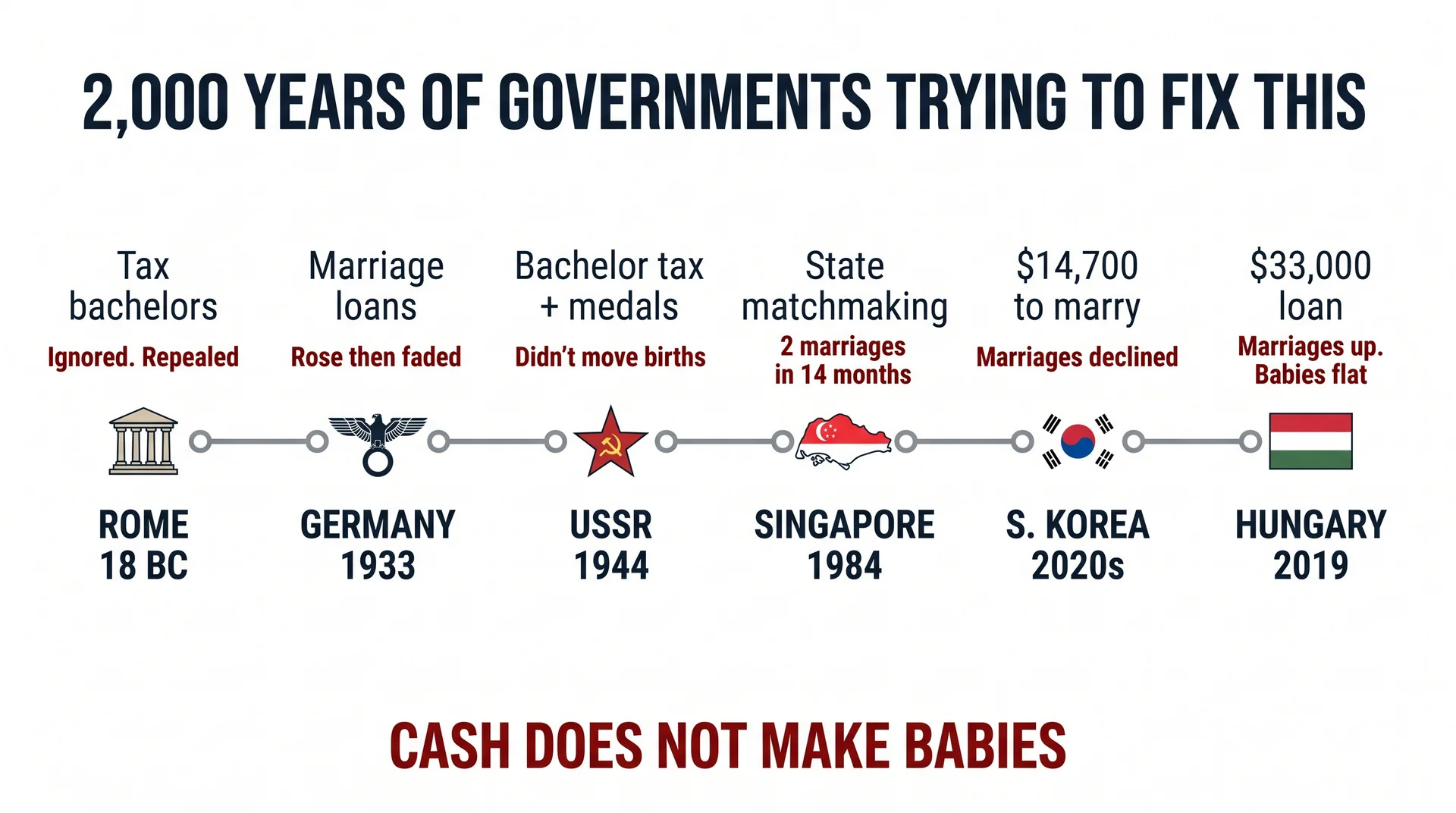
Almost every culture that has watched its marriage rate collapse has tried to do something about it. Almost none of them have succeeded at scale.
Augustus Caesar tried first.
In 18 BC he passed the Lex Julia and in 9 AD the Lex Papia Poppaea. Roman bachelors lost their inheritance rights, faced a tax for being unmarried, and were barred from attending public games.
Fathers of three sons got tax exemptions and priority for promotion. Women with three children got legal independence from male guardianship.
The Roman aristocracy ignored it. Inheritances were structured to evade the rules. Marriage rates among the senatorial class continued to decline.
The laws were repealed by Constantine in 320 AD as obviously ineffective.
Nazi Germany ran the next-largest experiment in 1933.
Newly married couples got an interest-free 1,000 Reichsmark loan.
Each child born forgave 25 percent of the loan principal. By 1938, over a million loans had been issued. Marriages rose. Fertility rose more modestly -- but then the rise faded.
Stalin’s Soviet Union went the other direction.
The 1944 Family Law included a tax on bachelors, single citizens, and citizens with small families.
Cash penalty for not marrying.
The Order of Maternal Glory rewarded women who bore seven or more children.
The Mother Heroine medal went to women with ten or more. About 430,000 women received it. The bachelor tax persisted into the 1990s.
It did not move Soviet birth rates much.
In 1984, Singapore created the Social Development Unit to match-make eligible singles.
The first 14 months cost about 300,000 Singapore dollars and produced exactly two marriages.
The Singaporean public renamed the program SDU — Single, Desperate, and Ugly.
Eventually it scaled to about a thousand marriages a year. Singaporean total fertility today is around 1.0.
South Korea has been trying every angle.
The city of Busan offers up to 20 million won — about 14,700 US dollars — for couples who marry after attending a state-sponsored matchmaking event. Plus 500,000 won for dating, 1 million won for engagement, 10 million won for the honeymoon.
Seoul offers a 1 million won “marriage starter fund.”
Jangsu County has paid couples 10 million won for getting married for eight straight years. The result. Marriage rates have not significantly changed.
In Jangsu County marriages actually declined.
Hungary in 2019 launched the most aggressive marriage subsidy of any modern Western country.
Couples where the bride is under 41 can get a loan of 10 million forints — about 33,000 US dollars — that is partially forgiven at two children and fully forgiven at three.
This actually worked, at first. Marriages surged 20 percent in the first nine months of 2019. September 2019 had the most weddings in Hungary since 1979. Over 50,000 couples applied.
But births did not rise. The Hungarian TFR went from 1.49 to 1.48 the same year.
The Hungarians got marriages they otherwise would not have had.
The marriages did not produce extra babies.
Couples timed weddings to qualify for the subsidy and then went back to the original baby plan.
The United States ran its own experiment in 2002 under George W. Bush.
The Healthy Marriage Initiative.
About 150 million dollars per year for five years on classes, counseling, and relationship-skills training for couples.
The official evaluation, the Supporting Healthy Marriage Project, found no effect on the likelihood of couples staying together or getting married, and no effect on relationship quality.
Iran in 2021 passed the Youthful Population and Protection of the Family Law.
Cheap loans, housing subsidies, child benefits. About 2.3 billion dollars went out in the first nine months. The Iranian TFR stabilized around 1.6 — well below the government’s 2.5 target.
The verdict, after 2,000 years of these attempts, is consistent.
Cash bonuses can produce short-term spikes in marriage rates.
They almost never produce sustained fertility increases.
Tax penalties on the unmarried are ignored or evaded. State matchmaking is embarrassing and ineffective. Marriage education is useless.
Here is what did start a big boom in marriage and babies.
Of course, World War 2 and economic boom afterwards, in the US.
Religion bounces back periodically in the US. When it does, marriage and babies increase.
Or a religious sub-population runs marriage as a communal institution with social enforcement — Haredi Jews, Amish, conservative Mennonites, Pakaluk’s Hannah’s Children mothers.
There is no recorded historical case of voluntary state-incentive marriage policy reversing a population-level marriage decline.
That is a sobering finding.
Stephen Shaw is the British filmmaker who made the Birthgap documentary in 2023. He spent years interviewing women in their 40s who had no children.
He found that 80 percent of childless women in developed countries did not choose to be childless.
They drifted past their biological window while trying to live their life in the right order.
They wanted kids.
They assumed they would have kids.
They were going to do school and career first and then settle down and have a family.
By the time the career was in place, the right partner had not materialized.
The partner they did have was not committing...
... fertility had quietly fallen off a cliff. Oops.
And one day they realize, it is too late.
I do not agree with this, but that’s what he found.
The truth is most childless women wanted to be mothers. I do believe this.
They just thought they had more time.
But why? Why didn’t they obviously see the biological clock and try to find a guy in their 20s?
Because the entire system around them, the schools, the career advisors, the cultural messaging, other women...
...all actively encouraged them to delay marriage and babies.
Now they’re in their 30s. Eligible good men are all married. And these single women have very little chance of finding someone, settling down and having babies in their remaining biological time.
Sigh.
I have men in my coaching program who are now 60 and 65 and 70 who are slowly realizing they are not going to get grandchildren.
Their daughters wanted kids.
Just somehow it never happened.
Watching them process this is genuinely sad.
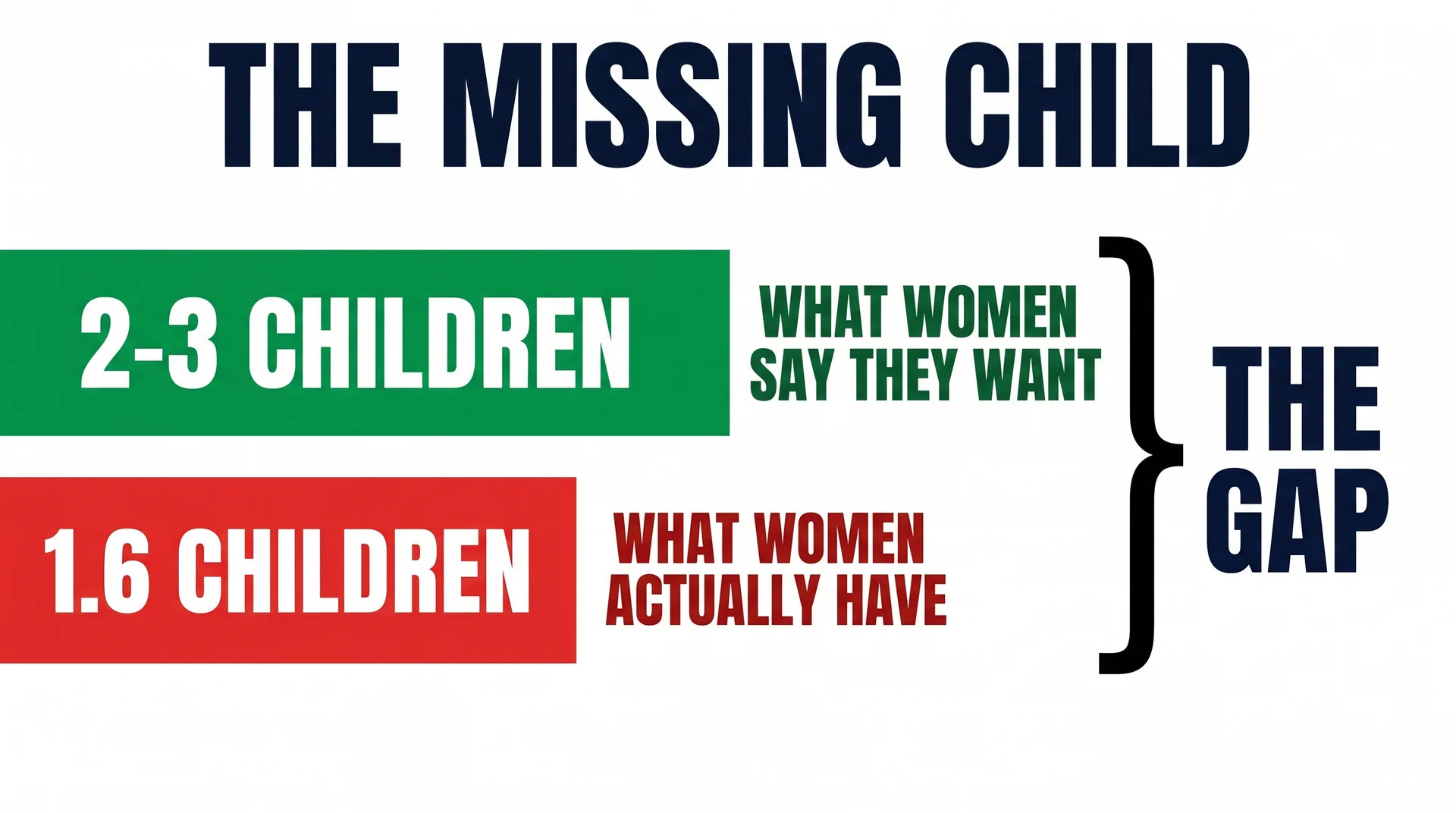
Stone has compiled the survey data from across the developed world. In every major country, women report wanting between two and three children, on average. They actually have about 1.6.
That is a gap of nearly one whole child per woman between what women claim they want and what women actually end up having.
If women had the number of kids they themselves said they wanted, the developed world would be at or above replacement.
If you live in the United States, you have probably noticed something.
It’s the college-educated professional women on the coasts who are not getting married and not having children.
The working-class women in the Midwest, the South, and rural areas mostly still are.
Pew Research has the numbers. Among American women aged 40 to 44, childlessness has historically been highest among the most educated.
Catherine Pakaluk is an economist at Catholic University who spent years interviewing American college-educated women who have five or more children.
Her book is called Hannah’s Children.
The mothers she profiled are not poor or uneducated. Many of them have advanced degrees. Professors, doctors, lawyers, engineers. They also have five, six, seven, eight kids.
What do these women with lots of kids all share?
A transcendent reason, a spiritual reason, to have children.
Almost every one of them framed having a large family in religious terms.
They saw their children as a gift from God, as their purpose, as the most important thing they would ever do.
One mother told Pakaluk: “When I was younger, I thought I was doing something great for God by having all these children. Now I can see that really God was doing something great for me.”
Another: “We are most ourselves when we give ourselves away.”
Pakaluk’s bigger point is that the women still having large families share a meaning structure that secular Western culture has largely abandoned.
They have a why.
Now we come to what I think is the deepest cause.
Several decades ago, young women were told a story. The story went like this.
You can have it all. A great career, a great marriage, great kids, travel, hobbies, friends, money, freedom. Just sequence it correctly.
School first, then career, then partner, then kids.
You will be a powerful, successful, fulfilled woman with all the choices.
It was a beautiful story.
It was also, for most women, a lie.
My wife Jodi and I married in 1987. We had our kids a few years later than that.
Jodi is a high powered lawyer. She worked in big firms, she was a partner briefly, then when we had our kids, she went freelance.
But she made very good money to support our family when I wasn’t making money. And we raised our kids at the same time.
It was very hard. Kids are noisy, destructive, expensive. But they are wonderful, and we did it even when it was very hard.
Today, girls aren’t willing to do that.
If you spend your peak fertility decade building a career and pursuing “experiences” -- travel, friends, a great apartment, a dog, hobbies...
...and you assume marriage and kids will be waiting for you on the other side...
...sorry, Charlotte. The math will not work for many or most women.
You have to be willing to do it all, and have it all, and not get much sleep.
When you see young couples with kids, you see them working really hard. Without much sleep. During great financial stress.
But it doesn’t last long. The kids are in school sooner than you know it, and career moves forward and the difficult period is now behind.
That’s what women without kids don’t understand. The difficult part doesn’t last very long.
But they postpone kids because they are convinced they can ONLY have career advancement, THEN they can have kids.
But guys I work with don’t want to date a girl in her late thirties. They want to have sex with them, but they don’t want to marry or settle down with them.
Women in their thirties are a tough sell compared to girls in their 20s, or mature women past the children bit.
So men do not magically show up at age 38 to commit to the woman who spent her best years on something else.
Those men are long since married, had kids, and if they are divorced, they are not looking to remarry and have kids.
Here is what filled the space where kids used to be.
Pets. Travel. Career. Friends. Hobbies. Streaming entertainment. Phone apps. A nicer apartment than your parents could afford. A bigger restaurant scene than any prior generation had.
But they are easier than having kids. Much easier.
And they hand back a steady drip of small pleasures that crowd out the much larger but harder-to-access pleasure of having a family.
Plus, parenting seems so daunting to today’s younger generation...
Bryan Caplan, the libertarian economist, wrote a book years ago called Selfish Reasons to Have More Kids.
His basic argument is that modern parents over-invest in stressful intensive parenting that does not actually matter much for child outcomes.
The result is that having kids feels harder than it has to.
Another reason to avoid having kids. They are too demanding, too expensive!
Caplan argued you can have more kids and be more casual as a parent -- and end up happier.
It’s not a big deal. Be nice to your kids, support them, let them grow up. You don’t have to be Super Parent all the time.
❤️ Quick break. Two favors to ask of you.
If this article is the kind of thing you wish someone had told you twenty years ago, hit the like button below. That tells Substack to show this piece to more people.
Second, restack it. There is a circle symbol — click on it, it creates a Substack Note, and send it on its way. Write something like “this is the actual data on why women aren’t having babies.”
And bonus favor — drop a comment with your own observations. I am especially interested in what you have seen happen in your own family or community. ❤️
Now we come to the part that most people would rather not think about.
If fertility stays where it is in the developed world for another 30 years, several things break.
The first is pensions.
Social Security in the United States is funded by a working-age population paying for a retired population.
When the worker to retiree ratio collapses from three to one toward two to one, the math breaks.
The Social Security trust fund is projected to be depleted in the early to mid 2030s. And that projection assumes higher fertility than what we are actually getting.
The second is innovation.
Charles Jones is an economist at Stanford.
His best-known paper on this topic argues that innovation and economic growth are fundamentally driven by population.
More people equals more ideas equals more growth. If population shrinks long enough, you get the opposite.
Fewer ideas, lower growth, eventually stagnation. Jones calls the worst-case scenario the Empty Planet.
The third is care. When you get old, somebody has to take care of you.
If there are not enough young adults around, that care becomes scarce and expensive.
South Korea is already discovering this. Japan has been discovering it for thirty years.
The fourth is civilizational confidence.
Societies that are not having kids are societies that have, at some level, stopped believing in the future.
The connection runs both directions. Less belief in the future means fewer kids. Fewer kids means less reason to invest in the future. The cycle compounds.
These are not partisan predictions. These are demographic math.
Cash does not work.
Hungary has tried the largest experiment in pronatalist policy in the modern West.
Massive tax breaks for families with kids.
Mortgage forgiveness based on number of children.
Subsidies stacked on subsidies. Spending on family policy ramped from one of the lowest in the OECD to one of the highest.
Hungarian fertility rose from 1.23 in 2010 to 1.61 in 2020. The second-largest TFR increase in the developed world during that period.
Then it reversed. By 2024 Hungarian fertility was back down to 1.38, despite continued spending.
Some defenders of the Hungarian model will tell you the reversal is due to economic shock, not policy failure. Maybe.
France has been doing pronatalism since the late 1800s.
Long-term effect of pronatalist policy on French fertility is estimated around 0.1 to 0.2 children per woman. France’s 2024 fertility rate was 1.62. The lowest since records began after World War 2.
Remember, the Roman Empire tried cash and laws. It did not work for them either.
Only one thing in the modern era. Marriage.
Religious beliefs help a lot, too.
Israel is the only OECD country with fertility above replacement. The national total fertility rate is around 2.9.
Religious Jews are at 3.9. Ultra-Orthodox Haredi communities are at 6.5.
The American Amish have a replacement rate somewhere between 5.7 and 10.4 depending on which subgroup.
Their population doubles roughly every 20 years.
Hasidic Jews in the United States show similar numbers.
Pakaluk’s American mothers with five-plus children are a smaller version of the same pattern.
These groups share a specific cluster of attributes.
Strong religious belief.
Tight community enforcement.
Marriage taken seriously as a vocation.
Children explicitly framed as the central purpose of adult life. No competing hedonic options that out-compete kids on a daily basis, because the lifestyle is intentionally constrained.
Robin Hanson, the economist, has been writing for years that the only stable long-term way is religious subcultures that have figured out how to sustain high fertility.
Everyone else genetically and culturally fades out.
Tyler Cowen has reached a similar conclusion from a very different starting point. The future belongs to whoever shows up.
For the men reading this who are over 50 and already have kids and maybe even grandkids, what does this mean for you?
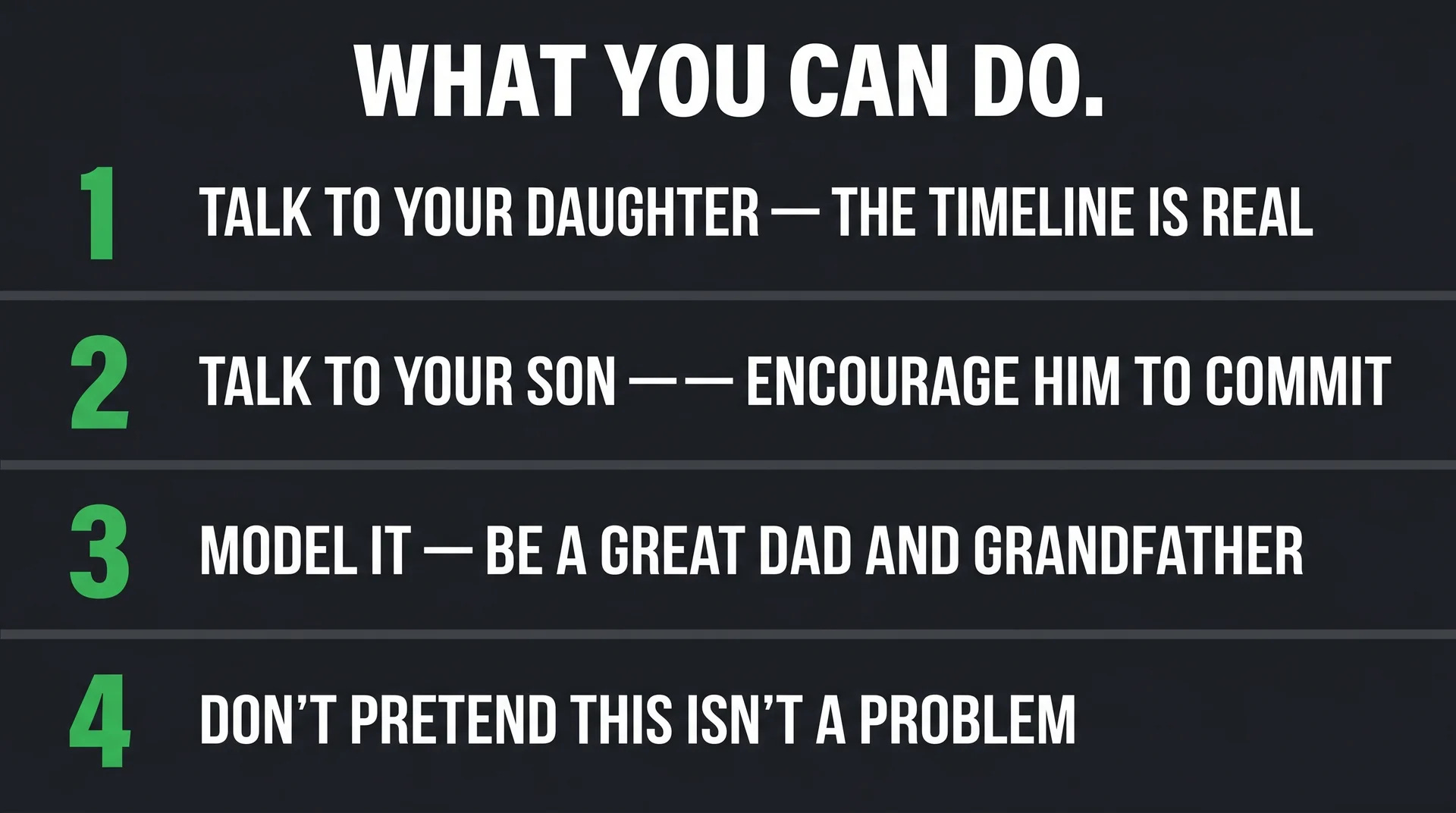
First, talk to your adult kids honestly. If your daughter is 30 and single and wants children eventually, the time to gently raise the timeline issue was probably already five years ago.
It is not too late. But the longer she waits, the more biology takes the steering wheel.
Be kind. Be specific. Tell her you would love grandchildren. Tell her you support her career. Tell her the two are in tension with biology in a way nobody told you when you were younger.
This doesn’t really work, but at least you can try.
Same conversation with your son.
Encourage him to commit. To marry. To start a family.
The longer he waits, the harder it gets. For him, for his future wife, and for the kids that may or may not come.
Second, do not pretend this is not a problem.
The mainstream culture has spent decades telling young people that family is one option among many and the timing is wholly flexible.
The data says otherwise. Your kids and grandkids deserve better than the cheerful lie.
Third, model it. If you are a grandfather, be a great grandfather.
If you are a dad, be a great dad.
Make the family experience that your kids saw growing up an experience their kids will want to repeat.
Fourth, think about the bigger picture.
Whatever your politics, the slow draining out of the next generation is something every man over 50 has a stake in.
Your retirement, your healthcare, your country’s prospects, all depend on there being enough people in their twenties and thirties to keep the wheels turning thirty years from now.
For all of human history until about 1970, every healthy society reproduced itself.
Most do not now.
This is the most important social change in two thousand years and almost nobody is talking about it honestly.
The mainstream story — climate, money, housing, selfishness — gets it mostly wrong. The actual cause is the collapse of marriage and the closing of the biological window before women find a partner. The proposed solutions — cash payments, tax breaks, subsidies — do not work.
What does work is a transcendent reason to make a family. The communities still having kids in the developed world all have one. The communities not having kids mostly do not.
That is a hard truth.
But it is not a hopeless one.
Fertility has collapsed before in history and reversed before in history.
The reversal has always required a recovery of cultural confidence. Some shared sense that the future is worth investing in, and that the way to invest in it is by raising children who will live there.
The families that figure this out — religious, secular, whatever — will inherit the future.
The ones that do not, will not.
1. Centers for Disease Control and Prevention, National Center for Health Statistics. Final 2023 Birth Data. National Vital Statistics Reports, Vol. 74 No. 1. March 2025. https://blogs.cdc.gov/nchs/2025/07/24/7819/
2. Stone L. Yes, marriage still matters for fertility: new evidence. Institute for Family Studies. 2024. https://ifstudies.org/blog/yes-marriage-still-matters-for-fertility-new-evidence
3. Stone L. How many kids do women want? Institute for Family Studies. 2018. https://ifstudies.org/blog/how-many-kids-do-women-want
4. Shaw S. Birthgap: Childless World. Documentary, 2023. https://www.birthgap.org/
5. Pakaluk C. Hannah’s Children: The Women Quietly Defying the Birth Dearth. Regnery Gateway, 2024. https://pakaluk.com/hannahs-children/
6. Cosgrave J, Edlund L, Tertilt M. Fertility in the time of depression: the impact of economic conditions on US fertility during the 1930s. Journal of Demographic Economics, 2018. https://www.cambridge.org/core/journals/journal-of-demographic-economics/article/fertility-in-the-time-of-depression-the-impact-of-economic-conditions-on-us-fertility-during-the-1930s/BE315948BC68F9271B2BE31103163707
7. Augustan marriage legislation: Lex Julia (18 BC) and Lex Papia Poppaea (9 AD). Historical reference. https://en.wikipedia.org/wiki/Jus_trium_liberorum
8. Jones CI. The end of economic growth? Unintended consequences of a declining population. Stanford working paper, 2020. https://web.stanford.edu/~chadj/emptyplanet.pdf
9. Centre for Eastern Studies (OSW). Hungary’s ongoing demographic decline: the increase in birth rates is only temporary. April 2025. https://www.osw.waw.pl/en/publikacje/osw-commentary/2025-04-14/hungarys-ongoing-demographic-decline-increase-birth-rates-only
10. Times of Israel. Israel’s birth rate remains highest in OECD by far at 2.9 children per woman. https://www.timesofisrael.com/israels-birth-rate-remains-highest-in-oecd-by-far-at-2-9-children-per-woman/
11. Anderson C, Eriksson B. The Amish population: county estimates and settlement patterns. Demographic Research, Vol. 52, Article 26. https://www.demographic-research.org/articles/volume/52/26
12. Pew Research Center. Rising share of US adults are living without a spouse or partner. October 2021. https://www.pewresearch.org/social-trends/2021/10/05/rising-share-of-u-s-adults-are-living-without-a-spouse-or-partner/
13. Fry R. A record-high share of 40-year-olds in the US have never been married. Pew Research Center. 2023. https://www.pewresearch.org/short-reads/2023/06/28/a-record-high-share-of-40-year-olds-in-the-us-have-never-been-married/
14. Stone L. 1 in 3: a record share of young adults will never marry. Institute for Family Studies. https://ifstudies.org/blog/1-in-3-a-record-share-of-young-adults-will-never-marry
15. Rosenfeld MJ, Thomas RJ, Hausen S. Disintermediating your friends: how online dating in the United States displaces other ways of meeting. Proceedings of the National Academy of Sciences. 2019; 116(36):17753-17758. https://www.pnas.org/doi/10.1073/pnas.1908630116
16. Cornell University. Struggling men hurt non-college women’s marriage prospects (Daniel Lichter research). 2025. https://news.cornell.edu/stories/2025/02/struggling-men-hurt-noncollege-womens-marriage-prospects
17. Pew Research Center. Decline of Christianity in the US has slowed, may have leveled off. February 2025. https://www.pewresearch.org/religion/2025/02/26/decline-of-christianity-in-the-us-has-slowed-may-have-leveled-off/
18. Putnam RD. Bowling Alone: The Collapse and Revival of American Community. Simon & Schuster, 2000. https://en.wikipedia.org/wiki/Bowling_Alone
19. Haidt J. The Anxious Generation: How the Great Rewiring of Childhood Is Causing an Epidemic of Mental Illness. Penguin Press, 2024.
20. Regnerus M. Cheap sex is the inconvenient truth in the retreat from marriage. Institute for Family Studies. https://ifstudies.org/blog/cheap-sex-is-the-inconvenient-truth-in-the-retreat-from-marriage
21. Perry L. The Case Against the Sexual Revolution. Polity, 2022.
22. Galloway S. A few(er) good men. ProfGalloway.com. https://www.profgalloway.com/a-fewer-good-men/
23. Reeves R. Of Boys and Men: Why the Modern Male Is Struggling, Why It Matters, and What to Do About It. Brookings Institution Press, 2022.
24. Hajnal J. European marriage patterns in perspective. In Glass DV, Eversley DEC (eds.), Population in History. 1965. https://en.wikipedia.org/wiki/Western_European_marriage_pattern
25. Routt D. The economic impact of the Black Death. EH.net Encyclopedia of Economic History. https://eh.net/encyclopedia/the-economic-impact-of-the-black-death/
26. National Research Council. Decline in fertility and marriage in the United States: report. National Bureau of Economic Research / NCBI archive. https://www.ncbi.nlm.nih.gov/books/NBK230349/
27. Marriage loan (Ehestandsdarlehen). Nazi Germany 1933 pronatalist policy. https://en.wikipedia.org/wiki/Marriage_loan
28. Order of Maternal Glory. Soviet Union 1944 family law and pronatalist awards. https://en.wikipedia.org/wiki/Order_of_Maternal_Glory
29. National Library Board, Singapore. Social Development Unit (SDU) established. https://eresources.nlb.gov.sg/history/events/3c520e6c-dc34-4cef-84f5-1d73062c411b
30. Korea Times. Marry and receive 20 million won: will cash incentives really drive marriage? 2025. https://www.koreatimes.co.kr/southkorea/society/20250524/marry-and-receive-20-million-won-but-will-cash-incentives-really-drive-marriage
31. Euronews. Hungary government scheme sparks marriage boom: will babies follow? 2019. https://www.euronews.com/2019/11/26/hungary-government-scheme-sparks-marriage-boom-will-babies-follow
32. Supporting Healthy Marriage Project / US Healthy Marriage Initiative evaluation. https://en.wikipedia.org/wiki/Supporting_Healthy_Marriage_Project
No posts
Comments
Nothing yet. Say the first thing.
Sign in to join the conversation.