
Let’s take a guy, Bill, who is 61 and says he did everything right. Clean eating, clean living, regular gym workouts, etc.
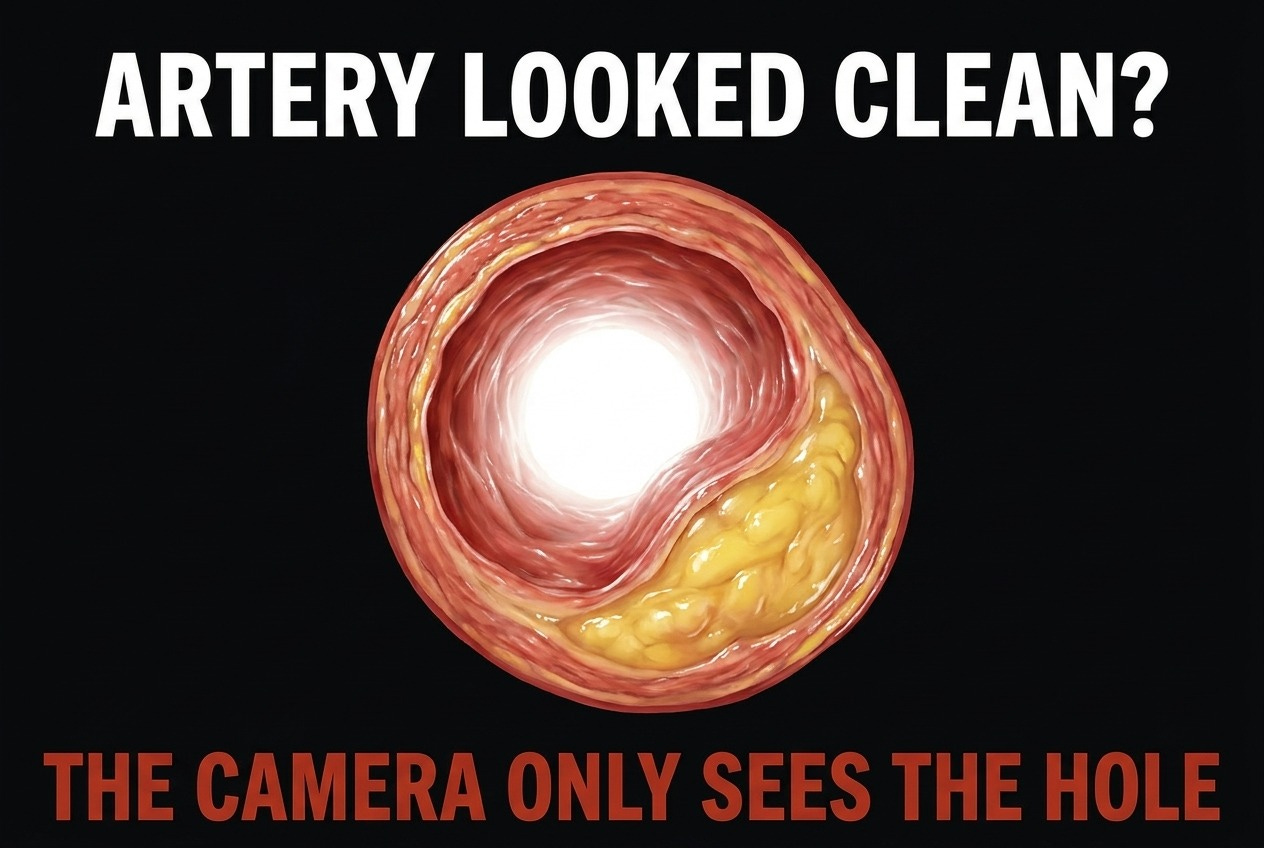
But one day...
...chest tightness on the golf course. Went in. Got the angiogram.
The cardiologist came out to the waiting room and showed his wife the picture on the screen.
Ninety percent narrowing in the left anterior descending artery. The one they call the widowmaker.
They put a stent in it that afternoon.
“They caught it in time,” Bill says, echoing what they told him at the hospital. “I have been walking around with a loaded gun to my chest. Thank goodness they got it in time.”
It is a very good story. But that is not the end of this story.
Twenty-two months later Bill has a heart attack that he does not survive.
Post mortem reveals: the heart attack wasn’t in the stented artery. The stent was fine. Wide open, working perfectly, doing exactly what it was put there to do.
The heart attack came from a different vessel. One that had been on the same film, on the same afternoon, and had been measured and written up in the report as a mild problem.
Nobody had been worried about it. Nobody had any reason to be worried about it. It was the good artery.
So I want to ask you a question that took me an embarrassingly long time to ask.
Not reading them badly. Not reading them carelessly. Finding the wrong ones. Systematically. By design. Every single time.
I went and read the original papers on this, some of them older than I am, and I have to tell you.
The studies reveal that they are NOT telling us the truth about heart attacks and stopped up arteries.
This reminds me of those expert wine judges who could not give the same wine the same score twice...in the studies run by Robert Hodgson.
We should always be testing the testers.
We should be seeing if they actually know what they’re talking about.
Someone finally did this with the people who are supposedly expert at reading these scans, called angiograms.
In 1976, four experienced angiographers — two radiologists, two cardiologists — were handed the same 20 coronary films and asked, independently, a simple question. Is this narrowing significant or not.
Not “measure it to the decimal.” Just: does it matter, yes or no.
On the left anterior descending artery — the widowmaker, the one they stented in Bill — all four agreed in 13 of the 20 films.
Thirteen out of twenty.
That study is in Circulation. It has been sitting there for fifty years.
Nobody has ever really answered it, because it cannot really be answered.
It is a flat photograph of a three-dimensional tube, taken from one angle.
The same lesion looks like a 50 percent or a 90 percent depending on where the camera was.
And that is not even the problem. That is the small problem.
In this article, I want to show you the huge problem with scans that are done on people’s hearts every hour of every day. The reason that people get stents and surgery. What if most of it is just looking at the wrong things?
What if the tests are just plain wrong, just like those wine judges who could not give the same wine the same score twice?
What can these pictures see? How can we be easily deceived by these tests?
There is a paper from 1987 that explains exactly why the plaque that killed Bill was invisible — not missed, invisible — on a film that a hundred cardiologists could have read and all agreed on.
Right now, today, there is almost certainly a plaque in your own coronary arteries that would not show up on that test.
Whether it is the dangerous kind is a different question, and it turns out to be a question you can actually get an answer to.
So here is what I want to walk you through.
Why the angiogram cannot see the plaque that ruptures. There is a physical reason and it is not subtle.
What the pathologists found when they cut open the hearts of men who dropped dead, instead of photographing the hearts of men who were still alive.
What happened when somebody finally did the one experiment nobody in cardiology wanted done — the one where the patient does not know whether he actually got the stent.
And then the part that matters most to you. Because if the big narrowing is not the thing that kills you, then something else is, and it is measurable, and almost nobody is measuring it.
I will also tell you the one place where I think the stent absolutely does save your life, because that part is real and I do not want you walking away from this with the wrong idea in your head.
And why I think stents are probably 90% over-used and ill advised.
Let me show you what is in these papers.
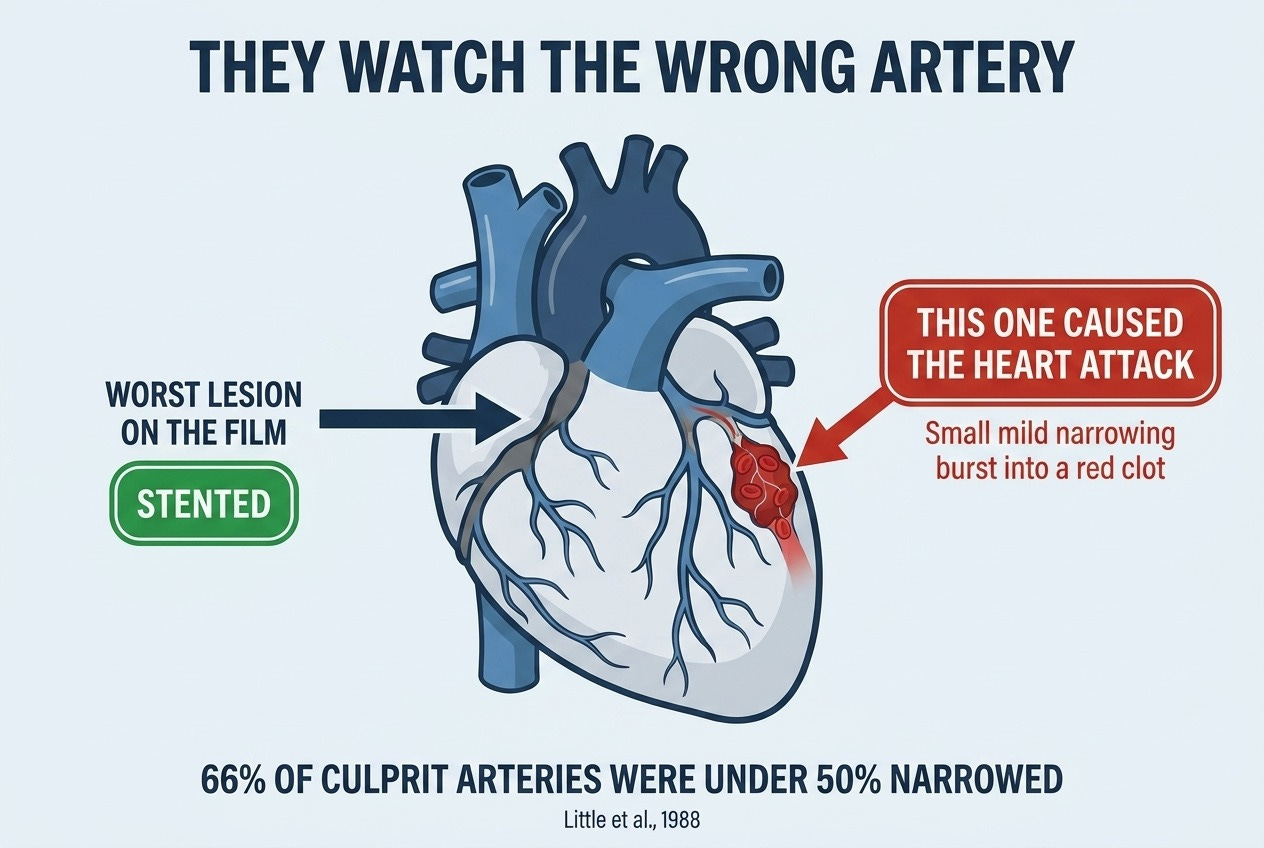
William Little is a cardiologist at Wake Forest, in North Carolina.
In the middle of the 1980s he found himself sitting on something unusual, and he seems to have been the first person to realize what he had.
At a big teaching hospital, a certain number of men get an angiogram for some reason — chest pain, a bad stress test, whatever — and then, some months or years later, have a heart attack and get another angiogram.
So you have a before picture and an after picture of the same man’s coronary arteries. Before the heart attack, and after it.
That almost never happens on purpose. You cannot design that study. You can only wait for it and collect it.
Little collected 42 of them.
Twenty-nine of those men had an artery that was newly, completely blocked on the second film.
That is the artery that gave them the heart attack. No argument about which one it was — you can see the plug.
So now you go back to the first film. The one taken before anything happened.
And you find that same spot, and you measure what it looked like back when everybody thought the man was fine.
Here is what he found.
Comments
Nothing yet. Say the first thing.
Sign in to join the conversation.