

Running is good for your heart.
More is better.
A marathon is the gold standard of fitness.
Is this really true?
Last month a student of mine asked me for help. He is 54. He has been running almost every day for almost twenty years.
I always shake my head in wonder when I hear a story from someone like this.
Four to six miles before work. Two marathons a year.
Trim. Lean. The kind of body men half his age would envy. Although if you look closely, he doesn’t really look good...
He felt great. Until he didn’t.
Heart palpitations. Lightheaded after his long runs. Some chest tightness coming up a hill he had been running for fifteen years.
His cardiologist sent him for a coronary calcium scan. Score of 410. No bueno.
The cardiologist said to him: you have the coronary calcium of a sedentary heavy smoker.
The man does not smoke. Cholesterol is fine. Blood pressure is fine. He runs forty miles a week.
The next MRI showed patches of scar tissue in his heart muscle, in a pattern that did not match any blocked artery.
His doctor said maybe he had a silent viral myocarditis at some point.
Here’s what I think. The running did it.
I want to walk you through what the research actually shows about doing too much cardio.
You may not be this extreme. But you’ll find out how surprisingly easy it is to over train.
Because the picture is not the one you have been sold. And I see slews of people who do too much cardio and there is something going on under the surface that needs to come out...so here it is.
Raimund Erbel is a cardiologist in Essen, Germany. He spent decades building one of the largest population CT cohorts in Europe, called the Heinz Nixdorf Recall study.
He scanned the chests of a few thousand middle-aged Germans, year after year, and watched what happened to their coronary arteries.
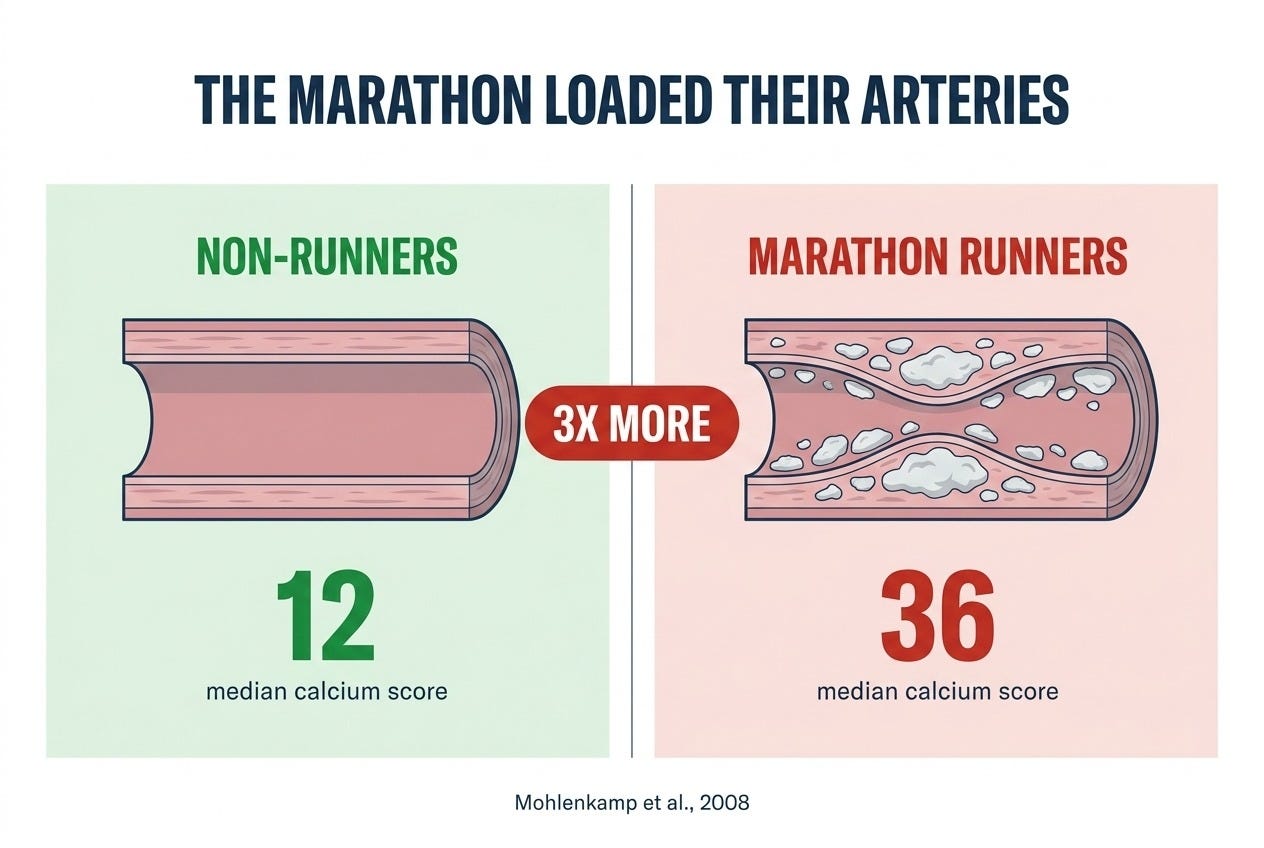
In 2008 he and a colleague named Stefan Möhlenkamp ran a side project. They pulled in 108 male marathoners. Every one of them had been running marathons for years.
Five or more marathons in the previous three years. Average age over fifty.
The marathoners were what you would call clean men. Better cholesterol than the general population. Lower blood pressure.
A predicted Framingham ten-year heart risk of only 7 percent versus 11 percent in the general population.
Then they ran the calcium scans.
The marathoners had a median coronary calcium score of 36.
The risk-matched controls — men with the marathoners’ SAME low cholesterol and SAME low blood pressure but who did not run marathons — had a median score of 12.
The marathoners had three times the coronary calcification of men with their actual risk profile.
The thing that was supposed to clean their arteries had not just failed. It had loaded them up.
The Essen group did not stop there. They put each marathoner through a cardiac MRI with gadolinium contrast — the same scan a cardiologist uses to look for scar tissue after a heart attack.
In 2009 the radiologist on the team, Frank Breuckmann, published the MRI results in Radiology. Of the original 108 marathoners, 102 completed the MRI portion.
Here’s what they found.
Comments
Nothing yet. Say the first thing.
Sign in to join the conversation.