
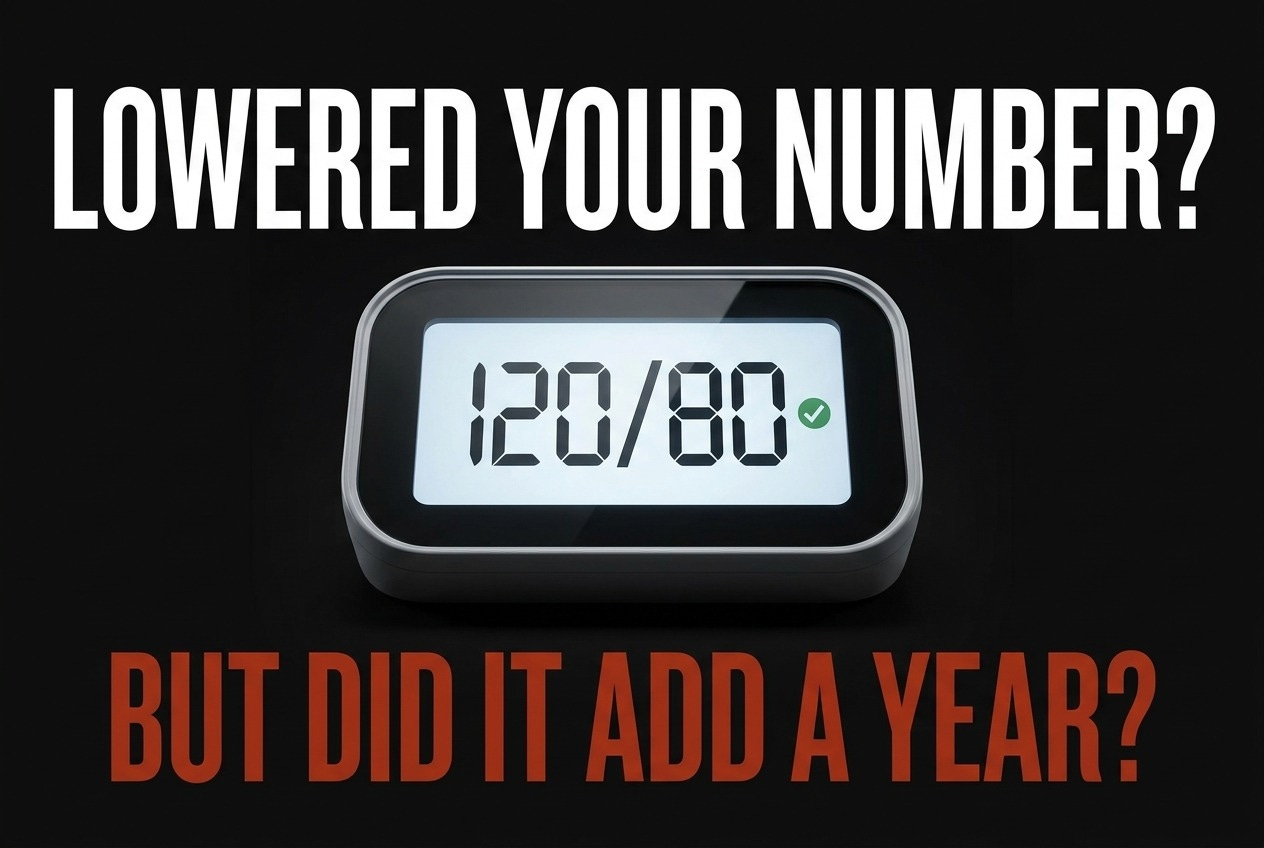
Your blood pressure is 150 over 90.
The doctor frowns, just a little.
“We need to get that down,” he says.
He hands you a prescription. Take it every day — probably for the rest of your life.
You take the paper.
Of course you do. Nobody wants a stroke.
But there is a question almost nobody asks in that room.
I’m not talking about “does it lower the number.” Medication is remarkably good at lowering blood pressure for most people.
So chances are high, medication will lower the number.
I mean the real question. The only one that matters.
If you take that pill and push your pressure down to 120 over 80, do you live longer than if you had left it alone?
I went looking for the answer. And it is not the answer I expected.
It depends on this:
How high is your pressure?
How bad is it?
How old are you?
As you’ll see in a moment, for a very large group of men — maybe the largest group of all — there is no good evidence the pill extends life at all.
Let me show you how to tell which one you are.
First, the numbers — so we are talking about the same thing.
Blood pressure is written as two numbers, and the top one — the systolic — is the one these treatment decisions mostly turn on.
That is the number I will use to draw the lines here. The bottom one, the diastolic, matters too, and I will come back to it.
A systolic under about 140 is not really what this article is about.
From 140 to 159 is what doctors call mild hypertension — mildly elevated. This is the big middle, and most men on blood pressure pills are sitting in it.
160 and above is what I am going to call genuinely high.
That line is not arbitrary. As you will see, 160 is right about where the trial evidence starts to show treatment actually saving lives.
And one thing counts as much as the number: your existing risk. A man who already has heart disease or kidney disease is in the serious category no matter what his cuff reads.
First we have to agree on what “works” even means.
When a doctor says a blood pressure drug “works,” he usually means one of two things.
It lowered your number. Or it lowered your “risk.”
Neither of those is the thing you actually care about.
You do not care about the number on the cuff. You care about how long you live, and how well you feel.
There is one measurement that captures whether a medication makes you live longer.
It’s what I always look at.
All-cause mortality.
Out of a group of people, how many were dead at the end — from anything.
Heart attack, stroke, cancer, a fall, the drug itself.
Everything counts.
Here is why that matters so much.
A drug can lower your stroke risk and still not help you live one day longer — if it quietly raises some other risk by the same amount.
So a guy has great blood pressure...but the funeral happens on schedule anyway.
So all-cause mortality is the only number I trust on a question like this.
When you read about a blood pressure drug, that is the number to hunt for.
The headline says: “Cuts stroke risk by 50 percent!”
Sounds great, right?
But that drug cuts your chance of a stroke from 2 in 100 down to 1 in 100.
The honest version: your risk went from 2 percent to 1 percent.
One person in a hundred was actually helped. That is the absolute number.
The other ninety-nine took the drug for years and got nothing from it — except the side effects.
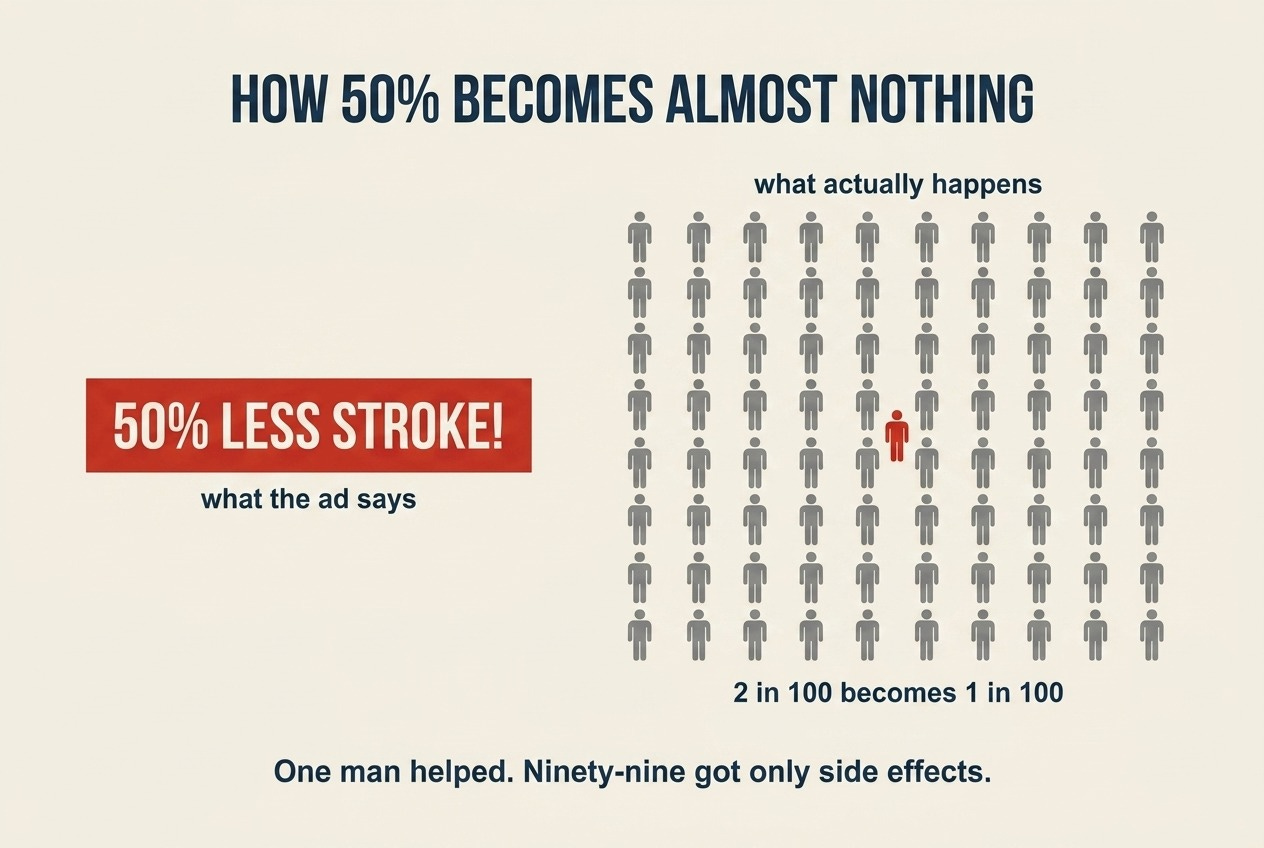
Same data. Two completely different ways of presenting it.
Big Pharma always manipulates this. Relative Risk versus Absolute Risk.
Relative Risk sounds amazing. 50% reduction in stroke death from this pill.
Absolute Risk in this case is a drop in the ocean. Reduction of 2 percent to 1 percent.
Doesn’t sound like much, does it.
So be aware of this Big Pharma game. Doctors regularly fall for it.
I learned to read this game years ago, and most recently writing about statins. If you read that piece, you already know the move.
The big relative-risk number gets the spotlight. The honest all-cause-mortality number gets left in the basement.
Pfizer claimed: the “vaccine” trial — published by Polack and colleagues in the New England Journal of Medicine in 2020 — had 8 COVID cases in the vaccine group vs. 162 in placebo, with vaccine efficacy reported as 95.0%.
That is the perfect illustration of this misrepresentation. Their numbers said:
1. Placebo group: about 162 cases out of ~18,300 people = about 0.88% got it
2. Vaccine group: about 8 cases out of ~18,300 people = about 0.04% got it
So the absolute risk reduction was 0.84 percentage points. Less than 1%.
(This leaves aside the honesty of the trial, which is highly suspect...I’m just using the numbers they supplied, assuming the trial was honest which is a big assumption.)
Using Pfizer’s numbers, you would need to “vaccinate” 119 people to prevent one symptomatic confirmed COVID case during that trial window.
Imagine if the news said, “new vaccine 1% effective.”
Nobody would have taken it.
But with relative risk, they said 95% effective. And technically that is correct.
But, you and I know it’s a game, a deadly game. A game of sleight of hand.
Doctors fall for this too. They are not statistically sophisticated, in my humble opinion. They need to go back to school and take a class in relative risk versus absolute risk. They are often misled.
And you see how treacherous this relative risk number really is?
I always try to find absolute risk as that is the real number to look at.
Did the people live longer when they take medication to control their blood pressure? Yes or no. Let’s look at the absolute numbers, not the relative risk numbers.
I’ll start with the punchline:
Let me start with the most common situation in America.
A man feels fine. At a checkup, his pressure reads 150 over 92.
He has no heart disease, no diabetes, no prior stroke.
He is just a basically healthy guy with a number a little above the line.
This is the biggest group of people on blood pressure pills, by far.
Mildly elevated pressure. Otherwise low risk.
So what do the drugs do for that man? Do they extend his life?
The cleanest answer comes from a Cochrane review. I dislike Cochrane. In the old days, though, their reviews were better than most. Not so true today.
Today’s Cochrane is suspect. But this is “old” Cochrane so we’ll look at their review.
In 2012, Diao and colleagues published a Cochrane review titled, plainly, “Pharmacotherapy for mild hypertension.”
They pooled the randomized trials of drug treatment for people exactly like that man — pressure in the mild range, 140 to 159 over 90 to 99, and no existing heart disease. Almost 9,000 people.
Here is what the drugs did for all-cause mortality.
I hope you will subscribe and help support my work.
Comments
Nothing yet. Say the first thing.
Sign in to join the conversation.