
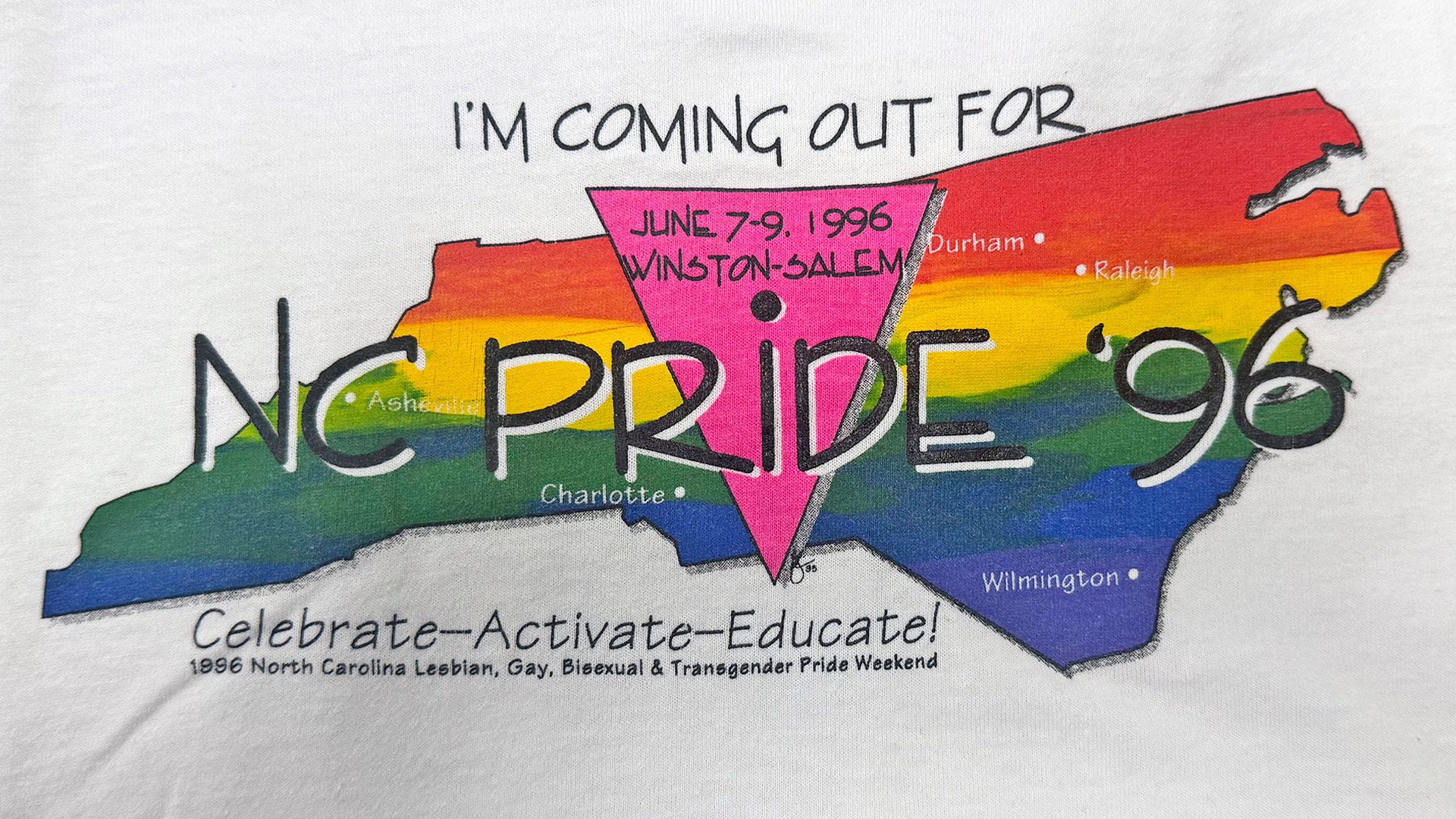
This weekend, my hometown, Winston-Salem, North Carolina, will celebrate Pride with a parade and festival. This year also marks the 30th anniversary of NC Pride ‘96, the first Pride march and celebration in Winston-Salem.
I was 10 years old when NC Pride ‘96 rolled into town. My fire-and-brimstone preacher made sure I knew about it, mocking the city as “Winston-Sodom” for hosting it. I’d come out four years later, but I was already being made aware of the queer world around me long before I ever had the language to identify and affirm who I was becoming. (My childhood independent, fundamentalist Baptist church was one of 42 local churches that ran a full-page ad opposing NC Pride; read more about that and see a PDF below.)
Though I didn’t attend the event, I’ve had the great pleasure and honor of knowing many of the people who helped make NC Pride ‘96 possible in Winston-Salem. One of those people, Susan Parker, was an essential mentor and pastoral presence during my teens and has continued to be a great friend into my adulthood. It was Susan who first reminded me of this year’s landmark anniversary. So, as this weekend approaches, I wanted to take just a few moments to celebrate and remember 30 years of LGBTQ Pride in my hometown.
To paint the picture of what NC Pride ‘96 was like, I’ve pulled from a variety of sources, including:
newspaper archives and stories as it was reported on at the time
the NC Pride ‘96 Guide
several quotes and memories from six people—Susan included—whose oral histories I and others conducted in 2021 as part of Charlotte Pride’s oral history project. Four of these interviews are archived and publicly available via UNC-Charlotte’s Special Collections. (I need to look into why some aren’t yet published.) Two of those interviewed attended or observed NC Pride ’96 and were among those who organized a new Pride event, Pride Winston-Salem, in 2011.
See citations at end of post for links to all sources.
Before the advent and utter proliferation of localized Pride events across the state, North Carolina once had a singular, statewide Pride march that often rotated between various cities. Another key distinction, often unknown or untaught to younger generations, is the difference between a “parade” and a “march.” In the ‘70s, ‘80s, and ‘90s, in cities both large and small, LGBTQ communities often held Pride marches, not parades. Celebratory in their own way, they retained an essential protest element that has been minimized in many modern Pride parades.
NC Pride’s first annual statewide event was in 1986 in Durham, though an earlier march had also been held in that same city in 1981. Winston-Salem’s hosting of NC Pride ‘96 was the 11th annual event. By the time it reached Winston-Salem, the event had been hosted in Durham four times, Raleigh three times, and once each for Chapel Hill, Raleigh, and Charlotte. It was Charlotte’s event in 1994 that shifted the statewide event from a single day’s march and rally to a full weekend of activities—arts and literary events, workshops and seminars, marketplaces, and more—certainly an early vision of the kind of weekend-long festivals one might see in Charlotte today, for example. Winston-Salem’s NC Pride ‘96 also had a weekend-long agenda, though the Sunday, June 9, 1996 rally and march remained the centerpiece.
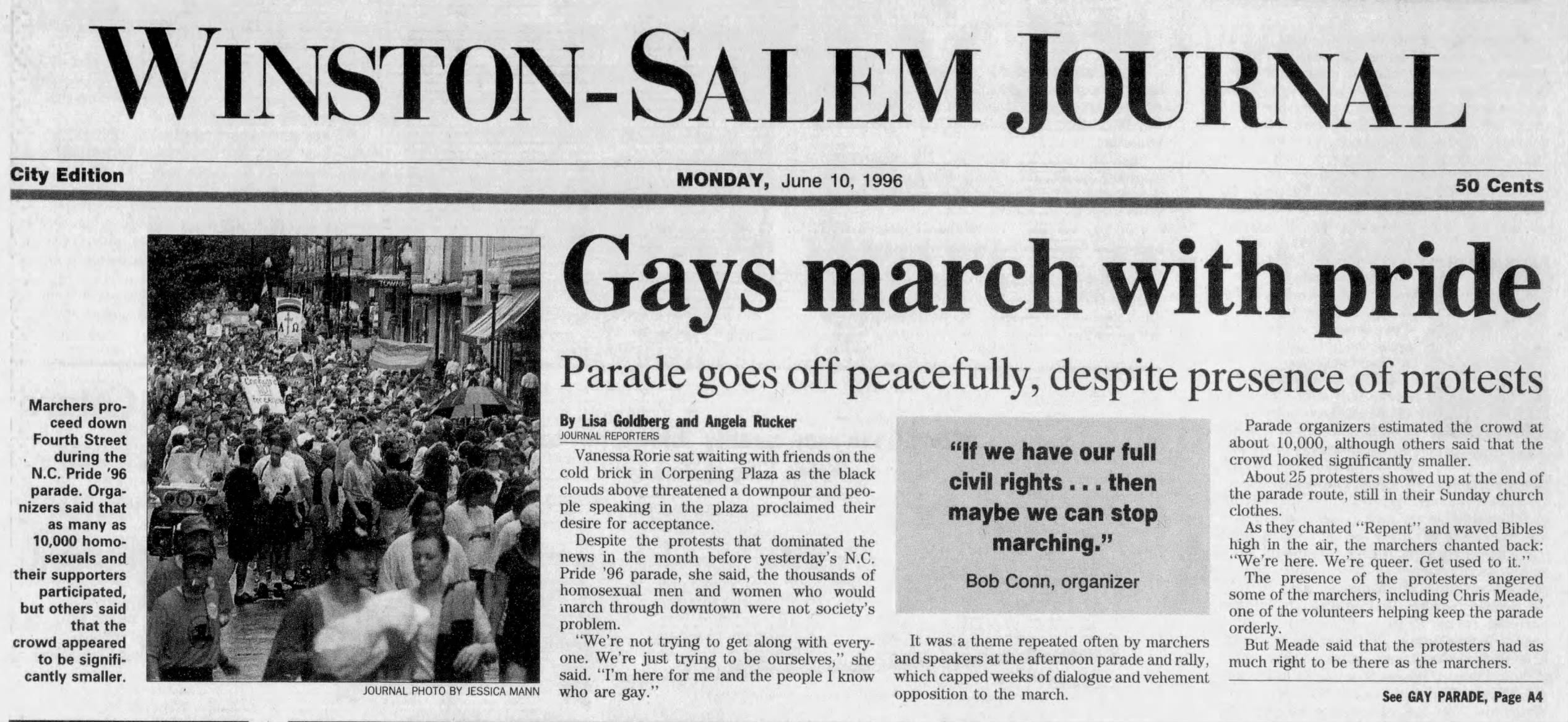
As reported at the time by The Winston-Salem Journal, The Front Page, and Q-Notes
The march, like all NC Pride marches at the time, included contingents from groups across the state.
One contingent, approximately 300 “Proud Allies of Pride,” marched alongside several PFLAG chapters across the state.
Several faith groups from Winston-Salem participated, including the Metropolitan Community Church of Winston-Salem, Parkway United Church of Christ, St. Anne’s Episcopal Church, Temple Emanuel, Trinity Presbyterian, and the Unitarian-Universalist Fellowship of Winston-Salem.
The biggest headline of the weekend was the rain. Ominous and cloudy skies had apparently been brewing the entire morning of the march, with the skies opening up into an utter deluge right as the march kicked off. The rain featured prominently in every news report—including Q-Notes’ headline: “Winston-Salem’s wet and wonderful Pride 96”—and was mentioned by oral history interviewees as a defining memory.
Approximately 10,000 people participated in the march, with some loud counter-protests that remained largely ignored by the marchers.
Weekend events included 45 different “Celebrate Wellness” workshops attended by over 1,000 people, a “Gay Marketplace” with merchandise and info tables from LGBTQ groups, a Saturday-evening reception, dinner, and a “Rainbow Ball” featuring a main ballroom, a country/western dance floor, and a piano bar. About 350 people attended an event with authors Mab Segrest, Minnie Bruce Pratt, Leslie Feinberg, and Barbara Smith.
A Winston-Salem city alderman had attempted to pass a resolution denouncing homosexuality prior to the event. No other aldermen seconded it, so it failed.
Berean Baptist Church, an independent, fundamentalist Baptist church led by well-known anti-LGBTQ pastor Ron Baity, led the charge in public opposition. They pulled together 42 local churches under the banner of “Churches for Christian Family Values!” to run a full-page protest ad in The Winston-Salem Journal on June 7, 1996 entitled “Commentary on the Gay & Lesbian Activities from a Christian Perspective!”. You can view a PDF of the full-page ad here (opens in new window; warning: anti-LGBTQ language may trigger reminders or feelings of religious trauma).
On that same day, June 7, 1996, The Winston-Salem Journal ran an article about Winston-Salem native Kevin Jennings, founder of what would become the Gay, Lesbian, and Straight Education Network (GLSEN) now known as Glisten. Jennings was among those in Winston for NC Pride ‘96, where he presented “500 Years of Queers,” a workshop on LGBTQ history. On LGBTQ advocacy, Jennings told The Journal: “People need to understand what the stakes are here. We know what not doing the right thing does. … It means suicides. It means dropping out. It means violence against lesbian and gay kids.” The article ran just three pages away from the anti-LGBTQ ad. Read the article in a PDF here (opens in a new window).
Come the day of the march, only about 25 protesters lined the parade route.
The event unfolded just as the North Carolina General Assembly was considering a same-sex marriage ban. Like many other states, and the federal government’s 1996 Defense of Marriage Act (DOMA), North Carolina ended up passing a statutory ban on marriage equality that year.
(pulled from the NC Pride Guide, news reports, and oral history interviews)
Local Organizing Committee:
Alex Norwood, co-chair
Cheryl Hopkins, co-chair
Stephen Carrigan, Rainbow Ball chair
Matt Dyson, hospitality chair
Joan Essick, Bridging the Gap outreach committee
Raymond Fox, merchandise chair
Bob Conn, Gay Media
Darnel Gay, march chair
Hank Hartz, housing chair
Kirby Heard, Pride Guide co-chair
Doreen Hughes, VIP Services
Ellen Hunter, Treasurer
Cathy Jones, vending co-chair
Janet Joyner, Arts with Pride Series
Mark Land, Proud Allies
Joy Lohrer, rally co-chair
Sarah Lu Bradley, Celebrate Wellness workshops co-chair
Gary Lundquist, Celebrate Wellness workshops co-chair
Rich Mashburn, Pride Guide
James McNair, Diversity
Monica Middleton, Arts with Pride Series
Rob Norwood, Gallery Hop chair
Kami Rowan, Arts with Pride Series
Jon Sikes, sports chair
Sharon Snow, Steering Committee member, Pride Peacekeepers
Connie Stafford, vending co-chair
Steve Willis, rally co-chair, Arts with Pride Series
Martha Wilson, Data Processing
Other Volunteers and People
Mandy Carter, Director of NC Mobilization ‘96, rally speaker
Don Davis National Gay & Lesbian Task Force, rally speaker
Susan Parker, media and public relations/interfaith event
Paris LeBon, honorary grand marshal
Joe Mantello, UNC School of the Arts alum, Tony Award nominated actor in original Broadway cast of Angels in America, rally speaker
Alex Norwood’s father, finances/accounting
Mike Nelson, Mayor of Carrboro, N.C., grand marshal
See the full NC Pride Guide ‘96 below for all speaker and entertainer bios, as well as a full listing of NC Pride ‘96 sponsors, contributors, and volunteers.
On what first Pride events revealed to him:
“That made me feel like I wasn’t a freak. Growing up, there was all this morality and perversion kind of vibe about being gay. So it was nice to realize it’s not such a big deal to be with gay people, to be with people who live and think like you — guys that are attracted to guys. That was a real revelation. The more I was around gay people that were also out, it just felt reinforcing.”
On why Pride matters:
“I’ve thought some leading up to this interview about the countless people that I met during the middle of the ‘90s that were gay, but were closeted, and they felt this edge to move forward. And it improved their lives. Once they got to participating with us on this Pride event and found that they were coming out — and their family members maybe didn’t know they were gay until they came out — it improved their lives for them to be more visible. That’s a big deal.”
On the spark and the process of bringing NC Pride to Winston-Salem:
“The process was actually just amazing because I knew, on that certain day, when I told myself, ‘Oh, let’s do this. You can pull this off. Just start talking to people.’ So I knew tons of gay people and lesbian ladies, and people that had money and people that didn’t have money, and I just started talking about it… The meetings started off with a dozen people. And then it was 25 people, and then it was 50 people, and it just grew and grew.”
On the community response:
“Really, really ready. [Not] In my wildest dreams, six months or nine months after that initial proposal to the board about the state march coming into Winston, I was just flabbergasted, you know. We ended up raising $78,000 and we had hundreds of volunteers… I met lots of people that weren’t out that wanted to help. And by the time June came around and we had the march and all the events, most of those people were out to their families and felt like it had changed their lives.”
On seeing closeted friends in the crowd:
“I remember marching in the parade and seeing people that I knew were gay that had come just to observe — getting grins from them, like, ‘I just can’t get out there and march with you, but at least I came to wave you on.’ That was sort of sweet and telling… I should tell you this: Cheryl and I both met our life partners during Pride. We joked, starting in ‘96 and over the past 25 years, about how we decided to host the Pride event and we met and married a redhead. That’s a coincidence that wouldn’t happen too often, I guess.”
On marching with his future husband:
“He remembers what I was wearing and I remember what he was wearing… I was wearing a Pride t-shirt — one of our t-shirts with the big logo — and a bright pink cardigan sweater and black jeans and cowboy boots. And he was wearing a striped button-down Oxford shirt and khaki pants. So we couldn’t be more different in terms of our wardrobe. But yeah, it was meant to be, and we’ve covered 25 years very successfully.”
On the rain:
“Oh yeah, now that was funny — talk about crazy. I think the church people thought it was justified, that God had sent the storm to rain on our parade. But I personally didn’t care about being wet and everybody dried out pretty quick. The march went on, even though people were getting wet and nobody really even had umbrellas. So we did our little march around downtown anyhow. … The ones [the rain] didn’t affect were the daycare center people. I had friends, some straight friends that took care of all the kids that were in a daycare, so their parents could march in a gay parade.”
On the deeper undercurrent of the march — and what it meant looking ahead:
“There’s anger under the surface about gays being belittled and murdered and restricted, or handicapped. Matt and I felt like we got married in ‘96 because we wanted to be a couple. And it took until 2013 before we could legally marry. Of course, that was astounding — I never thought that would happen. But the progress continues. Those were things that weren’t going to be available to gay men or lesbian women. But those things came.”
On attending her first Pride events in North Carolina:
“I was amazed to see how many people were there — amazed to see folks just laughing and holding hands and hugging and dancing and just enjoying themselves tremendously… Being involved in the Pride events was that same feeling of exhilaration, that same feeling of, ‘My God, we can do and be and inhabit space in the way everybody else does.’ And it was very empowering and very much made me feel more like a whole person.”
On religious pushback to the march:
“We had significant pushback from religious organizations in the area… There was a pastor named Ron Baity from Berean Baptist Church… Since folks were greeting each other with handshakes, I just reached out to him, just to be friendly and say, ‘Hi, my name is Susan. It’s nice to meet you.’ And he would not take my hand. He backed away from me — it was as though he felt he was going to catch something.”
On her most heartwarming memory from the ‘96 march:
“We had a significant number of members of the congregation who did take part in the march. And two of those individuals were Carl and Lucille Harris — just dear, delightful people… even at that point, they were both growing older and having some issues with walking, but they were gonna walk no matter what. And once we kind of stepped off with the march, it poured. I don’t mean just a little bit of water — it poured. And they never complained. They marched right along with us.”
On the protesters and the rain not stopping the march:
“We did have protesters… they had a major location where many of them came and were carrying signs and hurling scripture and trying to hand out tracts and that sort of thing. So it was pretty loud and obnoxious for us. But again, even with the rain, folks were happy and the parade went right along. We did not slow down a bit for the water, even though very few people had umbrellas with them that day. They really did not dampen the enthusiasm of the march.”
On the nature of the ‘96 event compared to later ones:
“I seem to recall in ‘96 that we had prepared some chants to use along the parade route… I’m pretty clear that in the ‘90s we were still in the mode of basically just trying to claim our space and claim who we are and claim our place in larger society, and not be willing to be marginalized and told that we were less than simply because of who we loved.”
On why he got involved:
“Somebody, and I don’t remember who, invited me to a meeting about having a Pride weekend in Winston. And I remember going thinking, ‘Nah, I don’t know if I want to get involved with this.’ But I remember somebody at the meeting saying, ‘Winston is not ready for this.’ And there’s this kind of contrarian side of me that when I heard that, I said, ‘Well, that’s why we should do it there, right?’ So that was when I decided that I really would get involved — when that person said we’re not ready for this. And the truth is, I wasn’t quite ready for it either.”
On his reluctance to actually march:
“The whole time I was doing this, I was going, ‘Well, I’m fine with helping set this thing up and making sure it’s successful, but there’s no way I’m gonna be in that parade.’ I had a lot of excuses. When you’re a journalist, you’re not supposed to be a regular person — you’re supposed to be outside, not involved. The other was, at the time I mostly walked with crutches, and there was no way that I could go all the way down the main street of downtown on my crutches. I kept thinking, ‘Okay, you’re the guy on the crutches, you’re gonna get your picture taken, you’re gonna wind up on the front page of the newspaper.’ I didn’t want to do that. I’m a private person. I don’t want to draw attention to myself.”
On accidentally ending up in the spotlight anyway — in a red convertible with an MTV celebrity:
“They said, ‘We need somebody to drive the marshal.’ I was thinking that we would drive them in our car, but when we got there, they said, ‘No, we’ve got this other car for you,’ and it was a red convertible. And it was for him to sit up on the back with the top down. Well, I guess I’m going to have a lot of people noticing me driving in a red convertible. And then it turned out this guy was really famous — he was the first gay person who really came out on The Real World, and it was a really big deal. We were driving down the street and people kept pointing and screaming. I just thought that was hilarious — I was the one who wanted nobody to see me, and here I was two feet away from the person getting the most attention in the whole event. And it was a great feeling. I had no idea so many people were gonna show up. I was stunned by the amount of people on the sidewalk watching. So many people that I knew. It was really good.”
On the moment that became his single most meaningful memory of the entire event:
“This woman — she was older than me, a lesbian, and she and her partner were for a long time the only gay couple I knew. They were real role models for me. But they were very fearful. When I talked to her about being involved in the Pride weekend, she said no. She said, ‘Why do people feel like they have to march in the streets? Why do they have to draw attention to themselves? Why can’t they just be quiet and silent?’ And I got it — I wasn’t all that far from that myself. I didn’t push her. And then after the parade, I was sitting at the information booth, and she came by and she had tears streaming down her face, and she was beaming — she was ecstatic. She said, ‘This is just wonderful.’ The next thing I heard from her, she was very involved in GLSEN. She was a retired schoolteacher and she became very active and very public about helping gay youth. To me, that’s my biggest takeaway of all the work that I did for that event. It was worth it just for what happened to her. Because what happened to her affected so many other people.”
On the deeper lesson life and Pride taught him:
“The lesson that I have to keep learning over and over again is that you can’t control the way people see you. Through my whole life, I’ve been trying to be a certain person or project something that is not exactly who I really am, thinking that everybody’s buying it. If you’re not just being you — which who is, you know — you’re wasting your time. So much effort went into something that was just completely a waste of energy. I still have to stop and catch myself, because I still do that. I’m trying to be real.”
On marching in his first Pride parade in San Francisco, years earlier:
“I just remember walking down Market Street in San Francisco the entire way, hardly able to see, because I was crying with such joy. ‘Oh my God, here I am. I’m finally here.’ And I was walking down the street and people were throwing beads and coming out and handing me flowers. So it was this remarkable event in my life to be able to walk in the gay pride parade as a person who was a member of the community.”
On how he and Alex Norwood got involved in organizing ‘96:
“Alex and I were dating. We traveled to Raleigh and went to the Pride celebration… Alex had kind of disappeared, and I saw him over at a particular table. He comes back and says, ‘Guess what? You and I are going to sponsor the gay pride parade in Winston-Salem next year.’ I went, ‘What? What the hell are you talking about?’ He said, ‘Yeah, I was talking to the organizers and they were very interested in branching out.’ And I go, ‘You’re fucking crazy. What are you talking about?’”
On his eagerness and caution in signing on:
“I was working full-time at a big hospital in Winston-Salem… I don’t know that I can commit to the kind of time this is going to take. But I’m really, really eager to be part of it.”
On being out and proud in a conservative environment:
“I was in this conservative state of North Carolina, and is this going to impact my job?… But it wasn’t really the issue because I was pretty robust in my wish to be loud and proud and out and available as a queer person in Winston-Salem. I didn’t have any reticence about my involvement in it.”
On the obstacles, stress, and ultimate triumph of organizing:
“It seems like there was some significant resistance to getting a parade permit, and it felt, at the time, like we were being discriminated against in terms of them not allowing us to have a parade permit like other organizations might have been able to do. But I mean, it came through at the end… At the last minute, one of the venues where we were supposed to have a party had cancellations and pull back. I just remember Alex going bonkers two days before, and he really didn’t recover for about a week after because of all the stress. But yeah — it came together.”
On the infamous rain and the chaos it caused:
“I remember it was horrible. It was horrible… Because it was raining so bad, there were some real problems with electrical issues. Either the music we had scheduled or the announcing and talking up on stage — it was really, really difficult. And that got to be kind of a hilarious joke because we had such difficulty with the technology.”
Nearly two decades after the first and only Pride march in Winston-Salem, local organizers launched a new, local Pride event, Pride Winston-Salem. Two of the key organizers had both attended the NC Pride ’96 event.
Her first Pride experience in ‘96 event:
“I actually think the first Pride I ever attended was that 1996 Pride event that was in Winston-Salem… 1996 happened to be in Winston-Salem… my memory would suggest that that was the first Pride event that I participated in. … I don’t remember a whole lot about it other than there were a lot of people at that event. It was certainly affirming… It feels celebratory and exciting, and people with just a sense of joy and unity — those are the memories that I have.”
On what ‘96 represented in its time:
“It was a different time and a different space for the LGBTQ community… I was out at work and that was an important part of who I was at that time. But there were still so many people in the closet, there was still so much that was unspoken, there was still so much silence in the community. And so, while it was there for the moment, when that moment was gone, we went back — many of us — to sort of living quiet lives… Nothing really changed after that Pride.”
On why Pride mattered as an act of visibility:
“It just really struck me at that time that we had no voice and we had no presence. And Pride was the most visible way to make that happen — to give voice and to give face and presence and Pride to the LGBTQ+ community in Winston-Salem. Without a doubt, that was gonna do it quicker, faster than anything.”
On Pride as a door-opener in her life:
“Pride was the catalyst for me to reconnect with the LGBTQ+ community. And so it opened the door for so many other things for me to take part in that have been truly significant events in my life and experience… it really started there — the attention that I paid to teen homelessness, our ability to do work with youth. I will be ever grateful for that experience and what it led to, ultimately.”
On the impetus for organizing Pride Winston-Salem, after witnessing friends denied a family membership at the YMCA:
“How long can you just sit around and just watch all this stuff going on until you say, ‘I’ve gotta step in and I’m gonna do something about this’? … I did it because I had really no other choice. The people who are activists, people who are willing to stick their neck out a little bit — you just do it because silence is not an option for me.”
On first observing NC Pride in Winston-Salem from his car:
“Back then … there was a North Carolina Pride, but it was rotated each year between some of the bigger cities. So Charlotte, and Winston-Salem, and Asheville, and Raleigh, and Durham… it was actually Winston-Salem’s turn on the rotation… I remember it was downtown, when there wasn’t much going on downtown, but there was a parade. I wasn’t a part of it. I just actually drove through it, or drove around it, you know, just to kind of observe it. And all of a sudden there was a huge thunderstorm. Of course, I was in a car, but the participants in the parade weren’t as lucky.”
On why Pride mattered historically:
“I think that historically they’ve been so important because the LGBT community really has been marginalized, and there were a lot of people — whether it was with their family, or with their employer, or with their faith community — they could not come out, they could not identify as who they truly were. And it’s just like the first time I ever went to a gay bar — I thought, ‘Gosh, I can be myself here. People will understand what I’m going through.’”
On his most powerful memory as an organizer of the 2011 event:
“I was sitting at a table or standing on the corner in downtown Winston-Salem. And just to see all the floats coming by and seeing the diverse group of people — young and old, and Black and White and Latino and Asian — whether they were in the parade or watching the parade, just everybody having such a good time.”
On what Pride is fundamentally about:
“Pride, I think, is just celebrating people being able to be themselves and being able to love the person that he, she, or they want to love. And as long as you’re not hurting another person, the fact that you love somebody shouldn’t have any effect whatsoever on anybody else.”
On what makes Winston-Salem Pride distinctive:
“I would think probably one thing that maybe makes Winston-Salem a little bit different is the amount of families that take part in watching the parade, being in the parade, being a part of the festival — also the number of faith communities that are involved… Winston-Salem has always been, I think going back to the Moravians who founded the town of Salem back in the 1700s, always been a pretty accepting place.”
On the impetus for organizing Pride Winston-Salem:
“Winston-Salem was a great place to live, work, and play, and there were a lot of folks who identified with the LGBTQIA+ community in Winston-Salem. And it was a shame that we didn’t have an annual celebration. Winston-Salem really brands itself as a city of arts and innovation — we needed to have a Pride.”
Churches for Christian Family Values. “Commentary on the Gay & Lesbian Activities from a Christian Perspective!”. Advertisement. Winston-Salem Journal, June 7, 1996. https://mattcomer.net/wp-content/uploads/2026/06/Winston_Salem_Journal_1996_06_07_ChurchesAd.pdf
Goldberg, Lisa, and Angela Rucker. “Gays March with Pride: Parade Goes Off Peacefully, Despite Presence of Protests.” Winston-Salem Journal, June 10, 1996. https://mattcomer.net/wp-content/uploads/2026/06/Gays-march-Winston-Salem-Journal-19960610_web.pdf
Roule, Charles. “Winston-Salem Hosts NC Pride: One in 10…Had Umbrellas!” The Front Page, Vol. 17, No. 13, June 21, 1996. https://newspapers.digitalnc.org/lccn/sn90018324/1996-06-21/ed-1/seq-1/
Ferber, Lawrence. “Pride Weekend Highlights Our Culture.” The Front Page, Vol. 17, No. 13, June 21, 1996. https://newspapers.digitalnc.org/lccn/sn90018324/1996-06-21/ed-1/seq-13/
NC Pride ’96 Guide. NC Pride. June 7-9, 1996. Charlotte Pride Archives, courtesy Alex Norwood, Charlotte Pride, Charlotte, NC. https://mattcomer.net/wp-content/uploads/2026/06/NC-Pride-96-Guide_web.pdf
Underwood, Kim. “It’s a Tough Road. A gay educator speaks from experience: Pain and scorn are a terrible price for kids to pay.” Winston-Salem Journal, June 7, 1996. https://mattcomer.net/wp-content/uploads/2026/06/Winston_Salem_Journal_1996_06_07_KevinJennings.pdf
White, Eagle. “Winston-Salem’s Wet and Wonderful Pride 96.” Q-Notes, Vol. 11, No. 3, June 29, 1996. https://newspapers.digitalnc.org/lccn/2006225405/1996-06-29/ed-1/seq-3/
Jamis, Mary, Rick Mashburn, Alex Norwood, Mark Smith, and Rex Welton. Oral history interviews conducted by Matt Comer and Ryan Farrior, Charlotte Pride History Project, February–March 2021. Audio/video recordings and transcripts. J. Murrey Atkins Library Special Collections, University of North Carolina at Charlotte. https://goldmine.charlotte.edu/search?c=Charlotte+Pride+Oral+History+Project&cc=Charlotte+Pride+Oral+History+Project&ln=en.
Norwood, Alex and Susan Parker. Oral history interviews conducted by Matt Comer, Charlotte Pride History Project, March 2021. Audio recordings and transcripts. Matt Comer personal archives, Charlotte, NC.
— Thanks to John Walton at Charlotte Pride for helping track down the location of the NC Pride ‘96 Guide and T-shirt among the organization’s archival holdings.
— Claude Sonnet 4.6 was used to analyze news stories and interview transcripts, with human review, editing, and final composition by Matt Comer. All writing in this post, save some of the brief descriptions of interview quotes, are original, non-AI compositions. Transcripts were created as part of the Charlotte Pride History Project by a professional, human transcription service; minor variations between audio/video interviews and transcripts may exist.
No posts
Comments
Nothing yet. Say the first thing.
Sign in to join the conversation.