
Western children’s publishing is a ‘progressive’ industry. A visit to your local Australian bookseller will reveal an endless supply of children’s books running a determinate spectrum of liberal messaging: be kind, reject gender norms, take personal responsibility for the environment, celebrate diverse bodies, families, and non-western cultures. And, yes, attend non-specific protests waving generic placards in a peaceable fight for our ‘rights’.
In these books, we march and cheer. But we never march or cheer for anything that threatens the western imperialist order. We may cast a nostalgic eye upon historic struggles. We may congratulate ourselves on achievements of civility that have made the ongoing maintenance of settler colonies more palatable. But contemporary revolutionary acts — of transnational solidarity, of uprising, of collective liberation — must never be modelled or imagined.
Over the past 790 days, the Australian children’s publishing industry has operated unaltered and unburdened by the moral imperatives of an observable mass extermination. Few conventional children’s publishing houses have made even the most indirect statements in support of Palestinian life, much less liberation — none have directly refuted Zionist colonialism, expelled the Zionists from within their ranks, or addressed their Zionist ownership and infiltration. The vast majority of children’s authors, illustrators, publishers, distributors, events, and awards are committed to the ‘smooth operation of business’1.
If we are to meaningfully engage with the production of children’s books, we must be clear-eyed about the ideological scaffolding and commercial imperatives of the western children’s publishing industry: a culture that profits from the self-conscious gestures and aesthetic conventions of ‘liberation’ — but only insofar as the enemy is never named, the status quo is never materially challenged, and Palestine, specifically, is erased.
In 2020, Following George Floyd’s murder by US police, publishing companies from across the imperialist west released hurried statements of solidarity, promised to add more non-white faces to an embarrassingly white industry, and scrambled to produce new books by non-white authors. These companies were eager to avoid any perception that they might be on the wrong side of a popular uprising — the wrong side of history. And, as books about racial justice climbed bestseller lists, they were also eager to capitalise on an unexpectedly lucrative market.
Producers of children’s books were no less willing to mobilise. Large children’s publishing houses created entirely new imprints to specialise in socially and racially progressive children’s books. They scoured Instagram for model minorities with large follower counts, who they pursued and signed to create picture books, with a rapid turn-around, courting the public appetite for shiny, instagrammable, anti-racist consumer items. These books were often so heavily edited and project managed as to be practically ghostwritten.
While carefully avoiding the inconveniently revolutionary practicalities of liberation, Australian publishers delivered an unprecedented quantity of diversity, representation, and good vibes. Although never identifying — much less condemning — the perpetrators (western imperialism, colonialism, Zionism, capitalism, the ruling class and its industries of policing, land theft, extraction, and war) they did offer well-meaning parents a marketable grab-bag of affirmations for young children: Stand up for your rights! Together we can make a difference! It’s ok to be yourself!
If this enthusiastic response to Black Lives Matter (BLM) was largely guided by cynicism, self-preservation, and profit, certain individuals within large commercial publishing houses did see genuine potential, in the chaos of this sudden corporate agitation, to usher in some genuinely liberatory work. I was approached by Alyson O’Brien, then publisher at Hardie Grant, to collaborate with Darumbal and South Sea Islander journalist and writer Amy McQuire to confront the colonial celebration of Australia Day, a picture book project that became Day Break, published in January 2021.
Although Australia Day was a relatively uncontroversial target for progressive parents, McQuire and I insisted that the book also incorporate a direct criticism of ANZAC Day — a far more sacrosanct imperialist holiday (and a hyper-nationalist ‘key sales date’ for Australian publishers). O’Brien supported this, knowing that, in the rush to press, a more radical inclusion might pass through the company’s editorial and marketing process unchallenged — and this proved to be the case.
Commercial publishing houses knew that the BLM Book Boom would be short-lived, and they scheduled accordingly. From concept to final files, we created Day Break in a few weeks (a process that should properly require many months, if not years). At the very last minute, I quietly included a keffiyeh, casually draped within one of the book’s watercolour illustrations. The first keffiyeh to appear in a mainstream Australian children’s picture book, it escaped our publisher’s notice until the book was printed, distributed, and placed on bookstore shelves. Zionists fumed.
Day Break’s second print run was rebranded as the launch title of Hardie Grant’s new children’s social justice imprint, ‘Bright Light’ — announcing itself as ‘an exuberant, groundbreaking collection of books for children, united by a vision to change the world – one conversation at a time’. In principle, this was a welcome development. However, like so many BLM-adjacent initiatives, the ideological parameters of this new imprint were quickly demonstrated. By 2023, Bright Light had acquired and published work by Julie Merberg, a New York-based Zionist and author of fanatical propaganda for children. This month, from the cover of new Bright Light title Dogs with Jobs, a German shepherd in a police vest leaps towards the viewer.
In 2021, the Zionist death machine renewed its extermination of Palestinians in besieged Gaza, escalated its broad-daylight theft of Jerusalem, and invaded Al-Aqsa Mosque. During this phase of colonial expansion emerged the Unity Intifada, a new iteration of Palestinian revolutionary decolonial organising, uprising, and resistance.
That year, as bombs shredded the bodies of Palestinian children, the abovementioned Merberg wrote Nice Jewish Girls. Produced through her own publishing house2 and illustrated by Georgia Rucker, this book for children promises the biographies of ‘36 extraordinary, hilarious, iconic, outspoken, fascinating Jewish women’.
‘Henrietta Szold didn’t invent Zionism’, the book begins, ‘but she turned the idea of it into a reality’. Racist, supremacist, and transparently fraudulent from cover to cover, the book’s Girl Boss icons include the repulsive war criminal Golda Meir and Haganah sniper Ruth Westheimer, Nakba perpetrators both. There is barely a page in which an opportunity is not found to glorify Israel and inculcate young readers with the ‘Zionist dream’.
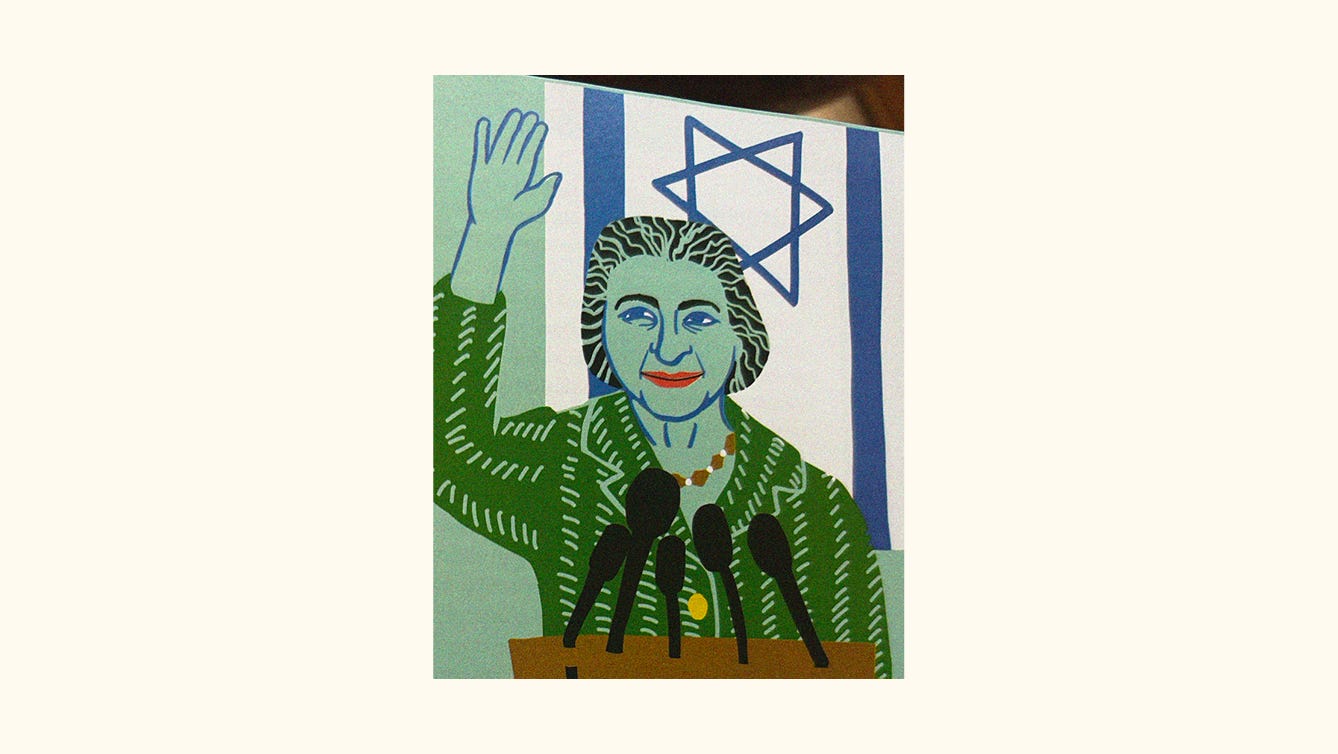
In stark contrast to the frenzied mobilization, hand-wringing, moralising (and, yes, profiteering) in response to the American abolitionist uprising exactly one year earlier, the Australian publishing industry remained unanimously and conspicuously silent on the slaughter of 2021 and the Unity Intifada. Publishers released no statements. They blacked-out no social media tiles. No solemn public pledges were made to hire or publish Palestinians.
Not a single one of the newly created ‘justice and diversity’ imprints or newly launched ‘progressive’ publishers — self-described as ‘brave’, ‘groundbreaking’, and ‘world-changing’ — would yet dare confront the fact of US imperialism and Zionist colonialism in Palestine (to which the Australian colony remains an enthusiastic accessory).
That same year, at the Australian office of Penguin, a commissioning editor of colour — introducing themselves to me resignedly as a ‘George Floyd hire’ — decided to leverage their brief BLM tokenisation to usher a Palestinian-authored picture book manuscript through the acquisitions process. I joined the project as illustrator. However, Penguin Australia rejected the manuscript before even reading it, based solely on the author’s identity. Any Palestinian on their list, they explained, might upset one of their bestselling (presumably Zionist) children’s authors. Soon after this incident, the ‘George Floyd hire’ quit.
Alongside two rare dissenters from within the industry, and in close consultation with Palestinian comrades, I co-authored a statement for fellow members of the children’s book industry to sign. Published in May of 2021, this statement is as relevant today as it would have been in 2006, 2008, 2012, 2014…
‘Our industry professes to nurture and enrich the experience of childhood. How then can we stay silent as children are targeted, murdered, orphaned, incarcerated, dispossessed and traumatised by an occupier?
We have watched the Zionist entity massacre entire families in besieged Gaza – while deliberately crippling essential health, social and cultural infrastructure. We have watched ‘
Israeli’ settler organisations threaten the homes of Palestinian families in occupied Jerusalem. We have watched the brutal assault on peaceful worshippers at Al-Aqsa. We have watched the mass arrests and killings of those who participate in protests against their own ethnic cleansing.We are watching with grief and horror.
We recognise these events as recurrent episodes in the violent colonisation of Palestine, ongoing for 73 years. We recognise
Israelas an illegitimate entity imposed on stolen Palestinian land. We recognise the sovereignty and humanity of Palestinians in their struggle against occupation and oppression.We note the enthusiasm with which the children’s publishing industry has previously mobilised during global movements for justice, releasing statements of solidarity and creating new imprints. By contrast, we note that the industry has largely maintained its silence on the ethnic cleansing of Palestine.
We understand that witnessing and naming play an important role in change-making. What we are witnessing is called genocide. With this letter, we hope to normalise this conversation within the publishing industry, the wider arts community and beyond; shifting us closer to a tipping point, and to Palestinian liberation.’
The open letter gathered a modest cohort of 300 signatories, including children’s authors, artists, designers, and publishing workers. Within the industry it was both anomalous and controversial. A number of its signatories lost work and funding opportunities. An Aboriginal author, for example, had their residential opportunity (on stolen Aboriginal Land) rescinded by the Zionist ‘impact investor’ who ‘owned’ the property; the author’s signing of the open letter was specifically cited as the reason.
Prior to the open letter’s publication, one of its co-authors, Tess, had been called into her boss’s office at a nominally progressive independent publishing house3 in which she was employed as children’s book editor. On its website, the publisher describes itself as a purveyor of ‘radical joy’ and ‘unconditional love’. Due to her support for the popular Palestinian and Aboriginal-led boycott of the Zionist-owned Schwartz Media conglomerate, Tess was accused of ‘antisemitism’ and ordered to inform her boss of any future Palestine-related activity. Not long after this incident, Tess quit.
At this time, Tess was only a distant acquaintance and comrade. A year later, however, she would become my life partner and regular creative collaborator. In 2022, Tess launched her own tiny independent publishing house: Slingshot Books. Her venture was the first — and remains the only — comprehensively anti-Zionist and openly pro-resistance children’s book publisher in the Australian colony.
Another year would pass before the Al Aqsa Flood operation of 7 October 2023 — a courageous act of revolutionary decolonisation — would successfully place the cause of Palestinian liberation within the scope of mainstream western perception, casting a floodlight into the well-maintained shadows of ‘progressive’ cultural production, and forcing Australian children’s publishers, one way or another, to take a side. Almost unanimously, our industry has chosen silence, complicity, and capitulation.
I’m sharing these reflections during a supposed ‘ceasefire’ in Gaza, an agreement already violated hundreds of times by the Zionist entity, killing hundreds of Palestinians, including children. Many more have been injured or remain unaccounted for beneath the rubble of ongoing bombardment and extermination. Still more will die from the ongoing weaponisation of siege and deprivation as additional tools of genocide: the deliberate annihilation of the conditions for life. There can be no ceasefire in a world where Israel exists.
Palestinian political prisoners, many of them children, are being released from Zionist prisons — sites of systemic torture, sexual assault, organ harvesting, medical neglect, murder, and mutilation. Undefeated after 15 months of genocidal bombardment, heroic Palestinian resistance factions have successfully liberated these prisoners from a powerfully armed American-empire-backed colonising force.
Today, the Civil Defence in Gaza confirms 20,000 children martyred by the Zionist entity since 7 October 2023. The actual number, of course, will be exponentially larger. Countless bodies have been shredded, buried, or completely vapourised. Nor does this number account for the living children who remain orphaned, homeless, permanently disabled, starved, imprisoned, and traumatised beyond our imagination.
For those of us involved in the making of children’s literature, it should be abundantly clear which children our industry deems deserving of joy. A child who poses no threat to the interests of western imperialism is allowed to thrive and fill a cozy bedroom with books about ‘diversity, inclusion and justice’. A child whose very existence unsettles the vice grip of imperialism must be erased. And those of us in the imperialist west who dare to honour these young martyrs are suppressed, smeared, and censored.
That said, Palestine has now crossed a certain rubicon of the liberal imagination. In the coming years we will undoubtedly see a wave of Palestinian representation in Australian children’s books. We can expect some welcome titles on this wave. Baraa Alawoor, for example, has illustrated Sara Haddad’s upcoming picture book, a 2026 title by University of Queensland Press (UQP), promising a story about ‘sovereignty, freedom and homecoming’ through a Palestinian child’s Nakba experience.
However, we can also expect western publishing houses with decades-long legacies of Zionism — with blood on their hands — to calculate, pivot and accommodate a growing market for Palestinian victimhood. While carefully avoiding the inconveniently revolutionary practicalities of liberation, they will no doubt furnish well-meaning parents with empire-friendly affirmations of Palestinian existence.
Of course, we can expect nothing so frenzied as the BLM Book Boom of 2020. Despite witnessing two years of relentless massacre, the vast majority of Australian publishers remain structurally and ideologically Zionist. But Zionism and capitalism have always operated in lock-step. The liberal arm of imperialism will mobilise to capture, co-opt, defang and commodify the language of revolution. Words will be stripped of meaning. We must resist the temptation to applaud.
Before it is finally defeated, warned Aimé Césaire in 1950, the colonial ruling class ‘is condemned to become every day more snarling, more openly ferocious, more shameless, more summarily barbarous’. Its ‘violence, excess, waste, mercantilism, bluff, gregariousness, stupidity, vulgarity, disorder’ he predicts, is a ‘domination from which one never recovers. I mean from which one never recovers unscarred’.
Our children, who must live through these days of vulgarity, deserve to know exactly who threatens their collective liberation — who must be confronted, who must be defeated. We must create new spaces for the production of children’s content free from western imperialist gatekeeping: more genuinely independent and genuinely revolutionary production and publishing houses, community libraries, childcare and educational spaces committed to the cause of decolonisation, the return of land and resources to Indigenous people, to systems of shared prosperity, and to the righteous imperative of Palestinian resistance.
Parts of this article were originally published by Debris Magazine, 2025
Thanks for reading Matt Chun’s Newsletter.
I’m an independent artist, writer, and picture book creator. To support my practice, visit my online store or consider becoming a paid subscriber to this newsletter.
I’m also a founding and current co-editor of revolutionary print periodical The Sunday Paper, an imprint of Slingshot Books.
To share information with me about censorship, ownership, funding, infiltration, or influence, please use my secure submission form. I’m happy to archive receipts from any industry or community. However, I’m more likely to follow up and write about a subject that falls within my areas of experience: primarily creative arts, the publishing industry, and news media in the Australian colony.
AI policy: I never use AI to generate, edit, or refine any part of my image-making, research, writing, or publishing process. When I make art, I use traditional materials: pencil, watercolour, and ink on paper. If you consume my work you can be sure that the labour, creativity, language, and materiality is my own.
‘I look around and wherever there are colonizers and colonized face to face, I see force, brutality, cruelty, sadism, conflict, and, in a parody of education, the hasty manufacture of a few thousand subordinate functionaries … artisans, office clerks, and interpreters necessary for the smooth operation of business.’
—Aimé Césaire, Discourse on Colonialism
Brooklyn-based vanity publishing house Downtown Bookworks, distributed by and closely affiliated with Simon and Schuster, the publisher of Netanyahu’s autobiography and books by Noa Tishby, amongst other horrors.
In 2022, this same company published a pro-union graphic novel for an adult readership, promoted as ‘a timely and inspiring history of unions and why we need them’ , ‘beautiful, bold and necessary’, and a ‘guide to union organising that’s in touch with the reality of work today’. Even as the book went to press, staff reported that this publisher busted their own fledgling attempts to unionise. This offers another stark example of ‘progressive’ cultural production under capitalism.
Comments
Nothing yet. Say the first thing.
Sign in to join the conversation.