
Tuesday, 22 August 2023
7.55am
I’m really looking forward to today.
When I got back from Bolton yesterday, I spent the afternoon transferring a few months’ worth of general creative notes I’d written in the Notes app of my iPhone – quotes from novels I’d read, my little observations of life and human behaviour, turns of phrase I’d overheard, that kind of thing – into my new, physical notepad, plus transferring what’s left and still unused in my old one, which is so battered it falls to pieces when I pick it up. It’s a thankless task but one I have to do as I dip in and out of my notepad endlessly when I’m writing. You need so much colour and detail to describe all the characters and locations in a 100,000 word novel and the well often runs dry. And I need to transfer my notes from my phone as I have to turn it off and leave it in the other room when I’m writing – it’s much too distracting.
But today isn’t about the new novel; I’m starting work on my treatment for the ballet about Hans Christian Andersen. And I think one of the reasons I’m looking forward to it is it’s entirely free of pressure and expectation, a nice little sideline that could prove to be fulfilling and give my career a boost – but if it doesn’t, no-one outside my circle need even know about it.
Having said that, I don’t really know how to set about it. But I’ve got my biography and I’ve got my complete collection of short stories so I’ll start reading and work out the rest as I go along.
I’ll try not to think about the news we’re still waiting to hear from Italy – the feedback from the house viewing, which Harry’s going to chase from the estate agent… If the buyers are interested, it could mean I’ll lose the setting for my next novel before I’ve even started work on the first draft…
7pm
There’s no news from the estate agent in Italy. I’m not sure whether that means the viewers are interested or not. But I’m going to have to try to put it out of my mind for another day.
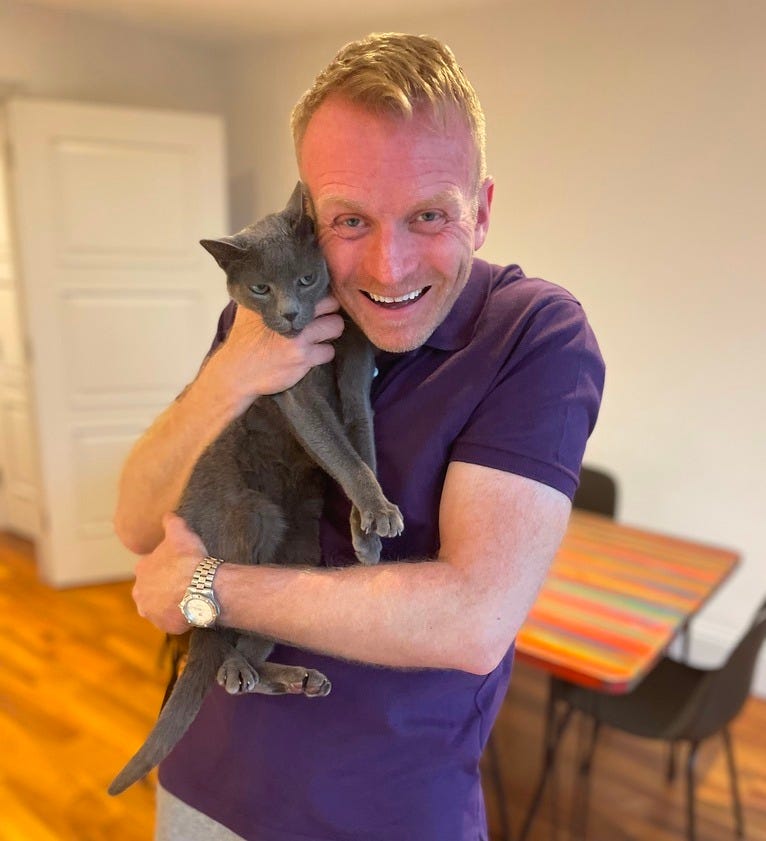
I’ve just popped some pasta bake Harry likes in the oven and have half an hour till it’s done. I’m in the kitchen, with the patio doors open to let in some air as it’s a hot, sunny evening. There are lots of flies buzzing around and they’re attacking the cat’s food bowl. But I can’t be bothered to bat them away – it’ll only be a losing battle. I’ll just cuddle her instead.
It’s been an intense day. I started by reading Hans Christian Anderson’s fairy tales – the originals, obviously translated into English. I’d already worked out which ones are the most closely inspired by his life, emotions or self-image. And I don’t want to have to set these up too much – I hate it when a piece of dance tries to tell too much story – so am only interested in the ones the audience will already know, at least in their basic outline. So that gives me The Little Mermaid, The Ugly Duckling, The Little Match Girl, The Red Shoes, and I was going to do The Nightingale but think it’s better to switch to The Emperor’s New Clothes. Not only is it more well-known but it’ll give me a different message to explore and open up some new themes.
As I’m going to weave these fairy tales in and out of the lead character’s life story, I then got cracking on a recent popular – and well received – biography. Unfortunately, I was slightly overwhelmed by the detail. There’s so much more than I found in the online research I did to come up with the first short treatment I sent to the choreographer. And I’d made one or two assumptions that I’ve since found out aren’t correct. First of all, I got the lead character’s name wrong. I’ve been calling him Hans, when apparently he was only ever referred to as Hans Christian and if this was shortened to just one name, it was Christian. And he almost always referred to himself – when he signed his letters, for example – as Andersen. So bang goes my title!
On the positive side, I’ve found lots of hooks of engagement for me as a writer. I was drawn in by the way the young Andersen was made to feel like a freak, how he was bullied for being effeminate, the brutal class snobbery he endured, and his battle through years of rejection – desperately clinging onto his self-belief – before he gained any kind of success as a writer. One episode in particular struck a chord; as a poor student from the provinces, Andersen stayed with wealthy benefactors in Copenhagen and would sometimes behave improperly, or get matters of etiquette wrong, or just not know how things were done. This came to a head at the annual ball for naval cadets, when everyone came wearing ‘dress coats’ in black, but he only had one in grey – and felt so out of place that he rushed back to his room and hid there for the rest of the night. It reminded me of my first formal dinner at Cambridge University, when I was in a minority as a student from a comprehensive in the north of England and didn’t even know what ‘black tie’ meant. My parents had bought me a double-breasted – which at the time was quite definitely not in fashion – navy lounge suit from Marks and Spencer, which we’d thought would work for all formal occasions. So I had to wear that and hope I blended in. It turned out I was the only student not to be wearing proper black tie and all night I felt miserably self-conscious and out of place. Unlike Andersen, I didn’t go and hide in my room: I smothered my anxiety with booze and got wasted. This was already a pattern by the time I arrived in Cambridge and would be for more than a decade afterwards. But that’s another story and a deviation from Andersen’s…
Another problem I’ve encountered from the Andersen biography has been all the gaps in the historical record, particularly when it comes to his sexuality, which was only rarely – if ever – acted on, so primarily existed in his head, his heart, and his hormones – which, from what I can gather, were often raging. Because being open about same-sex attraction in those days would have led to social ruin, familial rejection and professional dismissal – nineteenth century Denmark apparently had the death penalty for men convicted of homosexuality but didn’t enforce it – little evidence survives, which forces people like me to read between the lines and imagine his feelings. It forces me to imagine the torment that would have gone through his head. That’s fine because using my imagination is what I do when I write fiction and it’s what I love doing. But this lack of evidence – or the fact that family members often destroyed all evidence to protect reputations – is why so many historical figures who were attracted to men are often straightwashed from the record or have had their true sexuality denied. This is true of Tchaikovsky, Michelangelo, Leonardo, Alexander the Great, Lawrence of Arabia… And it’s one of the reasons I’m compelled to bring Hans Christian Andersen’s struggle with his sexuality to widespread attention. But the task at the moment is quite daunting. And it’s easy for me to lose conviction when I’m not doing this to commission but a quite casual expression of interest from a choreographer… Am I wasting my time?
I’d better stop and take that food out of the oven.
The Castle of Stories is out now, published by Pansy.
No posts
Comments
Nothing yet. Say the first thing.
Sign in to join the conversation.