
I returned home yesterday evening from a week spent in Baltimore at the AWP Conference, where (if you haven’t been) 10,000 or so writers and writing teachers gather annually to talk writing and reading, eat and drink literally everything in the city, shout ourselves hoarse, and go to innumerable late night off-site events in cafes and bars, each of which features thirty geniuses reading for seven minutes apiece, plus one bad actor who reads for fifteen. It’s one of my favorite events, in large part because so many of the people I love and admire will be there at the same time.
At this year’s conference, I gave one reading at an event generously organized by Ben Niespodziany (where I shared a little bit of the novel I just finished writing—thanks to everyone who said kind things afterward!) and two panels, one on “The Art and Craft of the Craft Book,” where I spoke alongside Heidi Czerwiec, Jehanne Dubrow, Jason Schneiderman, and Nicole Walker, and one on “Rewriting Stories That History Forgot,” with Sandra Simonds, Maurice Carlos Ruffin, and Joseph Scapellato. I also spoke at a memorial gathering for Dan Wickett, an old friend and mentor who was also my boss when I worked as an editor at Dzanc Books, as well as the founder of the Emerging Writers Network, an important early literary blog that championed so many writers of my generation.
Several people who attended my panels asked if I’d be publishing my comments somewhere, and this seems to be the appropriate spot! Thanks to everyone who came and wanted to see these notes again—including the lady in the audience who yelled at me to slow down my very fast speaking voice, haha. These are my notes for speaking, so they’re rougher than my usual fare here, but hopefully they’re still useful. After that, there’s a brief note about Dan’s celebration of life, plus an old story of mine and the Baltimore art that inspired it almost 20 years ago (and that I visited again this past week). It’s kind of a grab bag newsletter! Thanks for reading, as always, and thanks to everyone who said hi in Baltimore this past week. I came home feeling renewed and enthused to get back to writing, and I hope you all did too.
“The fiction writer is trying to create a false memory with the force of history.” —Samuel Delany, About Writing
“History is the trade secret of science fiction, and theories of history are its invisible engine.” —Ken MacLeod
In hopes of being concise and useful, I thought I’d quickly share five best practices for doing historical research and the writing that comes out of it:
The most important thing historical research does for me is help put me in the mind of people from the time I’m writing about. In fact, ideally what I want is to temporarily build myself a worldview from a particular period of time, as best I can: What does a person planting apple trees in 18th century Ohio know, desire, fear, and treasure? Where are the blind spots of a medieval peasant and soldier—and where are the places where his knowledge might be deep and rich, in ways mine is not? What does a 19th-century preacher interested in spritualism, telepathy, engineering, and abolitionism miss about the human mind because he’s living in a world before the invention of psychology? In every case, delving into what a historical person might’ve been taught, might’ve read, might’ve believed, all bring you closer to the truth of them, useful to understanding what they’ll do in each scene you write. This is especially the power of primary sources.
Your book can be smarter, more ethical, and more curious than its characters. If you’re writing a book about my aforementioned 18th-century apple tree planter, you’re writing about a white European settler with a certain view of history, a likely religious obligation for stewardship and dominion over the nonhuman world, hostility toward indigenous peoples and many others, and a lack of understanding of biodiversity, extinction, and other natural processes. That does not mean the book doesn’t know those things. Every novel is a model of the world. The historical novel is a model of the world in a particular time—but it’s a model built in a later time, which has its own way of seeing, seeing deeper, seeing around. The task is to make a model of the past that holds up to scrutiny in your time, while writing honestly about characters living in their own, different model.
It’s to your advantage to remember that sensory detail, especially of the body and the natural world, may not have changed significantly with time. The salt smell of the sea. The scent and feel of a leaf crushed between the fingers. The crispness of a first bite into an apple. You can bridge the centuries with a well-placed, evocative smell. Sex. Blood and guts. Farts. Weird as it sounds, your body probably smells a lot like Cleopatra’s or Jesus Christ’s did. Writing toward the body of your characters touches flesh through time.
Read, read, read—but skip the analysis whenever you can. I think I conservatively read about 300 books to write my last novel, Appleseed, including environmental essays and journalism, other science fiction novels, environmental philosophy, scientific research, myths, religion, fairy tales, and historical period research. What I tried not to over-ingest was analysis of any of the above, but especially the historical material: what I want are telling details, contemporaneous reactions and ideas, observations from people living in the time. Analysis comes from a future looking backward at the past with a kind of surety no one in the present can have about their own time. It might be intellectually relevant but it gets in the way of verisimilitude.
The less factually known about your subject, the more room you have to maneuver as you write. Write into the gaps of the historical record. Come at history slant, askance, askew. Writing about Abraham Lincoln is tough. Writing about Abraham Lincoln’s housekeeper or his horse’s groom or whatever might be incredibly productive.
I’ll end with a quote from Andrea Barrett, whose 2025 book Dust and Light is a fantastic guide to writing historical fiction. Here’s what Barrett had to say about doing an avalanche of historical research in order to write just one piece of her own fiction: “All that reading put me in a frame of mind emulating that of my characters. Ideally, fiction writers are trying to understand what our characters understand. No less than that; but also no more. Not what people later thought, after consideration and analysis, about the events through which our characters pass—but what our characters knew and saw and read and felt as they were living the moments they were living. Understanding analytically the world our characters inhabit isn’t much use; what helps is to understand what their world feels like, looks like: sensual details, images charged with emotion.”
After this panel, the writer Audrey Hosford came up and asked me if I knew of any communities for historical fiction writers. I don’t, but I told her if she gave me her email, I’d invite people to reach out to her to possibly share work or support each other in other ways. Audrey writes: “A little about me, in case it helps: I am working on a historical/speculative fiction project set in the American postwar (WWII) era, jokingly pitched as The Godfather meets Titanic. I have experience researching in the US National Archives in DC and Maryland, as well as tracking down hard-to-find or out-of-print sources. I live in New York City and my next research trip will be to the Kheel Center for Labor-Management Documentation and Archives at Cornell University.” If you’re a writer of historical fiction who’d like to get in touch with Audrey, send her an email!
Panel Description: While we often think of craft books as dry, didactic documents, they can be provocative, engaging, and even fun. Five writers from across genres will discuss their experiences writing such texts and address questions like: How might craft essays and lectures evolve into book-length projects? How do you develop an imaginative thesis and a creative structure? How do you overcome self-doubt and trust in the authority of your voice? And how do you make craft appealing to the reader?
My book Refuse to Be Done is a practical, friendly guide to novel writing and revision, breaking the process into three “drafts,” an exploratory, playful first draft of discovery; a second draft focused on structure and plot that includes a full rewrite of the book; and a third draft focused on tightening and polishing, in which the writer makes the final turn from the writer-based process to the reader-based product of a finished manuscript.
The earliest version of the content in RTBD emerged out of my own writing process. By the time I finished my MFA, I’d taken ten years of writing workshops, many of which ended with a requirement that we revise and resubmit one of our workshop pieces. But in all that time, I was never actually taught how to revise, only to do it—and while muddling through worked well for me with short stories, as soon as I started novel writing, it seemed impossible to brute force my way through revising 300 or more pages. That’s when I started looking for revision and rewriting tips everywhere, and started compiling my own best practices. The process in Refuse to Be Done is first and foremost my private practice, as developed by writing my first three published novels.
The public version of what became RTBD first appeared as a craft talk given thirteen years ago, at the 2013 Muse and the Marketplace conference. There it was sort of a grab bag of practical revision tips and techniques, but it went over well, and I could see people were hungry for the same practical revision advice I’d wanted for myself. I kept giving the talk—it became one of my “traveling shows”—adding to it and refining as it went. By 2015—the same year my second novel came out—it’d been shaped into the “three drafts” approach that Refuse to Be Done eventually took.
Around the same time I started giving the craft talk, I started teaching a generative novel writing course for MFA students, first at Northern Michigan University, then at Arizona State University. In that course, every students starts a draft from scratch, writing at least 2500 words a week for the course of the semester. As the class evolved, I started writing optional exercises to help guide students through various stages of the process. These exercises, developed over many iterations of the course, would become the other half of Refuse to Be Done.
Still, it had never occurred to me that I might write a craft book. In 2018, I visited the University of Alabama, where I gave the latest version of my revision craft talk. Afterward, the poet Heidi Lynn Staples kindly suggested to me that it should be a book—and I thought, Maybe I should! Thanks, Heidi!
I was in the middle of drafting my third novel at the time, but started outlining what would become RTBD. In the end, I wrote it between drafts of my novel Appleseed, alternating between the projects draft by draft, which meant writing a book on revising novels while I was revising a novel, a surprisingly helpful exercise that I will do exactly once in my career.
As for the actual writing of Refuse to Be Done, what I aimed for was a highly polished version of my actual teacherly persona, which I like to think is friendly and supportive, rigorous but generous, and more focused on process than product. In many ways, it’s the smartest version of the teacher I’d become by 2022, when it released.
There’s no one way to write a novel; there’s no one way to write a craft book either. But here are some takeaways from my experience that might be useful to others:
First, if the content of your craft book (or craft essay) emerges from genuine questions and needs in your own process, all the better. That makes it personal, not just academic. Your passion will come through in the writing.
Second, it’s great to test the material in various contexts. In this case, it was my own practice, my teaching, my public, speaking, and finally writing. There’s nine years between the first version of the craft talk that became RTBD and the book appearing on shelves. In some ways, it’s the most battle-tested material I’ve ever produced.
Third, writers are so hungry for practical advice and tangible steps they can take to better their writing. They don’t want an easy way out of the work, but they do want a way forward. The most challenging steps suggested in Refuse to Be Done—especially that full second draft rewrite—are the ones people have told me their most thankful for. The kind of people who write novels aren’t afraid of hard work. They just want help knowing what work to do next. Don’t we all?
An addendum to this one too, something I wish I’d said during the panel: At the end of the class I mentioned above, I used to assign students to write a craft essay about novel writing for a final project. Students would immediately object that they were beginners, that they had no business telling other people how to write—and then they would produce the most extraordinary craft essays anyway. My guess is that everyone in the room at the conference has a great craft essay in them, if they thought hard about what they’re learning from the project they’re writing. I wish more writers wrote them! We have so much to learn from each other, and the more the better.
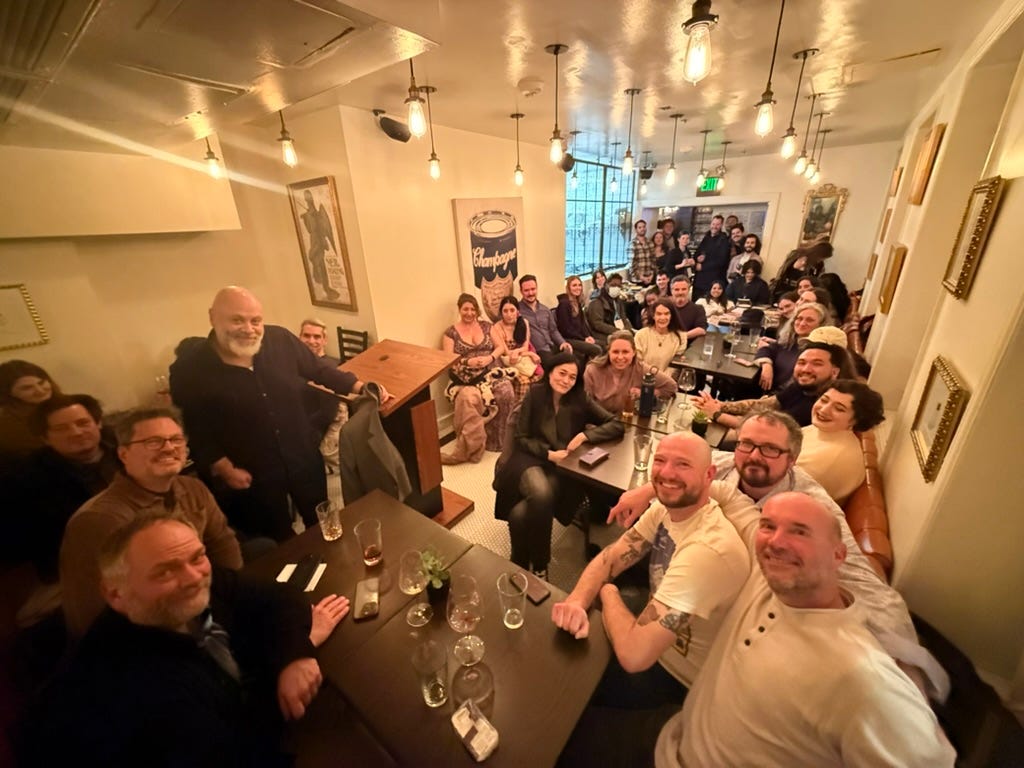
After Dan Wickett passed away this past year, Dzanc publisher and editor-in-chief Michelle Dotter and Dzanc author Robert Lopez organized a celebration of life for Dan for this year’s AWP. It was a beautiful night, one I wish Dan could’ve been to see, just so he’d know much we all loved and admired him. People told stories. People read pieces Dan had loved or published. I did some ugly crying at the podium. There were so many people in the room whose books I’d edited or otherwise worked on, during my time at Dzanc. The people in the picture above have been so important to my literary life. Almost no one was more important to it than Dan. I’m so grateful we had the chance to celebrate him and his legacy, and so thankful to Michelle and Robert for bringing us together.
On Saturday, I visited the American Visionary Art Museum with two old grad school friends, Bess Winters and Woody Skinner, where we walked the galleries and talked about making art and caught up on my life. AVAM is one of my favorite museums, and it was so good to be there again with two of my favorite people. I’ve been three or four times over the past 20 years, and I always leave wanting to go make better, weirder, more obsessive art. In the permanent collection is a piece called “Applewood Figure,” made by an anonymous artist in 1960. The placard beside it reads:
This graceful lone figure is carved from a single apple tree trunk. It was created as a self-portrait by a British mental patient who had a distinctive concave chest from years of tuberculosis. The artist was a patient of pioneering British art therapist, Edward Adamson, at Netherne Hospital. Adamson remembers that the patient took no interest in making art until he encountered this fallen apple tree during a walk of the hospital grounds and asked for help in dragging it indoors and with getting simple carving tools. This ethereal figure stands 5’ 7” tall. The young artist, still in his early thirties, committed suicide about two years after leaving hospital and is not known to have made any other art.
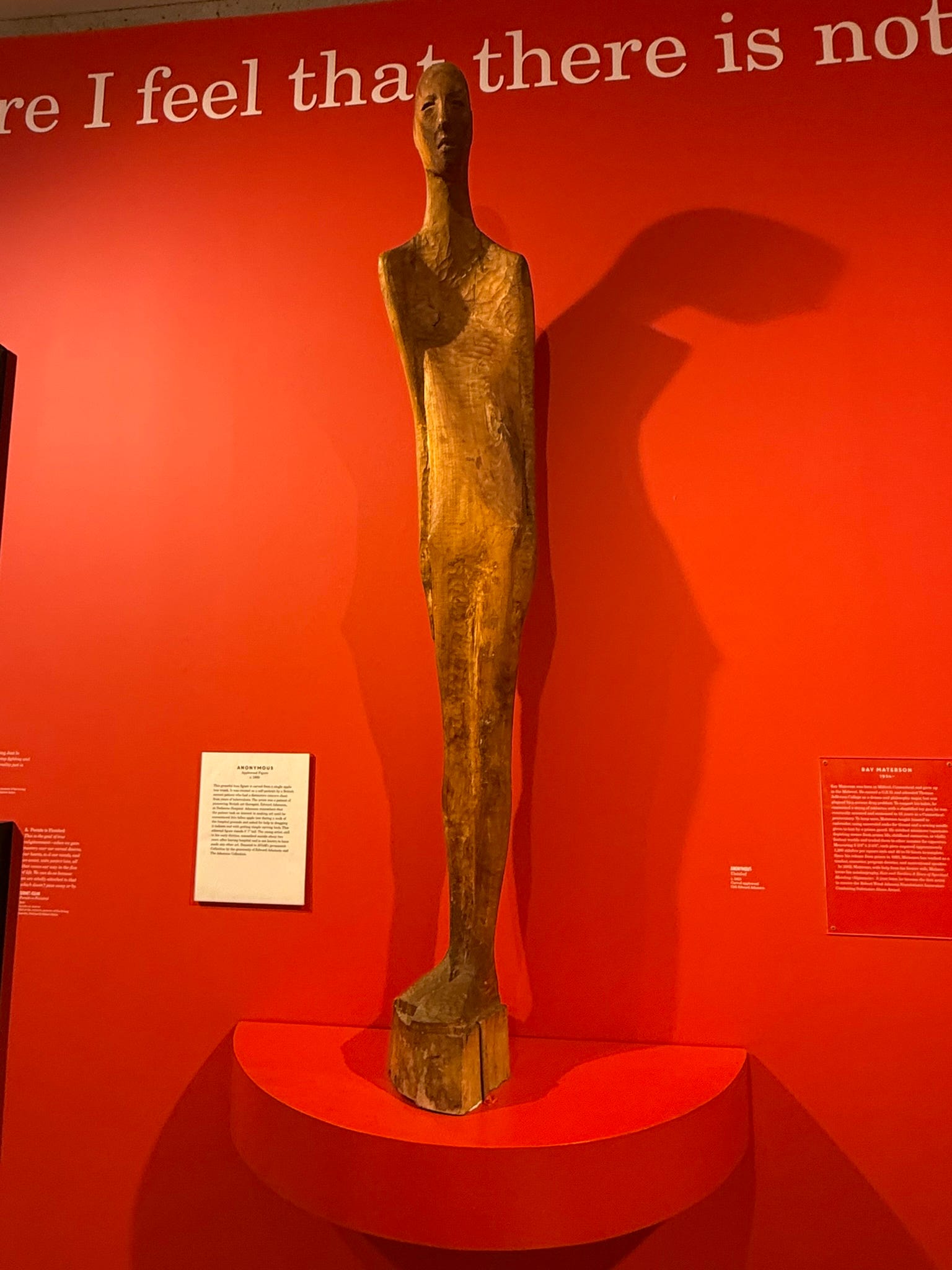
It’s such a haunting and beautiful self-portrait! I first saw it while I was in grad school, and in the fall of 2009 (I think!), I wrote a story inspired by it called “Walker, Wallace, Warren,” part of my novella Cataclysm Baby, an abecedarian of post-apocalyptic parenting stories now collected in my A Tree or a Person or a Wall. Having just seen “Applewood Figure” again, I decided it was a good time to reshare the story it inspired:
Now to make a memorial, a memory meant to outlast those recently gone from my head, lost through the holes eaten by this new wind blowing across my farm, bleached blank by the cloudy water that climbs thick and sluggish from my well. In goggles and duster, I gather my tools, go out of the house and into the ashy remains of the yard, this family orchard once lush and full of apples.
And all around me: Only stilled wood, dead branches over dirty ground. Only this lonely world grown atop my buried children, my planted wife.
With awl and adze, with hammer and chisel, I carve my oldest out of the first tree. I remake him as best I remember, shaping the roundness of his cheeks, grooving out the spaces between his teeth and toes.
When I am done, I fill my ears with my fingers to hold in the sound of his voice, the last words he said to me before we lost him. I clench my eyes so his image might not get diffused by the weak sunlight poking through my goggles, a dimness forever threatening to steal him from behind my lids.
Across the orchard, it takes weeks to rough in his sister and his sister and his brother and his brother. Upon a lightning-split husk, I stencil the twins that followed, then whittle out the other babies impossible to call boys or girls, their flesh too bent and broken upon their bones to name.
Our last child, the one birthed runny as yolk, I do not carve it at all. I haven’t the talent to make its nothing form out of wood, haven’t the strength to try.
On the first day of fall, I cut my wife’s body free of the centermost trunk, using my tools to re-create the inverted ribs of her diseased chest, the long-ago smoothness of her oft-emptied belly. With every skill I’ve learned, I remember her upon the wood: Her eyes exactly the proper shape and size, exactly the right tilt to complement the laughing smile last heard too long ago. Her nose alone I work on for days, slicing curl after curl off the bridge until it is the same nose whose tip I kissed goodbye every night, even at the end, when there was so little of it left. I spend a week curving bark into hair, and then a month carving her favorite blouse, the many folds of its matching skirt, both worn the sun-drenched day we were wed.
And then believing myself done, every cut and carved son as partially complete as he was in life, every doomed daughter dancing in wood around the figure of my long-missed wife.
And then waking to forgetting her name. And then forgetting all their names. And then wishing I had carved those syllables into the trees, so I might know which child is which.
And then telling myself it doesn’t matter, that their names are not important.
It was not their names I loved. It is not their names I miss.
Another weird wind blows, and then it is winter. And then there is me, no longer remembering any day when it was not winter. And still this project, seemingly unfinished: Always some new detail for me to add, some torso to reshape or dimple to correct. Some finger needing a nail, some foot needing the rest of its toes—because surely a child would have ten toes, ten fingers? Surely every child would have hair and eyes and ears and a nose?
Surely no child could be as incomplete as these?
And then one day berating myself for the lack of skill that left them ugly and warped, rent and ruined.
And then who are these people.
And then who am I to them, these ten perfect children made of trees, this one woman grown out of the applewood to raise them.
And how I wish I could join her. And how I wish I could be the father and she the mother and all these our children, so that none of us would be lonely again.
And how sure I am that whoever made them is not the good one who made me, because who would be so cruel as to keep us apart, with this unbearable distance between wood and flesh, this unchangeable differential of atoms.
All winter long I brush the snow from off their faces, so that I might study each one in turn, so that I might practice falling in love with them, as some father must have done, so long ago.
When the snow finally melts, see then this improbable sight, sprung forth from the palm of some unrecognizable child: some new leaf, some green branchlet blooming.
See now how I hold it in my fingers. And how I let it lay its buds across my palm. And how every day I think again I might pluck its growth free of the trunk, so that its fresh promise might tease me no more.
Thanks for reading, friends! Have a great month!

Thanks so much for reading! If you’re not already subscribed, please consider doing so by clicking the button below.
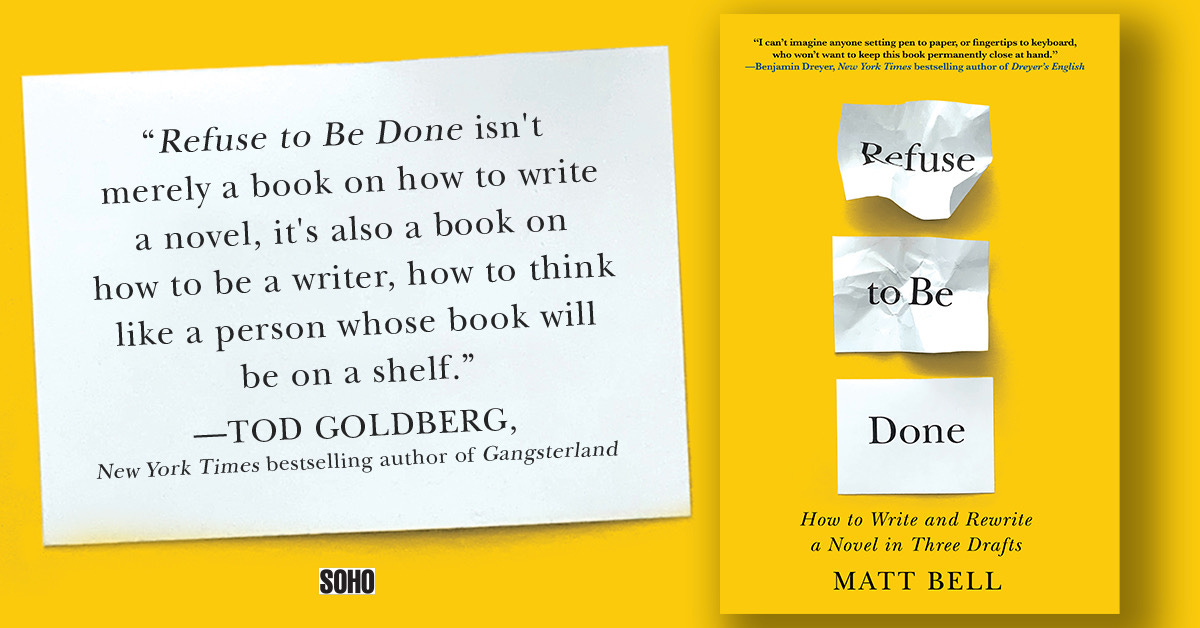
Matt Bell’s novel Appleseed (a New York Times Notable book) was published by HarperCollins in July 2021. His craft book Refuse to Be Done, a guide to novel writing, rewriting, & revision, is out now from Soho Press. He’s also the author of the novels Scrapper and In the House Upon the Dirt Between the Lake and the Woods, as well as the short story collection A Tree or a Person or a Wall, a non-fiction book about the classic video game Baldur’s Gate II, and several other titles. His writing has appeared in The New York Times, Esquire, Tin House, Conjunctions, Fairy Tale Review, American Short Fiction, and many other publications. A native of Michigan, he teaches creative writing at Arizona State University.
Comments
Nothing yet. Say the first thing.
Sign in to join the conversation.