
Over the years, I’ve developed a party trick of telling little-known stories of the origins of synagogue melodies
I know, it’s not as thrilling as ventriloquism or doing handstands. It just goes to show you what kind of parties I usually attend.
Nevertheless, this summer I had the opportunity to turn my casual interest into some actual scholarship. Published last week in Masorti Journal (Vol. 70), I have completed a new article which charts the music of Conservative Judaism, largely via the genealogy of its core synagogue melodies.
Here’s the link to read it: https://masortijournal.org/where-the-tunes-come-from/
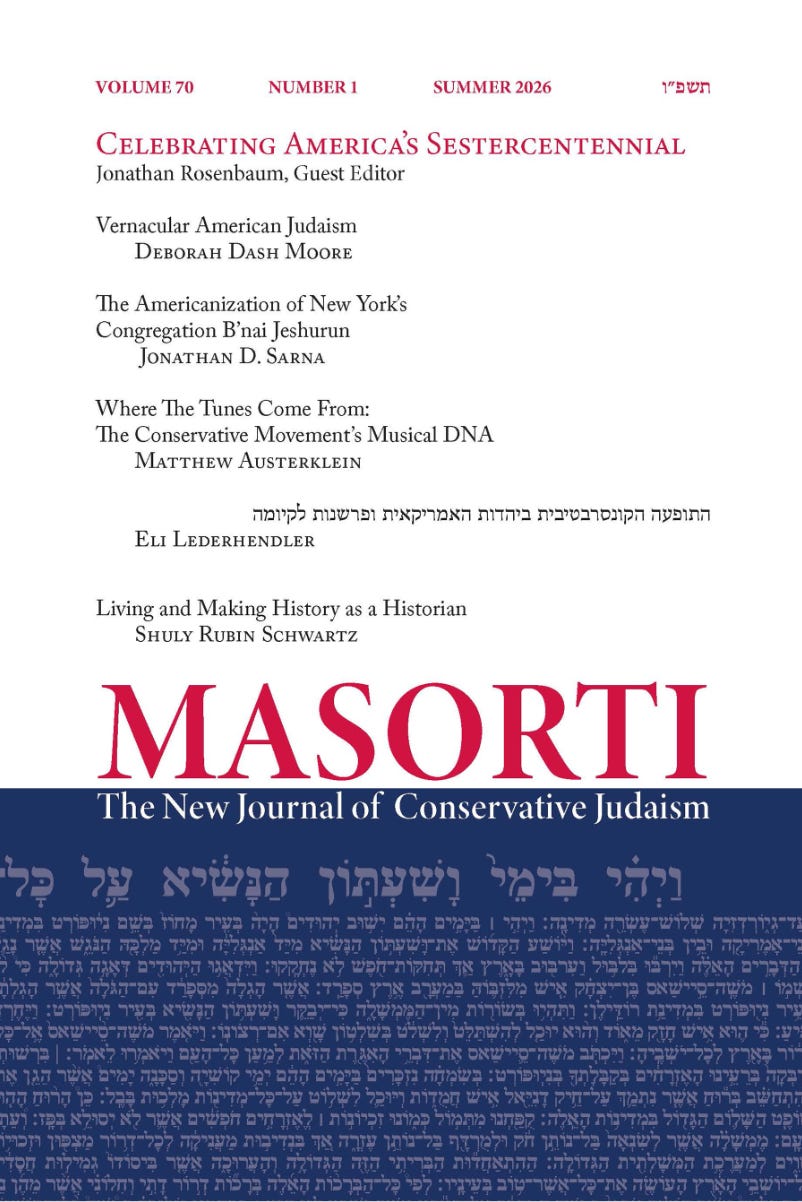
Those of you who follow this Substack will recognize several stories within which I have explored here over the past few months. This larger article puts them in much broader context, exploring the many layers of musical development which reveal Conservative Judaism’s history and its musically-implicit commitments.
This full issue of Masorti is also open access and and fully readable online. There’s a lot of food for thought.
Those of you who would like to download the PDF, either of the article or the entire journal, you can do so here.
As I mention in the article: I am sure that I will leave out some melody that is considered, in some circles, an essential part of the Conservative musical canon. In such a case, I am consoled by the prospect that the aggrieved reader will write me with their musical objections, and thereby I will learn more of the larger story of which we are both a part.
To every reader, I offer the same assurance that I give to my congregation: “I want you to know that all of your tunes are “the right ones.”
Enjoy.
[ERRATA]:
Rabbi Moshe Pomerantz, the composer of the famous Ahavah Rabbah at Camp Ramah in Connecticut, was born in 1934, not 1935. See Figure 9.
Chazan Jaclyn Chernett studied with Chazan Stephen Robins and others cantors in the UK for many years. She then studied with Cantor Sol Zim and Cantor Ken Cohen in New York, ultimately receiving her ordination from the Academy for Jewish Religion.
Nurit Hirsh composed the famous “Oseh Shalom” for the 1969 Hasidic Song Festival, not the 1977 one. Additionally, the winner of that year (1969) was Tzam'ah Nafshi by Rabbi Pinhas Kehati.
No posts
Comments
Nothing yet. Say the first thing.
Sign in to join the conversation.