

Conspiracy theories are all the rage nowadays. The rise of extremist politics and online culture have encouraged more and more trafficking in this responsibility-jettisoning practice which allows us to spin tales about forces beyond our control.
Such magical thinking is the tragically normal result of human pattern perception —”our brain’s tendency to connect the dots, even when those dots are unrelated. It’s an ancient survival tool which helped our ancestors avoid predators. But today, this same strength can also confirm our biases or, as with many of today’s mass movements, our worst inclinations.
Judaism has very little patience for conspiracy. That is because it is a religion that fundamentally sees itself as having agency — not as the tragic subject of another’s machinations, but as spiritually independent and subject to God alone. As Mijal Bitton points out regarding the Jewish observance of Tisha B’Av:“
Agency, it turns out, is a strange kind of resource. Wherever you place it, that is where the power in your story lives. Place it with Rome, and you have written yourself a tragedy in which you are the scenery. Place it within the covenant, and you have written yourself an audaciously hopeful claim: Our choices moved history, and they can move it again.”
Nevertheless, there is one conspiracy theory which I can confirm is widely held by North American Jews: the three sh’mo conspiracy. That is to say — the theory that the traditional melody for the end of the aleinu prayer hides a secret concession to Christianity.
This is how the story goes:
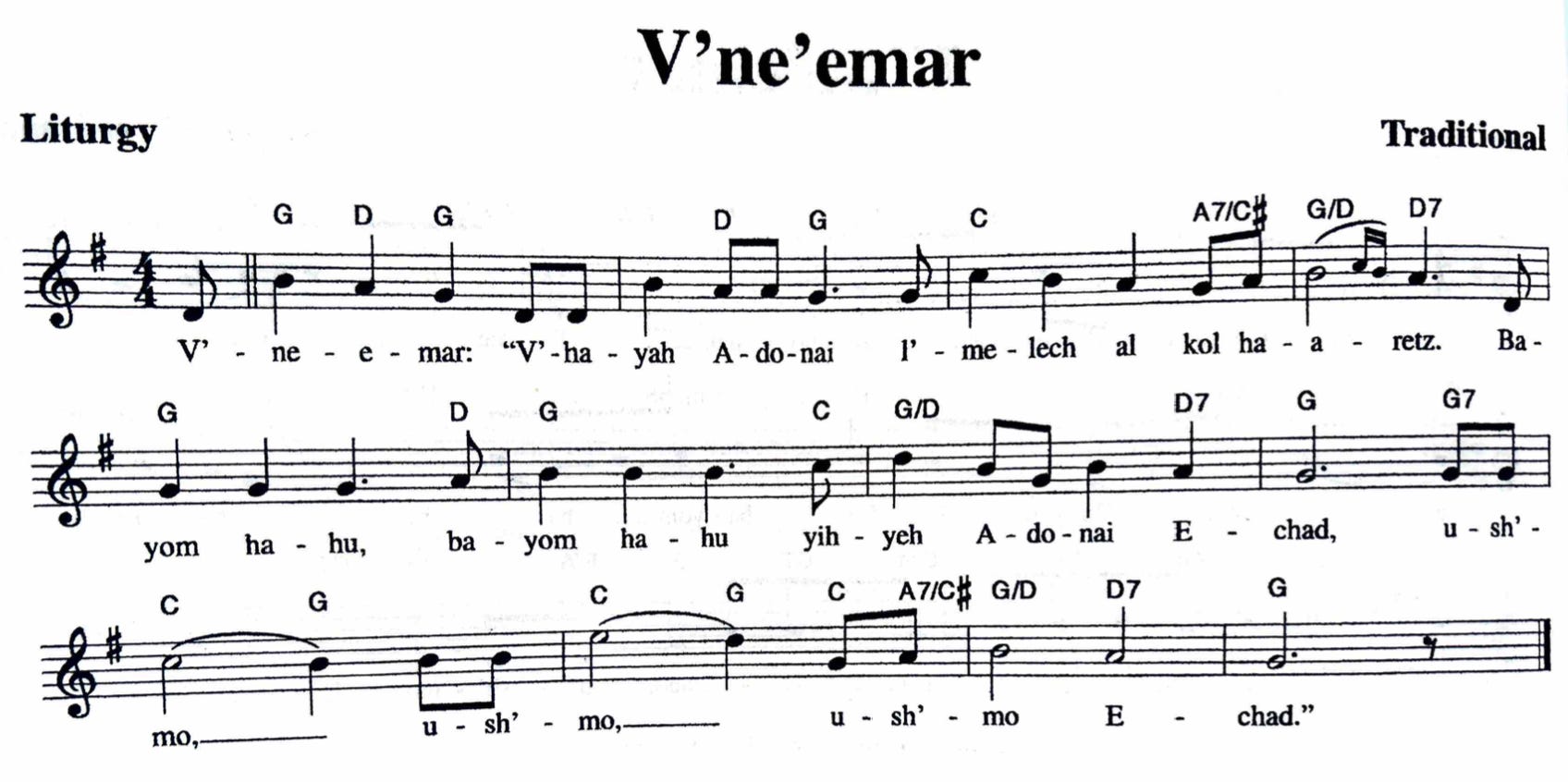
The final line of the aleinu prayer reads as follows:
וְנֶאֱמַר וְהָיָה ה׳ לְמֶֽלֶךְ עַל כָּל הָאָֽרֶץ בַּיּוֹם הַהוּא יִהְיֶה ה׳ אֶחָד וּשְׁמוֹ אֶחָד
“And it is said: And the LORD will be King over the whole earth; on that day the LORD will be One and His Name One.”1
The traditional American melody, as transmitted orally over the decades, repeats the penultimate word ush’mo (“and His Name”) three times, so that the musical setting ends up conveying the sentence: “and His Name, and His Name, and His Name — is One.” Interpreting this liturgical word repetition as the implicit the address of three different divine entities, the Hebraically-oriented Jew is seized with fear that this could be seen as an acknowledgment of the trinity — the Christian conception of a triune God comprised of the Father, the Son, and the Holy Ghost.
This issue has been the basis for much Jewish wailing and gnashing of teeth. My colleagues tell stories of prayer leaders and ritual committee members demanding the abandonment of the melody due to its theological implications — even adding new layers of conspiracy that the repeating of “bayom hahu” (and on that day) indicates the Christian concept of the Second Coming. Many synagogues who retain the tune employ a different number of “sh’mos” — one, two, or even four — and thus avoid the problem. But many non-Orthodox synagogues simply embrace the three sh’mo version, leaving such theological speculation for the synagogue parking lot.
This liturgical conspiracy, founded on the assumption that the musical repetition of these words conveys Christian theological precepts, is a fallacy which reveals more about Jewish anxieties than anything else.
So let’s debunk this conspiracy, and then go deeper to the heart of the matter.
The fact is that none of the original versions of this melody include the triple repetition of the word “ush’mo.” Its earliest printing, attributed by Rabbi Israel & Samuel E. Goldfarb to themselves in their religious school music textbook The Jewish Songster (1925), includes four repetitions.2 The final sh’mo forms a plagal cadence, also known as the “Amen cadence” for its prevalent use at the end of hymns. Considering the piece in light of the American hymn culture into which the Goldfarb brothers were adapting Eastern European synagogue music, the four-shmo conclusion becomes a legible, original expression of the musical spirit of the age.
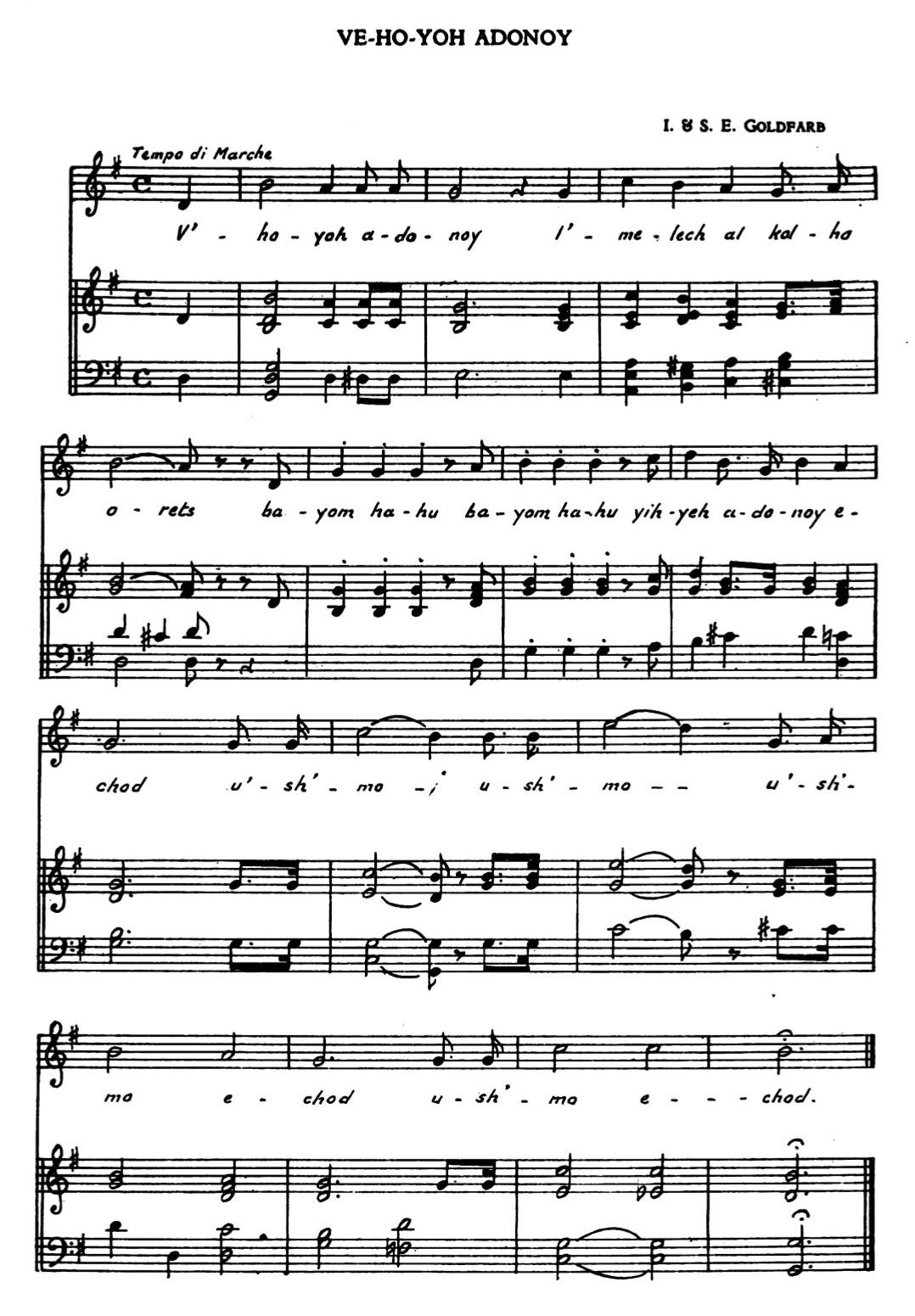
Yet neither the composer’s attribution nor the form of the melody was to remain constant. In the Goldfarbs’ next volume, Synagogue Melodies for the High Holy Days (1926), the composer is listed as Rabbi Israel Goldfarb alone, perhaps indicating that his brother Samuel had previously provided only the piano arrangement. The quantity of ush’mos too went down dramatically — from four to only one.
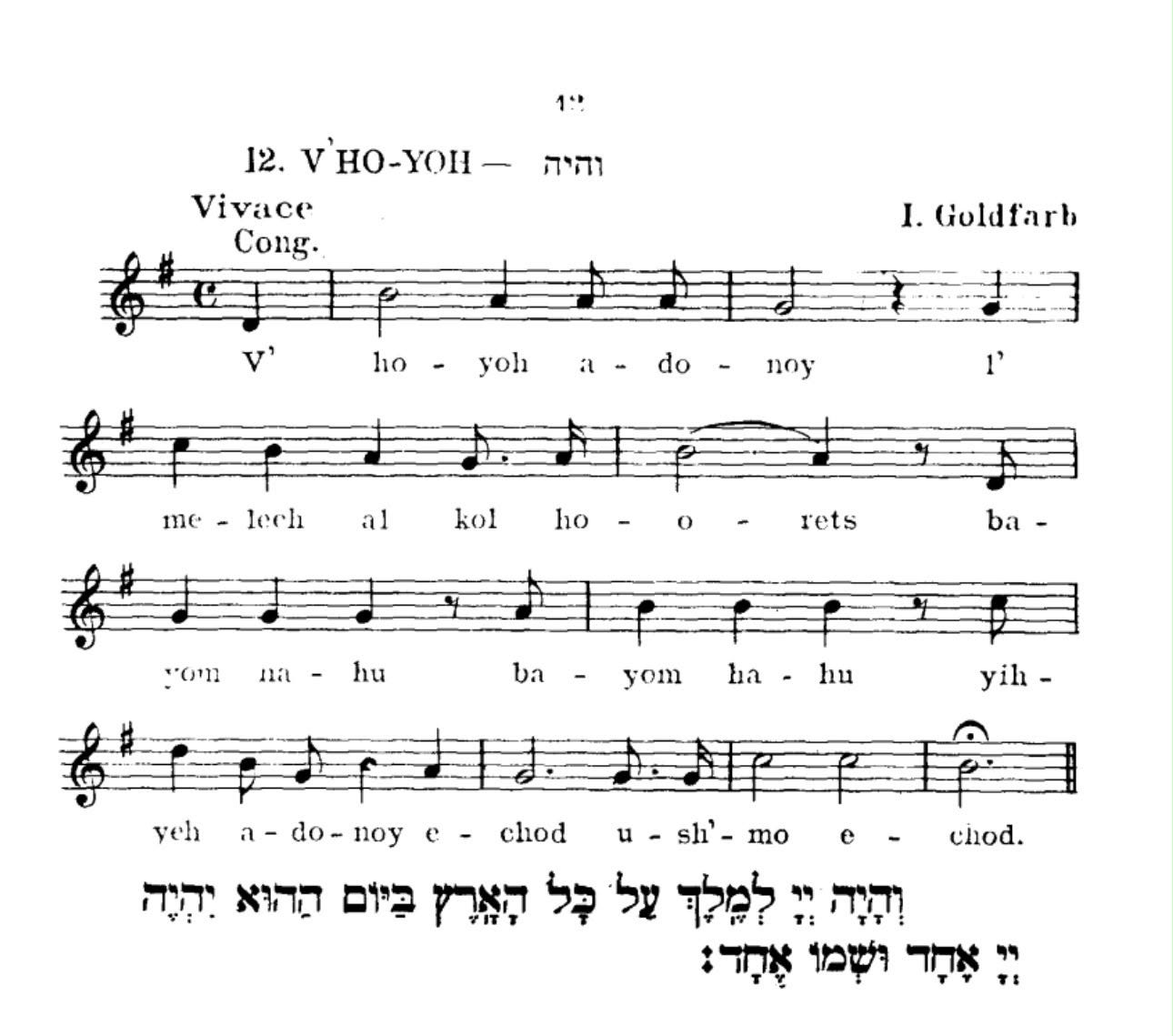
This musical change may have had several purposes. The audience of the volume differed from its predecessor, serving as a congregational hymnal rather than a music book for Jewish schools. The editors thus might have been opting for a repetition-free version that could be easily conveyed without piano. The High Holy Days also feature very long services, and the one-sh’mo version may have been an abbreviation for time. Or, perhaps, halachic or theological issues associated with repeating this word may have already caught up with Goldfarb, leading him to quickly abridge the melody.
Synagogue regulars will also notice that both publications omit the first liturgical word, v’ne’emar, typically included in this tune today. This practice first pops up in Moshe Nathanson’s Manginoth Shireynu (1939), in which v’ne’emar appears as a cantorial “solo” prior to the congregation’s entrance with the standard tune. Nathanson’s broad impact on Jewish music, including via synagogues, Jewish summer camps, and the Board of Jewish Education, may have influenced the eventual adoption of this “solo” measure as an integral part of the congregational melody.
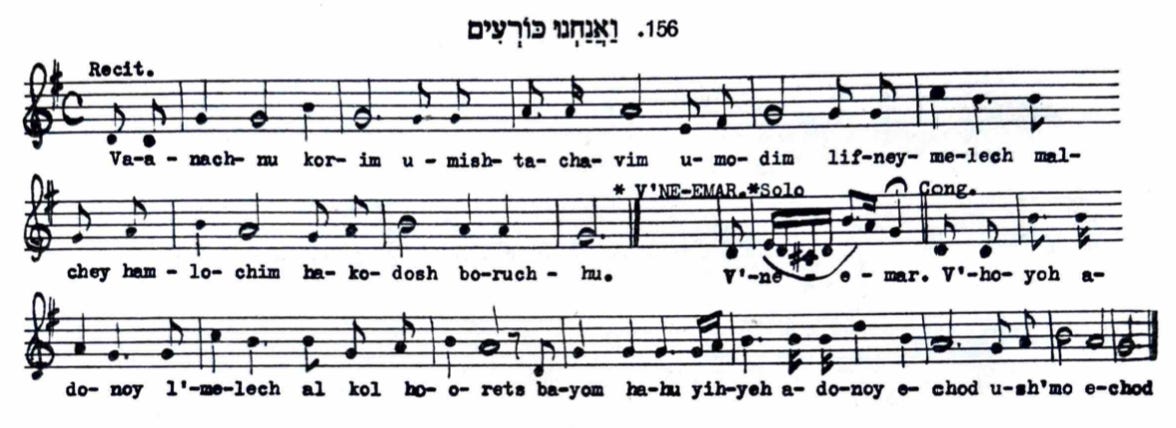
However, Nathanson presents a conundrum regarding composer attribution. In his later anthology of congregational melodies, Zamru Lo (1955), Nathanson lists the melody’s composer as Sigmund Sabel (1849-1924), the Jewish freemason and organist who also wrote the famous opening to the aleinu prayer.
Without earlier musical documentation, it is difficult to determine the composer with certainty, but Rabbi Israel Goldfarb seems the more likely candidate. Sabel would have been known to both Goldfarbs; while they were young students building the Jewish congregational singing movement at the turn of the twentieth century, Sabel was already in middle age, established as a composer and musician for Jewish settlement houses, orphanages, and masonic lodges in New York. The Jewish Songster, published by the Goldfarbs in the year after Sabel’s death, attests this knowledge by correctly attributing the aleinu melody to him. Nathanson’s knowledge of Sabel, on the other hand, was more removed, as he arrived in New York only two years before the composer’s passing. So it is perhaps via Nathanson’s ignorance that all of the aleinu melodies — aleinu, va’anachnu, and v’ne’emar, which flow so beautifully together in synagogues across the world — were first attributed to Sigmund Sabel.3
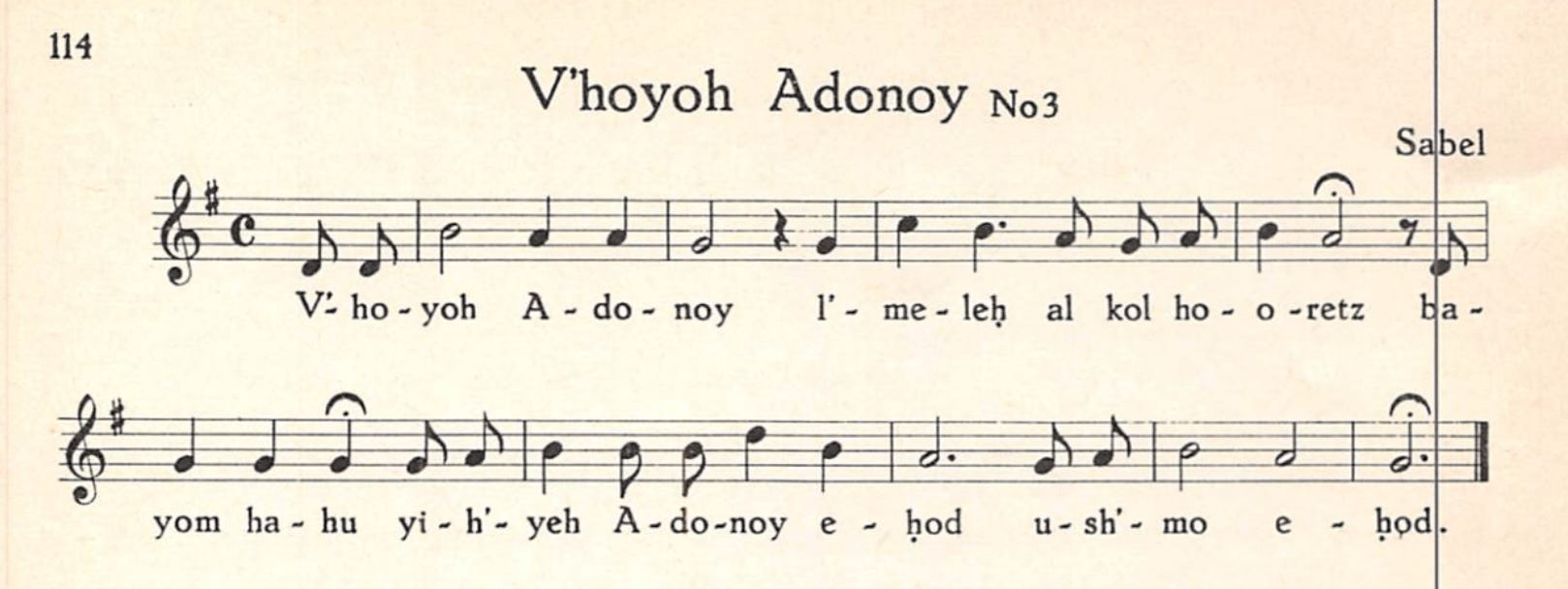
No matter how many ush’mos you prefer, the historical record makes plain that it was neither the composer’s intention to have three, nor to cause worshippers theological anxiety. Our reception of the tune with three sh’mos is a likely result of the popular adaptation of the melody in its most transmissible form. It is the daughter of time, as is our creation of the Christological myth surrounding it.
Yet debunking this myth of surreptitious Jewish musical trinitarianism is not sufficient. The question is what lies beneath. As Hussein Aboubakr Mansour keenly points out:
“Debunking is an adolescent intellectual activity, thrilling but impotent. But a genealogy is nonetheless worth tracing, even if we concede, as we should, that origins should never be treated as exhaustive explanations, because it helps reveal what the idea was built to do, what it replaced, what it does achieve, and what it may inadvertently conceal even from those who love it most.”4
So let us trace the Jewish theological anxiety of this melody, and see what it achieves, replaces, and conceals.

Conspiracy thinking surrounding this melody may also be due to one Jewish generation’s particular experience with Christian evangelism.
Attending Jewish youth group at the turn of the 2000s, I keenly remember visits from a counter-missionary group called “Jews for Judaism.” This organization was founded in 1985 by Rabbi Benzion Kravitz as a way of counteracting the activities of the Christian missionary organization, “Jews for Jesus,” which attempted to convert Jews with its syncretistic message. They warned us that these missionaries might attempt to prove the merits Christianity by invoking the three sh’mos conspiracy as proof of the trinity’s presence within the Jewish service. It seemed incredulous. But such a claim says more about the thin knowledge and religious literacy of many American Jews than the music itself.5
Jewish anxiety about the repetition of words as a sign of theological heresy has an old pedigree, going back to the rabbinic period. The Talmud cites that “One who recites Modim, modim is silenced…because it appears that he is praying to two authorities (BT Berachot 33b).” For the rabbis of Babylon, this was likely from fear of Zoroastrianism, whose idea of two powers in heaven was prevalent in Sasanian Persia. The Mishnah’s earlier comment is likely referring to other sorts of heretics, like gnostics and Christians. Early Christianity, after all, was comprised largely by Jews, with many converts to the new movement that preached in synagogues and served as prayer leaders. This led eventually led to the composition of the blessing against heretics (birkat haminim) by Shmuel HaKatan in the late first century, attempting to delineate the theological boundaries of the emerging rabbinic movement.6
In more recent memory, Jewish anxieties surrounding liturgical word repetition have served to affirm pietism and police new aesthetic movements. With printing and standardization of the prayerbook in the sixteenth century, rabbis created increasingly complex meaning systems around the fixed words, developing complex mind maps of mystical intentions with important theurgical stakes. At the same time, the standardization of the prayerbook dried up the need for new poetry, leaving music as the primary outlet for liturgical creativity. Thus musical experimentation and kabbalistic precision went to war, with cantors stuck in the middle. The repetition of words thus initially came to represent liturgical malpractice over covert heresy, condemned by centuries of rabbis as the indulgent, musical trampling of mystical precision.7 Yet Ashkenazic cantors never gave it up — whether for the sake of music or for the authentic outpouring of religious emotion.
What to make of these aleinu anxieties? The believing kabbalist could make the case that avoiding repetition is of the utmost importance, preserving our spiritual secrets and universe-saving devotions. The litvish rationalist will point out the infelicities of such repetitions in creating nonsensical or even heretical sentences, like the three ush’mos themselves.8
Yet for me, the main lesson is one of intention. In the Talmud, the Kabbalah, and our own legal system, intention matters. If we are so brittle so as to easily reduce our liturgical music to surface misunderstandings, then our prayer life is shallow indeed.9 It is the soul of the words, what goes on beyond the music itself, that we should truly be anxious to discover. As Rabbi Heschel taught:
“Yet, what is the nature of kavanah or inner participation? Is it paying attention to the context of the fixed texts? Thinking? Prayer is not thinking. To the thinker, God is an object; to the man who prays, He is the subject. Awaking in the presence of God, we strive not to acquire objective knowledge, but to deepen the allegiance of man and God. What we want is not to know Him, but to be known to Him; not to form judgments about Him, but to be judged by Him, not to make the world an object of our mind, but to let the world come to His attention, to augment His, rather than our knowledge. We endeavor to disclose ourselves to the Sustainer of all, rather than to enclose the world in ourselves.”
In short, if we are worrying about sh’mos, we are missing the whole point.
My sincere thanks to reader Kevin Longobart for alerting me to these sources from the Goldfarbs.
The origin of the second melody is likely an adaptation of a Salmon Sulzer composition. For a new biographical look at Sigmund Sabel, see my article from last week:
A rabbinical faculty member at my seminary once posited to me that it was partially the trinitarian claims of Christians which caused the rabbis to institute the recitation of the kedusha desidra — a study-based liturgy featuring the words “Holy, holy, holy!
LORD of Hosts—Whose presence fills all the earth!” (Is. 6:3). The kedushah desidra explicates each prophetic iteration of “holy” as having a specific referent, excluding the Christian interpretation. Interestingly, the Talmudic rabbis claimed that the recitation of kedusha desidra is one of the things keeping the world from destruction (cf. Sotah 49a).
cf. BT Berachot 28b-29a.
This is largely addressed in my PhD dissertation, “The Professionalization of the Ashkenazic Cantor in East-Central Europe, 1500-1750,” Halle-Wittenberg University (2026).
Another famous word-repetition failure comprises a well-known joke in cantorial circles:
HAZZAN: V’hu rachum, viychaper avon.v’LO Yashchit. (He is merciful and forgives sin, and will not destroy…)
CHOIR responds in harmony: ….YASHCHIT! (He will destroy!)
This is true also in the formation of Jewish law. To paraphrase Rabbi Ebn Leader, a good posek is one who asks a person what they think they are doing — i.e. their intention — before passing judgment.
No posts
Comments
Nothing yet. Say the first thing.
Sign in to join the conversation.