
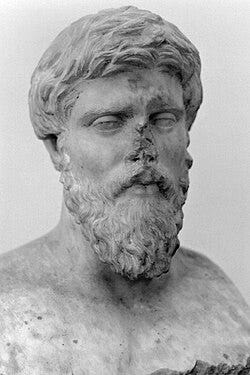
“It is so hard to find out the truth of anything by looking at the record of the past. The process of time obscures the truth of former times, and even contemporaneous writers disguise and twist the truth out of malice or flattery.”
-Plutarch, The Life of Pericles
During my last three years of weekly writing, one story has never been far from my mind: the celebrated yet clouded biography of Salomon Sulzer, that legendary first modern cantor whose life spanned the full blossoming of Jewish Emancipation in the Austro-Hungarian Empire. His death in 1890 came after decades of astronomical accomplishment, overseeing the modernization of the Western European cantorate during his lifetime and largely in his own image.
Now, I’m trying to recognize the true man behind the long shadow he cast over my profession. To date, I’ve already spilled much digital ink Sulzerian subjects:
Sulzer as an art song composer and his parallels with Goethe (5.11.26).
The history of modern Sulzer scholarship (3.23.26).
Sulzer’s meaning in the eyes of his Christian contemporaries (2.9.26).
Sulzer’s political music & activities during the Märzrevolution of 1848 (2.8.24)
Yet now, I am curious to get down to the biographical truth of the man. This is especially difficult due to the dense forest of hagiography surrounding his life story. Both the utility of Sulzer’s career to modern musical agendas and his own carefully orchestrated narrative of personal greatness have made separating fact from fiction a formidable challenge.
The problem derives in no small part from the fact that his career was of interest not only to Jews, but to Viennese society at large. Sulzer’s synagogue service was celebrated as a tourist attraction within five years of his arrival, as documented in this article from foremost musical periodical in the German-speaking world, the Allgemeine Musikalische Zeitung (Sept. 22, 1830)1:
“A visit to the Jewish house of worship on Sabbath evening should offer every music lover a rare and special interest. Apart from the fact that the magnificent temple itself, a tastefully and simply decorated rotunda with two stories, is impressive in and of itself, the highly dignified ceremonies are also of a kind that evokes the most sublime religious feelings….
However, the most surprising impression is made by the musical part of the service. The lead singer, Mr. Sulzer, a young man who is also prefect of the entire vocal choir and teacher of the music students, has one of the most beautiful baritone voices: soft and flexible in all gradations, from the softly breathed pianissimo to the resounding forte, with a range of one and a half octaves, every note is a bright, resonant ore.
Among the boys, one believes one hears true angelic voices, and equally admirable is their firm intonation, as well as their sureness in responding, even to the most unusual deviations. In addition to the prescribed psalms based on the original melodies, the artistic directors…have invited several other composers to contribute to this institution, and thus its archive has already been enriched with valuable compositions by Schubert, Würfel, Gyrowetz, Drechsler, Seyfried, Fischhof, and others, which are as appealing due to their antique-oriental style as they are due to their wonderfully moving performance, and in every respect offer a completely individual artistic experience, which locals rarely miss, and which inquisitive foreigners of all nations consider among the most interesting curiosities of the imperial city.”
From his abode in the political and musical capital of the Austrian Empire, Sulzer used his fame as an art song singer, community leader, and delightful musical curiosity to build his imperial reputation, particularly through the success of his first published work, Schir Zion.2 After forty years in his position (1866), Jewish writers and cantors penned numerous biographical sketches to celebrate his achievements and career.3
Today, I’m going to show you what I believe to be the very first major piece of Sulzer hagiography, dating to a critical juncture in both his career and the ultimate trajectory of Viennese Jewry under liberalism.
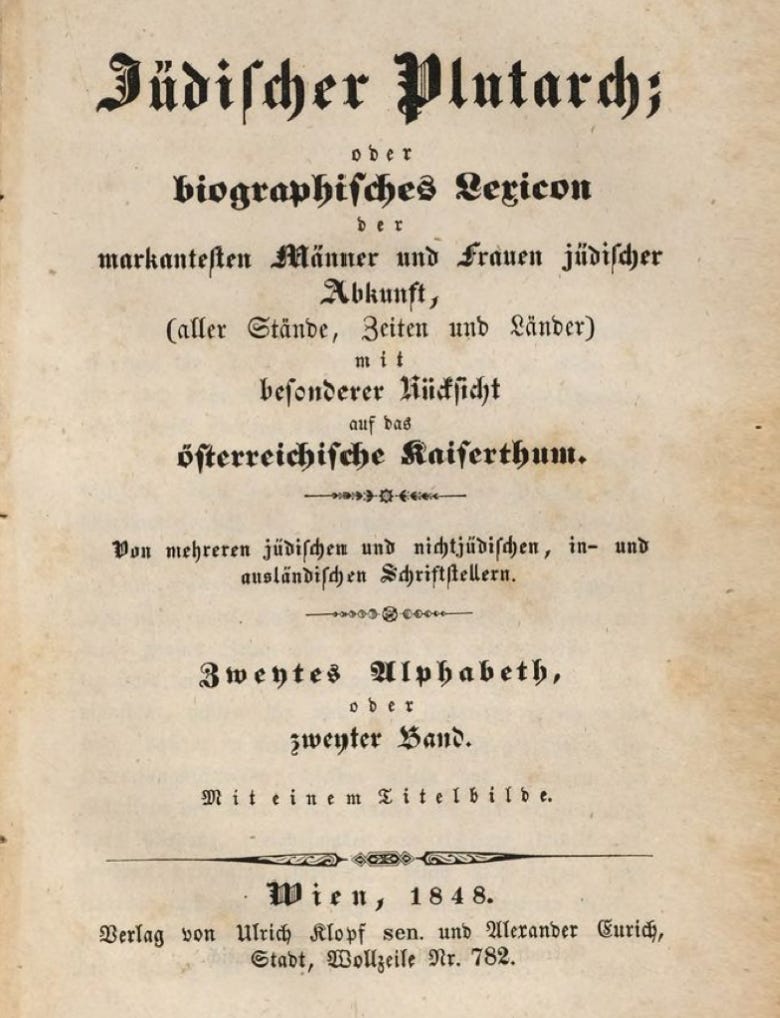
This curious two-volume set is entitled Jüdischer Plutarch (“Jewish Plutarch, OR a biographical lexicon of distinguished men and women of Jewish parentage (of every rank, era, and land), with special consideration for the Austrian Empire, from diverse Jewish and non-Jewish sources, both foreign and domestic.”)
Such a title naturally derives its meaning from the works of the Greco-Roman philosopher Plutarch (50 CE - c. 120 CE), well-known amongst the classics for his book Parallel Lives, a collection of biographical sketches of famous Greeks and Romans written for the moral edification of his society.4 So too, editor Simon Deutsch sought to depict accomplished Jewish personalities, including rabbis, musicians, actors, writers, philosophers, and magnates, implicating their biographies as a similar source of moral uplift for the Austrian public.
Published, as the preface explains, “in the Spring of 1848,” the book was generated in the hopeful throes of Jewish emancipation leading up to the Märzrevolution. This critical juncture in Viennese Jewish history saw crowds across the city protested against the conservative regime of Count Metternich and patriotically demanded universal basic rights. After a short confrontational period, the government and Emperor ultimately capitulated and offered equal rights to all religions, including — finally — to the Jews of the Austrian Empire.
It was this moment for which Sulzer and his community had long awaited, operating as an unofficial community under the Toleranzpatent for several decades. Sulzer had played his part well during this time, producing the aesthetics of Jewish emancipation long in advance of its political arrival. The critical year of 1848 saw Sulzer at his most prolific, producing patriotic hymns and street songs for the Austrian public and the “legion” of revolutionary university students. When a Jew, Spitzer, was killed along with five others at the barricades on the 13th of March, Sulzer and his rabbi, Mannheimer, accompanied the city’s priests and dignitaries to the Schmelzer Cemetery on March 17th, officiating on equal footing with their Christian fellow citizens. This final arrival of full political rights for Jews was the culmination of the first half of Sulzer’s career; it is no wonder that the editors of Jüdischer Plutarch put him on the cover of their second volume.
The trouble with researching a legend is that you’re faced with just that — legends.5
While this particular work leaves out many of the more dramatic stories of Sulzer’s youth which would characterize later biographical sketches and personal recollections, it is fundamentally a work of hero worship (as the author is not shy to admit) in service of the nearly-fulfilled promise of Jewish emancipation. Deutsch’s piece also conflicts with later biographies (Kulke, Tänzer) on a number of points, including on whether his young trip to Karlsruhe was for yeshiva or musical studies.6 But most of all, it demonstrates how celebrated Sulzer was among his dense network of admirers, and how his story functioned as one of many which legitimated Jewish participation and rights in a liberal society.
So enjoy this story — even if it is the stuff of legend.
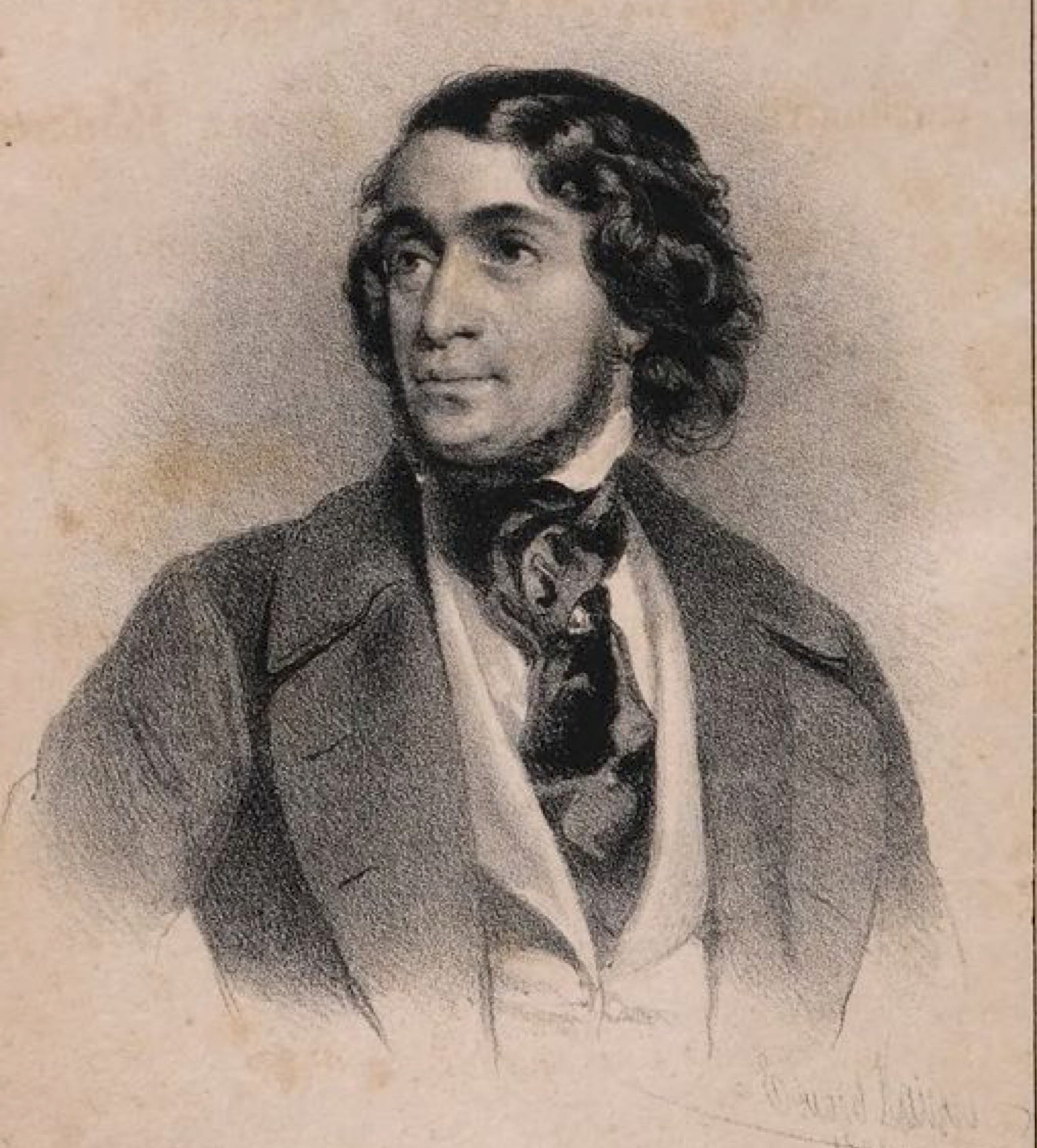
“A Priest of God Most High” (1. B.M.)
Around the first half of the last century, the Jews were expelled from Sulz and, through the intervention of their former leader, received asylum from Count von Hohenems in Vorarlberg. In remembrance of this expulsion, the grandson of this man called himself Sulzer — the name of our hero, who was born in Hohenems on March 30, 1804. His parents, who were among the most honorable and respected members of the community, had initially destined him for a career in commerce; however, after being miraculously rescued from a flood in his early youth, his pious parents dedicated their son, whom God had now given them a second time, to religious service.
To obtain an Jewish position, he was encouraged to diligently study Hebrew and rabbinic literature, which he pursued rigorously at the rabbinical schools in Hohenems and Karlsruhe. Besides their studies, the [Sulzer[ boys exhibited an irrepressible love for musical art at avery early age, which had such an influence on him that he devoted himself exclusively to music, pursuing it with such diligence and zeal that, as a fifteen-year-old boy, his talent enabled him to hold the position of cantor in his hometown; and he distinguished himself so greatly in the rigor of his official duties, that he soon became the darling of his fellow citizens, who called out their warmest congratulations when, after five years of service, he received a reputation worthy of his talent and knowledge as cantor of the Jewish congregation in Vienna.
In Vienna at that time, the local Jews organized themselves into a community, built a magnificent temple, and secured the most splendid and brilliant orator among the Jewish theologians, Mr. [Isaac Noah] Mannheimer, for this new institution. Through the acquisition of our Sulzer, they added such an ornament to their synagogue that it still adorns and glorifies itself today. Sulzer not only performed the duties of a cantor but also actively assisted in establishing a contemporary form of worship, which was all the more difficult at that time because the young community had as many differing opinions as it had members. His rich, resonant voice (in the noblest sense of the word) and his enthusiastic and inspiring delivery truly contributed significantly to achieving unity.
Sulzer had now attained a sphere of influence commensurate with his talents. He strove ever more to perfect himself in the art of music, systematically studying all the theories and principles of composition under the then-famous Kapellmeister von Seyfried. He also established a singing school for Jewish youths, training them to become singers of God. This school still exists today and has already cultivated talents not only for sacred but also for secular music.
Sulzer’s methods were soon adopted by other Jewish communities, and elsewhere, initially in larger communities, the form of worship as it was conducted in Vienna began to be introduced. It was gradually recognized that the choral singing was the very essence of the worship service. Sulzer now saw himself as the only one who could provide advice and assistance in this matter, and communities from all over the country and abroad turned to him. This prompted him to publish his hymns under the title Schir Zion in 1838. These hymns, due to their quality and integrity, were so well received that a second edition had to be published as early as 1842.
Through this work, Sulzer has achieved the great merit of having created synagogue music for Judaism, which it lacked until then, if one disregards the old, inherited melodies that cannot claim any musical or even artistic merit. Sulzer’s work is cherished by nearly all Jewish communities, and in every corner of the world, hearts are lifted, spirits are uplifted, and souls are inspired by music that flows from such a sensitive soul.
In addition to this work, Sulzer’s talent has earned him a fine reputation as a composer through the many sacred and secular songs he has written. His achievements were recognized by the highest authorities; thus he received a very valuable diamond ring from His Majesty, our most gracious Emperor, as a token of the highest favor, and gold medals of honor from His Majesty the Emperor of Russia, as well as from His Royal Highness the Grand Duke of Baden, and several musical societies in Oedenburg, Klagenfurt, etc. appointed him an honorary member, and in the near future he will produce a work for the synagogue that will satisfy all the requirements of both the older and newer aspirations of the Jewish people.
In 1845, his sphere of influence expanded when he was appointed professor of men’s choir at the local music association [Musikverein], and here, too, the annual exams demonstrate the dedication with which he carries out his duties. Many students from his school skillfully lead worship services in numerous congregations, or have turned to secular singing, where they bring great honor to their teacher; among his students is his eldest daughter, Marie, a very young girl who has made such rapid progress at his side that she has already made her debut with distinction at La Scala in Milan. May Sulzer see his offspring come of age, to the joy of his own heart—just as God granted his father; a man of more than ninety years, he still revels in the fruits he himself has sown.
We have not yet written a word about the powerful, crystal-clear voice of our Sulzer, with which he uplifts so many hearts, because we consider ourselves too feeble to capture in words the magic and linguistic notions that his tones evoke in us. One need only hear Sulzer sing to be convinced that he has no rival. In social situations, Sulzer is sociable and friendly, quick to be inspired by all that is noble and grand, and when it comes to supporting his fellow human beings, he is certainly second to none.
This is one of many examples, which include visitors like Frances Trollope, Robert Schumann, Giacomo Meyerbeer, and Franz Liszt.
Even prior to this, Sulzer was hobnobbing with the highest of dignitaries. As reported in Phönix in the spring of 1837:
“A brilliant soirée and an evening of musical and recitation entertainment recently took place in the apartments of Archduke Franz Karl and Archduchess Sophie of Austria, attended by Their Imperial Majesties the Emperor and Empress, all the Archdukes, and Princes Metternich and Kollowrath—a total of 60 people. Mr. Sulzer, Rabbi of Vienna, was one of those invited to grace the soirée with his very beautiful voice.”
For an extensive list, see Tina Frühauf, Salomon Sulzer: Reformer, Cantor, Icon (Hentrich & Hentrich, 2012): 70.
This purpose needs no explanation to the nineteenth-century reader, who will have known Plutarch naturally from his education. The introduction to Jüdischer Plutarch says as much to the obvious implication of Plutarch among his readers:
“Jean Paul says: a preface is really nothing more than an extension of the title; and Jean Paul is probably right. We will have no need to extend or explain the title of our book; it characterizes itself clearly enough. But there is certainly no need for a specific justification for publishing a Jewish Plutarch; and everything else will follow naturally.”
Another disputed point is the document’s claim of Sulzer’s 1838 publication of Schir Zion. This is the claim he makes in Sulzer’s own preface, yet the majority of the evidence leads to an actual publication date towards the end of 1840. The earlier date may be antedated due to Sulzer’s desire to be recognized, as other similar publications (like that of Maier Kohn in Munich) were coming out simultaneously. My thanks to my colleague Alon Schab for this insight, which will be explored in more depth in his upcoming article, “Tracing the Sulzerian and the non-Sulzerian in Copenhagen.”
No posts
Comments
Nothing yet. Say the first thing.
Sign in to join the conversation.