
If you enjoy observations like this from 150+ countries, you can subscribe here.
At some point, I realized that a large part of my day wasn’t shaped by what I was doing, but by how often I had to decide what to do next.
Not the big decisions. Those are rare, and when they appear, you feel them. They carry weight, they require attention, and you know when you’re making one.
What fills the day is something else.
What to wear. What to eat. Where to go. Which route to take. What to cook. What to buy. How to structure the next hour. None of these feel important on their own. You move through them quickly. You don’t stop. You don’t struggle. You just choose and continue.
And because each of them is small, you never question how many of them there are.
But they don’t happen once.
They repeat.
Every morning you decide what to wear. Every day you figure out food again. Every time you leave the house you choose a route, a place, an option among many. The structure resets constantly, and with it, the need to decide.
At some point, I noticed that this had very little to do with necessity. It had everything to do with how many options exist.
There is more of everything than you could ever need.
More food than you could ever try. More places than you could ever visit. More variations of the same things than you could ever meaningfully distinguish. And all of it is presented in a way that invites you to engage with it.
You open a menu and scroll. You stand in front of your wardrobe and compare. You look at a map and evaluate. You check alternatives even after you’ve already made a choice.
None of this feels heavy.
That’s why it goes unnoticed.
Because the problem isn’t difficulty.
The problem is continuity.
Your mind doesn’t leave decision mode.
It stays there all day, moving from one small choice to the next, never settling, never fully switching off. You’re constantly selecting, adjusting, comparing, even when nothing important is at stake.
And by the time something actually matters, something that requires clarity, discipline, or conviction, your attention has already been used up on things that didn’t deserve it.
Nothing breaks. You still function. You still move forward. But something feels thinner than it should.
I didn’t arrive at this all at once.
Years ago, during my studies, someone told me she had stopped making unnecessary decisions. Same clothes every day. Same structure. Same setup. Not because she didn’t care, but because she wanted her energy to go somewhere else.
At the time, it sounded extreme.
Now it feels precise.
Because once you start looking at something as simple as clothing, you realize how much sits behind it. Not just what you wear in the morning, but everything that leads to that moment. What style you prefer. Where you shop. How often you look. What you compare. What you keep. What you discard. What fits together. What doesn’t.
And then you repeat the process again the next day.
So I started removing it.
Not all at once. Gradually.
I stopped treating everyday things as decisions that needed to be made repeatedly. I made them once and kept them stable.
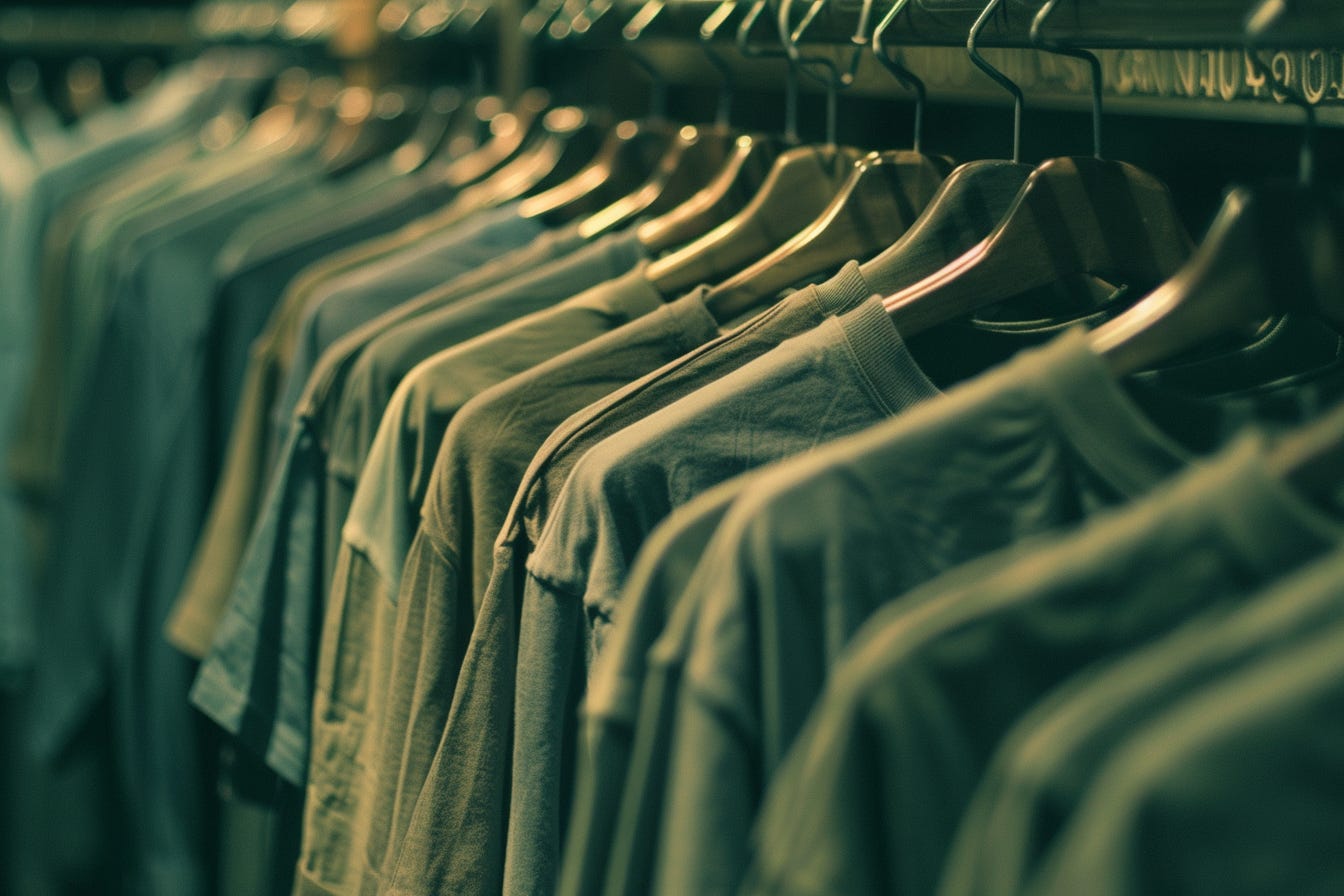
Clothes became simple. Same cuts, same structure, small variations, nothing that requires thought. I don’t stand in front of my wardrobe in the morning. I take what’s there and move on.
Food followed the same pattern. Breakfast is fixed. Lunch is fixed. Not because there are no alternatives, but because I don’t need them. The decision has already been made. I don’t revisit it every day.
Dinner is different. That’s where I want variation. That’s where I cook and choose. But even there, I don’t start from zero. I keep a list of meals I want to make, so I’m not selecting from everything that exists. I’m picking from something I’ve already filtered.
The same applies to movement.
I don’t sit down and ask myself where I should go every time I want to do something. I’ve already done that work. Thousands of places marked, categorized, stored. When I need one, I don’t think. I look at what’s nearby and go.
No searching.
No evaluating.
No second guessing.
That changed something fundamental.
Not because it made life more efficient, but because it reduced the background activity I hadn’t even noticed before.
When fewer decisions are required, attention behaves differently. It settles faster. It stays longer. You’re not constantly interrupting yourself with small choices that pull you out of what you’re doing.
You move more directly.
And the interesting part is that nothing important is lost.
The idea that more options create a better life only holds if you actually use them. Most of the time, they sit there unused, waiting to be considered, pulling attention every time you encounter them.
My grandparents lived in a completely different structure.
They didn’t have these choices. Not in food, not in clothing, not in work, not in lifestyle. Their lives were defined by constraints. You wore what you had. You ate what was available. You worked where you could.
That wasn’t freedom.
But it meant something else.
Their attention wasn’t fragmented by constant selection. They didn’t spend their days comparing similar options. They didn’t carry around hundreds of small decisions that repeated endlessly. Their energy went into what was in front of them.
We moved in the opposite direction.
We removed constraints and replaced them with options. That created flexibility, but it also introduced a layer of constant decision-making that sits on top of everyday life.
And that layer is easy to underestimate.
Because everything still works.
You just don’t realize how much of your attention is being used to manage things that don’t matter.
I see it in small details.
Objects lying around create decisions. You look at them and think about whether to move them, clean them, organize them. A clear space removes that entirely. There is nothing to evaluate, nothing to adjust.
The same principle applies everywhere.
Every additional option creates a moment where your mind has to engage.
One is nothing.
A hundred becomes noise.
A thousand becomes normal.
And once it’s normal, you stop noticing it.
Until you remove it.
Then the difference becomes obvious.
Not because something new appears, but because something disappears.
The need to constantly decide.
I notice it most when I’m outside.
When I’m hiking, I don’t want to think about what comes next. That’s the whole point. The moment you start planning the return, or the next stop, or what the rest of the day should look like, something shifts immediately. You’re still walking, but you’re no longer fully there.
And I see it all the time.
People are already ahead in their head while they’re still inside the current moment. They talk about when to go back, what to eat later, how long something will take, what comes after. The conversation moves forward, even though the experience hasn’t finished.
For me, that breaks it.
Because then it stops being an experience and turns into a sequence of tasks. You move through it instead of being inside it. You’re no longer paying attention to where you are, you’re managing what comes next.
And that’s exactly what I try to avoid.
Removing unnecessary decisions during the day isn’t about control or optimization. It’s about protecting the parts of life where no decision is required at all.
If everything around you constantly asks for input, your mind stays in that mode. It keeps scanning, planning, evaluating, even when there is nothing to solve.
And once that becomes your baseline, it follows you everywhere.
Even into moments that were supposed to be simple.
In the end, the question isn’t how many options you have.
It’s how many of them you allow into your day.
And whether you still have the ability to be fully inside something once you’ve chosen it.
If you want to receive future field reports
and notes from 150+ countries, you can subscribe below.
No posts
Comments
Nothing yet. Say the first thing.
Sign in to join the conversation.