
Lately I have been enjoying the spoils of summer with museum trips and local adventures, even as the headlines have been full of obsessions with dominance and feuding men. It reminds me that the sun on our skin and discovering a new kind of butterfly are their own lovely version of care and resistance.
Centering women and a respect for life, imagination and curiosity are, I think, inextricably linked. Which is what I try to capture in this piece. I hope you like it!
Sometimes I work inside the American Museum of Natural History.
There are a lot of not-lovely things about living in New York City (most of them can be found on the subway on any given morning, for starters). But this is one obnoxiously lovely thing about living in the city—the fact that I can just pop into this glorious space.

This grand museum lived large in my imagination before I ever set foot in it, storied as it is through Franny and Zoey, and the place where Richie and Margot Tenenbaum camp out when they run away from home—living in the African Wing surviving on crackers and root beer.
There’s also the “Night at the Museum” movie of course, and the fact that’s it’s the site where Ross and Rachel famously finally seal the deal.
The museum structure itself is nothing short of a castle—a gothic revival style castle specifically, complete with turrets, that takes up four entire city blocks next to Central Park. It’s actually not a single building, but consists of eighteen interconnected units. Apparently it was meant to be a matching bookend to that other temple of New York City that sits across the park from it, the Metropolitan Museum of Modern Art.
It’s as though the museum itself offers up an imagined, fairytale version of what the city might have been, or what it could be.

I get to work in the museum sometimes because access to the museum is free to New York City residents. And the museum has a gorgeous library that anyone can use as long as they are willing to be quiet and not bring food inside.
It’s an easy bargain to make, honestly, to sit with your laptop or book in what feels like a modern cathedral with sweeping views of Central Park West and the hot dog carts below. Or maybe it just feels that way to me because I’m American, and third spaces are so scarce here, much less ones that are inspired and cared for and clean.
While I’m working in the museum library, underneath me are incredible treasures. There is a 100-carat ruby, and a 7-foot tall amethyst geode for starters, in the stunning Hall of Gems.
There are approximately one gazillion different specimens of taxidermy, from blue-nosed gibbons to an entire family of African elephants. There are mastodons, saber-toothed cats, lemurs so small that they could fit in the palm of your hand. There is a butterfly vivarium where if you stand very still a butterfly might alight on your shoulder or hand.
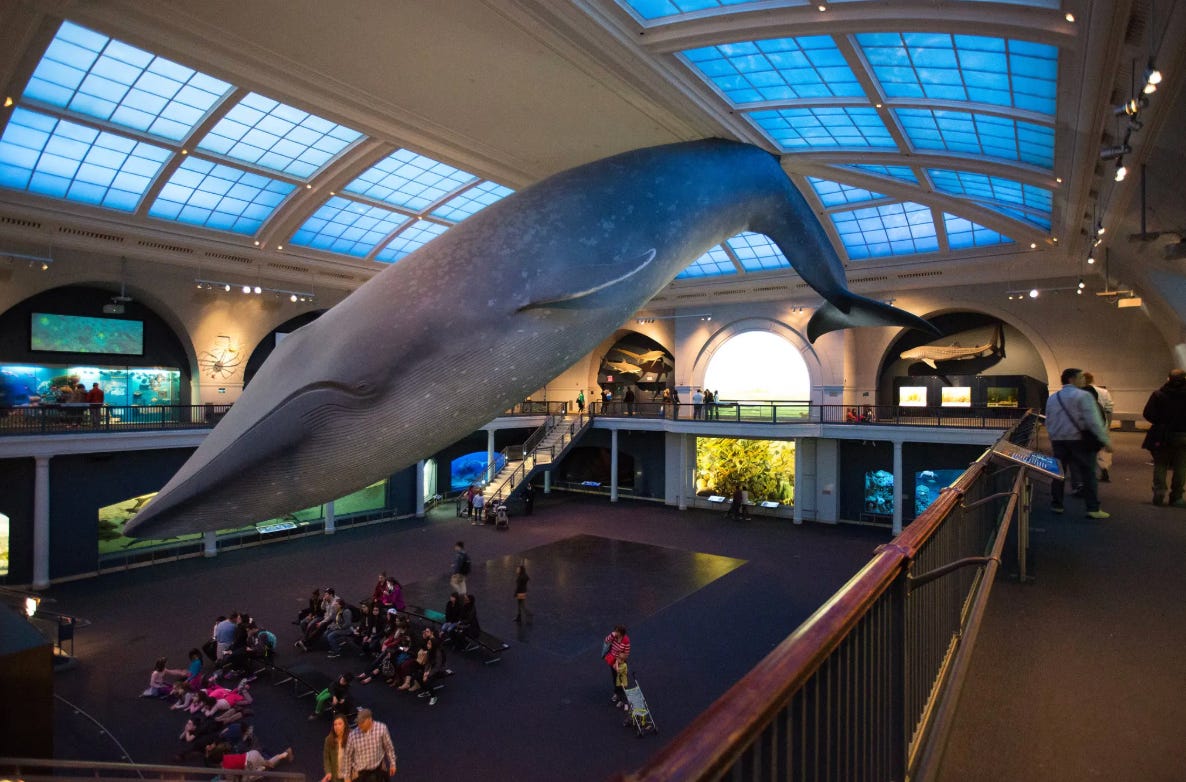
Here you can learn about how fungal networks allow trees to talk to each other. A life-sized blue whale, the largest creature to ever inhabit planet Earth (bigger than any dinosaur that ever lived, did you know?), is famously suspended from the ceiling in one of the wings, and you can go lay under it in the cool dark if you want to. (When I’m there with my young daughter, we usually want to).
Greeting visitors at the entry is the complete reconstructed fossil of a 4-story tall Barosaurus, rearing up to protect its young from the attacking skeleton of what looks like a velociraptor.
(Also, thanks to the generosity of my daughter’s godmother, we have a family membership here which also gives me access to a little lounge, right next to the Barosaurus, that has free coffee and tea. This, to me, is the high life.)
Every time I go to the American Museum of Natural History, my heart swells with the sheer wonder and majesty and mystery of all the things that there are to study in this world of ours.
I could spend a life studying leaf-cutter ants and how they construct entire ant-sized civilizations and workflows with nothing but scent, pheromones, and their animal intelligence, as far as we know. I could spend a life trying to learn the secret language of whales that allows them to teach each other how to hunt or recognize their grandmother.
I could spend a life learning how sea turtles are born with the natural intelligence and power of mapping into multiple magnetic fields that give them the ability to navigate across thousands of miles of open ocean from birth, and return to the beach where they were born to nest. Meanwhile I couldn’t find the place I was born, or even my way across Upper Manhattan, without Google Maps.
Whenever I’m in the museum, I think what it would be like if everyone that wanted to could spend their lives studying the things that there are to study in the museum.
If we had built a society where people could pursue a life of understanding the cosmos, or the ocean floor, or geothermal activity, or what were T-Rex arms for anyway—instead of lives where we have to make spreadsheets and strive to earn food and shelter.

This sounds bananas to an American capitalist sensibility, but we have so much abundance that our society could certainly do this if we wanted to.
We would have more scientific breakthroughs, and less mental illness. We would definitely have more wonder. We would have more appreciation for life, I think, including our own lives.
One of my favorite things in the museum right now are a collection of giant, blown-up photographs of insects taken in microscopic detail by the wonderful “macrophotographer” Levon Biss. Because the photos of the insects are several feet tall, the result is that it’s as though you’re looking at a bee through the eyes of another bee. Or you’re seeing a bee as though it’s the same size as you, a human. Let me tell you, a bee, when seen in this new size ratio, is just as stunning as any bear or cheetah or other charismatic megafauna.
The fuzz becomes fur. The skin around the eye has the lapis hue and texture that’s as vibrant as the scales of any tropical snake. Its delicate wing is impossibly perfect, its eye is as foreign and wonderful as any undersea creature’s. If you step close enough (or zoom in here), you can see the flecks of pollen that are nothing less than nuggets of gold that are nestled in its fur.
Why do I want to weep at the golden payload of pollen collected on its abdomen, as gorgeous and gilded as anything in the museum’s Hall of Gems?

Everything around us is crafted so beautifully, with such intelligence, and with such grace.
Will man ever make anything as beautiful and functional and perfect as this bee, made as it is to pollinate a specific mint plant whose life depends on it—and is able to communicate with its species to build an entire bee-city that supports its family and neighbors without uttering a single spoken word, while living in perfect harmony with its kind and its environment?
Of course we won’t. Which is part of what makes it so wonderful, if we had the humility to recognize it.
The museum has problems, too. It also represents many of our flawed and problematic strivings. It was first conceived as a monument to Teddy Roosevelt, for example, who was an original conservationist who gave us many of our best loved national parks, and who also believed in white superiority and Manifest Destiny.
Until several years ago there was a deeply problematic statue out in front of the museum that I would not have felt comfortable walking past, especially with my inter-racial family and biracial daughter. Thankfully, that statue has been removed. The museum represents our colonizing past in ways that are recognized and not recognized, and our continued colonizing instincts.
And yet even with this cracked foundation, so much of the museum is spilling with knowledge about and attentiveness to and curiosity about life, life, life.
It reminds me of the line from the Mary Oliver poem: “Whoever you are, no matter how lonely, the world offers itself to your imagination, calls to you like the wild geese, harsh and exciting – over and over announcing your place in the family of things.”
In its best light, the idea of the museum is like the myth of the building itself: it offers up an imagined version of what we might have been, or still could be.
All of this could be different, it seems to say to me. What if everything about the mystery and beauty of life and its forms was as elevated and important and treated with care and curiosity out there as it is in here?
Imagine it, it says. Imagine it.
What are you and your loved ones doing to dip into wonder and awe this summer? I would love to hear about it in the comments.
If you liked this piece, please hit “like” or restack it, or leave a comment—it’s the best way for my work to find new readers.
Are you enjoying MR? You can become a paid subscriber and support something that centers women every week—for less than the price of a cup of coffee!
Our next summer book discussion is “Famesick” by Lena Dunham, and so far I am LOVING it. Read up and join us.
Lane Anderson is a writer, journalist, and Clinical Professor at NYU who has won fellowships and awards for her writing on inequality, gender, and family social issues. She received her graduate degree from Columbia University. She was raised in Utah, and lives in New York City with her partner and child.
Comments
Nothing yet. Say the first thing.
Sign in to join the conversation.