
Most advice about language learning online is either focused on getting tons of exposure through immersion or about speaking early with native speakers. The truth, however, is that we need exposure and speaking practice.
And the best way to improve is to combine both.
Unfortunately, even the rare conversations about mixing the two forget about why reading can also be very useful for improving your speaking skills.
Indeed, there’s a lot of discussion online about using videos or music to practice speaking but real improvements come from combining the visual content and audio.
It’s now easier than ever to do so thanks to AI tools.
The best way to memorize anything is to tackle it from different angles.
Seeing a new word in a text is the first step to remembering it. It gives us the opportunity to look it up and analyze the sentence it’s in.
Listening to the same word in another sentence helps strengthen it in our memory and slows forgetting. Much of learning is not defeating forgetting, but repeatedly pushing it back.
Using it in our own sentence then helps us make it ours.
This might feel obvious but the reality is most people don’t do this because we tend to rely on…well, hope that we find the same word one day.
What I recommend is to turn hope into action to make this become reality.
It all starts with picking a text.
Choose a text that is neither too easy nor too complicated. Depending on your level, you can go for a daily conversation, a short story, a simple description of an environment, a news article, or even a research paper if that’s what you’re into.
After reading it and looking up words you don’t know, turn to ElevenLabs to listen to it.
ElevenLabs is an AI platform that allows you to choose a voice and listen to any text in most languages. With its free tier, you get 10,000 credits per months which is enough for quite a few texts.
If you prefer avoiding it, you can paste the text to ChatGPT or another such tool and add “Repeat what is written below without saying anything else” and send. Click the button to listen to the answer with its voice. Although it’s nowhere near the quality of ElevenLabs.
FYI, if you really want to avoid AI, then you can request native speakers to record themselves on Rhinospike but it might take a long time and texts have to be rather short for people to actually do it.
The best approach for your memory is to do the following in that order:
Read the text without audio
Listen to the audio while reading along
Listen to the audio
Once you’ve listened to the audio, it’s time to make the words you want to activate appear in other sentences about the same topic.
One solution is to add the text into NotebookLM (now called Gemini Notebook) and request a short podcast while specifically asking it to use the words you want to remember.
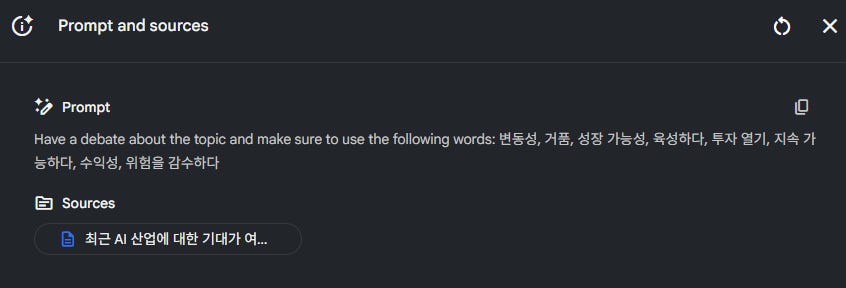
You can also ask ChatGPT to create a conversation about it and then click the listen button as we did for the original text.
We’re finally there. We’ve only focused on the preparation until now but it’s time to speak.
With the use of tools like LoopMate (completely free) or WorkAudioBook (only 10 minutes of practice per day for free), you can add the downloaded audio from ElevenLabs and NotebookLM and start shadowing sentences one by one over and over again.
Shadowing means to speak out loud along with the audio, trying to keep the same rhythm, same inflection, and all. In short, imitating the voice you hear.
The goal is not simply to read the entire text out loud, it’s to make it come alive through your voice. Whenever I do this, I have to repeat certain sentences a dozen times to really get my tongue used to move in the ways my target language requires.
Finally, it’s time to make the words you wanted to learn truly yours.
If you have native friends, you can share the original text and say you want to chat about it in their language.
Otherwise, and more convenient, open ChatGPT and begin an audio conversation.
You could start the conversation by reading the text and finishing with “Let’s talk about this text. Keep the conversation going and reuse terms from it often.”
Turning new words read into words in your vocabulary that you can use in daily life is what language learning is all about: make the language yours.
So here it is in summary:
Read a text
Listen to it with ElevenLabs
Listen to a podcast about it with NotebookLM
Shadow the text and/or podcast with LoopMate or WorkAudioBook
Have a discussion about it with ChatGPT, Gemini, etc.
Five simple steps that’ll get you to master these words you really want.
Of course, not every word needs this entire process. Common, simple words will come back often enough that you don’t need this. But for the ones you struggle with or know you won’t encounter often, I don’t think there’s a better way.
Oh, right, you can make it even better by writing a short text yourself with them too. If you do this, you’ll have practiced all your passive and active skills for learning a language!
Cheers for reading,
Mathias
Comments
Nothing yet. Say the first thing.
Sign in to join the conversation.