
There is no script on earth more beautiful than Hangeul.1
There, I said it.
It might not look like some huge claim but it is for me because my love for Asian languages originated from the mind-blowing discovery as a high-school student of Kanji, the Chinese characters used in Japanese, because they are combined to create words that hold meaning in each each character. I mean, come on, how magnificent is that.
Yet my heart beats stronger whenever I see Hangeul.
My love for Hangeul originated with a meeting I had just after graduating from high school, in 2008.2
I was doing a workcamp—some volunteering work—in the south of France for three weeks with people from all around the world. Two Korean girls were there and made me discover for the first time in my life Korean. We became good friends and I learned a few words from them such as 잘자, 안녕, 내일 봐, and so on.
When they left, one of them cut off the carton from a cereal box and left me a message she called “Secret Word Korean” fully written in Korean.
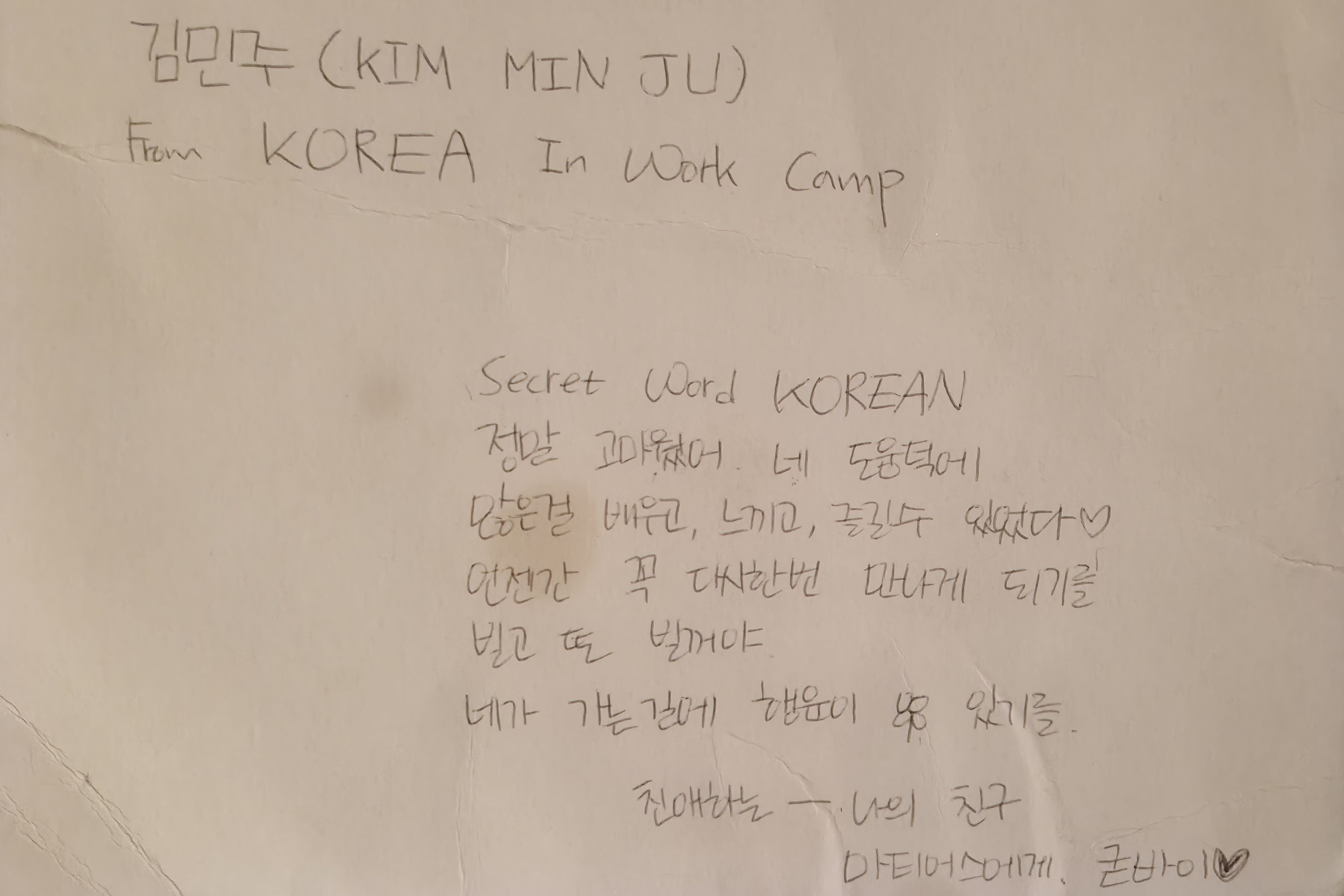
At that time, all I knew was how to write my name in Korean: 마티아스. I didn’t know what was read how in this word. I just knew how it was written so I recognized it in the message.
After they left, I sat down with a guide about Korea they had left me with. It included a Hangeul table so I decided to decipher some words. I began at the top but quickly dropped it to try to understand the last words.
One stood out: 굳바이.
I spent two hours on that message and didn’t get what it meant but I did get what that one word was.
You see, Korean has a few letters that have multiple pronunciations. These letters are all in this last word: ㄱㄷㅂ.
The first can be a G or a K. The second a D or a T. The third a B or a P.
So I wrote every combination possible with these: Kutpai, Kutbai, Kudpai, Kudbai, Gutpai, Gutdbai, Gutpai, Gutdbai, and Gudpai.
I don’t remember why but I began saying them out loud and then it jumped to me: Gudbai… Goodbye.
Oh. My. God.
My mind was blown and I was hooked.
I know. It was simple but, after two hours, I had read a word on my own. And after spending so much time looking at that table and message, I had it all pretty much memorized. I never had to relearn it, only to make it more natural through exposure as the years passed later.
This was my first experience with Hangeul but it turns out its story itself is even more magnificent. This is one of the newest scripts in the world for major languages and also considered the easiest in the world as it’s the most logical and scientific.
You might think “What do you mean it’s simple? Having letters that can be pronounced in multiple ways is messed up!”
I’d get this feeling but what if I told you that 99% of the time, the right pronunciation is… the easiest to do?
Is Kutpai easier? Gutbai? or Gudbai easier to say out loud? I vouch for the latter. To hell with the T followed with a B or P.
But let’s get back to its story.
Hangeul was created in 1443 by King Sejong so the population could learn to read more easily instead of having to learn tens of thousands of Chinese characters called Hanja.3
He designed the system specifically for the common people, aiming for a phonetic script that was intuitive enough to be learned in a single morning. By publishing the 훈민정음 (Hunminjeongeum) in 1446, Sejong democratized literacy, allowing Koreans of all social classes to accurately record their spoken language for the first time.
You know how most languages have their own shorthand when written by hand? How we link letters in the Roman alphabet in countless different ways because it feels faster to write?
Koreans do it too but it’s so natural and common that even letters typed adopted some of these simplified versions.
For instance, look at the picture of some letters I wrote below.
ㅊ and ㅎ on the left have a small life parallel to the one below at the top. These are the original versions of the characters but many people now write a perpendicular line instead because it’s easier to link. And if you look at their version I typed at the start of this paragraph, that’s the almost same on a computer.
This doesn’t stop here. The ㅈ and the bottom part of ㅊ were not supposed to be like that. They were closer to a Japanese ス in Katakana.
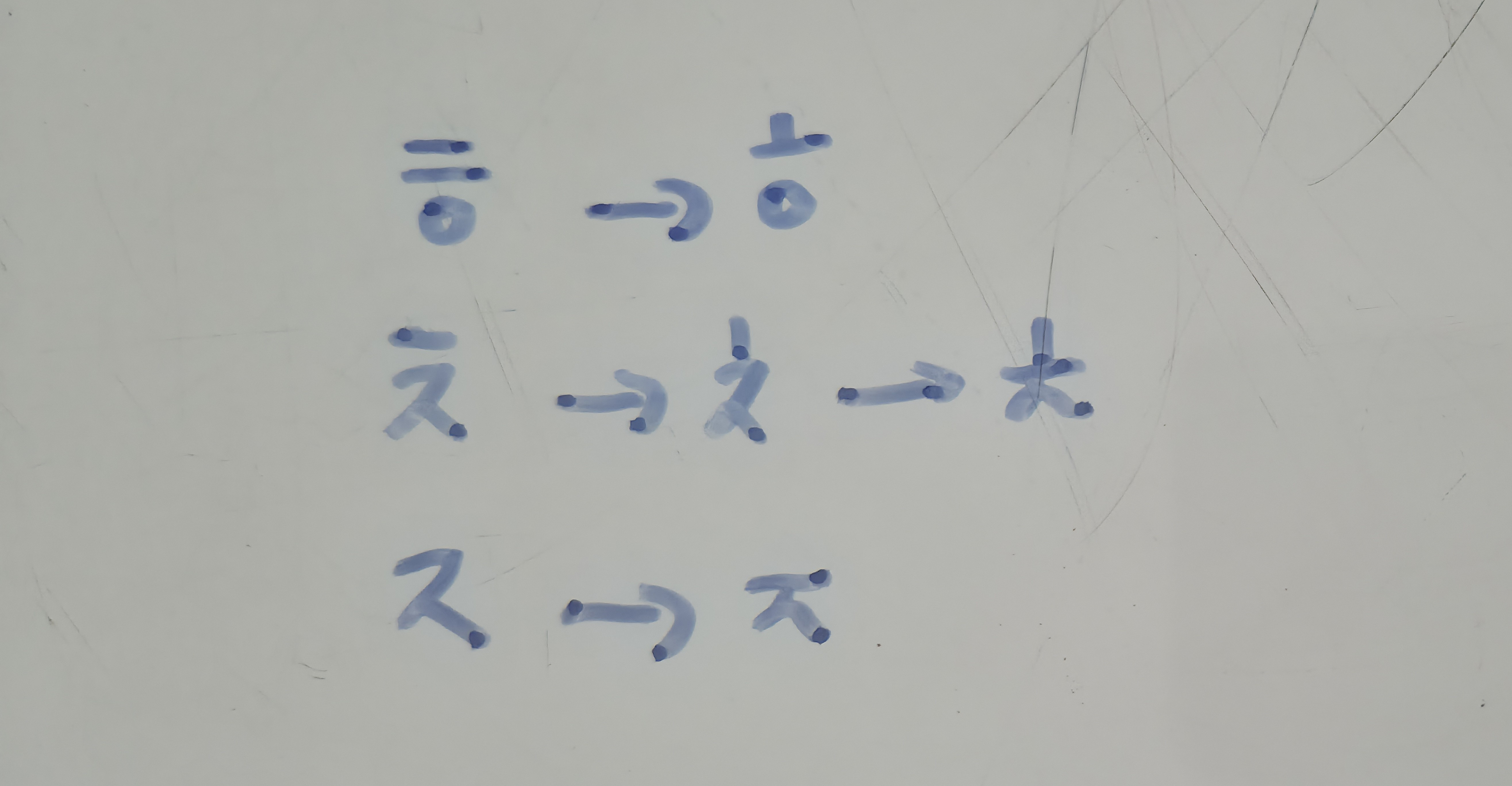
The written language is evolving through handwritten letters and typed ones. I don’t know if there’s any other language on earth like that.
Side note: Do let me know if you know of another one though! I’d love to find another one!
I’m a bit uptight in some ways, as some of my friends and family would say.4 I love organization and having a good setup.
Korean words are combination of letters that fit together like Legos. You want a K, you can type ㄱ. You want to make it KA? the ㅏ gets linked to it as 가 and changed the format of the K slightly. Make it KAK (or KAG or GAK) and you got 각. See how both Ks are different yet still fit into a tiny little square?
That’s what I’m talking about. This beauty of making them fit into a box naturally.
Here’s a full sentence so you can appreciate the boxes:
한글은 세상에서 제일 예쁜 글이라고 생각하지 않은 사람들이 잘못 생각한다.5 😁
I could go on for ages talking about why Hangeul is the most beautiful script in the world and why we should all know it. Hell, even some people in Indonesia wanted to use it for their language, Cia-cia, at one point!
But I know I ramble too much too often so I’ll leave you there.
Because I know no word can ever truly express my love for this script. Even the words 사랑해 are too weak.
I know Hangul has become the more commonly used way to write it but Hangeul is still the official version and I prefer it to avoid hearing it with a “u” sound as in “Goodbye.”
God that’s a long time ago. #howtofeelold
I love those too, but I can’t deny they’re a tad more of a challenge to master.
Take off the “some of” from this sentence to get the truth.
“Those who don’t believe Hangeul is the most beautiful script in the world are wrong.”
Comments
Nothing yet. Say the first thing.
Sign in to join the conversation.