
If you are reading this…. are you reading this? If so, firstly, thank you, I do understand if you do not wish to receive these posts so please unsubscribe, this is my first post on an unfamiliar platform..
Why am I here; well, I have making practices which happen daily; clay, sound, image, and having spent many years trying to separate these to make sense of them, I wonder if I can simply have a space to share them and ask that you all make sense of them in some way, ideas around the making of objects and objects I will make. I am hoping there are threads running through what you see, read, hear and at some point you can shout out what they are and I’ll take notes, and in return I’ll do the same for you……deal?
New Website with Saggar works-
Swey design made me a wonderful new website which is amazing, soft and understated, calm and has great style. The idea is that this new website will be a space to sell my more ceremonial works in clay and Etsy will continue to sell mainly my tableware pieces. I have been thinking about this for a while as my work progresses and becomes for me more refined is Etsy the space to sell this kind of work, and the answer is no, I have never been a maker who does ‘drops’ a few times a year, I make frenetically throughout the year, aiming for the end of year shows and fairs. The Saggar works on the website now are some of my favorite pieces I have made, a very magical process of taking bisqued pots to Suffolk and Saggar firing them in a special place, on the River Deben across from Sutton Hoo, imbued with resonance of place and magical ancient ghosts overlooking this alchemical process. Please take a look and enjoy them. www.mathewpauljinks.com
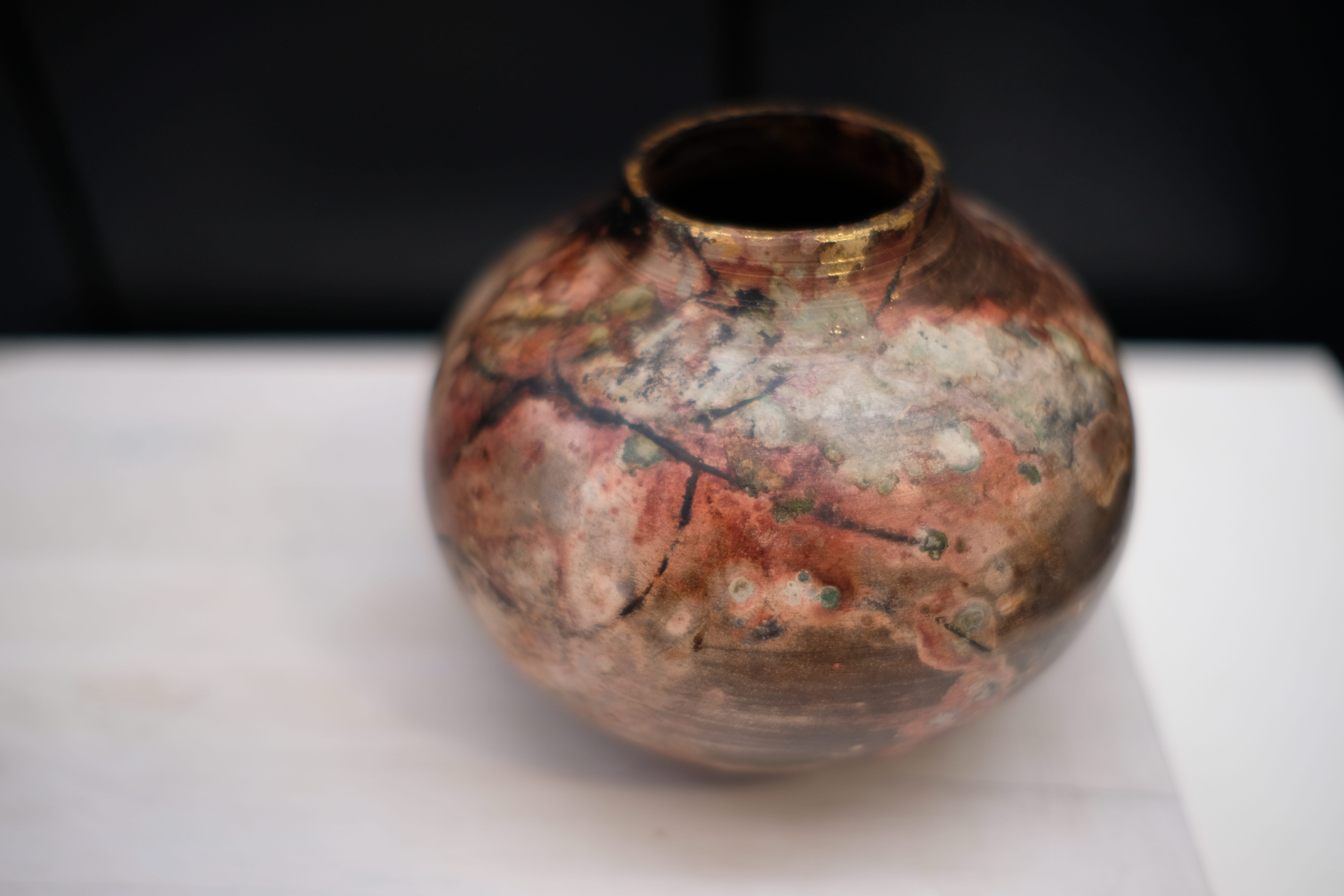
Saggar fired Moon Jar 2026.
WILD CLAY-
From this same space in Suffolk I have been harvesting wild clay, the geologic clay seam moves across Sutton Hoo and through the river and along through Woodbridge and Melton and beyond. From the BGS website- “Coarse-grained, poorly sorted, cross-bedded, abundantly shelly sands (in East Anglia). Dark green and glauconitic when unoxidised, but typically oxidised to yellow or reddish brown with ferruginous concretions (iron pan). Basal bed of rounded flint pebbles. Offshore, fine- to medium-grained, muddy, calcareous, glauconitic sands. Shallow marine deposit. Piacenzian (Waltonian) to Thurnian (MIS ?103 - 82).” Quaternary Period 2.53 Billion Years old.
Basically Red Crag, high in Iron, think Brick red in color. When fired to 1060 Degrees C in the electric kiln it fires very vitrified hard and strong with very low absorption. Because it’s basically an Earthenware body I will be using low fire glazes which means I will have to Bisque them at a lower temp say 900 degrees to get proper glaze absorption into the clay body.
On another thought stream I am toying with making a mid fire oxidation glaze from the wild clay slip and to do this I will need to make a Triaxial line blend to work out what Frit and Silica combo will work, more tests of that coming.
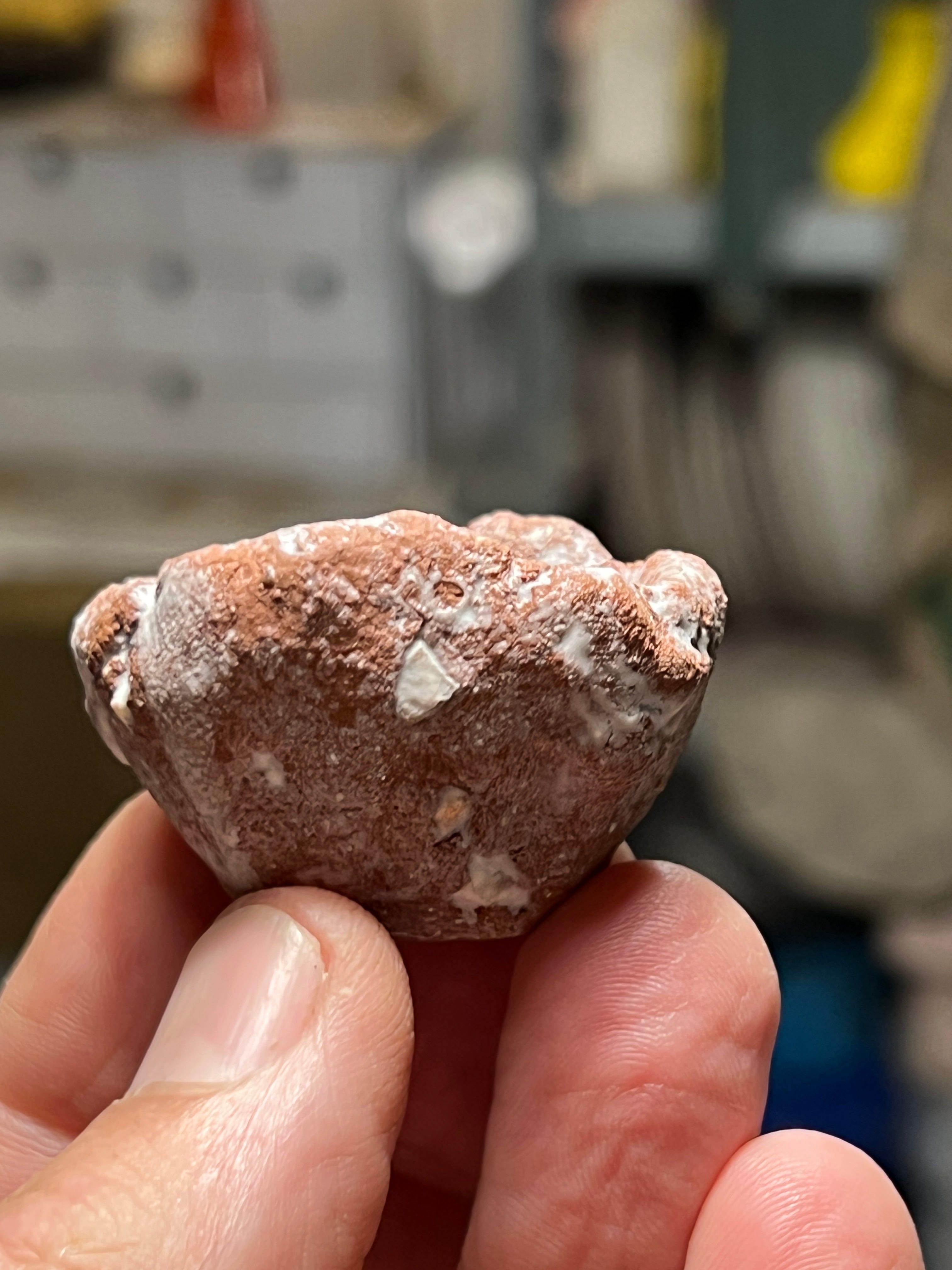
Suffolk Red Crag Clay Fired to 1160 Degrees C.
SOUND-
This is where I might lose the potters as I talk about a sound thing I’ve been wanting to try. So I make what’s called Modular Music, which as the term implies is music made from modules, specifically small synth modules in a case, all the modules together make a group of sounds which get mixed together and recorded. Then you put your music out there on Bandcamp and hopefully someone listens, anyhow. What follows is more technical than anything but it has a conceptual spine to it that might reflect in a practice as a whole, let’s see. As I said I record these sounds in a stereo format, so all the sounds get mixed down live as the modular is running in a mixer unit or external mixer and then recorded to stereo. And I have always enjoyed this combining of sounds, by adding reverb and effects pedals and made very specific sonic choices for the mix as a whole, but the one thing this process lacks is the ability to separate the sounds later as it is always a stereo file, which can be mastered but not adjusted individually, which means if a certain sound is annoying and you wished you had faded it out sooner then you are stuck with that choice, and this kind of thing frustrated me. So I decided to explore stemming, which is where you take a group of sounds and record them separately at the same time and then this gives you the opportunity to edit them later in your computer, in my case five stems. So 2 things here, 1; going modular is supposed to be a kind of practice of getting away from computers, and 2, stems don’t capture the actual stereo mix of the reverb and effects and balancing of sounds and that sweet spot I liked to think I was chasing in the mix and a certain amount of magic which is locked in to the process. But the outcome is the ability to change your piece radically after you have recorded and maybe even record more on top to add passages, ostensibly to carry on the work of creating further, rather than just mastering the track. Now this adds a certain amount of further work, and I can be lazy with my music so this might force me to get back to taking it all a bit more seriously but it might also make me sad to have lost the ‘magic’ that I am suspicious of. Also a future desire is to master 1/4 inch tape in stereo but I can always bounce it out of the computer onto tape before mastering it again :) So the question is how often do we in our creative practices create forks and or restrictions because we are stuck and maybe need a fresh perspective on a model of working?
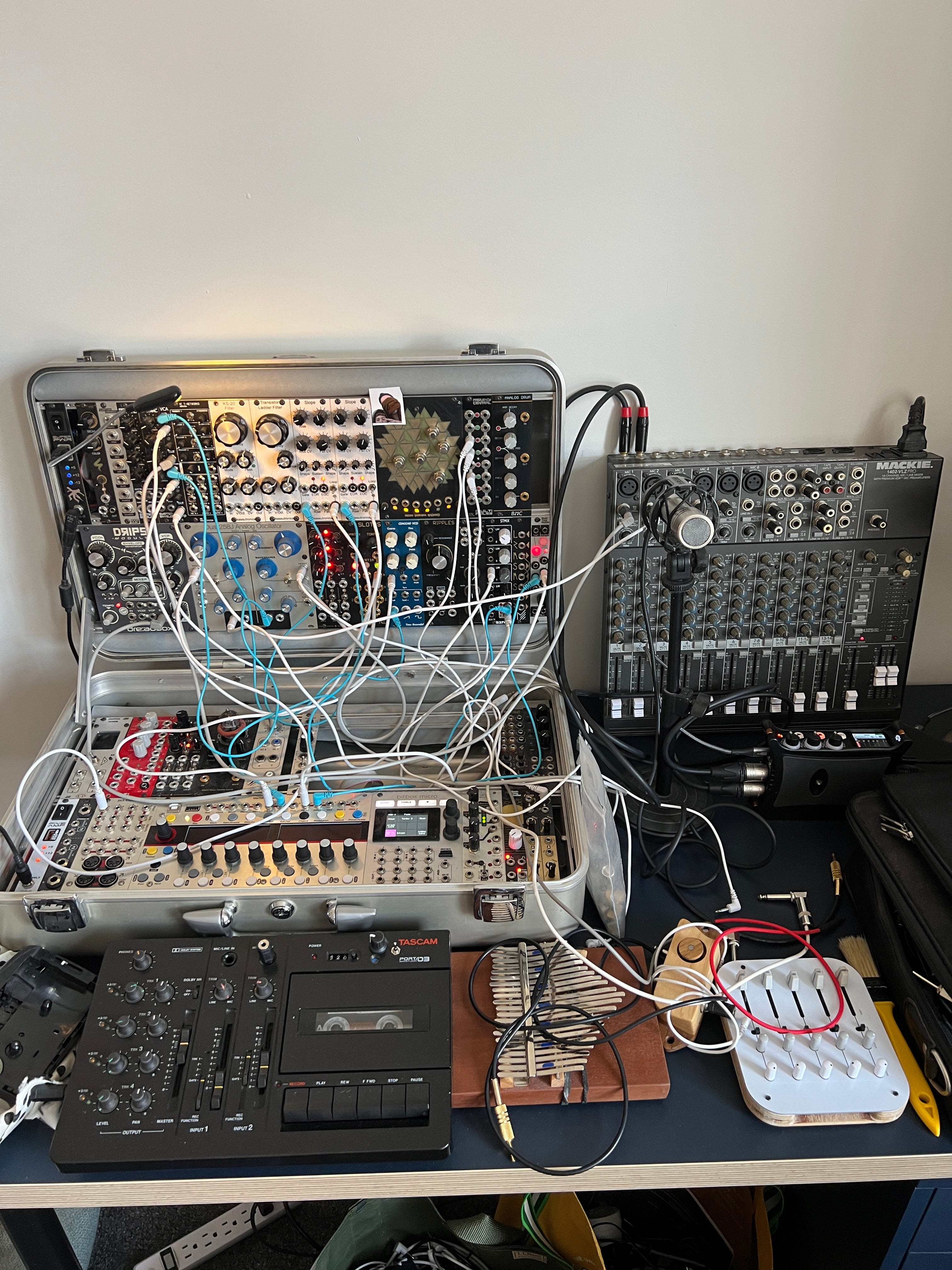
Modular setup.
IMAGE-
Lastly a project in the works is Cyanotype animations. You may have seen these popping up as workshops in photo spaces, such as New York, Ed Carr is a great person to look at. Agnes and I are working on a music video for a friend. We are shooting on a Sony 4K with old German lenses but I want to incorporate moments of cyanotype animations throughout. To do this you shoot a short video then extract the frames as still images, so if you shot at 25 frames per second that’s 100 images for a 4 second animation, so you can ditch half of the frames by turning it into 12 fps 48 still images, and making the animation on what’s called two’s, but that’s for later. So you take your 48 images, make them Black and white and invert them to become negatives and size them to fit on a sheet of A4, 6 images at a time on a sheet, so you will need two sheets per second of animation, 8 sheets for the 4 seconds. Then you print these images onto an inkjet presentation film and these a4 sized sheets are used to expose the cyanotype, which if you are unfamiliar with is a UV sensitive negative process, made up of a simple 2 part solution which gives you beautiful blue monotone images. You coat sheets of paper in a dark room using a brush and when they are dry you can expose them in sunlight with a simple sheet of glass on top to hold the negative against the paper, and then you just wash the print, no developer needed. Once dry you scan the sheet of 6 animations into your computer and then cut them up in Photoshop and number each image so you have a sequence.
Then put the images back into photoshop as a timeline and there it is a cyanotype animation, the nice thing is you can tone the image digitally at this point and make adjustments. The sloppier you are with the brushing of the chemical the better because it adds texture and interest. The key to this whole process is consistency, and as we don’t have much sun all the year round a UV LED lamp is essential, so there is a little investment in the process, although Cyanotype chemicals are really cheap. I don’t have any images of the process yet as it’s in my head, if you have any insight to the process do let me know. Here’s a video on the process on Youtube-
So here it is my first post, I offered you Clay/Sound/Image and there it is.
Now I realise how bonkers this whole post sounds, I’m blaming the heat wave.
Images for context x.
Comments
Nothing yet. Say the first thing.
Sign in to join the conversation.