
My recent post about the church of St Michael and All Angels in Copford has proved to be one of the most popular pieces yet on the Broken Compass, so this seems an opportune moment to bring this post, first published here last May, out from behind the paywall. I really enjoy exploring England’s churches, so I might make these a more regular feature. All thoughts and/or suggestions welcome in the comments!
I posted some photos of Minster Abbey on Sheppey as a Note here on Substack a few days ago, and I thought afterwards that it would be fun to write briefly about the abbey and a few other survivals of the Anglo-Saxon church in south-east England. Perhaps I am wrong, but I think we don’t pay enough attention to the extraordinary tenacity of these buildings, or to the deep continuities they embody amidst the ephemeral wreckage of modernity. Their endurance seems to have something of the quality of those who built them: an indomitable persistence in the face of hostility and indifference, a certainty that outlived kingdoms and empires.
There is no particular plan or thought behind the choices: they were simply the four that first sprang to mind. Although having said that, at least three of them are historically important – or, at least, represent important moments in English history. I have visited them all over the last few years and, with one exception that is noted below, all the images are mine. (None of the photos were taken with sharing in mind, which perhaps will explain their dubious quality!) Between them they run from the years immediately preceding the arrival of St Augustine on Thanet to the decades in the run-up to the Norman Conquest.
Do let me know your thoughts in the comments. And please do recommend other churches across the country where our Anglo-Saxon inheritance is written in the masonry or timber.
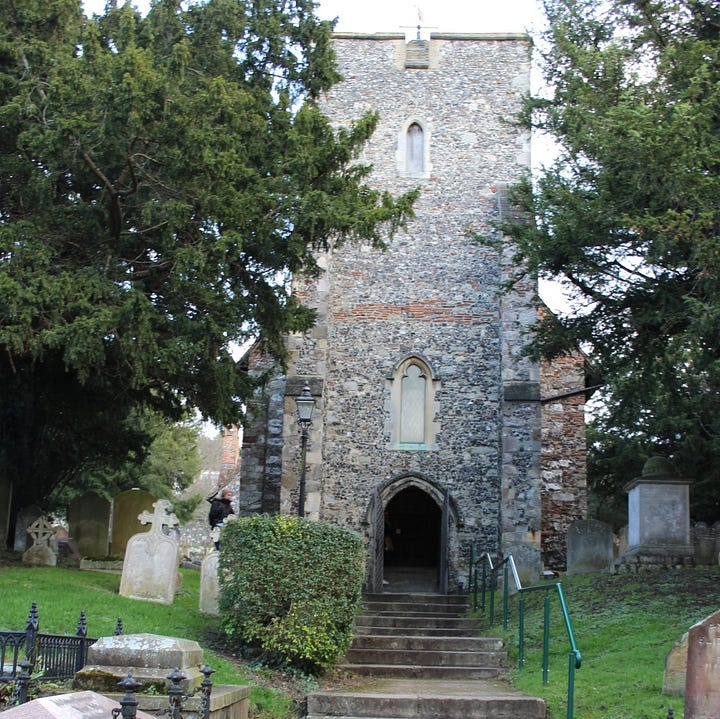
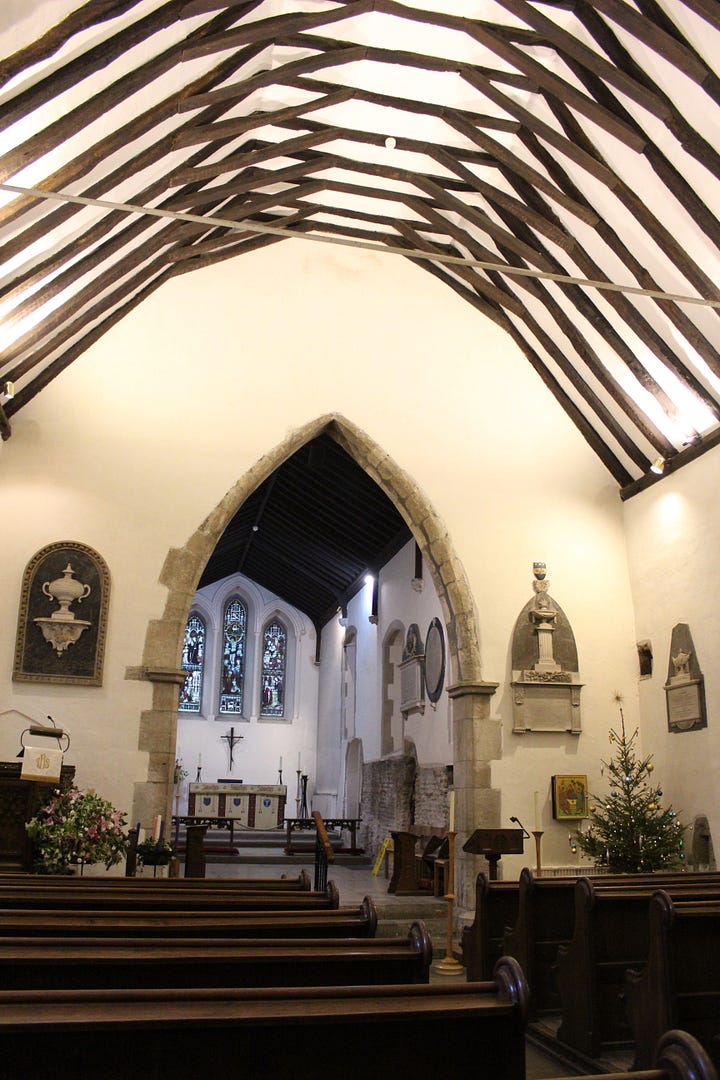
It’s remarkable to think that when St Augustine arrived on the shores of Britain on his mission from Gregory the Great in 597, part of this building was already here to greet him. It was founded by Bertha, the Merovingian Christian queen of the pagan king of Kent, Æthelberht. Æthelberht’s dynasty, the Oiscingas, were thought to have been founded by a son of Hengist; the history here runs so deep its feet swim in myth.
It was part of Bertha’s marriage settlement that she be allowed to practise her faith unhindered, and she brought with her from Paris a bishop named Liudhard to act as her confessor. The marriage most likely took place in 579.
According to English Heritage, the oldest part of the church interior, the chancel, dates to the seventh century, but there is a lot of Roman brickwork visible on the outer wall to the south and Bede records that the church was first built “whilst the Romans were still in the island”. Bede also records that St Augustine’s mission “first began to come together, to chant the Psalms, to pray, to celebrate Mass, to preach, and to baptize” here.
The church has been in constant use ever since. So that’s over 1,400 years of devotion and prayer: the sense of continuity is profound, almost vertiginous. It stands on a hill overlooking the city, and you can look out over the ruins of St Augustine’s Abbey to the cathedral and see centuries of history at your feet.
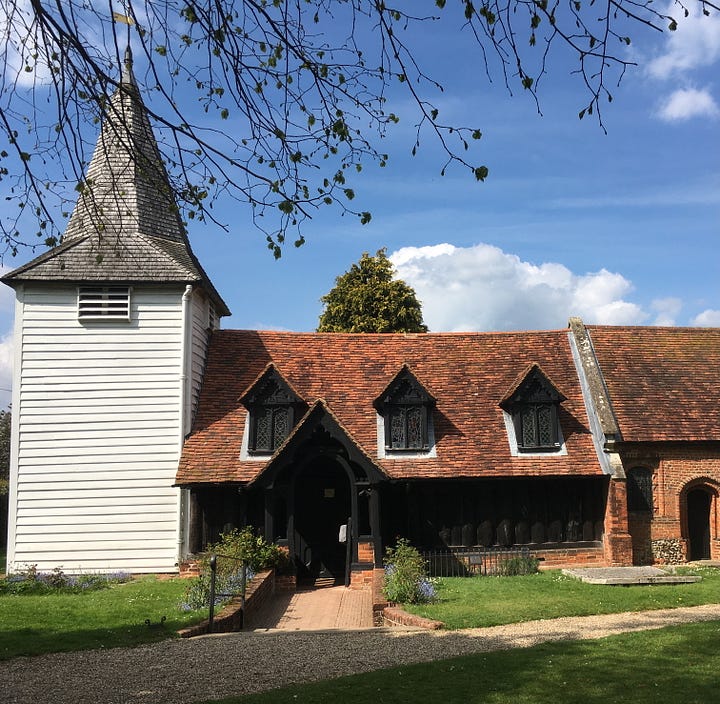
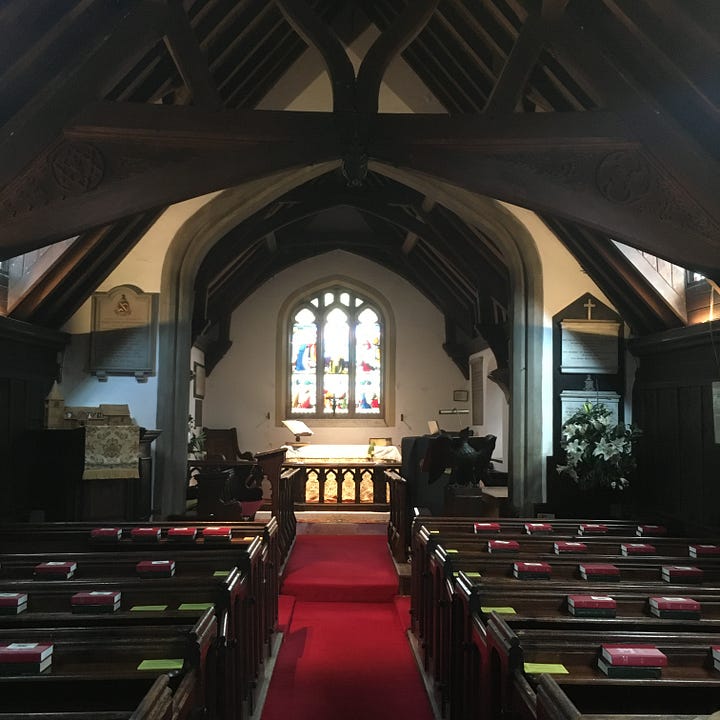
Greensted is in rural Essex, only about thirty minutes outside London, but it doesn’t seem to feature much on tourist trails. Which is a shame, because it is the only surviving example in England of an Anglo-Saxon stave church. It’s also reputedly the oldest extant wooden building in Europe, although inevitably not much of its original wooden structure remains. The walls of the nave are constructed from fifty-one oak logs, split in half lengthwise, which rest on an oak sill; the flat surface of the logs face inwards. As is probably clear from the photos, the gables are steep and the nave walls only rise to about five-and-a-half feet. The church interior is eerily gloomy, but it’s a gloom is oddly comforting and warm.
There seems to be some debate about the age of the oldest oaks: English Heritage’s listing dates them to 845, although Wikipedia cites a later dendrochonological study which places them shortly before the Norman Conquest. It is said that the body of the English martyr-king St Edmund rested here in 1013 on its translation from London to the Benedictine abbey at Bury St Edmunds, where it became one of the great pilrimage sites of medieval England. A manuscript from around 1300, now in the British Library, is the only source for this story; it refers to ‘a wooden chapel [that] remains until today’, which suggests to me that even a couple of hundred years after the first millennium, wooden churches were unusual.
There is archaeological evidence for two older wooden buildings beneath the chancel floor which date to the seventh century, which places them in the early years of St Cedd’s evangelising mission to the East Saxons, which began in 653. St Cedd was Northumbrian and was trained at Lindisfarne, which may account for the church’s dedication to the Celtic saint Andrew.
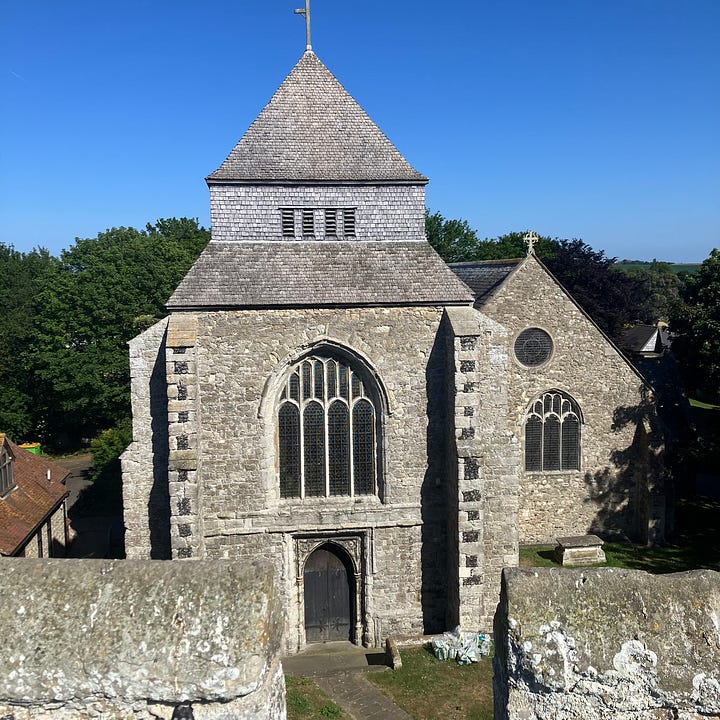
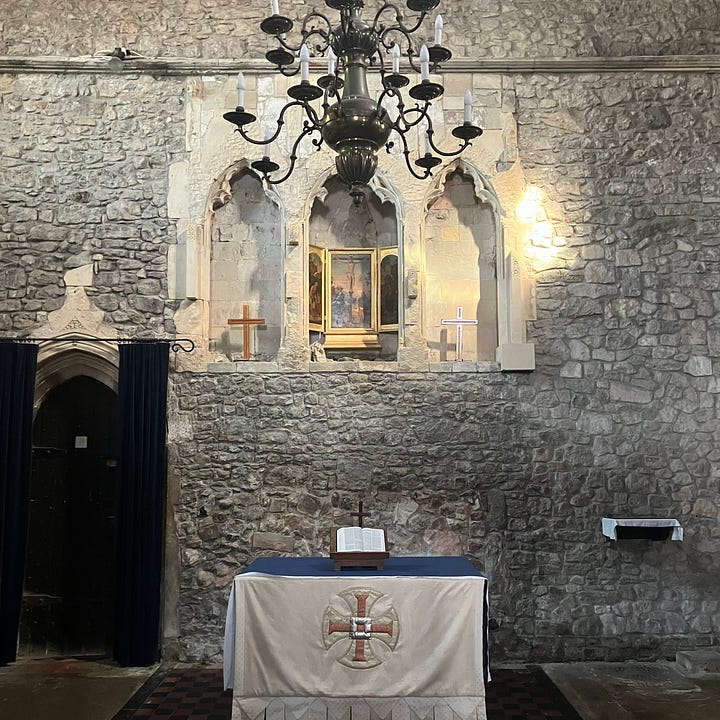
I’ve been meaning to visit Minster Abbey, also known as the church of St Mary and St Sexburga, for a long time. We finally went last weekend. It sits on a rise on the isle of Sheppey, which is otherwise flat and marshy, on the Kentish shores of the Thames. Like a lot of the end-lands around the fraying edge of south-east England, Sheppey feels more remote than it really is, a world unto itself.
As the church’s current dedication suggests, it was founded by the Anglo-Saxon saint, Sexburga, who also went on to become the abbess at Ely, which was founded by her sister Æthelthryth. Sexburga – whose name also appears as Seaxburh – was the queen of the Kentish king Eorcenberht, the grandson of Bertha, who founded St Martin’s in Canterbury. When Eorcenberht died in July 664, Sexburga acted as regent until their eldest son Ecgberht came of age, at which point she took her vows and founded the abbey here.
Hasted’s Survey of the County of Kent records that the monastery was repeatedly attached by Vikings, which, given its prominant position and proximity to the Thames, can hardly be surprising. Only one chapel, dedicated to St Sexburga, survives from the Anglo-Saxon foundation. Roman spolia in the outer wall of the chapel are reportedly from a Roman garrison outpost which formerly occupied the hilltop.
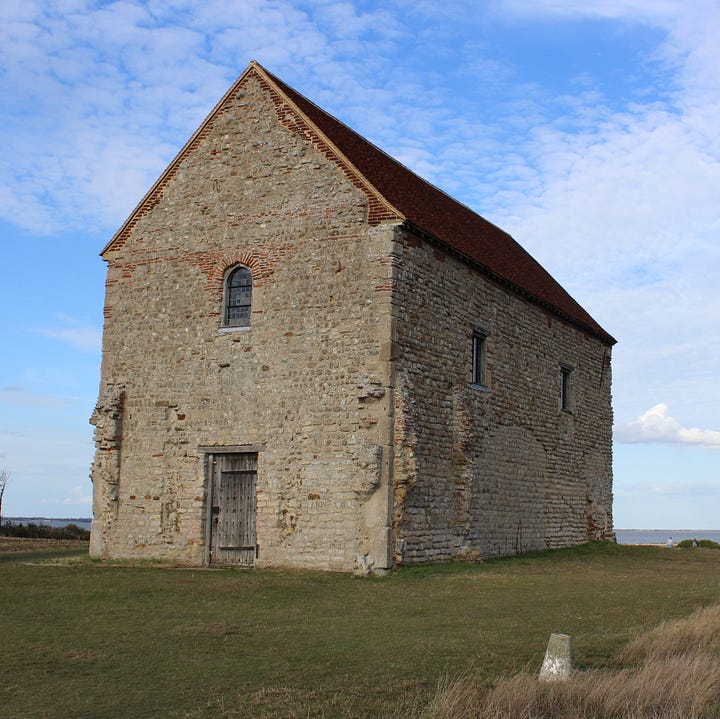
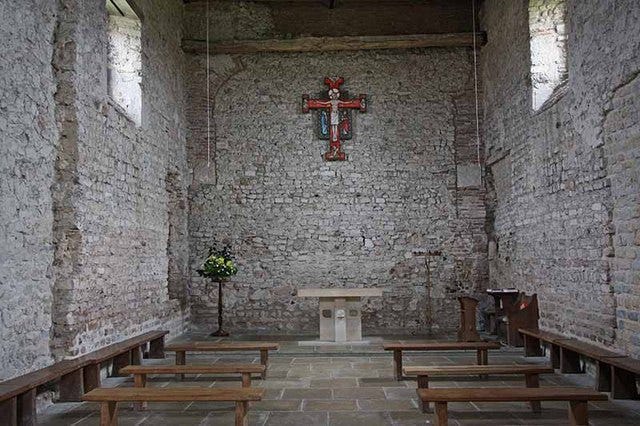
St Peter-on-the-Wall feels even more remote than Minster Abbey. It sits on the Dengie peninsula overlooking the mouth of the River Blackwater, alone on the headland with nothing but open land around it. You reach it down a long country track. (It’s never been open when I’ve visited, hence the use of someone else’s interior shot.)
If you were standing outside the church in early August 991 you would have had a clear view of the Viking fleet sailing upriver to fight the Battle of Maldon. But even then the church was over three hundred years old. It was founded as a monastery in c654 by St Cedd in the course of his mission to the East Saxons. But much of the building, in material if not in structure, is much older than that. Cedd built his monastery across the foundations of the west wall of an old Roman fort called Othona, which the Saxons knew as Ithancaster, and he made extensive use of Roman ashlar, septaria and brick. Sitting so concertedly athwart the ruins of an imperial structure must have been a statement of intent.
The building as it currently stands is only the nave of the original church: it once had an apse to the east, and a porch at the western end above which stood a tower. It became a chapel-of-ease to the local parish in the Middle Ages, and then fell into disuse. At least, it fell out of sacred use: it was a barn for a while. It was restored as a chapel in the early 20th century.
Perhaps it is fanciful, but the very isolation of St Peter-on-the-Wall seems to speak to the precarity of the Christian mission to pagan Britain: small numbers of committed men and women in a wild and liminal landscape building outposts of their calling – an empire of the spirit – on an abandoned empire of the world.
Comments
Nothing yet. Say the first thing.
Sign in to join the conversation.