
“From a biological perspective, breast milk is a wonder. From a stress perspective, that statement alone can be a trigger.”
My boobs went (mini) viral ten years ago.1
Well, not exactly my boobs but rather what I was doing with my boobs while in a pretty standard predicament: finding somewhere to pump breast milk (skip ahead to the story HERE).
The catchier bit of the essay likely related to the event I had to navigate for this challenge – the Consumer Electronics Show (CES), the classic “man’s world”, tech-focused trade show2. In 2016, the year of my mini-viral pumping post, CES put on a pretty good show of embodying the way tech heavily skews men/masculine, pushing all things women/feminine off the main trade show floor and into a weird side room3. To say that the show was a hostile environment for pumping mothers is not an exaggeration. Another woman (who I met later) told me that, when she asked the same event organizers about a “Mother’s Room”, the response she received was: “This event is thought for professionals and not even kids are allowed to go inside the venue.” Ew. I figured since our booth was in an area for tech related to babies and mothers, maybe, just maybe, I might have some luck. Nope. Instead, when I asked an organizer on site where to pump, she (yes SHE, a mother herself) just looked at me and shrugged.
A lactivist was born that day4
Like many people, the issues around pumping breast milk had never crossed my radar until experiencing it first hand. Once it did, I had a new level of internal (and sometimes external) outrage at the way this world sees and treats motherhood.
But this is not only about pumping. More of a “pumping is symbolic” launch point. The pain points related to pumping breast milk symbolize the false (and often forced) choices around breastfeeding that need more attention. And the societal framing of ‘pumping as a personal issue’ symbolizes the way motherhood ‘choices’ are flipped into broader exclusions of women.
When I started pumping in 2013, breastpump innovation had been stalled for decades. The style of pump extracting the “liquid gold” from my body had not been updated in nearly twenty years5. It’s what my insurance covered. The working motherhood message: “if you want to return to work because you live in a country without paid leave, and continue breastfeeding, that’s your choice BUT you get what you get .”
Of course, the working motherhood message clashes hard with the societal message: “to be a good mom, you need to exclusively breastfeed for at least one year, longer is better” and there you have it: false choice.
The messaging, the symbolism, the projected assumptions, and cultural whiplash of “only a baby-on-the-breast will do! (but not in public)”, “breast milk is the only option! (but if it interferes with our back-to-work policy, good luck ma’am)”, “exclusive breastfeeding is the only safe option! (but figure it out yourself)”. Layer upon layer of unnecessary stress piled onto a body that is still very much in recovery mode. A perfectly storming, single issue stressor depot that I will always circle back to, even though my own mammary glands have long given up the ghost.
There is more than one way to provide breast milk. Multiple modes and methods for feeding a baby. Which means there should be more support for the full range of feeding strategies. There should be a broader consideration of the health risks and risk mitigation for mom and baby when it comes to breastfeeding or not breastfeeding or just simply breastfeeding less. There is nuance in this conversation. So much nuance. There is individuality in this conversation. So much individuality. True choice would reflect specific needs and preferences and circumstances (but, ding ding ding, as you may have guessed, we don’t live in that world).
For those who are new here, 👋😁. Some extra reading material on this subject:
Identifying the stressors associated with breastfeeding/infant feeding:
A summary of all the things:
A deeper dive into “choice” and stress when it comes to breastfeeding
Breastfeeding in context of Good Mother myths:
Having explored this topic from a few different angles, I wanted today’s piece to pull all of breastfeeding stuff together under a central theme – a grand, solutions-oriented unification – but wrestling that view at the tail end of summer-mothering-madness has gone squiggly with complexity in my brain.
I’ll do my best to un-squiggle but, no promises…
Words have power and the narratives of motherhood keep a tight grip. The language around feeding tends towards an unnecessarily binary (I talked about how this shows up in lactation support and framed a better example here.) I like to think that the culture wars have moved past the “breast is best” vs “fed is best” battles of yore but even if those words are not directly leveraged, the sentiment has a stickiness to it. I understand where each camp sits, so I’m not going to make an argument for either side. Instead, this is more of a reminder to refocus on who should be the target of these messages? Hint: NOT THE LACTATING PARENT.
This button is a secret passageway...
If you’re on a “breast is best” train, fantastic. That slogan could (in theory) be super helpful when oriented towards policy makers deciding paid leave6. Should (in theory) help boost funding for researchers studying human breast milk. Could (in theory) help launch new accessible lactation solutions that actively support the breastfeeding journey through whatever twists and turns it takes7. Ah, life in my theoretical dream world. So logical.
Outside of the dream world, the phrase could benefit from a little added nuance –“any breast milk is pretty darn good” – when directed at parents; factoring in the reality that combo-feeding (feeding with both breast milk and formula) is common and often (ironically?) the feeding strategy that allows mothers to continue nursing for even longer. It’s support and accessibility and flexibility that is key to an extended breastfeeding journey, not drilling a catchy phrase into every new mother’s brain.
If someone cannot (or chooses not to) breastfeed, for any number of reasons, that’s ok too. The language around breastfeeding also skews the risk:risk equation with bigger ramifications. As I’ve discussed before, the risk:risk skew comes in strong in the context of high maternal mental health risks versus low risks of not breastfeeding.
In a different but still damaging way, the guilt-laden language and risk:risk skew also shows up anytime a debacle with infant formula hits the news. For example, last spring, ByHeart and Nara Organics, two formula companies, had a recall due to linked cases of botulism. Babies got sick. Some got terribly sick. Less than 50 babies were affected; only four in Nara’s case. But the social messages around every shortage and every recall (this wasn’t the first and it won’t be the last) can be terrifying and shame-heavy for formula feeding moms. Emphasis on moms. When I spoke to Andrea Ippolito (founder, CEO of SimpliFed and my go-to resource for everything in the feeding universe) about how formula feeding/combo feeding/breastfeeding parents may feel in the madness of the recall, she explained:
“When you’re fully formula feeding, there’s guilt. With combo feeding parents, the stress may be more around how do I ratchet it up? With breastfeeding moms, there is the stress of the “no days off and no nights off” tether. You honestly can’t win. There’s also this feeling of hopelessness for anyone formula feeding – you’re basically making a bet on a brand because it’s not a matter of if it’s gonna happen but when. Yet [formula, overall] is very safe. Very, very, very safe.”
The problem is that the risk tolerance when it comes to babies (also seen when it comes to mom vs baby risk during birth) is as close to zero as possible. Whenever the outcome involving our children is scary (or projected to be scary), we take no chances whatsoever. I get it! But the skewed risk tolerance requires a complete disregard to the ways zeroing out baby risk elevates stress-related parental/maternal health risks. Built on that deeper message: prioritize the baby, forget about the mother.
Andrea put this in a wider context for me:
“25% of women have a PMAD diagnosis. Gestational diabetes rates are rising, preeclampsia has doubled in the last decade. We have focused all this attention [on the formula recall], with an announcement that may have downstream impacts on mom’s mental health, and yet there are much bigger risks impacting moms and babies that we still have not solved for.”
The only context where “breast (milk) is best”, as a statement, strongly aligns with the research comes from studies on preemies, colostrum, and preventing necrotizing enterocolitis. While I do think education and support for expressing colostrum in these circumstances are important, I also think we need to look for broader options. The NICU is already a stressful environment, especially for those in marginalized communities. With maternity wards and NICUs closing across the country, hitting rural areas hardest, physically being with your NICU baby can be damn near impossible due to distance, transportation constraints, child care issues, crappy (or lack of) paid leave policy, etc. Those barriers need a good chipping away at because relying on education emphasizing the life or death nature of providing a wonder food that only comes from your breast, when your breast is over 60 miles away from your baby, is an enormous weight to pile onto somebody already enduring so much.
In the meantime, how do we recognize the critical importance of colostrum without passing along the stress of that responsibility to lactating parents? Breast milk/colostrum banks are part of the solution but more research on and implementation of colostrum substitutes is another interesting path. One company doing some fascinating work in Leonie Health. They are making a biologically active colostrum product made from human milk; the same profile as natural colostrum, with the exception of living cells.
Once again, stress mitigation for breastfeeding in this critical window (where evidence actually connects breast milk with infant health outcomes) relates to options, (true) choices, support, and flexibility. A complete overhaul of those policy-related barriers would be fantastic too, please and thank you.
You know what’s harder than going back to work before you are truly ready? Having to discuss your newly enlarged, leaking, food-producing breasts with your manager. I had this experience during a multi-day job interview and, yeah, it’s not fun. Taking this stress point off someone else’s return-to-work stress load is huge.
To emphasize that depth of return-to-work pumping, I love the way Corinne May Botz captured the experience with her Milk Factory project and essay for The Persistent:
“Like many Americans, I saw parenthood as a matter of personal and private responsibility. In the blurry survival mode of early motherhood, I didn’t think about the absence of paid family leave. I accepted the fact that in order for my body to maintain the ability to produce breast milk for my daughter, I would have to pump when away from her, when she would normally nurse.” — Corinne Botz for The Persistent
It is not just about the physical space. Pumping always sucks (that impossible-to-avoid pun!) but the culture around the return-to-work process and feeling that you are welcome in the space, as a mother and a worker, can help reduce the identity friction set up by the good mother vs good worker narratives. Botz’s pictures capture this in a way I cannot fully describe.
“Throughout the history of art, breastfeeding appears as a symbol of maternal love in paintings, mostly made by men. Pumping seems a more accurate reflection of what being a parent looks like in a late-capitalist society that values productivity over health and human attachment. Symbolically and materially, expressed milk simulates physical and emotional intimacy when mother and child are separated.” – Corinne Botz for The Persistent
I’ve had both good and bad experiences with return-to-work-and-pump spaces.
Good: When I was nursing my first kid, I was still a postdoc. My advisor was on sabbatical and encouraged me and a grad student who had a baby around the same time to designate his office as our lactation room. We put up a sign with a cute cow whenever one of us was inside pumping. Technically, our building had a “pumping room” a few floors up. A converted supply closet that (I was told) still had a few teaching skeletons ready to drop on your head. But I found that postpartum return was all about efficiency – how much work could I cram into the window of time I was away from my baby – and taking the extra 10+ minutes for each pumping session to run up to an entirely different wing would not do. Having that room, directly off my office and the lab, simplified so much.
Not so good: A little after my CES escapades, our startup was part of an incubator program that required the companies to work out of the same office space for a given period of time. One benefit of working for a small, young company was that I was able to craft my own paid leave policy and built in a lot of flexibility for my first year8. Including that I would not be physically in office for more than one pumping session when I came in. When our time at the incubator overlapped with this year, I asked the woman in charge of the program about a space where I should pump, she replied: “We have a gender neutral, single stall bathroom that should work. It has a little table.” I wish I still had the email I sent to her. A very long, point-by-point examination of why that answer is unacceptable. Included something about how single stall bathroom are the favorite dumping grounds for all the dudes in the office and “would you eat a sandwich in there?” while also pointing out that by not having a pumping option, I would no longer be able to participate in the program as required because I would only have a three hour window in the office. She replied immediately to let me know she would assess the space to find a better alternative. I never benefited from that found space but I heard she did ok for those after me.
Here's my point: designate the space. Just do it. Even the presence of a room/space/nook/pod marked for lactation, regardless of whether or not it is used, sends a “you are welcome here” message, whether in an office, an airport, a museum, or really, anywhere. It also sends a message to everyone who passes by: “food-producing humans walk amongst you”. Narrative change and normalization on multiple levels.
First, I want to acknowledge that there are many (many many many) reasons some folks cannot stand up against the bullshit and be a part of normalization. For those of who are able (and willing), making breastfeeding and pumping a more visible thing makes it a more normal thing.
I love stories of lactivist behavior. Do you have a good one?
Ok, now back to that “viral” story.
Below is an edited version of what went up in 2016. To skip ahead, I should point out that publishing this activated a string of events that created a few change ripples. I connected with a journalist, Lauren Dragan, who also had a terrible time pumping at CES, a friend introduced me to the Mamava team (the company behind those awesome pods you see in most airports), and we all got to work behind the scenes making sure the experience was different for breastfeeding/pumping CES-bound moms in 2017.
Luckily, we also had an internal contact too. My post made it to someone with authority (albeit in a frustrating, “but why didn’t you do something sooner” kind of way), who wrote in the comments:
“Your post made me laugh and cringe at the same time. I love the good humor you approached this situation with, but recognize this as a problem. I’m the proud momma of a 16 month old baby girl. I’m also the director of global event communications for the Consumer Technology Association (CTA) — we own and produce CES. I love my job. I love my baby. I love travel. This all means that like you I have had to pump in a myriad of random, amusing and disgusting places… That aside, I wish we would have found each other onsite. For CES 2015 I had a four-month-old so I can relate on every single level. We have designated areas onsite (albeit few and far between) for staff to use as pumping areas, and I would have graciously offered this space to you this year. Having said that, clearly that’s not enough. We have an amazing strategic team for CES that is actually made up of 100 percent women! I will be raising this at our upcoming meeting and hope that we can see a more public solution to this for CES 2017.”
One of these days I will spend more time unpacking that one (so much in there that feels representative of the deeper issues) but this is already far too long of a piece so let’s get to the fun stuff.
Below is the intro-chopped, lightly edited version of the original post.
[cut cut cut bits]
I’m not shy about pumping.
But my biggest challenge came last week, pumping in the man’s world of the Consumer Electronics Show, where you can try multiple types of virtual reality but the lactation station of the future has yet to materialize.
This time I had a three month old. Since I did not want to risk killing my milk supply by messing with my expression schedule, I would have to pump every 3–4 hours each day for the 36 hours I was away.
Game on.
7:00pm - Baby bedtime.
Preparation is key.
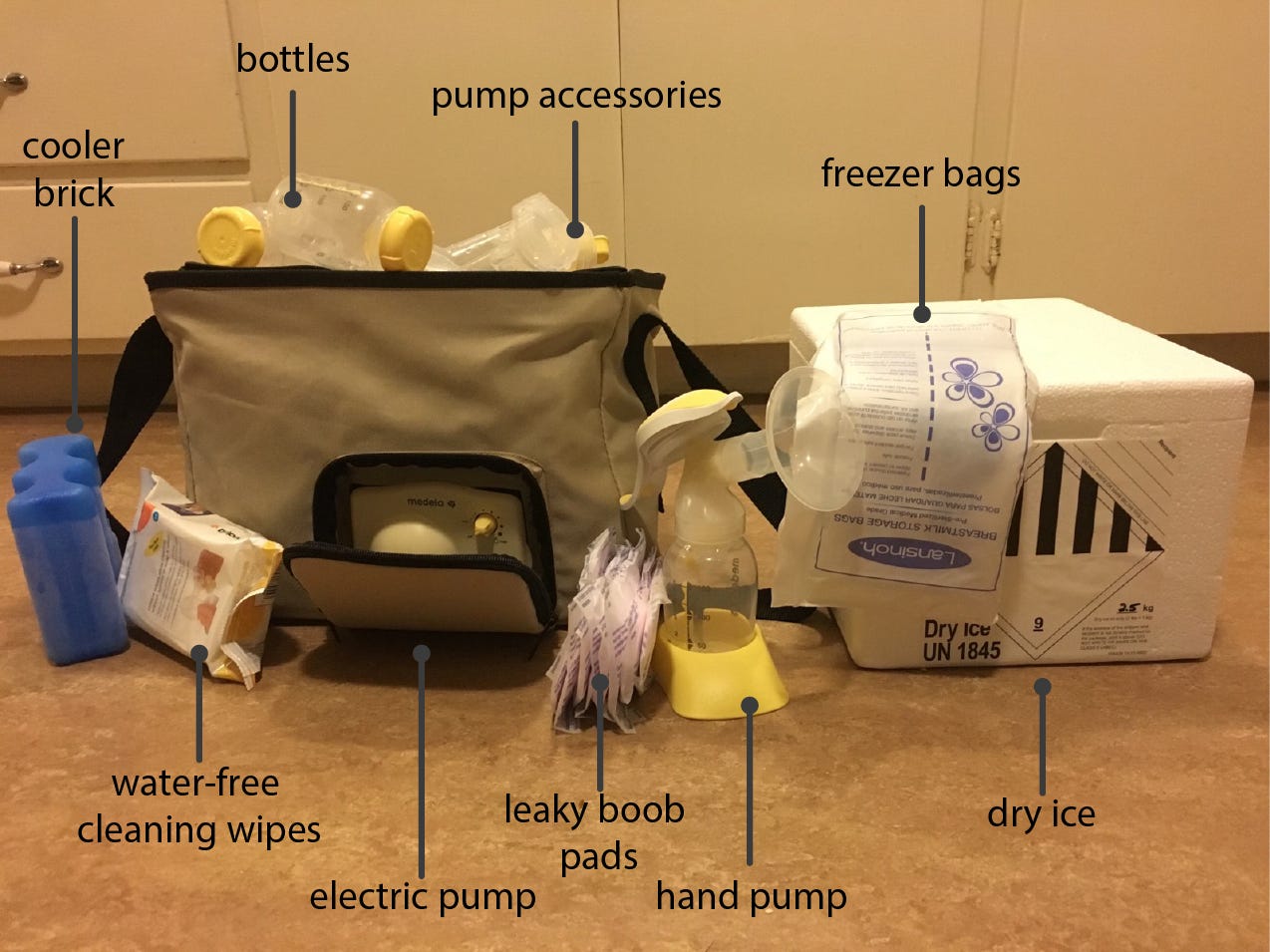
Electric pump with built-in cooler. Hand pump. Bottles. Pump accessories. Water free wipe things. Leaky boob pads. Freezer bags. Cooler brick. Dry ice.
Yes, dry ice. Frozen milk is the easiest way to transport plus I didn’t know what our freezer situation would be at our accommodation. Thankfully, TSA allows 5.5lbs of dry ice in checked bags. (My mind does not allow for pump and dump as an option)9
3:30am Feed
With a 6am flight, I want to time one last feeding as close as possible to avoid pumping before takeoff.
4:45 Baggage check
Serious baggage limitations on Spirit (RIP) so I check my electric pump. I repeatedly asked airline attendant if my bag will be fine with the dry ice but I put my hand pump in my carry on just in case my bag mysteriously disappears.
7:15am Decision time
Flight descending into Vegas. Do I wait for my checked bag or use hand pump immediately? I decide to roll the dice and wait for my checked bag.
7:45am My bag made it.
Flight lands at 7:30. Bag at the carousel almost immediately. Our accommodation is only 15 minutes away, I’ll pump there.
8:15am Time to pump!
I furiously unpack and pump. Almost 5 hours since I fed the baby and she would have eaten again around 6am. My sore boobs are not-so-subtle reminders that I already broke my rule of pumping every 3–4 hours.
Not off to a good start.
9:30am Booth set up
Looking at a long day stuck on the convention floor. I will have to pump at least three times on-site today.
11:30am Pump One
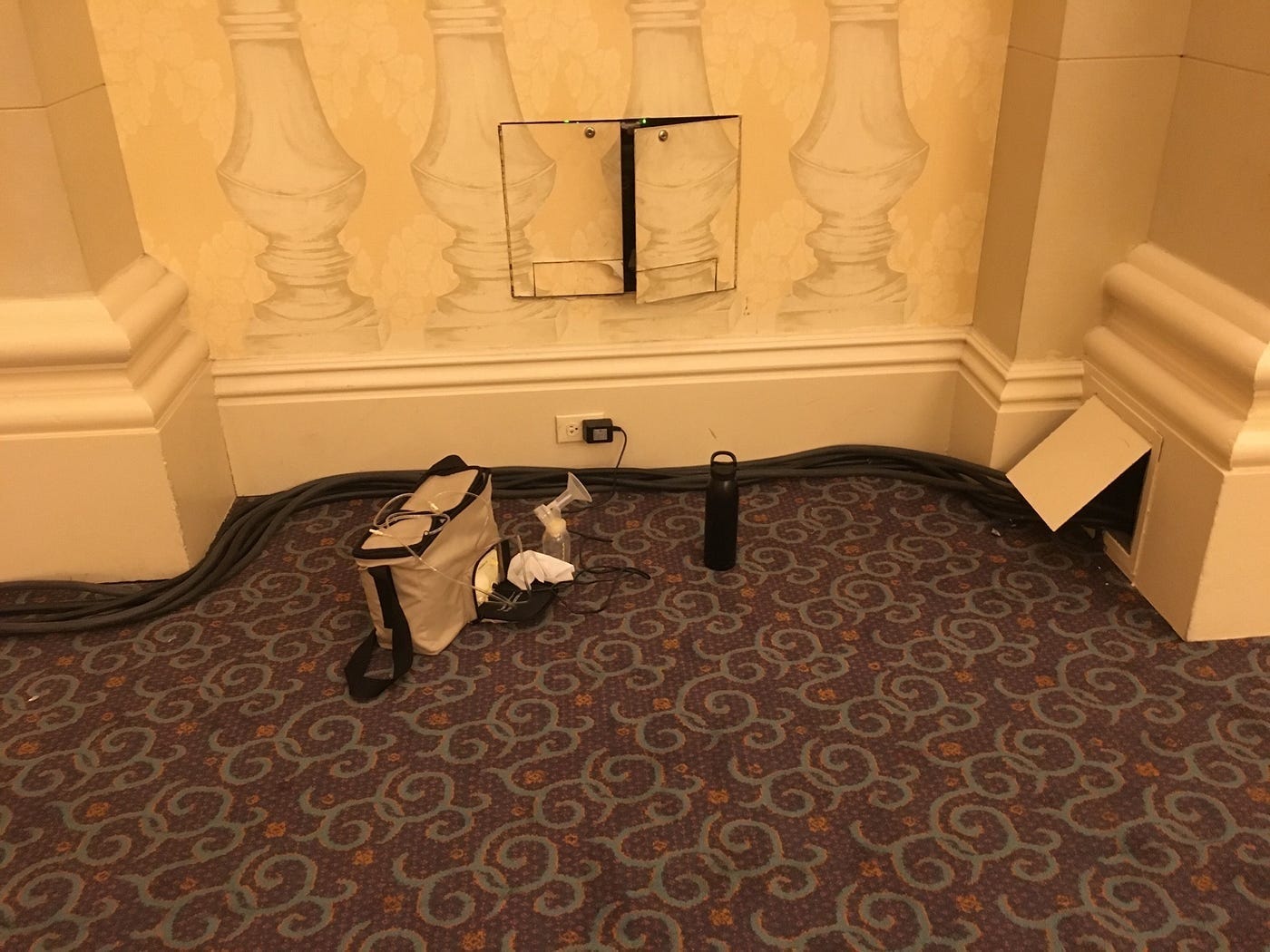
I find a bit of down time with the booth and frantically race around to find a spot to plug in my electric pump. No freaking outlets anywhere except for those in very public space, each with a small crowd hovering to charge their devices.
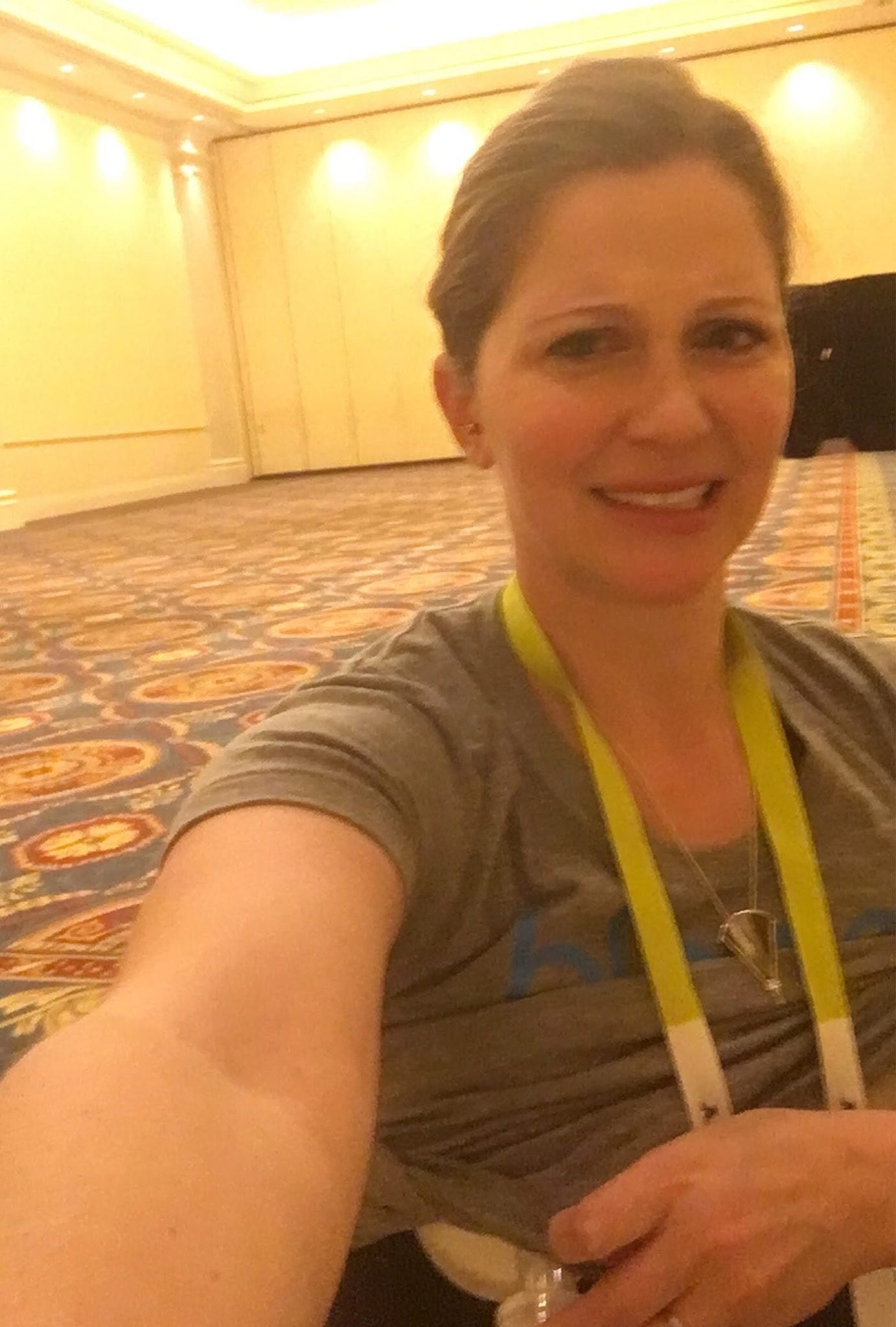
I find a secret entrance way to a secret empty ballroom. Score! I set up and start pumping. Except for the team of men coming in and out gathering up chairs, I have some “privacy”.
2:30pm Pump Two
My own private ballroom again (except for the occasional setup crew guy). This is going to be so easy!
5:45pm Pump Three
My ballroom has been discovered. I tuck myself in a corner, 20 feet from a team of guys on a conference call.
9:00pm “Home” at last
On the couch, looking at pictures of the wee ones, all alone. I have never been so relaxed pumping before.
7:00am Pre-CES pump*
*Of course, this 7am pump is in addition to a middle of the night pump.
10:30am Pump One
Back on the floor and a lot of traffic hitting our little booth. I peel away, seek out the secret passageway to my secret ballroom and…. it’s blocked! There’s an event in my pumping space!
I frantically search for another room. I ask one of the few women with CES credentials. Blank stare.
Time to get creative. Or brave. Or both.
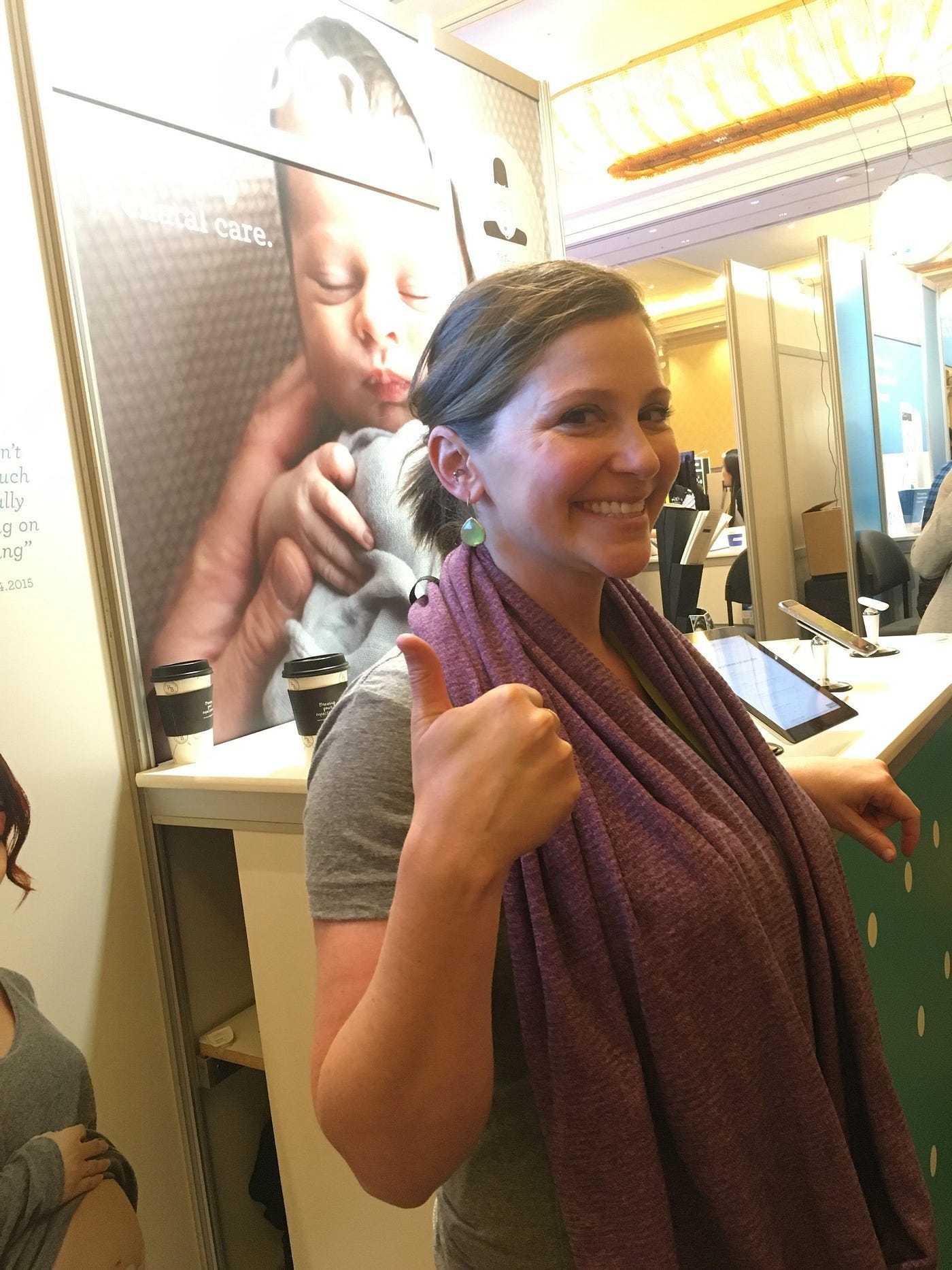
Luckily the nice folks over at the Freemie booth have hooked me up with their hands-free pumping cups. I get them in place, return to the booth, plug myself in and away I go. Nowhere to hide and all of a sudden our booth is swamped. I find myself pumping while working our booth at CES.
2:30pm Pump two
Ballroom still occupied. Another Freemie pump at the booth. At least this time I sit down… on the floor.
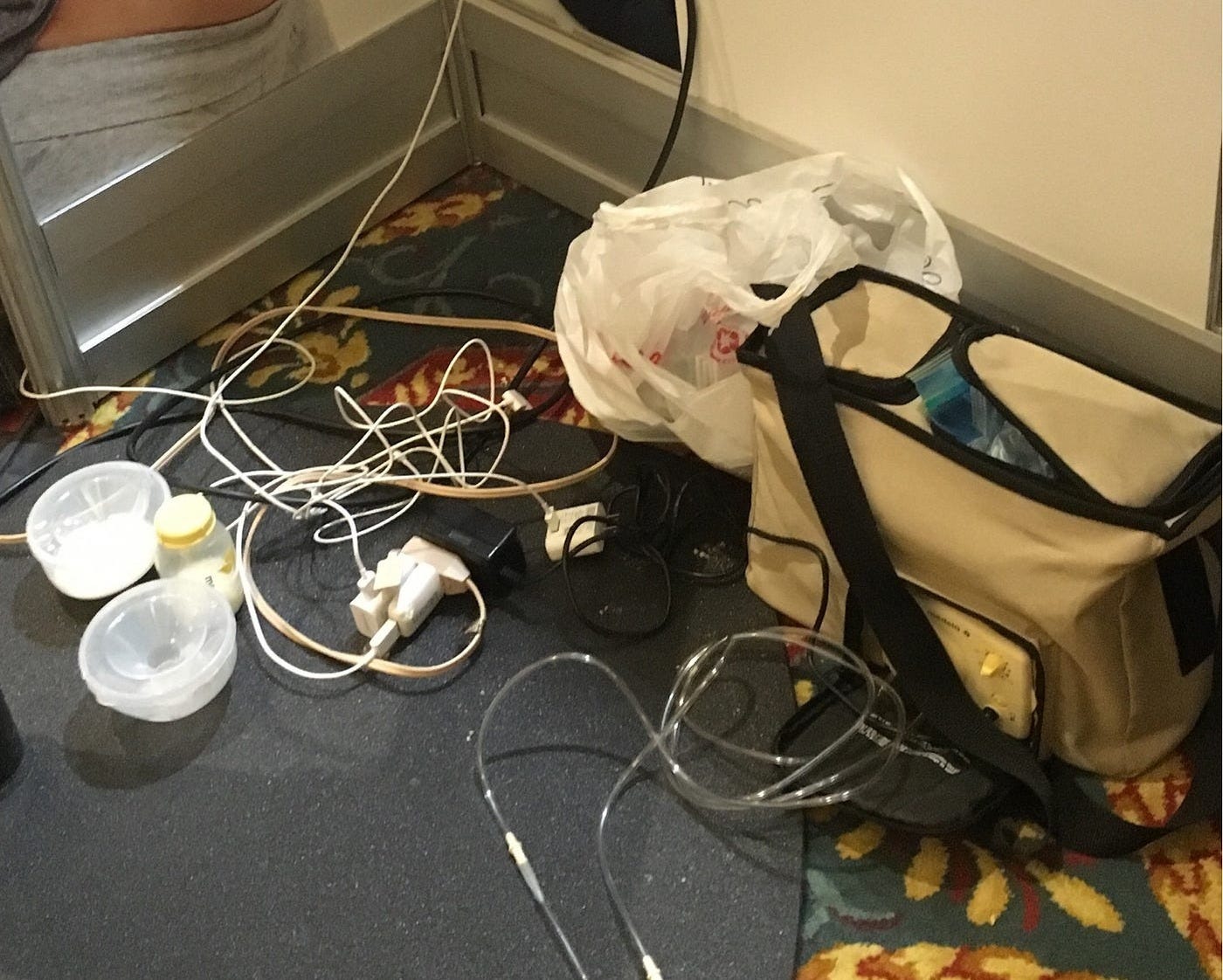
5:45pm Pump three
My ducts are terribly clogged. My breasts DO NOT like hands-free pumping equipment and I will need to massage the crap out of them to unclog. This kind of pumping session will require much more privacy. Our showroom is closing so I decide to wander the floors of The Venetian to find a better spot. I stumble upon a “family” bathroom. Luckily there is an outlet. But I only have access to it if I sit on the floor next to a drippy soap dispenser.
I have 25 glorious minutes of unclogging my milk ducts while pondering the mystery of why a toilet seat would be left up in a bathroom with a urinal.
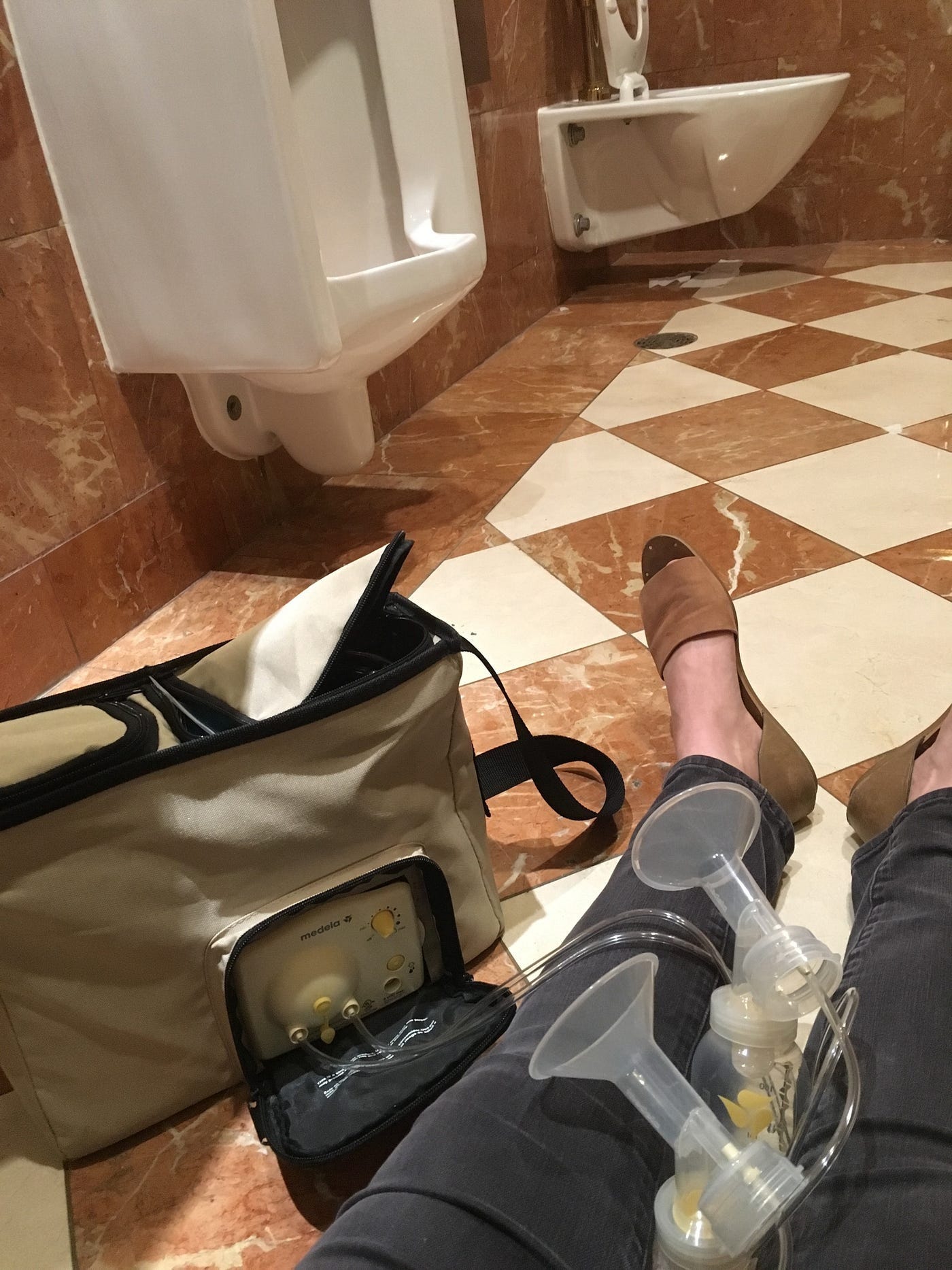
7:45pm Heading home
I arrive super early for my 10pm flight. I transfer my milk from the day to freezer bags and pop them on the dry ice. I pack my electric pump in my checked bag. I move my hand pump to my carry on.
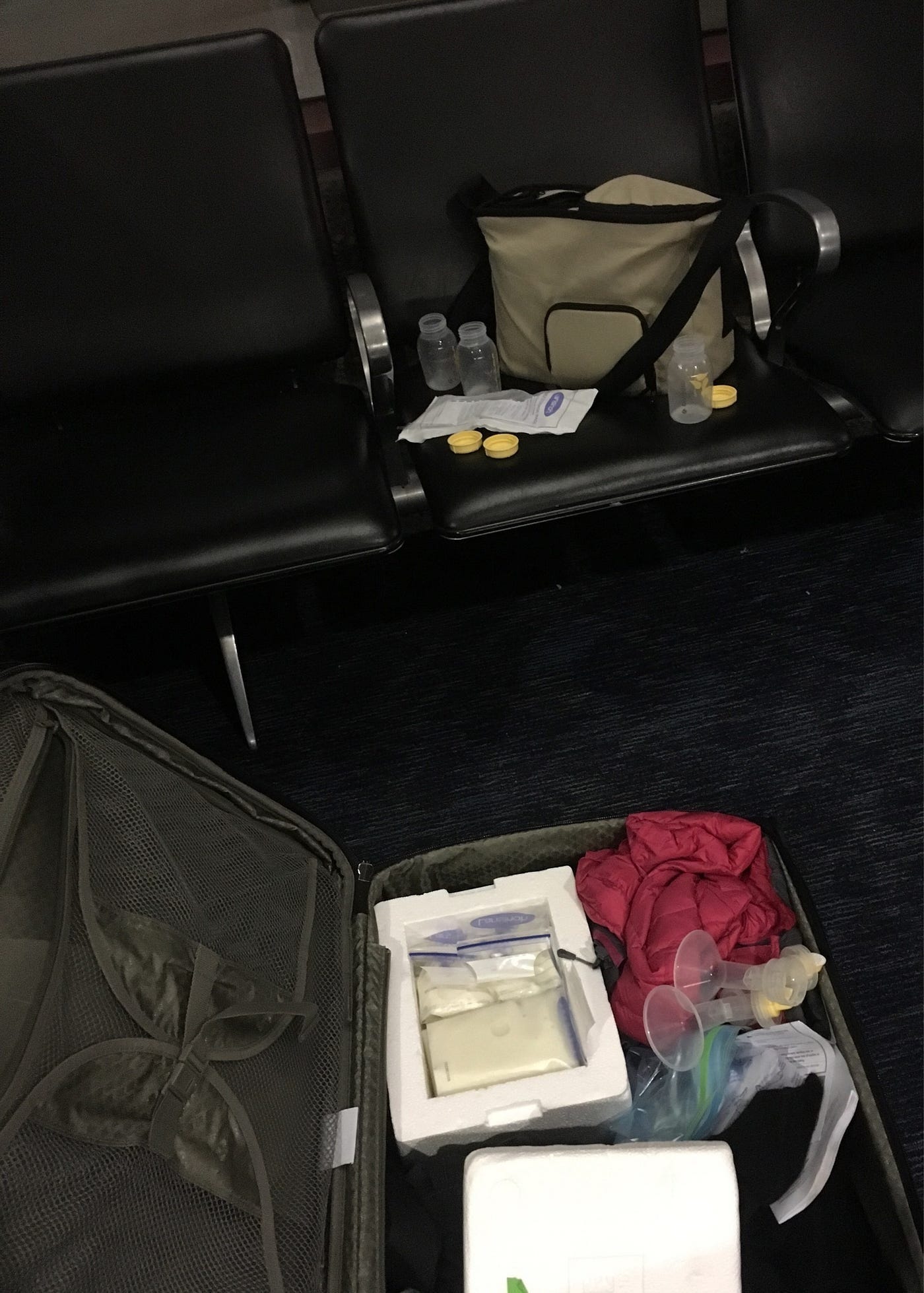
8:50pm One last pump
I will get home after midnight so I need to pump one more time. I sit on a toilet in the bathroom stall and use my hand pump. I’m in there for over 20 minutes.
Hard not to feel like I’m doing something dirty.
12:30am Home!
Milk goes in the freezer. Baby wakes up to eat.
Of course, this story has a parallel with the one I shared about my experience having an academic job interview when my first baby was only 6 weeks old:
After re-reading my pumping recap, I had a similar “holy hell… how the fuck did I do this?” reaction– but also, “why the fuck did I do this?”
I remember thinking that I had to be there as part of a very small team. I remember thinking that defining my limit to 36 hours was my taking a stand. I remember thinking that I could absolutely pull this off. Fast forward over ten years later, seeing my mind-melting, logistical gymnastics laid out… woof. Yes, I’m glad some good came out of it on the lactivist side, but, beyond that, what was the point?!
When I say stress is gendered, simply cruise that timeline (or Corrine Botz’s images) to see how stress can show up differently for mothers as lactating humans in the workplace when clashing with the “ideal worker” norm. Male workers would never have had to deal with any part of this experience or the stressors along the way:
On top of the stress factor, it’s not hard to read between the lines here and see why women may drop out of careers, especially in intensely male-biased industries, upon hitting this first wall. And half of it is the symbolism: you’re not welcome here.
The way whole industries ignore or disregard the simple fix — acknowledging and anticipating pumping needs — frames the broader issues too well.
But sure, call it a “losing ambition”.10
One more thing! Can I bug you for a tiny gesture of support? A simple tap on that ❤️, a share, a recommendation, or (if you’re feeling extra generous) a ridiculously low monetary upgrade of $6 for the ENTIRE YEAR (keeps me caffeinated 😉):
Only $6 for something free? What a deal!
Yes, emphasis on MINI here
Probably not technically “viral” but I’m giving it that classification after an on-air mention by Emily Chang (Bloomberg), who referred to my essay as a "viral post" when discussing the rise of Medium as a publishing platform in an interview with the Head of Partnerships. My post was mentioned in the same sentence as Beyonce and Hillary Clinton so... I’m taking this one 😄
Yes, I had to travel for work when my baby was three months old. See footnote 6.
A reporter who had attended CES that year commented on my post to point out the ridiculousness of this set up: "It was also very striking how the “world of innovation” had no problem sticking tech aimed at women and children in an entirely separate ballroom and not on the main show floor. A few fellow reporters were referring to it as the ‘ladyghetto.’" The ladyghetto had everything from beauty tech to baby tech. Let that one sink in.
I learned this term from (maybe coined by?) the amazingly creative team at Mamava (those simple but beautiful lactation pods you see in airports and other public spaces). I just love it so much.
as long as its not an argument that moms should stay home after birth (without paid leave)
More on that another time. The policy I wrote for myself built in a lot of flexibility but it did come with other expectations. It was the reason I was asked to roll up to CES for 36 hours with a three month old at home, but also the reason I still had some leave days at 6 months. Without a federal paid leave policy in this country, it’s easy to think anything close to four months is overly generous.
I also connected with the team at Milk Stork after this post.
Comments
Nothing yet. Say the first thing.
Sign in to join the conversation.