
The presets that cause the most damage often sound incredible when you load them.
I call them showroom presets.
You open Serum or Diva, hit one key, and the patch fills the room. Huge low end, wide stereo, bright top, long reverb, chorus, compression, movement everywhere. In solo, it sounds finished.
Then you bring the track back in.
The kick loses punch. The sub gets blurry. The vocal chop sits behind a cloud of effects. The off-beat hats lose their bite. The patch that sounded expensive on its own starts taking space from every part that matters.
When I catch myself scrolling through 400 presets, I stop. At that point I am not choosing a sound for the track. I am waiting for a preset to solve the arrangement.
A better habit is to pick a sound that is close enough, strip it back, and carve it into place.
I use four decisions.
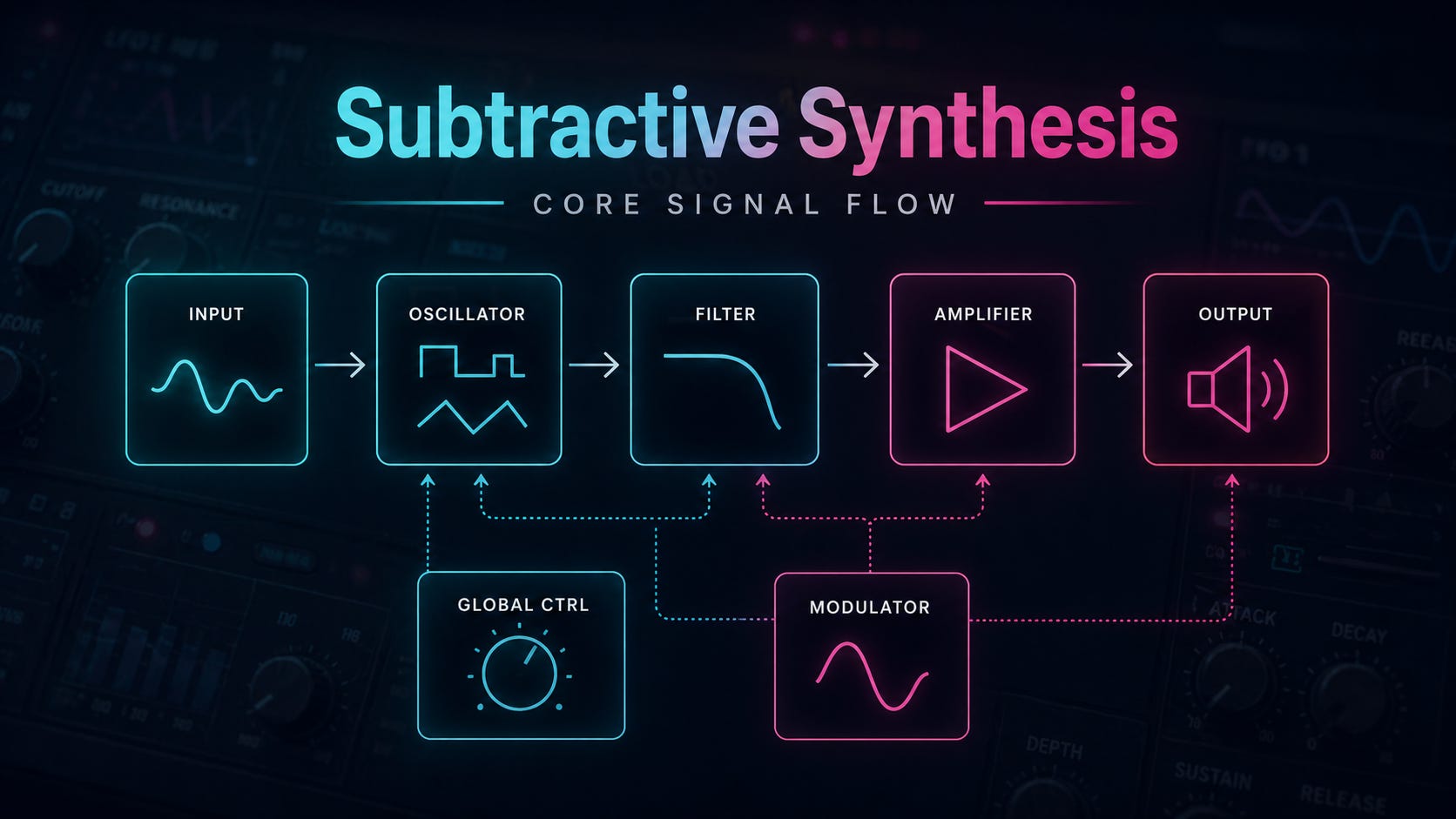
The oscillator gives you the block of sound you will carve from. A sawtooth gives you harmonic edge, which helps if the part needs to cut through drums, bass, and pads. A square wave gives you a hollower tone, which can sit under a topline without pushing so hard into the front of the mix.
Before judging the patch, turn off the perfume: reverb, delay, chorus, heavy widening, multiband compression, and any effect that makes the sound feel finished before the track asks for it.
This is where a lot of muddy synth parts begin. Three detuned supersaws can feel huge for five seconds. If the part only needs to support a build-up, that size becomes extra work later.
Simplify the source first.
Showroom presets often arrive with too much low end and too much air. They try to give you the thrill of a finished drop while ignoring the kick, sub, clap, riser, vocal, and other synths already living in the mix.
Reach for the filter before you replace the patch.
If the synth crowds the kick or sub, high-pass it. For a background arp, that might mean cutting everything below 150 Hz or 200 Hz. For a pad, you might go higher if the low mids are building up.
If the synth fights the vocal chop, hats, or lead, pull the low-pass filter down. You do not need 16 kHz on every synth layer. Sometimes the track opens up when a patch stops shining on top.
A strong synth part occupies the slot the arrangement gives it.
If the tone works but the part feels stiff, check the envelope.
The envelope controls how the sound enters, holds, and leaves. That shape decides whether the synth locks with the drums or steps on them.
For a bass that needs to hit with the kick, use a fast attack and a short decay on the volume and filter envelope. Keep the tail under control so the next hit has space.
For a pad in a breakdown, slow the attack so it blooms after the main transient. Let the kick, clap, or vocal take the front edge of the beat.
One small move can change the groove: soften the synth attack by 5 to 15 milliseconds. The drum transient gets through first, and the section feels less crowded without sidechain compression.
A synth part that repeats without change can turn into background noise.
Use an LFO, but keep it small unless the genre wants obvious wobble. Route a slow LFO to filter cutoff, wavetable position, fine pitch, or a little volume. Set the amount low enough that you feel the movement before you notice the modulation.
The goal is not to show off the LFO. The goal is to stop the part from sitting like a flat loop for eight or sixteen bars.
The Two-Minute Rule
If I cannot find a preset that gets me most of the way there in two minutes, I stop searching.
I pick the closest sound and edit it in the track, with the drums and bass playing. That keeps me out of the preset lottery and puts my attention back on the arrangement.
The best synth sound is the one that still works when the kick, sub, vocal, drums, and transitions are moving around it.
Open one synth part in your current project and ask four questions:
Raw tone, frequency slot, envelope shape, movement.
Comments
Nothing yet. Say the first thing.
Sign in to join the conversation.