
Ciao.
Act surprised. We’re finding out AI isn’t the salvation we were promised. Over the past few weeks, commencement speakers who talked up AI took their fair share of boos, and a run of reports showed companies hiring humans back after learning that AI costs them more and doesn’t do enough.
The reason isn’t that AI is worthless. We’re not that contrarian. For most of us it has replaced search engines and the platforms we used for research, analysis, and number-crunching. It changed how we work. The reason sits in the human capacity to absorb new technology, and in the fantasy a lot of CEOs hold that they can rewire how their company works over a weekend.
Read on.
Avy

Most-clicked link from the last issue: you are really scared of LLMs.
In 2024, Klarna’s CEO told the world the company’s AI was doing the work of 700 customer service agents. Hiring froze, costs dropped and the press wrote the obituary for the support job.
A little over a year later he was quietly recruiting humans again, admitting the all-AI version produced lower-quality service. “We went too far,” he said.
The easy move is to file this under “AI is overhyped” and scroll on. Klarna failed for a different reason.
When AI walks into a company, it comes through one of two doors.
Through the first, it’s an assistant. A fast junior who drafts the memo, cleans the data, summarizes the call you missed. Nothing changes structurally. You cut a few roles, maybe. The work is the same work, done quicker. Almost everyone is here, and there's nothing wrong with being here.
Through the second, it’s infrastructure: the layer the company runs on. Decisions get made differently and faster. The division of labor rearranges itself around what the machine can hold. It's the door everyone talks about, breathless. It's also the door almost nobody walks through. Ethan Mollick has been making this distinction for a while now, the shift from treating AI as a better calculator to treating it as a teammate.
An MIT study this year put a number on the failure: 95% of enterprise AI deployments showed no measurable return. Take the figure with a pinch of salt. Six-month window, fifty-odd interviews, and the initiative that published it is building the very agentic infrastructure it points to as the cure. Not the most impartial source in the world.
The companies that failed didn’t fail because their people were too dim to run the tools. Half the staff were already using ChatGPT and Claude all day, off the radar, getting more out of them than the official systems leadership had bought. They failed because the tools don’t remember, don’t integrate, don’t bend to the actual workflow. If you’re betting on the infrastructure door, the question stops being “is the model good enough” and becomes “can my company metabolize it.” Where AI adoption worked, the wins came from the bottom, from the people closest to the problem, not from a central AI office dropping a platform from above.
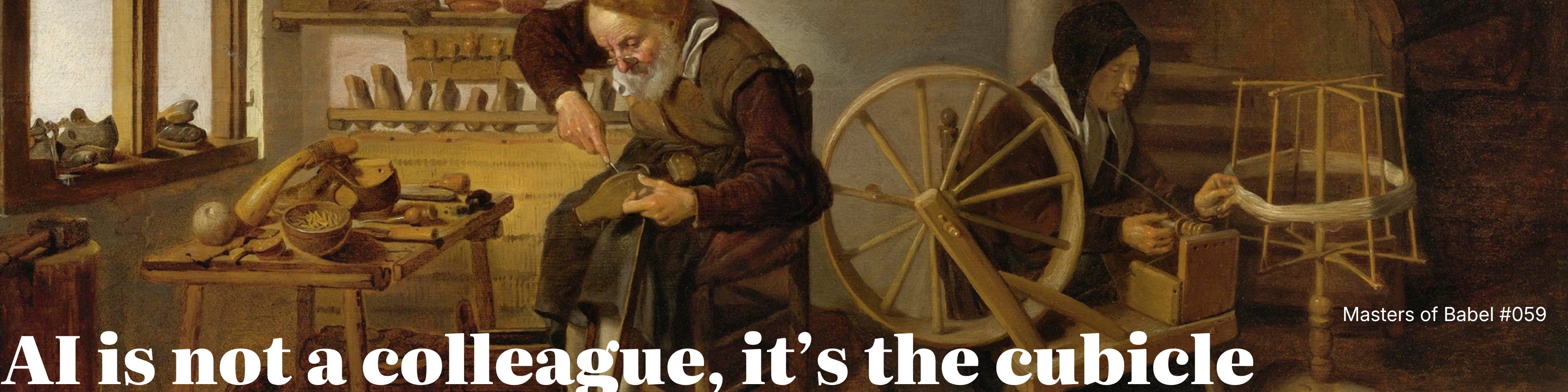
AI misfires when you command it top-down in the name of efficiency. It works when human teams learn to relate to it the way you relate to a workspace. It’s where the work happens, you can do a lot to adapt it to your needs, but it doesn’t dictate how the workday looks like.
We run companies in everyday chaos: a supplier vanishes, a tariff lands overnight, that strait closes, a competitor suddenly does that thing everyone swore was impossible, the hype cycle curdles into disappointment right when you’d budgeted for it. A brand-new problem every day. An AI is trained on the world that already happened, on old problems. Chaos is the exact moment the world that already happened stops predicting the next one.
Which means AI tools are structurally weakest precisely where you wanted them strong. In a new situation, with no precedent to pattern-match against, they have the least to offer and the most confidence offering it. The dream is “let AI run operations through the turbulence.” Turbulence is the one thing it can’t run.
Say you’re disciplined. You let the machine do the analysis and you keep the judgment for yourself, the part that weighs all the forces in the room and owns the call. Clean division of labor. Except judgment isn’t a separate organ you keep in a drawer. It’s built by doing the analysis, year after year, until you can feel when a number is lying to you. Hand the analysis away for long enough and the muscle that lets you catch the machine’s mistakes quietly wastes.
I wonder if that’s the real risk of AI in management. Not that it replaces the executive, but that it slowly removes the practice that made the executive worth listening to, and nobody notices until the day the model is confidently, expensively wrong and there’s no one left in the room who can tell. Judgment is a muscle.
Two ideas for using AI as infrastructure without betting the company:
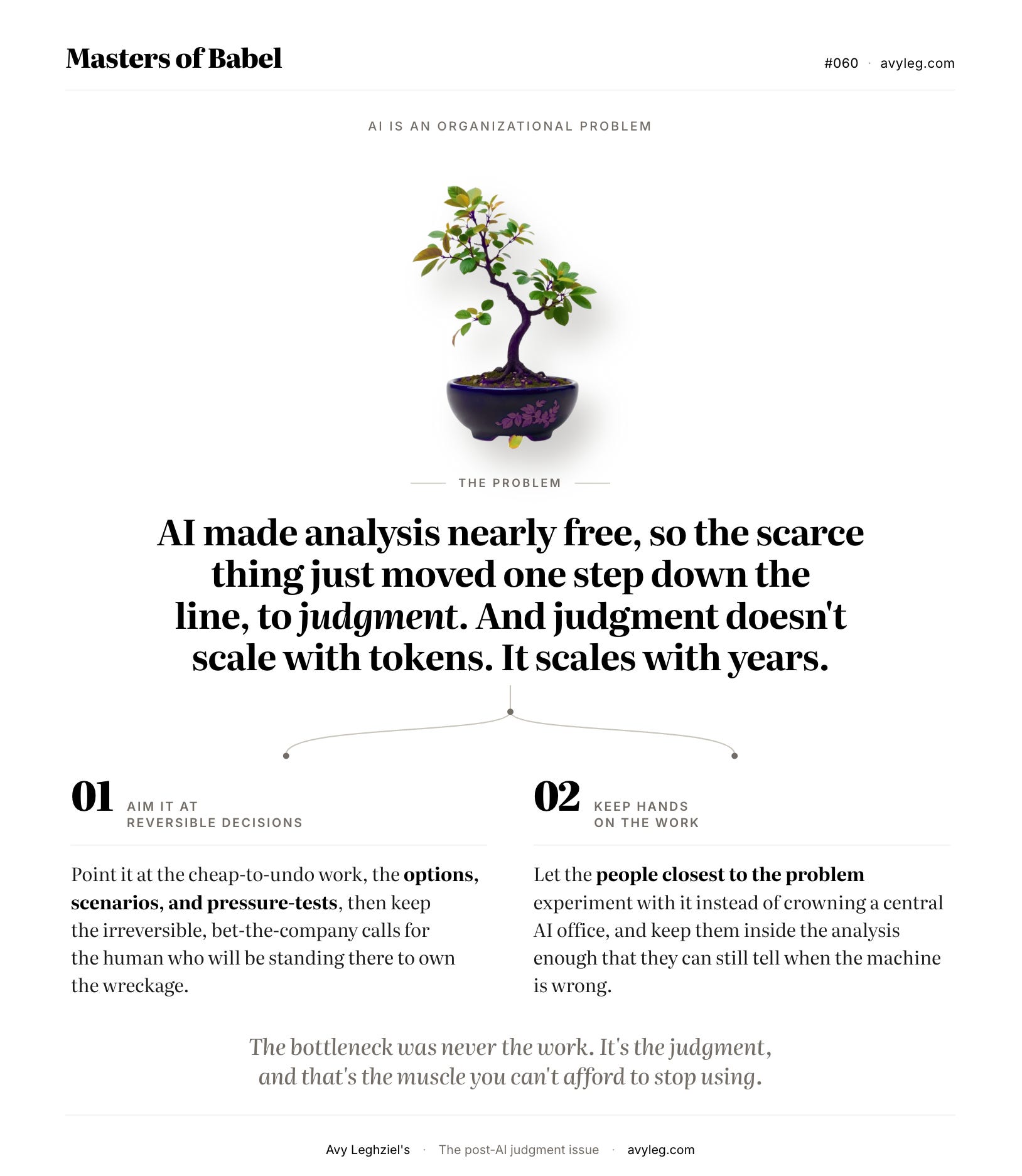
Use it on reversible decisions. Generating options, sketching scenarios, pressure-testing a plan, surfacing the blind spot you didn’t know you were standing on. These are cheap to get wrong and cheap to fix, and this is its home turf. It is also the fastest way to get the analysis a consulting firm used to charge you six figures and three months for. As a draft, it’s extraordinary.
The further a decision slides toward irreversible and politically loaded, the layoff, the market exit, the bet-the-company pivot, the more it belongs to a human who will still be standing there to own the wreckage. “Reversible or not” is a cleaner test than “important or not,” and you can apply it whenever you want without useless meetings.
Let the people closest to the work experiment with AI instead of crowning a central AI function. Keep your own people inside the analysis enough that they stay able to judge it, even when judging it is slower than letting the machine decide.
The cleanest way I can say it: AI doesn’t solve chaos. It makes analysis nearly free, which feels like the whole game until you notice it just moved the scarce thing one step down the line.
The bottleneck isn’t the work anymore: it’s the judgment. And judgment doesn’t scale with tokens. It scales with the years a person spends actually doing the thing.
So the question for anyone holding a shiny new system isn’t “what can this do for me.” It’s “what am I about to stop practicing, and can I afford to lose it.”
AI is more helpful for newbies. They are 14% more productive, but expert workers… not really. Article.
AI is not a calculator. Original interview with Ethan Mollick on why we are thinking about AI the wrong way. Podcast.
The comeback of the human workforce. The most recent research on the matter. It estimates that half of the workforce will be rehired by 2027. Article.
The anti-AI movement in colleges. The antagonism is not driven by ideology, but from fear of long term unemployment. Article.
Reversible decisions. Jeff Bezos outlines how to understand if a decision is reversible or irreversible. Video.

If you were forwarded this by a clearly amazing friend, or if you just subscribed — welcome! I recommend you start here.
If you enjoyed what you just read, consider upgrading. Masters of Babel Pro members get access to one-on-one consulting, video deep dives, exclusive resources, and much more.

Speak soon,
Avy
P.S. - I am mostly active on LinkedIn and Substack. The first one for work, the second one for my soul. Let’s connect!
Comments
Nothing yet. Say the first thing.
Sign in to join the conversation.