
Hey!
Every week, I share five things to encourage and equip in life with God.
Welcome to all you new subscribers, I’m glad you’re here! You’re always welcome to reach out, send something you’ve found, or share how an item here lands with you. I enjoy hearing from you.
This week:
1. Pocket Puritans | Thomas Watson
2. The Stone in the Middle of the River | Winn Collier
3. Make Every Effort | J.B. Phillips & 2 Peter
4. You Choose | Snodgrass
5. Hope on the Horizon | KXC
Enjoy!
MK
⬇️ Check out my book on who you’re becoming and how to grow in Christ! ⬇️
Read the forward from Jen Wilkin | Grab a copy here | Here’s a Discussion Guide
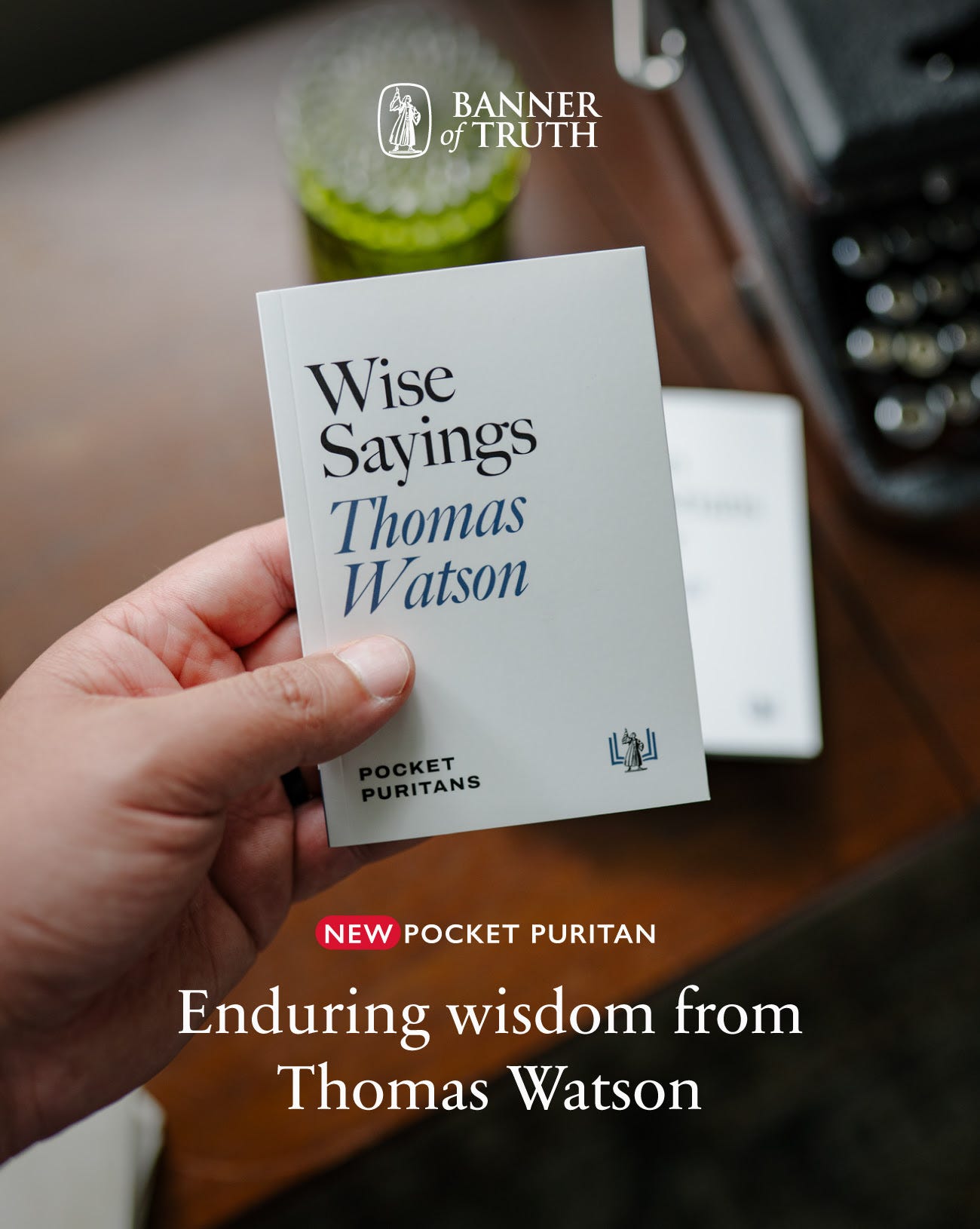
I’m one of those people who carries a book around wherever I go, usually able to read a couple pages in between things. It’s a habit I’ve kept for decades, and never got into a kindle. I need to hold the book, write in it, and remember where it is on the page. I also love shorter works or anthologies that help me get into a new author.
Banner of Truth has put together series of Pocket Puritans, and I got a notice this week about a new edition of sayings from Thomas Watson. Anytime you can get a compilation of quotes across a body of work, it’s a gold mine to dig away in and keep on your shelf. I love my copies of A Mind Awake (Lewis), The Cure of Souls (Forsyth) and George MacDonald (complied by Lewis himself!).
Check out this one of a puritan that you’ll want in your library and your heart.
Eugene Peterson is one of the pastoral voices that has shaped my sense of vocation in this pastoral work. I never had the to meet him, but his imprint in my life through his pastoral theology is one I’m ever grateful for. Winn Collier, Peterson’s biographer, has a piece this week on how Peterson was a stone in the middle of a river, and how his congregation experienced him as a pastor. My heart resonates with much of this, of the pastoral way of being (or habitus, for you Harold L Senkbeil fans) in daily life.
Here’s a snippet:
Some discovered how unsettling it was being part of a church that was so quirky and plain, with so little regard for normal church foofaraw. Lots of people think they’d love a church with only minor programming, with a pastor entirely disconnected from the assumed (almost doctrinal in its adamance) mechanisms for church growth and the ensconced strategies for discipleship. But when the new wears off, most of us are more committed to the glitter than we think.
But if those unsettled folks stayed, they’d eventually notice how all of life (Sundays and weekdays) integrated into an expansive, liberating God-radiating story. Life became prayer. And they recognized how much they appreciated the way Eugene honored God’s unique pursuit of each individual person, nothing cookie cutter. People felt safe, seen for who they were rather than for who they might be. People realized, maybe for the first time, how they actually had a pastor.
Read the whole thing here.
Thanks for this, Winn. It blessed me.
I’ve grown very fond of J.B. Phillip’s translation of the New Testament. I shared this week how I came into possession of my copy, and it is dear to me. I’ve learned Lewis and Peterson both were readers of the translation - Lewis saying it was like looking at a familiar picture after it has been cleaned. I can only imagine it was an influence in Peterson’s later gift of The Message to a different generation.
I’m preaching 2 Peter 1:3-11 this weekend, and enjoyed the translation of this passage:
1-2 Simon Peter, a servant and messenger of Jesus Christ, sends this letter to those who have been given a faith as valuable as yours in the righteousness of our God, and saviour Jesus Christ. May you know more and more of grace and peace as your knowledge of God and Jesus our Lord grows deeper.
3-4 He has by his own action given us everything that is necessary for living the truly good life, in allowing us to know the one who has called us to him, through his own glorious goodness. It is through him that God’s greatest and most precious promises have become available to us men, making it possible for you to escape the inevitable disintegration that lust produces in the world and to share in God’s essential nature.
5-7 For this very reason you must do your utmost from your side, and see that your faith carries with it real goodness of life. Your goodness must be accompanied by knowledge, your knowledge by self-control, your self-control by the ability to endure. Your endurance too must always be accompanied by devotion to God; that in turn must have in it the quality of brotherliness, and your brotherliness must lead on to Christian love.
8-9 If you have these qualities existing and growing in you then it means that knowing our Lord Jesus Christ has not made your lives either complacent or unproductive. The man whose life fails to exhibit these qualities is short-sighted—he can no longer see the reason why he was cleansed from his former sins.
10-11 Set your minds, then, on endorsing by your conduct the fact that God has called and chosen you. If you go along the lines I have indicated above, there is no reason why you should stumble, and if you have lived the sort of life I have recommended God will open wide to you the gates of the eternal kingdom of our Lord and saviour Jesus Christ.
In sermon prep this week, I was reminded of a passage from Klyne Snodgrass’ work, Who God Says You are: A Christian Understanding of Identity. Longtime readers will know this is one of my favorite books, and the final chapter is a wonderful appeal to do the work of becoming a person. It’s the cherry on top of an incredibly helpful discussion around things you inherit and things you choose in life that shape who you’re becoming. Often in conversation, I hear people (and hear myself) make excuses for the way things are, or what happened - when we had agency all along to impact outcomes based on our choices.
Here’s a bit from Snodgrass. Pick up your copy of the work here.
Here is the really crucial point. You do choose yourself, even though it is only in the context of the givens of your life. Yes, there is the huge debate about your ability to choose, the limits to your ability to choose caused by sin, hardwiring, and other people’s sins and inabilities, but you still choose yourself. You did not choose to be born, your family of origin, or where you were born. You do choose if you will stay where you were born and how you will handle relations, even messy family relations. You choose whether you will be honest with yourself about yourself and whether you are willing to be displeasing to yourself in order to become what you should be. You choose whether you will be honest about and examine the society of which you are a part. You choose to accept or reject illusion. You choose whether you will live an unexamined life. You choose whether you will take responsibility for your actions. You choose how you will handle your urges and desires, especially your anger and your sexuality. You choose whether you will give attention to and love God and God’s will or whether you will ignore God’s intent for your life and go your own way.
Who you are today is the product of your yesterdays. All your choices impact who you woke up as this morning, and your choices today will impact who you are tomorrow. At any given point you are a becoming someone - are you choosing who you are and will be?
This one hit with me this week. Enjoy, and lift your eyes.

If someone forwarded this to you, I write two kinds of emails: one on select Tuesdays about life with God and the other every Friday, where I share things I’ve found during the week. If you want to subscribe but can’t afford it, email me, and I’ll take care of it—no questions asked.
I pastor, teach, and lead at The Village Church, serving as an Elder and the Executive Director of Discipleship. I’m also working on a Ph.D. in Church History, studying Jonathan Edwards and character formation. I’ve written A Short Guide to Spiritual Disciplines: How to Become a Healthy Christian.
Thank you for reading and supporting my work as I seek to shepherd with compassion and wisdom, equipping people to embody God’s truth for all of life.
Talk soon,
Mason
Comments
Nothing yet. Say the first thing.
Sign in to join the conversation.