
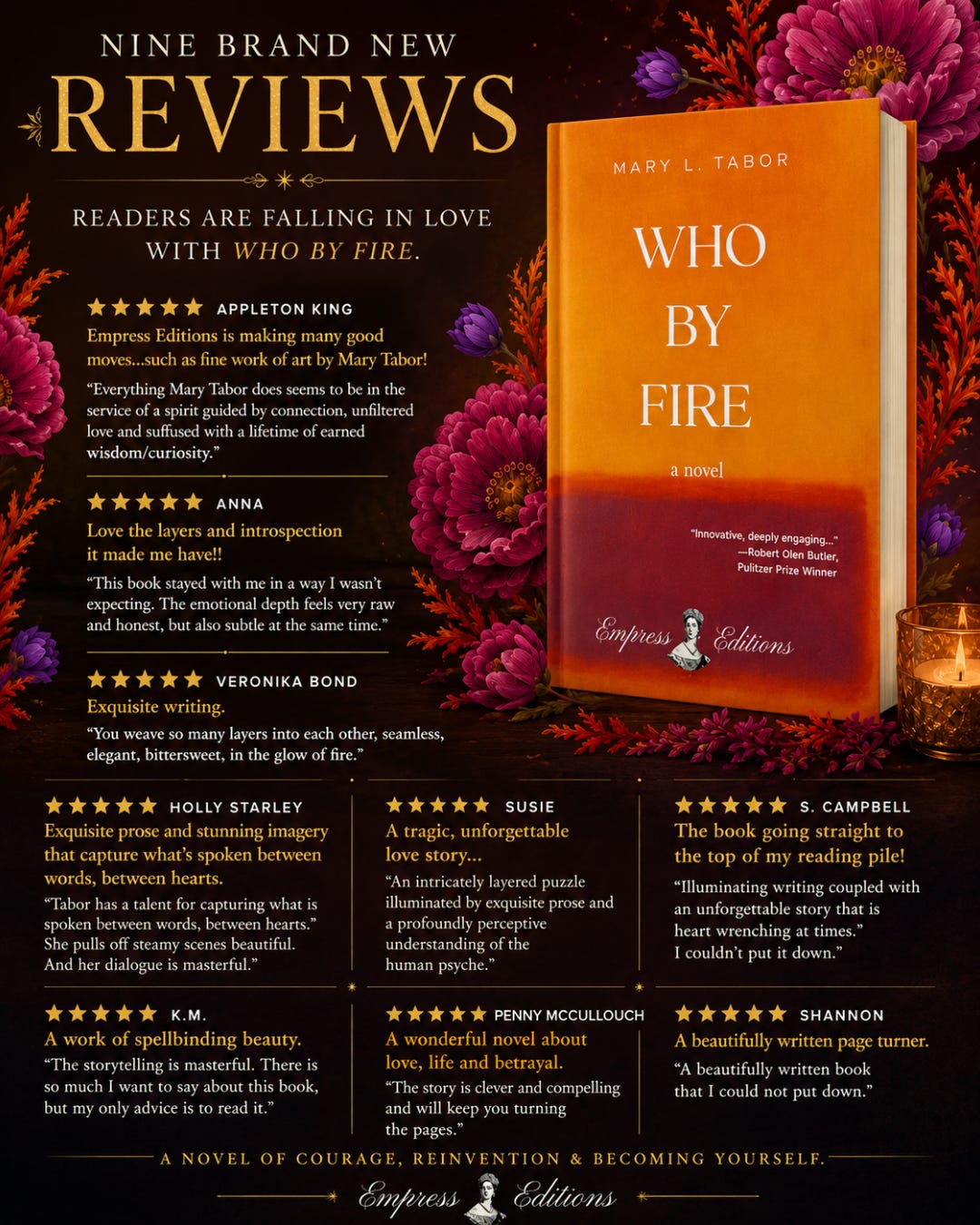
Course requirements: Purchase of Who by Fire. Readings: Short stories provided to course members via downloadable pdfs. (As a limited example: See the FREE Sample Class that follows below)—Sample class is not via Zoom the way every part of the Masterclass will be, meaning: All Zoom with writing experiments and dialogue among me and all participants!
Need more about me? Go here!
1. Cost of FIVE-DAY MASTERCLASS: $400 (discount of my usual price)—or FREE—see below; payment via Paypal invoice (even if you don’t have a PayPal account)—once you sign up by writing me at marytabor@substack.com with your email address, and, once we set the date for the course, I’ll send you the invoice. To set the week and time for the class, I’ll send options (all emails bcc-ed to protect)—be sure to tell me your time zone, and I’ll choose the week that works for most folks.
Note: At the Smithsonian’s Campus-on-the-Mall, I TAUGHT a similar course FOR a DECADE. Folks even took it more than once!
The class will be FREE for you or your book club if you or your book club buys 10 copies of Who by Fire, bought new, (verified by receipts sent to me at marytabor@substack.com); give extras away to friends if you don’t have a book club (do the math: $192.00).
2. We will meet via Zoom for two-and-a-half hour sessions for five consecutive days. This course is based on a highly original teaching method I honed at the Smithsonian where it was considered one of the top two courses taught there (the opera teacher served wine! :)— and at George Washington University to rave reviews for over a decade.
In the Masterclass, we will read eight short stories in the manner of this FREE class, parts one and two.
Today: Not Zoom: FREE Sample class, scroll down to see for today and tomorrow.
In the Masterclass you will understand both the craft and the invention—and be able to separate the two! Those two aspects are key to creativity. No toolbox book will give you this. I can and have! I will also send via email after each class pdfs of encouraging, insightful essays by famed writers that I’ve collected over my many years of teaching creative writing and understanding the mystery of “invention”.
Want something simpler? My online course is available now with a $50 dollar subscription to my Substack. It does not, however, include the live interaction that the five-day intensive does.
What you’ll have at end of the five-day intensive:
You’ll understand the “how” of writing fiction through a discussion of stories, read for themselves as works of art but more specifically to understand how, as John Gardner noted, “Fiction does its work by creating a dream in the reader’s mind.” The course will examine the complex work that creates this dream, analyzing the techniques that can be learned if we are writing and, if understood, make us more astute readers. As most literary short stories draw from the writer’s personal experience in some way—though not tied to fact—the course also builds the foundation for memoir and personal history.
Those who are writing or would like to begin will be offered in-class, getting-started experiments—a chance to try your hand at writing. Others may choose solely to enjoy the close analysis—from a writer’s point of view—of some of our best American stories. Both kinds of students are encouraged to join.
Writing experiments will be included in every class and you will have, along with the understanding explained above, fodder for beginning a story (memoir or fiction).
In the last session, along with our other work, I will explain in detail how CONFLICT operates in Chapter 40, titled “My Story” of Who by Fire—and on this last day each participant gets a personal, private zoom conference with me.
Class size: as many who sign up—date and time to be determined to fit the schedule of most of the participants.
Sample Class, limited and not via Zoom below: scroll down: My analysis of the assignment is here—but works better if you do this part on your own first.
Note: This free class will not include a writing experiment because, in the course, those who wish will read out loud—but that’s not required! I don’t want you to give away your creative work here for this sample learning experiment over 2 days: today and tomorrow!
Part 1 of limited “Sample Class”: Read “Good Country People” (PDF below) by Flannery O’Connor. HONOR SYSTEM: do not google for answers. If you do, you won’t learn anything. My approach guides you through a process of teaching yourself with my help by “looking”!
Remember the flick The Big Short? Michael Burry looked—and so did Mitch Baum.
“Good Country People” Pdf follows:
Part 2 on “Good Country People” by Flannery O’Connor
Let’s read and then LOOK! You will read “Good Country People” Twice!
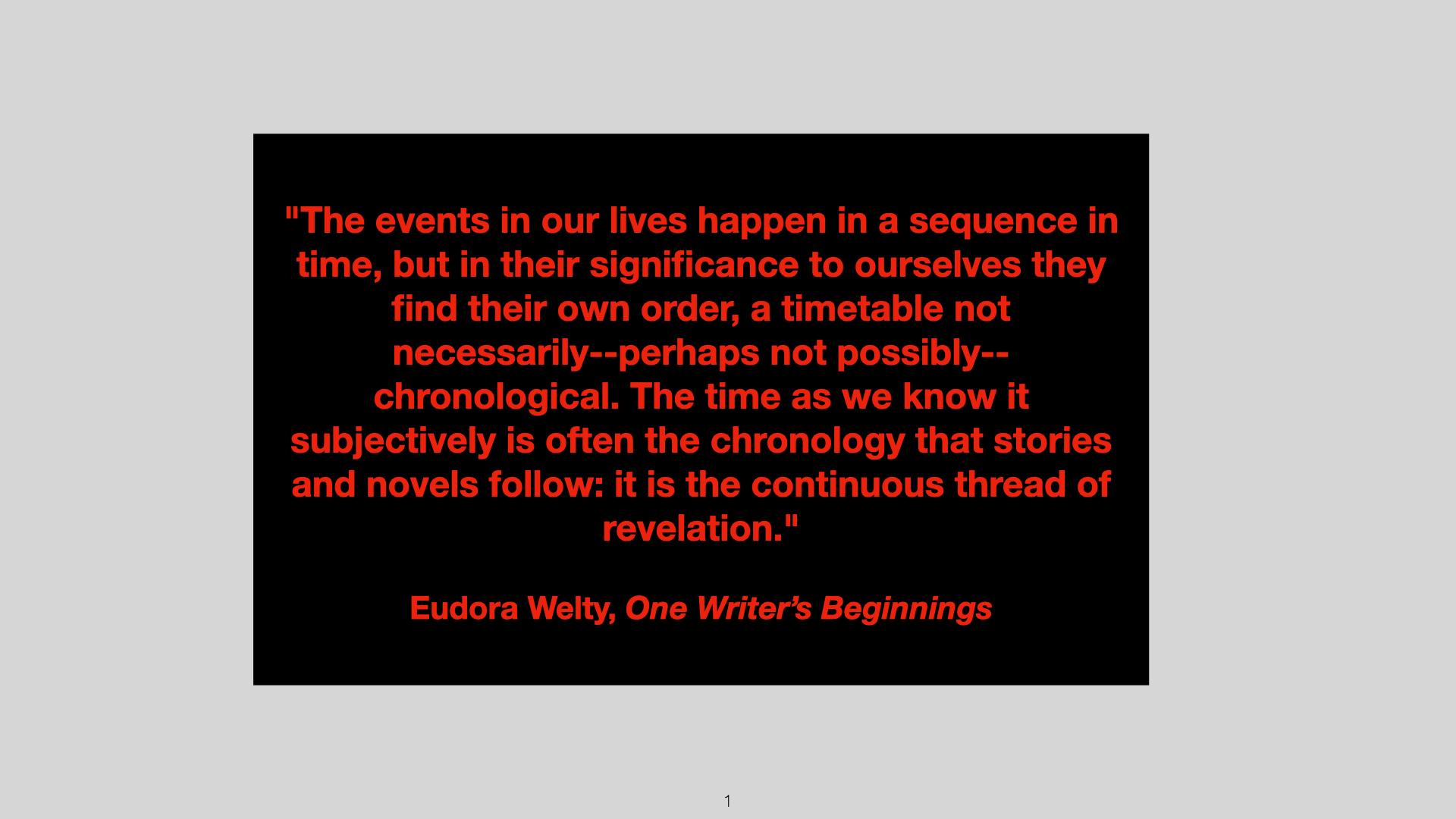
Opening quote:
First Read: For your first read (even if you’ve read the story before for a class in college or high school)—
Or: like Tommy Lee Jones, the actor, who says he’s read everything Flannery ever wrote!—
you give me a subjective response on how the story struck you. No so-called “right” answers. Answers go in comments.
In the Masterclass—in contrast to this “Sample Class”, we’ll do this by talking to each other via Zoom:
Assignment for Part #2 on “Good Country People”: Read the story AGAIN! Then answer my q’s as best you can; don’t worry; I have “worry” covered!
Questions are tough (don’t google!). No one fails with me when we LOOK!
What you’ll learn—even if you can’t answer the q’s to your satisfaction: How you read AFTER the five-day course will change—AND how you watch a good flick will change, AND maybe how you read forever! Your ability to begin to write your own story, should you wish to do so, will have begun.
After you’ve read “Good Country People” once for its organic whole as every story or novel or memoir should be read, read it AGAIN as a writer OR TO BECOME A BETTER READER:
List the plot elements. The plot is what happens in a story.
For example, in this story, the first plot element that appears to drive the story is this: The Bible salesman arrives.
Now: List all the plot elements. Put your list and your answers to my questions in comments. In the Masterclass via Zoom, we’ll do this in direct conversation with me and everyone else in the class.
Then:
1. How does each plot element work to reveal and deepen the reader’s understanding of Hulga/Joy?
2. Explain to me why the “plot” is not what the story is “about,” so to speak, even though without it there’s no story. Of course, this latter point is arguable. We’ll discuss my assertion. You learn from me, and I learn from you, as any good teacher knows!
3. Do you think Hulga’s wooden leg is a gimmick? Why? Why not?
4. Building on that: O’Connor said about this story that the wooden leg accumulates meaning in the story? How? Why?
Answers go in comments!
Sample Class (scroll down for q’s for you) without the discussion I’ll have with you in the intensive class live via Zoom.
I will give you my answers, after WE LOOKED—and respond to your comments!
So, for Sample Class, we can discuss further in comments.
Do the assignment on your own and then, say what you think; no wrong answers!
If you sign up for the Masterclass, all of the Master classes—unlike the “Sample Class”— will be via Zoom. xx
My analysis in response to the q’s for the non-Zoom FREE “Sample Class are here. But, of course, the sample class works best if you do the assignment first before seeing what I have to say.
In the LIVE Zoom classes, I will never lecture because the key to good teaching is exchange—not lecture!
Love,
Comments
Nothing yet. Say the first thing.
Sign in to join the conversation.