
“Mary Swander is funny,” said one of my Amish neighbors, a three-year-old in a straw hat, with rounded cheeks and a wide grin that lifted his whole face up as if it were a stage curtain. “Funny Mary Swander.” He grinned at me.
Mmmpf, I thought. This child is speaking English. Very unusual. And he lives a good 3 miles away from me. I barely know him. It seems my reputation has traveled. But was this a compliment?
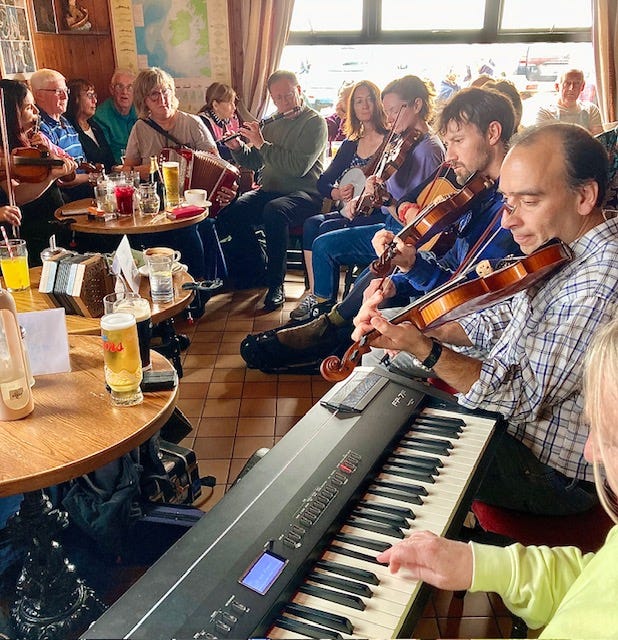
In my childhood, we lived with my Irish grandmother. She had grown up in a world of superstitions and pranks, jokes and sarcasm. She could be quick-witted, filled with one-liner put-downs, and at the same time, a levity that made a dark time bearable. At an early age, I learned that humor had been a way to push through hardships, through every challenge from the The Gorta Mor (the Great Hunger), to the Great Depression. It was a kind of humor that said, “Don’t let this little problem stop you. Keep going. Make fun of it. Get your mind off of it. Let’s have some music, and for God’s sake, spare others the dreaded details of whatever you’re stewing about.”
My grandmother could also easily slip into the role of the seanachai, the rural storyteller. In the days before T.V.s and screens, when the radio was turned on only for the hog market reports and the recitation of the rosary, my grandmother often sat in front of the fire, and in a deadpan, spun self-deprecating stories that had the whole family cracking up.
From these sessions, I learned about the basics of entertainment, and the components of a good story. I didn’t have the words for these elements until much later, when I studied literature in college, but I clearly absorbed concepts like protagonist, antagonist, conflict, setting, climax, and resolution.
And like most children who lived a rather isolated life, I thought that the rest of the world loved story, too. I thought families held together by meeting hardship with humor. By the time I hit that college literature class, I realized that a sense of humor, at least the Irish sense of humor, was cultural. And no, most families didn’t use humor to blunt the sharp edges of suffering.
Car accidents—never my fault, mostly hits from drunk drivers-- have plagued me throughout my life, becoming my own Gorta Mor. Paralysis, broken bones, torn ligaments, ruptured disks, spinal cord infections, cerebrospinal fluid leakage, traumatic brain injuries, pain, pain, pain, and more pain. I have been in traction off and on since I was 15. My attic looks like Lourdes, holding an array of walking devices—wheelchair, walker, and cane. Braces for every part of my skeleton hang from the rafters: wrists, arms, neck, clavicles, low back, legs, ankles, and toes.
At one point in the recovery from one of these accidents, I was sent for EMDR, a kind of psychotherapy that addresses severe trauma. Through the guidance of the counselor, I was instructed to call to mind a targeted trauma, then release that memory through a sequence of rapid eye movements.
My therapist directed me to explore the incident in my mind. I sat quietly at the end of it, shaken by the depth of the experience. I was hoping against hope that this memory would leave me. I don’t remember saying anything.
Then the therapist turned to me with a frown. “I don’t want you to misunderstand and think I’m blaming the victim, but I want to know why you make a joke out of everything?”
“Because I was raised Irish?”
Her brow furrowed, lips tightened.
I knew I could never explain a seanachai to this woman.
I left.
The memory didn’t.

“Here it is,” my Irish friend Jane said, holding up a medical report and x-rays of her shoulder. Months before, she had taken a terrible fall, broken bones, and had had multiple surgeries on a leg, her back and a hip. She’d been in rehab for months and in physical therapy several times a week. But she was still having terrible pain.
“Will you need to have surgery on your shoulder?” I asked. “Is the rotator cuff torn? Or is it something else?”
“Well, let’s see,” Jane held the medical report up to the light. Apparently, there is a tear on the whatchamacallit next to the thingamabob. . .
The room full of visitors began to smile.
. . .that attaches just beneath the doodad above the doohickie.”
Smiles turned into laughter.
“Repair suggested to the thingamajig to prevent atrophy and promote full ROM of the whatsit area.”
“Oh,” I said. “Best to schedule that procedure right away before the whoseywhat forgets.
Sociability goes right along with the Irish sense of humor. I spoke to another Irish friend on the phone the other night. He had just gotten out of the hospital for surgery.
“I was in for five days,” he said. “I was on a ward. Eight people there all together.
I had taken enough of my Amish neighbors to hospital wards--cramped rooms, curtains pulled around end-to-end beds, with no place for a visitor to sit, and no privacy. But the Amish never complained. Instead, they said they enjoyed the hospital ice cream and were thankful to be feeling better.
My Irish friend had a similar attitude.
“My fellow patients were real nice human beings. And the staff was top-notch. Attended to all my needs. Really an interesting experience getting to know all those good people, and being thankful that I was in a well-run hospital.
“There was a Russian guy in there. He spoke through Google Translator. All of a sudden, we’d hear the phone roar, ‘Mne bol’no. (I’m in pain.)’ He’d get a pill, and then we’d all go back to sleep. A positive experience all around.
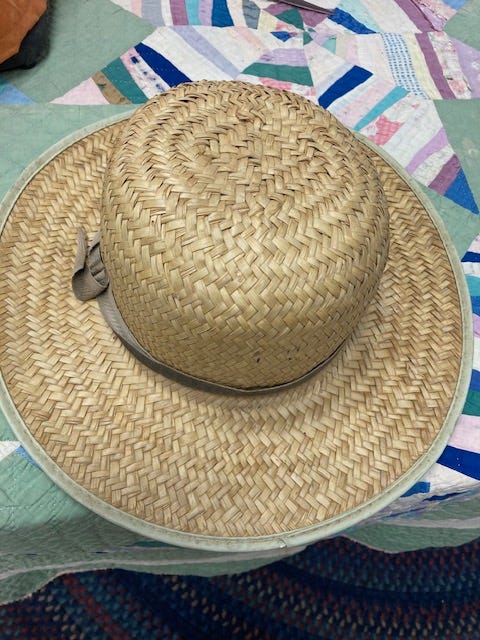
“Funny, funny, Mary Swander,” the Amish child repeated to me, laughing and giggling.
I decided his words were positive. It was good to model humor in any community. And when this child grew up, I wouldn’t have to teach him about a seanachai.
I am pleased to be a member of the Iowa Writers Collaborative. Follow our writing in the Sunday and Wednesday round-ups. Always something to like.
No posts
Comments
Nothing yet. Say the first thing.
Sign in to join the conversation.