
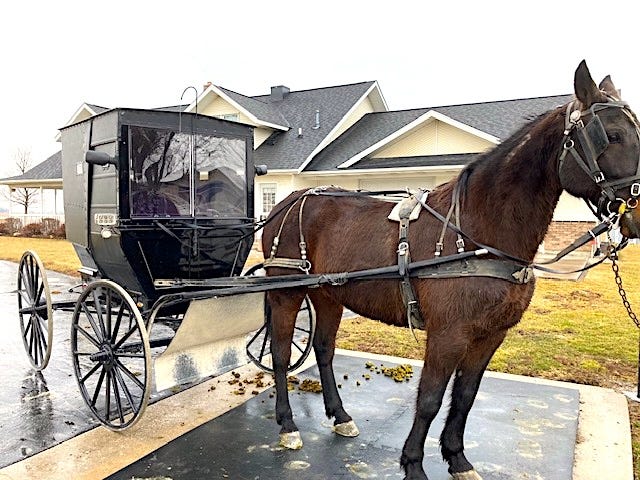
“We’re at war,” I told Elmer Kauffman, my Amish neighbor.
“Trump bombed Iran,” he said, “before they could develop an atomic weapon.”
“Well, we don’t want them to have a nuke, but the whole thing is more complicated than that.”
I was surprised Elmer even knew about the war with Iran. Without TV, radio, or a national newspaper, the Old Order Amish are often blissfully unplugged from mainstream culture. Usually, they get their news from English neighbors or delivery men who slant things toward whichever side of the polarized news media they happen to consume.
I try to explain things in the most neutral way possible. But at times, it can be difficult.
“Now who is this guy Elon Musk?” Elmer had asked me last year.
“A very rich man who is trying to cut our whole government down to nothing.”
“Nothing?”
“He thinks it’s okay, because he wants us to all go live on Mars.”
“Can we survive on Mars?”
“Not without a massive amount of technology.”
Elmer’s brow contracted. I could see him mentally x-ing off Mars for the Amish community.
“Well, then, who is Bill Gates?”
Do I explain the Epstein files? Maybe not.
“He made a lot of money on computers, and now gives much of it away to get people vaccinated.”
“Mmph,” Elmer said. Neither of those two things appealed to him.
“Trump will make a deal with the Iranians,” Elmer said.
“Obama already made a deal, but Trump tore it up. He tried to negotiate again, then he just started bombing Iran.”
The Amish are pacifists, and during the Reformation, their beliefs about war pitched them out of the Catholic Church and onto woodpiles to be burned as heretics. Now, they live in a cloistered world, with just enough contact with the secular world to monitor national and world wars from a distance. Their biggest fear is the draft that forced their young men to register for military service. The two world wars were especially brutal for the Amish conscientious objectors.
In World War I, there wasn’t even a conscientious objector designation, so the Amish men were just thrown in the barracks with all the other draftees. The Amish had been told by their bishops that they had to show up, but were to resist at every turn. They weren’t to put on the uniform. They weren’t to train with a gun. And they weren’t to kill anyone.
This wasn’t a popular attitude from a German-speaking people. The Amish suffered humiliations, psychological and physical torture. They were thrown in prison. Alcatraz. Fort Leavenworth.
By World War II, a conscientious objector designation had been created. COs were separated from the other men, but mistreatment continued. COs were treated reasonably well by the Vietnam War, but were still in danger of harassment and verbal abuse. And gaining CO status became difficult. Men had to prove that they were opposed to war of any kind, not just the Vietnam War.
Amish communities become watchful and leery of any U.S. involvement abroad. On 9/11, my Amish neighbors were working in their fields when President Bush flew from Offutt Air Force base, near Omaha, back to Washington, D.C. The plane, accompanied by fighter jets, flew so low that the Amish could read the lettering on its side: United States of America. The Amish knew something dire was happening, but they weren’t sure just what.
By the time we began bombing Iraq, the Amish concerns became real.
“We’re at war now, right?” they asked me during the shock and awe phase.
“I’m afraid so.”
“Will they reinstate the draft?”
“I doubt it. But you never know. We just don’t know.”
We have a lot to learn about passive resistance from the Amish. They have resisted wars for hundreds of years, but they also integrate the philosophy into their everyday lives. They try to settle differences peacefully. They do not sue anyone. They do not play football, a game designed to toughen men for war.
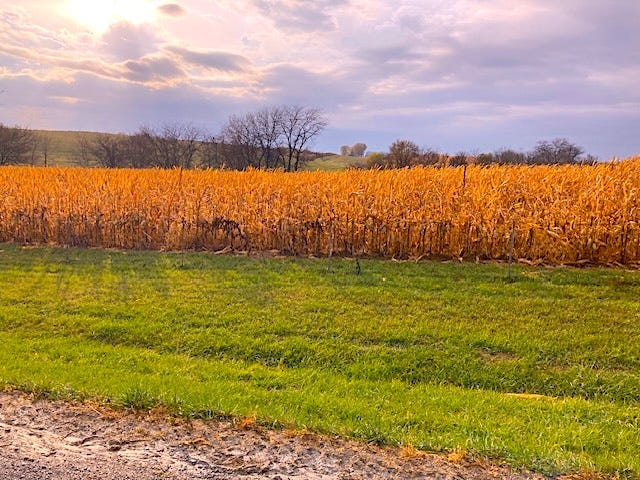
Historically, Amish resistance became obvious during their school controversies. Until the 1960s, the Amish mostly attended one-room public schools. My own house was such a school with 28 scholars, around 26 of them Old Order Amish, the others various neighborhood English students.
Then in 1965, the state of Iowa decided to close down its one-room country schools, and bus all the children to town. The Amish were told to put their children on the bus and to finish all grades through high school. The Amish don’t go to high school for this very reason. They don’t want their children to have a secular education and perhaps end up drifting away from the Amish life. No, the Amish wouldn’t send their children to town. They would start their own schools with a certified teacher. This arrangement carried on for a few years until the Amish could no longer afford a certified teacher from town. The Amish put one of their own eighth grade graduates in charge of their classrooms.
Then one day the sheriff showed up in the Hazelton, Iowa, Amish community, and ordered the children out of Hickory Grove School and onto the bus.
“Run!” an Amish father said, and the children ran through the schoolyard, squeezing through a barbed wire fence, and scampering through a cornfield to the timber where they hid until the authorities finally pulled away.
The children got the all-clear sign, returning to their one-room school. But some of the Amish parents were fined for refusing the sheriff’s orders. The Amish refused to pay. So the sheriff raided their Sunday services and hauled off some of the men to jail.
Later, the superintendent of schools who had ordered the raid said he regretted the whole incident. He didn’t understand the Amish lifestyle at the time. He didn’t know any Amish personally. And he didn’t understand their commitment to resistance.
This same scenario played out 18-20 times. Often, some outside organization would pay the Amish fines. It was suspected that Governor Hughes even paid at least one of the fines himself.
Over time, the superintendent got to know the Amish well.
“I realized that there was no way that the Amish were going to send their children to a public school,” he said. “In fact, if I had told the Amish you are going to send your kids to the Oelwein schools or be shot, they would have stood there and let themselves be killed.”
The Kalona community also resisted the school order, but their resistance took a different form. They said that no state authority had ever been to one of their schools, had never spoken to their students or teachers. They wrote the governor a letter, inviting him to come and observe their schools, classrooms that were also functioning without certified teachers.
“If you find our schools acceptable, we will then continue teaching our children as we have been doing. If you find our schools lacking, we will close them down.”
And then one day a huge big black car pulled into a school lane. The writing on the side of the car was clear: The State of Iowa. The governor himself stepped out and took his place at the back of an Amish school classroom, staying there all day, taking notes. He ate lunch with the students and interviewed the teachers. He went out for recess and watched the children play a game of softball. Back inside, he followed along with the lessons in the textbooks.
At last, at the end of the school day, the governor looked the teacher in the eye and said, “Why, I think this is a perfectly fine school.”
The governor’s office issued a state-wide exemption for Amish schools. They were allowed their own teachers in the one-room schoolhouses they had built for themselves in the country. They were never again forced to ride the bus to town, never forced to attend high school. They had no further worries. Except for getting drafted into a war.
Take in an upcoming performance of Mary Swander’s play called Coop, about Amish resistance during World Wars I and II.
19 April, 2026. Sunday at 2pm. German American Heritage Center and Museum, 712 W 2nd St., Davenport, IA.
21 April, 2026. Tuesday at noon. Muscatine Community College, Muscatine, IA.
25 April, 2026. Saturday at 7:30 pm. Fairfield Arts and Convention Center, 200 N Main St, Fairfield, IA.
Find out more information about Coop here:
Read and support my very talented colleagues in the Iowa Writers Collaborative:
No posts
Comments
Nothing yet. Say the first thing.
Sign in to join the conversation.