
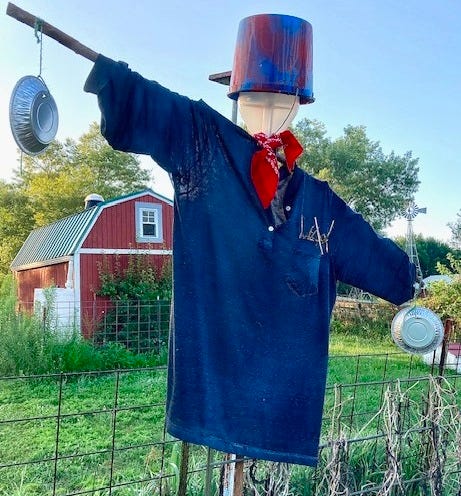
No, I am not inundated with crows attacking my vegetable garden. No, I am not spreading netting over my berry bushes. If a starling wants to eat some of my aronia berries, he’s welcome to them. I try not to fight this battle. If a cowbird or house sparrow is tearing up my young lettuce seedlings, I make note. And plant something tougher like Swiss chard the following year. Rather, I let the birds go where they may, putting out water for them, hoping they are thirsty and not really hungry. Or, like the bluebirds, hungry for cabbage worms. I try to allow my feathered friends to become more of an aid than a hindrance. Birds are not a big problem for me.
Rabbits are another story. Rabbits will move right into my garden, chomping down on my peas and beans, leveling them to the ground. Rabbits will even attempt to make nests in my garden. My dog Banjo helps keep the rabbit population under control by chasing them out of the pasture, or by camping over their holes in the spring. Hey, I’m on guard. Look what I’m doing! Aren’t you proud of me?
But the rabbits keep coming throughout the whole gardening season. So, I string aluminum pie tins around the plot. A scarecrow makes a great rack, the pie tins suspended on baling twine, clashing together. Their banging and clanging create a rhythm section for the melody the birds carry throughout the morning. The pie tins’ whirling, twirling, and flashings of light help scare the rabbits away. Some. Not a complete victory. But my peas and beans can now complete their life cycles.
In my early gardening years, I always built a scarecrow. I lived in the city then, and the whole project was more decorative than practical. Up went a frame, then a milk jug for a head, a seed cap glued to the top. A dish drain became a rib cage. An old Hawkeye T-shirt and an old pair of ripped jeans completed the outfit. Year after year, variations on this theme appeared, with my artist friends suggesting that maybe I should have gotten an M.F.A. in junk sculpture rather than a degree in creative writing.
Then I moved to Buggy Land, and I wasn’t sure a ragged scarecrow was the right fit in this area. Here, the gardens are immaculate, weedless, with straight rows ringed by pink bubblegum petunias. Soon after, a national film crew appeared to profile me. A friend helped me spruce up my house and garden, and he brought over a ceramic fountain statue of St. Fiacra, the Irish patron saint of gardeners and herbalists (and taxi cabs, hemorrhoids, and sexually transmitted diseases.) Within days, water was bubbling through St. Fiacra’s feet, and I put my scarecrow construction on hold.
The Egyptians were the first people known in the Western world to use scarecrows. Ancient civilizations weren’t as tolerant of bird damage as I am. In the days before supermarkets in every city, or Dollar Generals in every small town, crop loss could result in a serious dent in the food supply. Or even famine.
Quail and pigeons tended to devour Egyptian wheat fields. Farmers draped nets on wooden frames to protect their fields from the pests. Then according to Walaa Abdelhakim’s Scaring Birds: The Concept of Scaring Birds in Ancient Egypt, the Egyptian farmers tied long cords of white fabric around their bodies, hiding to surprise the birds, then catching the unsuspecting birds with the nets.
Native Americans also stationed themselves in their agricultural fields to scare off birds and pests. Buffalo Bird Woman, a Hidatsa, was born around 1839 and lived on the Fort Berthold Reservation in what is now North Dakota. She was known for maintaining the traditional lifestyle of the Hidatsa tribe. Gilbert L. Wilson, an anthropologist, gathered her oral history and transcribed her words into the book Buffalo Bird Woman’s Garden, documenting Natives standing on platforms, singing, clapping and banging objects together to scare off birds.
Natives also made human-like figures they placed in fields to ward off pests. In the Western world, the Romans placed wooden statues in their gardens and field, erecting effigies of fertility gods like Priapus (the god with an over-sized phallus that could hold up a season’s worth of produce) to protect the harvest. Roman armies spread throughout Europe, taking their scarecrow-building skills. Local cultures began making scarecrows of cloth, and stuffing them with straw.
In Ireland, locals slipped into the very skin of scarecrows, bringing them to life with music and dancing in folk traditions. Irish mummers, groups of neighbors dressed in flamboyant costumes with straw masks often covering their whole heads, travel from house to house during the 12 days of Christmas, often culminating their revelries on St. Stephen’s Day. The mummers sing, play music, and perform ancient plays symbolizing death and rebirth.
Historically, the mummers portrayed heroic figures like St. George and St. Patrick, or folk characters like Jack Straw, or mythological characters like Beelzebub. The mummers also poked fun at political figures like Oliver Cromwell.
On the contemporary scene, scarecrows have come full circle. Disembodied bio-acoustic sounds are sometimes used today to drive away swarms of birds, from both gardens and businesses. For example, starlings are naturally afraid of predator raptors, so playing the calls of hawks, owls, and eagles may spell danger and drive the smaller birds away.
Playing the distressed sounds of birds of the same species may also do the trick. Starling cries may mimic an injured or trapped bird, warning others to stay away. Loud sharp sounds like gunshots or cannon fire may also scare away nuisance birds (as well as ruin the hearing of the humans who set them off.) Softer sounds can be equally annoying, often mimicking the noise of cicadas. Some business owners say they will tolerate the cicadas instead of the smell of bird droppings on the sidewalk outside their doors.
Overall, scarecrows may not be as effective as we would like. Yet they open the door to something deeply primitive inside us, something that for a moment gives us a feeling of control over another person or species. Or over a change in our own identity. Or a moment of magical thinking. Scarecrows may scare even us. Or create comic relief. Or entertainment. Or an evening of escape from an oppressive political situation.
Scarecrows have many functions, creating a shift in our everyday consciousness toward something more fantastical, something that lifts us out of our mundane lives. And how fun to find this thing in the middle of a garden or flat field. And isn’t that a surprise we need in our lives right now?
I am pleased to be a member of the Iowa Writers Collaborative. You can catch up with us through our Sunday and Wednesday round-ups.
The 2026 Bio-Sanctuary Contest

First prize: $1000
Runner-up: $500
Deadline: October 1, 2026
Entry fee: $10
AgArts announces our 2026 Bio-Sanctuary Contest featuring $1,000 (first prize) and $500 (runner-up prize). We are seeking writing—poetry or non-fiction, 500-word maximum. Along with your writing, submit 1-3 excellent photos that document the specific bio-sanctuary that you’ve enhanced or created. Winners will be published in The Blazing Star Journal and Emerging Voices Substack page.

What’s a bio-sanctuary? A refuge that allows flora or fauna to flourish. A bio-sanctuary can be as small as a balcony bird-feeder, or as large as a wetland. It can be a pocket prairie or a windbreak. It can be a mason bee house, or logs and branches stacked up to create a dead hedge, inviting insects, frogs and toads, and fungi to take up residence.
Why are bio-sanctuaries important? To build robust and resilient ecosystems, providing food and shelter to vanishing wildlife.
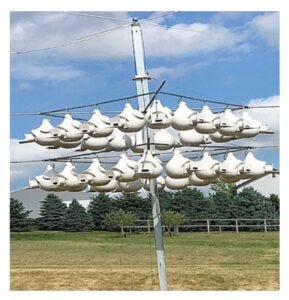
AgArts is a nonprofit designed to imagine and promote a healthy food system through the arts. We are based in collectives throughout both rural and urban areas in the U.S. where we help fund and support artistic projects that envision better ways to grow and consume our food.
Deadline is October 1, 2026. Submit here.
No posts
Comments
Nothing yet. Say the first thing.
Sign in to join the conversation.