
In this edition, sponsored by Connolly Communities in beautiful Green Pastures:
More hard time handed down for another Marysville/Richwood drug ring participant
City gets clean audit; cleared of false allegations on real estate purchases
Backers of Marysville East and Marysville South commercial developments get it right in New Albany
What surprises Richwood Bank CEO Chad Hoffman about local consumer behavior these days?
Part 4 of our Special Report on the MEVSD Facilities proposal: Can you say “Kohl’s Cash?”
Acura’s newest design car is pretty cool
But first, a word from our sponsor

Apartment hunting? Get ready to love where you live with Connolly Communities.
Discover comfortable apartment living in one of Marysville’s friendliest, most established neighborhoods—a place where you’re more than a tenant; you’re part of the family.
Our attentive, kind team takes care of the details, giving you more time to relax, settle in, and enjoy feeling at home.
Whether you’re looking for convenience, community or a welcoming place to begin your next chapter, Connolly Communities is ready to welcome you.
Your new home may be available today.
Explore current apartment openings and schedule your move at connollycommunities.com/availability.

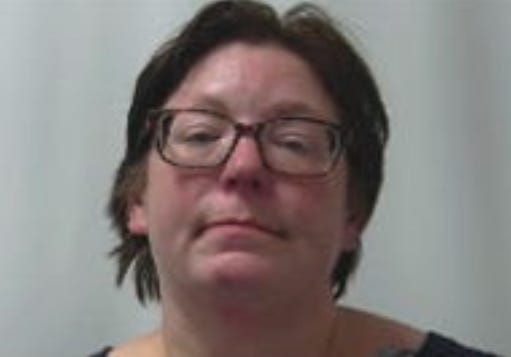
Another local drug ring suspect is taking up residence at ORW.
A 47-year-old woman was sentenced Thursday to three to 4½ years in prison for her role in a drug trafficking operation investigated by the Multi-Agency Drug Enforcement Task Force.
Elizabeth Ellen Ames pleaded guilty in March to two counts of aggravated trafficking in drugs, both second-degree felonies. Union County Common Pleas Judge Don Fraser imposed a mandatory indefinite sentence of three to 4½ years on one count and a mandatory three-year sentence on the second.
The sentences will run concurrently, meaning Ames will serve an aggregate term of three to 4½ years.
Court documents identify Ames as a driver for Brandee Greer, who prosecutors described as the principal supplier in an organization distributing methamphetamine and cocaine between Marysville and Richwood.
Prosecutors said Ames drove Greer to Columbus to obtain drugs and transported drugs and proceeds in her Nissan Rogue.
In one October 2025 transaction, investigators said Ames drove Greer to Columbus after a confidential informant provided $1,400 to purchase approximately one ounce each of methamphetamine and cocaine.
Laboratory testing identified 27.97 grams of methamphetamine and 27.88 grams of cocaine.
Fraser determined Ames committed the offenses as part of organized criminal activity.
However, the court also noted that she had no prior criminal record, had lived a law-abiding life for a significant period, and had shown genuine remorse. Her risk-assessment score indicated a moderate risk of reoffending.
Ames received credit for 267 days already spent in custody.
Following her release, she will be subject to mandatory post-release control for at least 18 months and up to three years.
The court ordered Ames transported to the Ohio Reformatory for Women in Marysville.
The final suspect in the drug ring is Billy Joe Vincent. He has a court date slated for September 3, 2026.
The ringleader, Ms. Greer, was sentenced to 22 to 27.5 years in ORW for her role.
The Ohio Auditor of State’s Office has officially accepted an independent audit of Marysville’s 2024 financial records.
The audit, completed by the accounting firm Julian & Grube, Inc., gave the city an “unmodified opinion”.
It’s the highest financial rating a city can get and means the city’s books are accurate and fair.
The clean bill of health comes as the state’s auditor’s Special Investigations Unit officially closed a separate, preliminary investigation into recent land purchases by the city.
Marysville Matters obtained a copy of the investigation report and the regular audit on Thursday. The state auditor’s office confirmed the investigation had been closed and the outcome communicated to the city.
The state launched the investigation in January 2025 after a citizen complained that the city had paid unreasonably high prices for three downtown properties in late 2024.
After reviewing property appraisals, purchase contracts, wire transfers, and municipal records, state investigators cleared city officials of any wrongdoing regarding the property values.
Specifically, the state looked at three transactions:
South Court Street: The city purchased this property for $585,000 in October 2024. Investigators found this matched an independent appraisal of $585,000, and the purchase was properly approved by the city’s Board of Control.
South Plum Street: The city bought this property for $550,000 after renegotiating the price down from $675,000. Investigators found the negotiated price was reasonable compared to nearby city-owned land and met strategic goals for downtown redevelopment.
South Oak Street: The complaint alleged the city bought this land for $47,000 and sold it two weeks later for $500,000. However, investigators discovered the city never bought or sold this land. The transaction was actually made by Habitat for Humanity, a private charity. Instead, the city had purchased nearby land on Chestnut Street at a public auction for $475,000 to serve as a beachhead for local redevelopment.
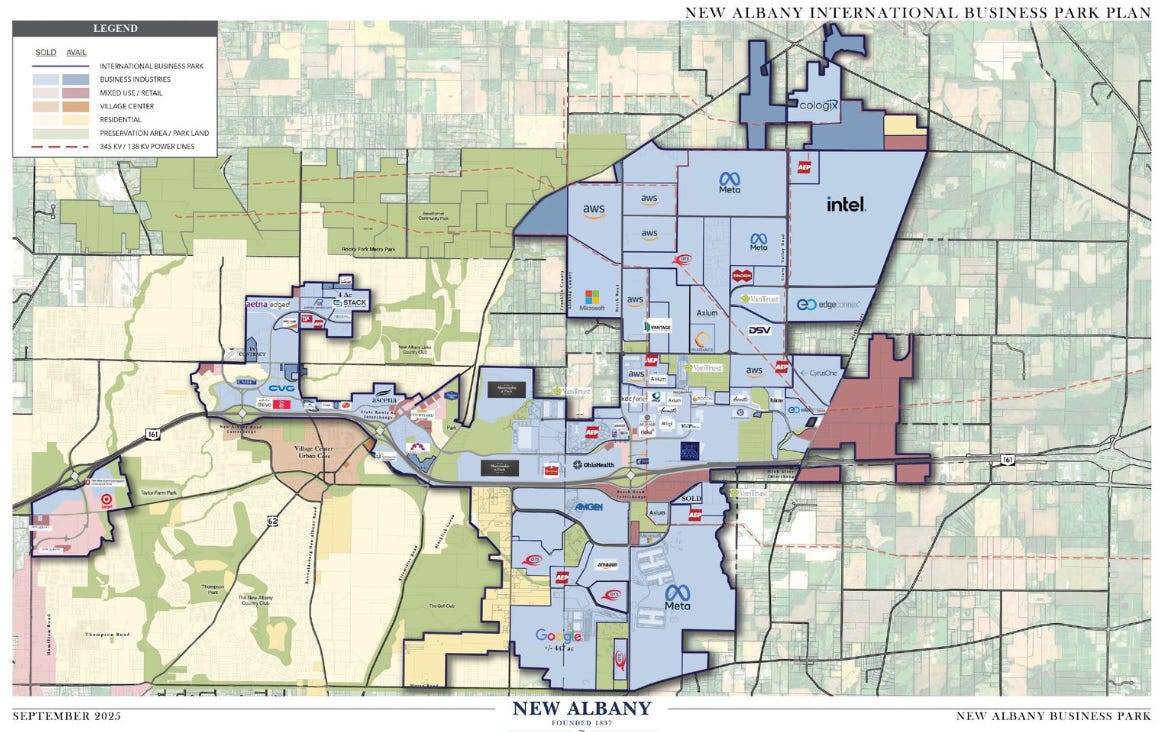
Above: Zoning map of New Albany shows industrial district in blue
New Albany is getting it right on data centers. That’s the opinion of two county commissioners who got a tour this week.
Union County Commissioners Tom McCarthy and Shaun Bailey shared details of their Monday tour of the New Albany Industrial Park during Wednesday’s Board of Commissioners meeting.
The commissioners were highly impressed by how the city manages its massive tech developments.
New Albany currently hosts more than 40 data centers, yet local officials have found ways to build them in harmony with nearby residential neighborhoods.
According to the commissioners, New Albany succeeded by directly addressing the design and placement concerns that the public often raises about data centers.
Instead of mixing these large structures into retail or housing areas, the city keeps them strictly within dedicated industrial zones.
To block them from public view, developers build dirt mounds between 6 and 12 feet high and plant trees on top of them.
The city also enforces strict architectural rules so the data centers do not look like giant concrete boxes.
Developers must include decorative elements known as “fenestration”—such as fake windows and fake doors—to make the facilities resemble normal office buildings.
The visual screening is so effective that the massive computer warehouses are virtually invisible to nearby homeowners.
“The residents of New Albany can live and have no idea data centers are there,” Bailey said.
The commissioners contrasted New Albany’s organized approach with other developments in Ohio.
McCarthy described a data center in Sandusky that was built next to a car dealership and a restaurant with no buffering at all. He called it a monolithic structure that leaves drivers traveling right along a security fence next to a major highway.
McCarthy noted that New Albany benefits from a single developer systematically managing thousands of acres. As developers begin amassing large tracts of land in Union County, he expressed hope that local officials can achieve the same level of unified planning, which is much harder to coordinate when multiple developers are involved.
“Clearly they’ve done a good job there,” McCarthy said.
The New Albany Company is the developer behind the commercial developments at Marysville East and Marysville South.
Paid advertisement

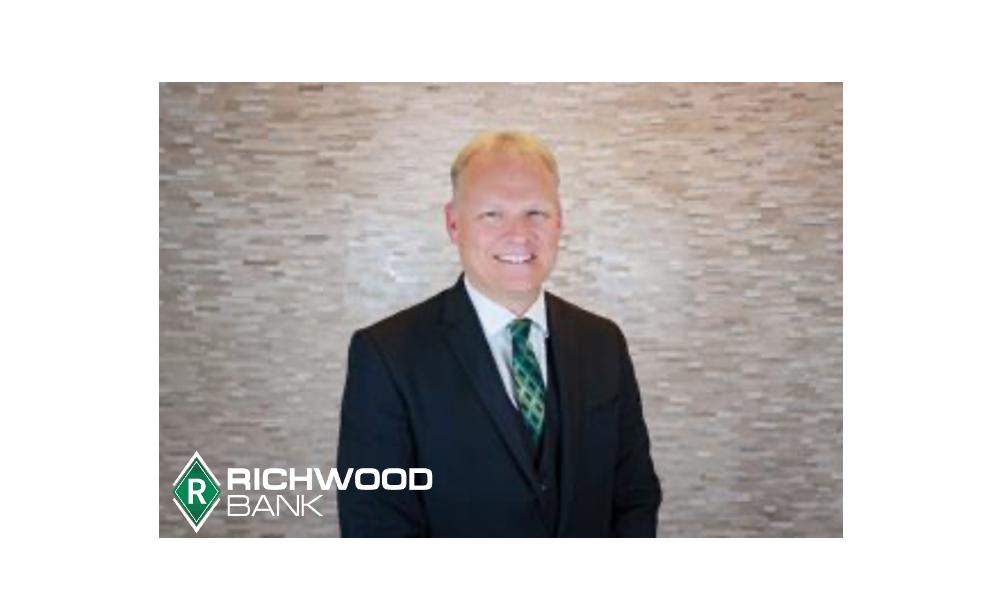
Richwood Bank President and CEO Chad Hoffman said one of the biggest surprises in the local economy this year has been the continued strength of consumer spending.
“The amount of money still being spent is astounding to me,” Hoffman said. “I go out to restaurants, I go to shopping locations, and they are extremely busy right now.”
That includes higher-end restaurants and retailers selling discretionary items—not typically the places consumers continue to frequent when household finances are under significant strain.
“If the economy is doing that bad and the gas prices are affecting us that much, how can people be spending that on clothing or on eating out?” Hoffman asked.
Several factors may be keeping that spending alive.
Wages remain relatively strong, unemployment is historically low, and many homeowners remain locked into mortgages with interest rates in the 3%-4% range. Those lower housing payments leave more money available for other purchases.
Hoffman said some younger adults living with their parents may also have more disposable income because they are not carrying the full cost of housing.
But the spending comes with a potential warning sign: Credit card balances remain high. Hoffman said that raises questions about how much of the current spending is supported by income and how much is being financed through debt.
“At what point do the credit card companies say, ‘You don’t get any more credit?’” Hoffman said. “That always makes you nervous.”
Despite uncertainty surrounding interest rates, Hoffman said residential mortgage lending continues at rates that are closer to historical norms.
Borrowers became accustomed to unusually low mortgage rates, but rates in the 6% to 7% range are not abnormal over a longer period.
On the business side, Hoffman continues to see companies making measured investments. Richwood Bank typically experiences a summer slowdown in loan applications as customers take vacations, but activity generally begins picking up again as schools reopen.
The bank set a goal of 5% loan growth for 2026 and had already reached 3.6% growth through the first half of the year.
“People aren’t going gangbusters,” Hoffman said. “They’re not going crazy, but they’re making smart investments.”
He believes some businesses are moving forward now because they see current borrowing costs as reasonable and worry that rates could be higher in the future.
As for the remainder of 2026, Hoffman is hoping for something that may sound unexciting but would offer businesses and consumers some needed stability: more of the same.
“I’m hoping status quo,” Hoffman said. “I’m hoping rates stay where they are.”
If consumer activity remains healthy and businesses continue making careful investments, Hoffman believes the local economy can finish the year with steady, sustainable growth.
Special Report
Marysville school district officials are working to lock in a 54% state funding match that could result in the state flipping the bill for a future elementary school.
The funding would come through the Ohio Facilities Construction Commission’s Expedited Local Partnership Program (ELPP).
This program allows the district to secure state credit for future building projects.
The state match is a significant part of the district’s revised $128 million facilities strategy unveiled last week during a community engagement session.
Treasurer Todd Johnson likens the arrangement to a well-known retail analogy.
“To me, it’s basically Kohl’s Cash,” Johnson said. “The same way Kohl’s Cash works, you have to spend some of your own money first, and then they give you some money on the back end.”
Under the plan, the district would have to fund the first phase of its project, which includes converting Creekview into an intermediate school and building new elementary schools at the Raymond Elementary and Edgewood Elementary sites.
The potential 54% state match provides a significant discount on the plan’s total cost and would fully fund a 6th elementary school, likely in the future Marysville East residential development north of US 36.
However, to obtain the 54% match, the district faces a deadline.
The state determines funding shares based on a “Wealth Rank.”
As Marysville’s property values and incomes continue to rise relative to other Ohio school districts, the state’s share of costs is likely to decline.
Treasurer Todd Johnson said the district has a narrow window to finalize the deal. It needs to secure funding approval from voters.
“We have a 12-month period to secure that funding,” Johnson said. “The program requires that we have a ballot issue to acquire funding... we have a 12-month time period to lock that in.”
If the district waits, the 54% state share will decrease.
This would put a higher cost on local taxpayers. Once the credit is secured, the funds could eventually pay for a sixth elementary school as growth continues.
The ballot issue to pay for all of this could go before voters in May 2027. Tomorrow, we’ll take a closer look at what that might look like and how it might actually provide tax relief for some of the community's residents.
Meanwhile, district officials encourage residents to watch last Thursday’s full presentation and to continue asking questions and providing feedback in the weeks and months ahead.
To hear the full details of this strategy, watch the complete community presentation here.

Acura unveiled a dramatic new concept car Thursday that will shape the appearance of future models, including the next-generation RDX Hybrid.
The NEXERA Vision debuted ahead of Monterey Car Week in California as Acura marks its 40th anniversary. It embodies the “design language” of future Acura models.
The sports coupe introduces a new lighting signature inspired by Acura’s “A” logo, along with butterfly doors, active aerodynamics and 22-inch wheels.
Acura said the concept’s styling will begin appearing on production vehicles with the fourth-generation RDX Hybrid, expected in the coming years.
Inside, fixed seats are integrated into the floor to lower the driver’s position, while the pedals and steering wheel adjust to the driver. The cabin also incorporates recycled aluminum, recycled polyester Alcantara, and a leather material designed to support reuse.
“The NEXERA Vision sets the course for the next generation of Acura design,” Acura design chief Yasutake Tsuchida said.
The following is a paid advertisement
![the
COURTRIGHTGROUP
GHTGROUP
the COURT
]]
BUY
SELL
give
KW CONSULTANTS
KELLERWILLIAMS.
REALTY
Jennifer
We don't just
COURTRIGHT
REALTOR®
work here-
WE LIVE HERE.
Cody Coomes
Kara Radabaugh
Jennifer Courtright
Destiny Ratliff
Stasia Peake](https://substackcdn.com/image/fetch/$s_!GR-b!,f_auto,q_auto:good,fl_progressive:steep/https%3A%2F%2Fsubstack-post-media.s3.amazonaws.com%2Fpublic%2Fimages%2F055abdf8-3949-4676-aac7-3fd0e905f90c_928x744.png "the
COURTRIGHTGROUP
GHTGROUP
the COURT
]]
BUY
SELL
give
KW CONSULTANTS
KELLERWILLIAMS.
REALTY
Jennifer
We don't just
COURTRIGHT
REALTOR®
work here-
WE LIVE HERE.
Cody Coomes
Kara Radabaugh
Jennifer Courtright
Destiny Ratliff
Stasia Peake")
When you hire The Courtright Group, you’re working with neighbors who live, work, and raise families in Marysville.
We know the local market, invest in our community, and help sellers maximize their home’s value through expert marketing and preparation
Buy • Sell • Give

Timely. Fact-based. No filler. No paywall.
All the benefits of modern, digital journalism at its finest.
Also, if you are interested, I’ve started a Marysville Matters podcast channel where I will post interviews with local newsmakers, including our candidates running in the May GOP primary.
You’ll find it wherever your favorite podcast is available, including Apple Podcasts, Amazon Podcasts, and Spotify. If you subscribe, you’ll get notified when I publish a new interview.
You can help us as we grow:
Hit the LIKE button (it matters, too!)
SHARE the newsletter with a friend or co-worker.
Follow us on Facebook for breaking updates and on our new Instagram account.
Subscribe for FREE daily updates straight to your inbox!
A big thanks to Connolly Communities for sponsoring today’s edition!
Have a great Friday!
-Joe C
Comments
Nothing yet. Say the first thing.
Sign in to join the conversation.