
Content note: This post discusses domestic violence, coercive control, stalking, non-fatal strangulation, threats against children and animals, murder, murder-suicide, and institutional failures.
IT IS NOT A DECISION TO STAY. IT IS AN ATTEMPT TO STAY ALIVE.
We are creating a new exhibit through the Write Where We Belong ecosystem:
Why Didn’t She Just Leave? Documenting the Violence That Prevents Women from Leaving the Men Who Abuse Them
This exhibit is not intended to replace the What Were You Wearing? exhibits. It is an extension of that same work. The purpose is clear and it remains urgent: to expose and upend victim-blaming myths that perpetuate violence and silence victims.
The exhibit is a production of Write Where We Belong and The Gabby Petito Foundation, in partnership with Bevin Llanes and A New Dawn: Remembering Macey Dawn. The curatorial team includes: Mary Simmerling PhD, Nichole + Jim Schmidt, Denise Huskins Quinn DPT + Aaron Quinn DPT, Suzy Boylan JD, Jen Murphy, Bevin Llanes, Justin + Becky Bradshaw, and Angie Giorgis.
Why Didn’t She Just Leave? is a sister project to What Were You Wearing? It grows from the same moral and curatorial premise: victim-blaming questions are never neutral. They are accusations disguised as inquiry. They turn attention away from the perpetrator and back onto the person who was harmed or murdered, and back onto the families left behind.
There are many versions of the question at the center of this work.
While a woman is being abused, the culture asks: Why don’t you just leave?
If she survives, she is asked: Did you try to leave?
After she is murdered, her family is asked: Why didn’t she just leave?
These questions attempt to relocate responsibility for the violence committed by men. They allow the culture to keep asking women and the people who love them to explain the violence committed against them.
What Were You Wearing? exposes the myth that clothing causes rape. Why Didn’t She Just Leave? exposes another dangerous myth: that leaving is simple, safe, and entirely within the victim’s control. It is not.
Again, the framing matters: the question Why didn’t she just leave? presumes that leaving is in the victim’s control, and that staying is a decision she is free to make. But it is not. The victim is not making a decision to stay. She is attempting to stay alive.
That is the claim at the center of this exhibit. The question assumes that the exit door is open. This exhibit documents what is standing in front of it.
The question ignores coercive control. It ignores surveillance. It ignores stalking. It ignores financial dependence, housing insecurity, the impact of trauma, PTSD, isolation, threats of suicide, threats of murder, threats to children, threats to animals, guns, family court, police minimization, and the terrifying fact that leaving can be the most dangerous moment in an abusive relationship.
And sometimes, she does leave. He will not. Sometimes, she tells him to leave. He refuses. Sometimes, she moves away, blocks him, ends the relationship, asks for help, tells someone she is afraid, and still he follows her. He stalks her. He threatens her. He hunts her down and murders her.
These men do not only threaten women. They threaten their children. They threaten their animals. They threaten to kill themselves. They threaten to destroy everyone and everything the woman loves. They weaponize the people and animals she loves into hostages. They use love as leverage. They make leaving feel like abandonment, and staying feel like the only way to keep everyone alive.
Abusers exploit the emotional attachments women and children have to animals, using pets as pawns in coercive control. The National Link Coalition reports that more than 71% of women in shelters said their abuser had harmed, killed, or threatened animals to coerce, control, and intimidate them. The same source notes that many abused women delay seeking safety out of fear for what will happen to their pets or livestock.
Children are part of this record, too. Children are not bystanders to coercive control. They are co-victims and co-survivors. They are directly harmed by the violence, the threats, the surveillance, the fear, the aftermath, and the systems that fail to protect them. The National Link Coalition notes that between 3.3 and 10 million children each year are exposed to domestic violence, with serious effects on behavioral, social, emotional, and cognitive development, and that acts of animal abuse often occur in the presence of women and children.
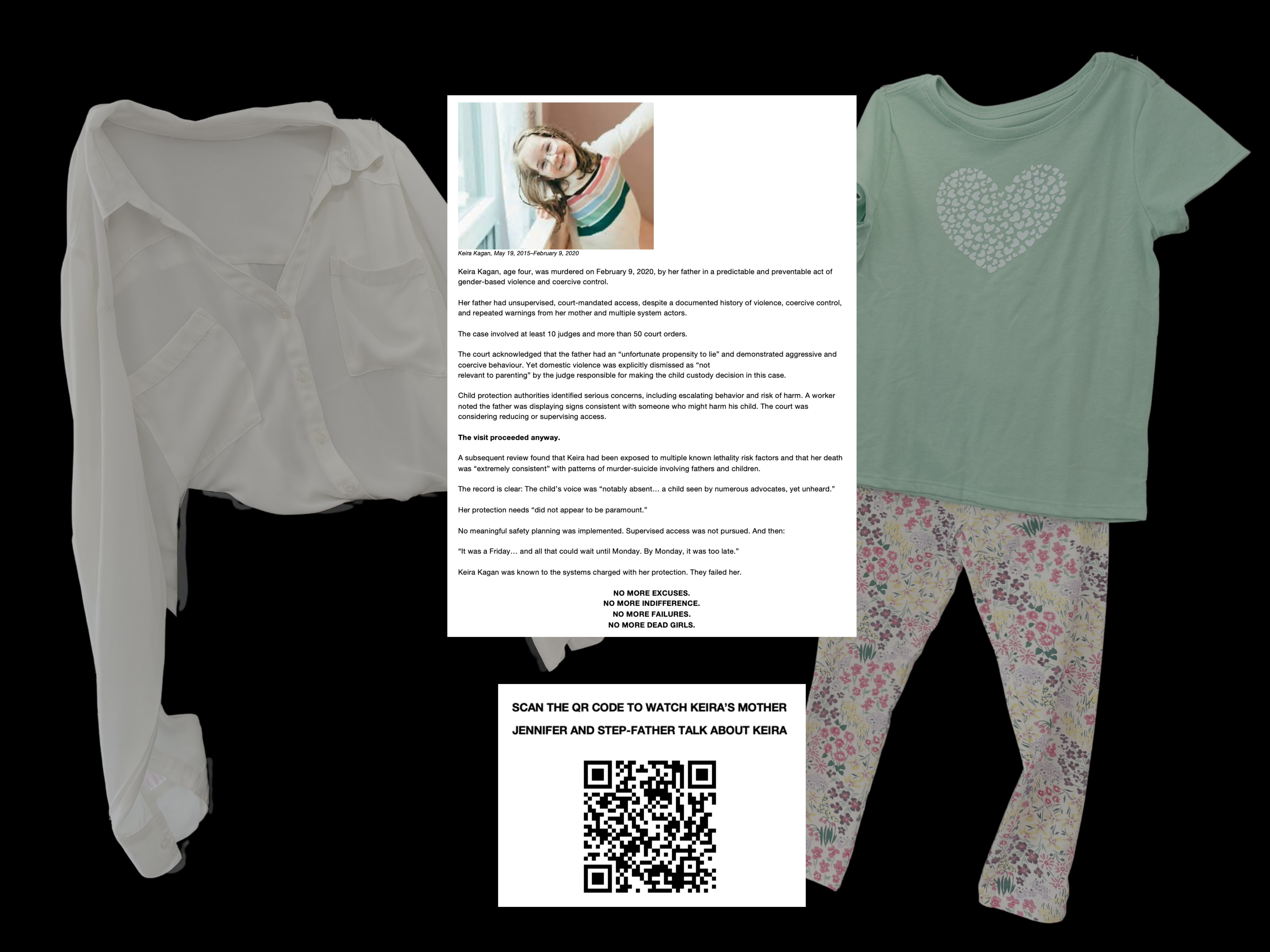
Keira’s mother, Jennifer, left her abusive husband. Still, the danger did not end. Because leaving does not always end the violence. Sometimes the violence is rerouted through the child.
Jennifer Viater’s daughter Keira was four years old when she was murdered by her father in a predictable and preventable act of gender-based violence and coercive control. Keira’s father had unsupervised, court-mandated access despite a documented history of violence, coercive control, and repeated warnings from her mother and multiple system actors.
Keira’s case involved at least 10 judges and more than 50 court orders. Child protection authorities identified serious concerns. The court was considering reducing or supervising access.
The visit proceeded anyway.
Keira’s story belongs in this exhibit because children are not collateral to coercive control. They are often the next site of it. When a woman leaves, an abusive man may continue the violence through custody, access, litigation, threats, and the children themselves.
The question is not only why didn’t she leave. Jennifer did leave. The question is why leaving did not protect her child.
And the answer is not that no one knew. The record was there. The warnings were there. The danger was visible. But the systems charged with Keira’s protection did not act with the urgency Keira’s life required. Instead, Keira was delivered into grievous danger by the systems that failed her. She was in her father’s custody in an unsupervised weekend during a time he knew her safety with him was being assessed and his custody reviewed.
Watch a video about Keira’s case and the law in her name here.
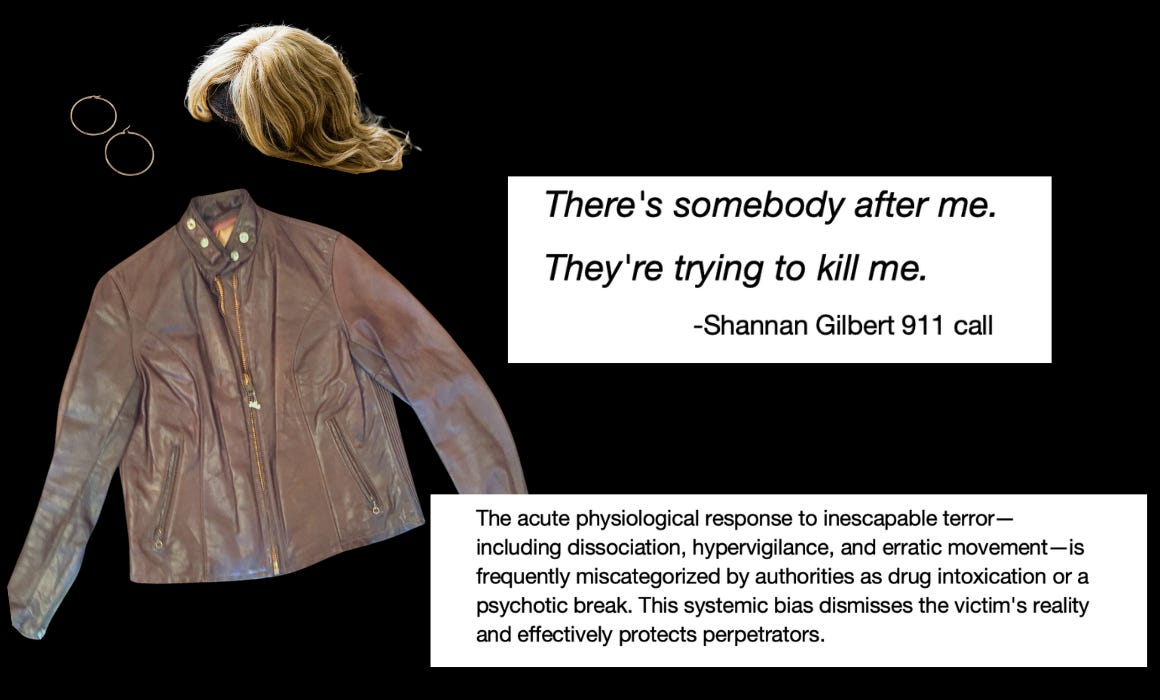
The What Were You Wearing? storyboard for Shannan Gilbert makes another part of this architecture visible: how systems misread and recast women’s fear to fit the narrative they have already drafted.
Shannan’s terror was recast as intoxication, hysteria, irrationality, or a drug-induced panic. A woman running for her life was treated as a problem of perception rather than as a person in danger.
That matters here because the same pattern repeats across these cases. A terrified woman is called irrational. A woman running for her life is called hysterical. A woman in danger is treated as confused, intoxicated, dramatic, unstable, or impossible to help. A woman who has been kidnapped and assaulted is told her story is not credible because it doesn’t “make sense.”
Part of what this exhibit does is document the consequences of systems that fail to record and act on prior crimes. This is why the work of Denise Huskins Quinn and Aaron Quinn belongs inside this exhibit and this architecture. When Denise was kidnapped and raped, law enforcement publicly cast her and Aaron as liars rather than victims. Their credibility was attacked while the perpetrator remained free. That disbelief did not simply harm Denise and Aaron. It protected Muller’s ability to continue committing violent crimes. When victims are blamed, disbelieved, criminalized, or treated as unreliable narrators of their own lives, the violence is allowed to continue. The record gets buried. The pattern goes unnamed. And while the culture is busy managing victims’ credibility, the perpetrator remains free.
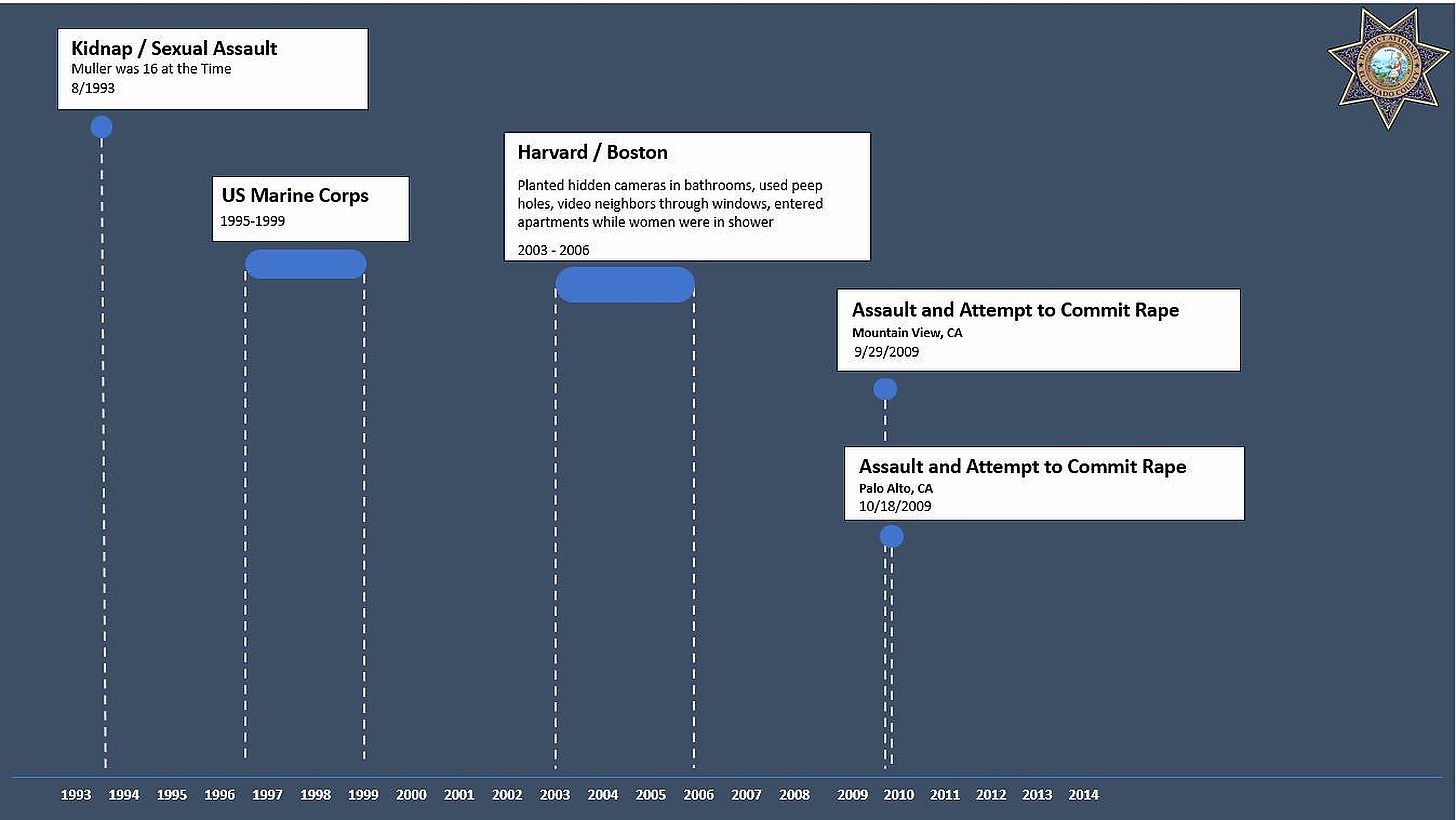
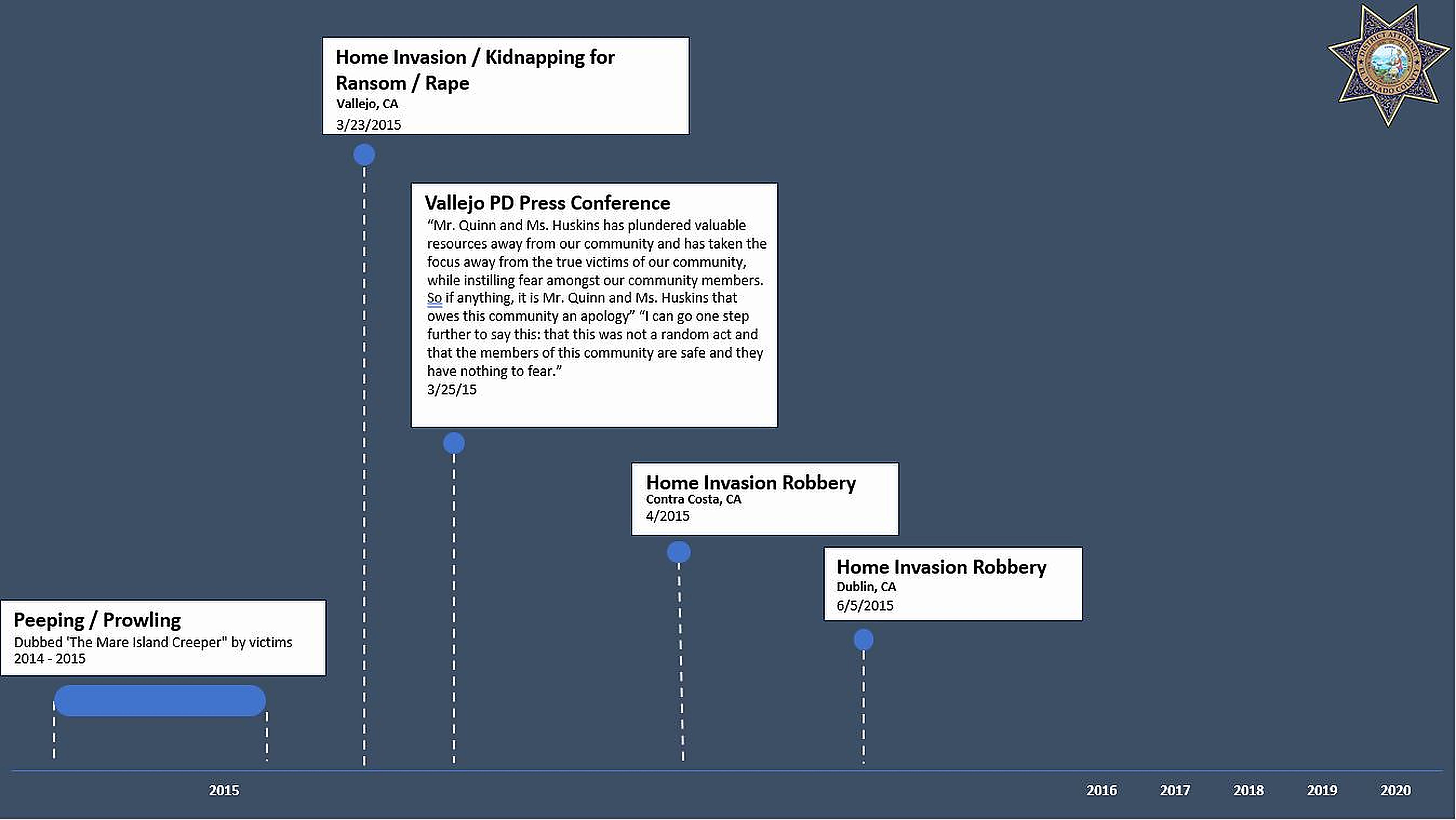
Ignoring it does not make it go away. The danger remains. The perpetrators do not stop. They continue—sometimes emboldened. They find new victims. And they go on to commit new crimes.
That is the structure this exhibit documents. Not only why women cannot leave. But what happens when they do. When they are finally set free. When they are finally able to escape.
You can watch a video about Denise and Aaron’s story here.
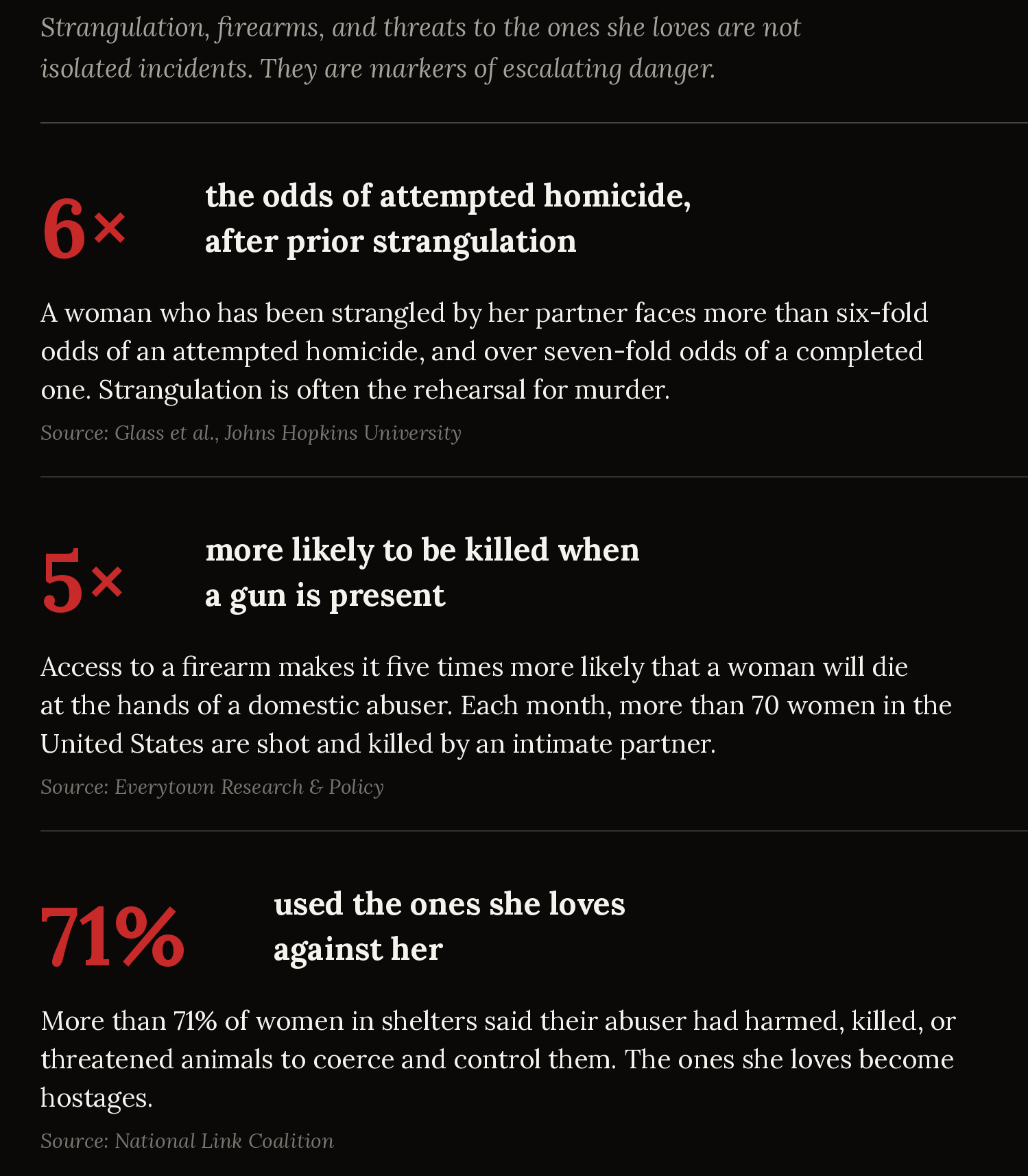
The effects of non-fatal strangulation cannot be underestimated. And what it signals cannot be ignored.
Non-fatal strangulation is not “non-lethal” simply because the woman survives that day. It is terror. It is a demonstration of control over breath, consciousness, and life itself. It is the perpetrator telling the victim: I control whether you live and when you will die.
It also tells us what we already know: this is a lethality marker. In the landmark research on non-fatal strangulation and intimate partner homicide, prior non-fatal strangulation was associated with greater than six-fold odds of attempted homicide and over seven-fold odds of completed homicide.
We cannot keep treating choking and strangulation as one violent incident among many. It cannot be dismissed as “rough sex.” Because it is often the rehearsal for murder. And it must be treated that way.
The presence of a gun escalates the danger even further. A firearm does not merely increase risk. It changes the lethality of the situation. Everytown reports that access to a gun makes it five times more likely that a woman will die at the hands of a domestic abuser, and that every month an average of more than 70 women in the United States are shot and killed by an intimate partner.
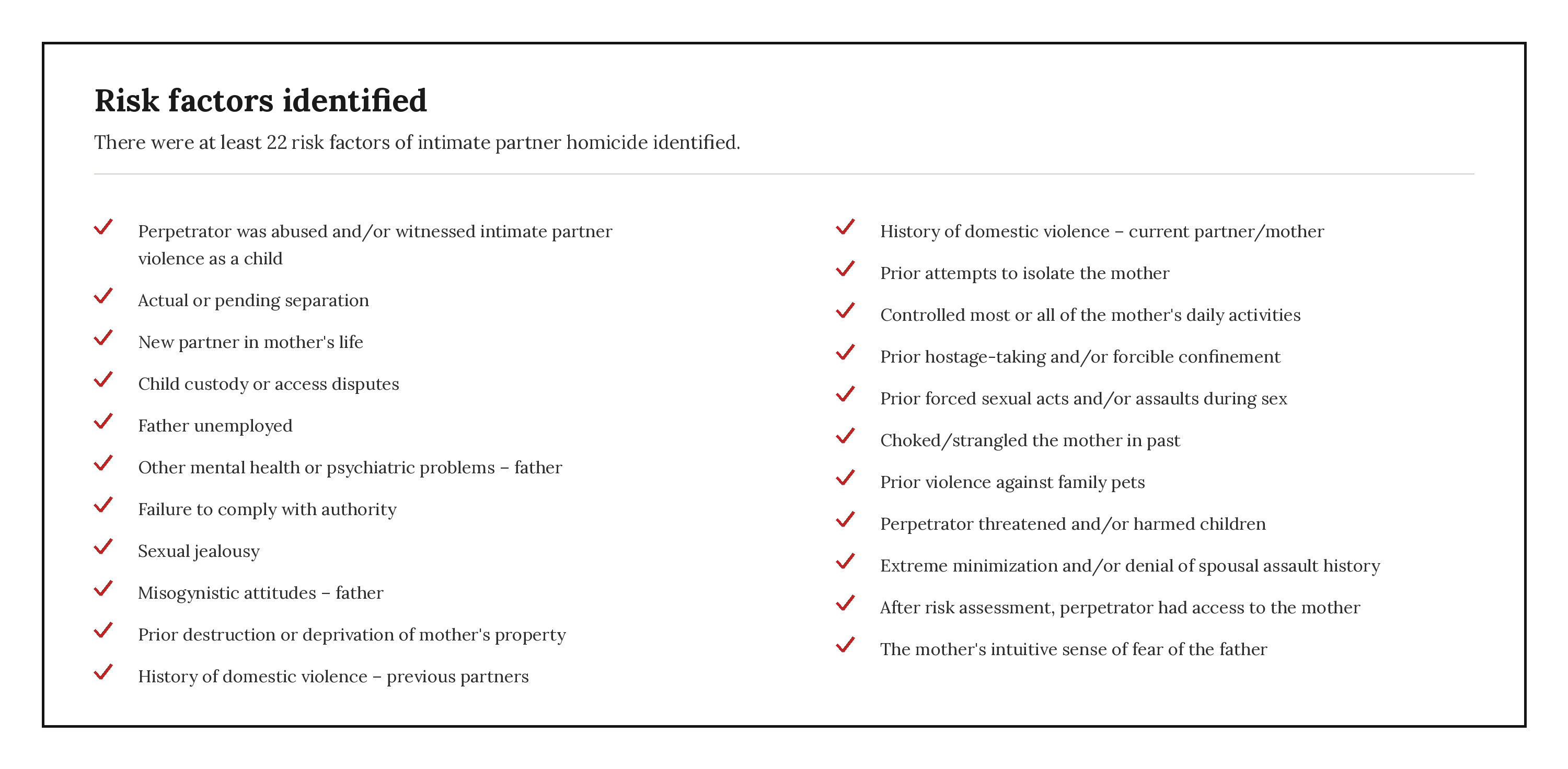
When coercive control, separation, stalking, threats, non-fatal strangulation, threats against children and animals, and guns come together, we are no longer looking at an ambiguous situation. We are looking at a record of escalating danger. The threats are not hypothetical. They are real. And the consequences are catastrophic.
It is not only the violence that keeps women trapped, it is also the violence that follows when men refuse to let them go. Not only the women who are murdered. But the children who see it, hear it, live inside it, and are forced to carry it. Not just while it is happening, but for the rest of their lives.
Learn more about non-fatal strangulation here.
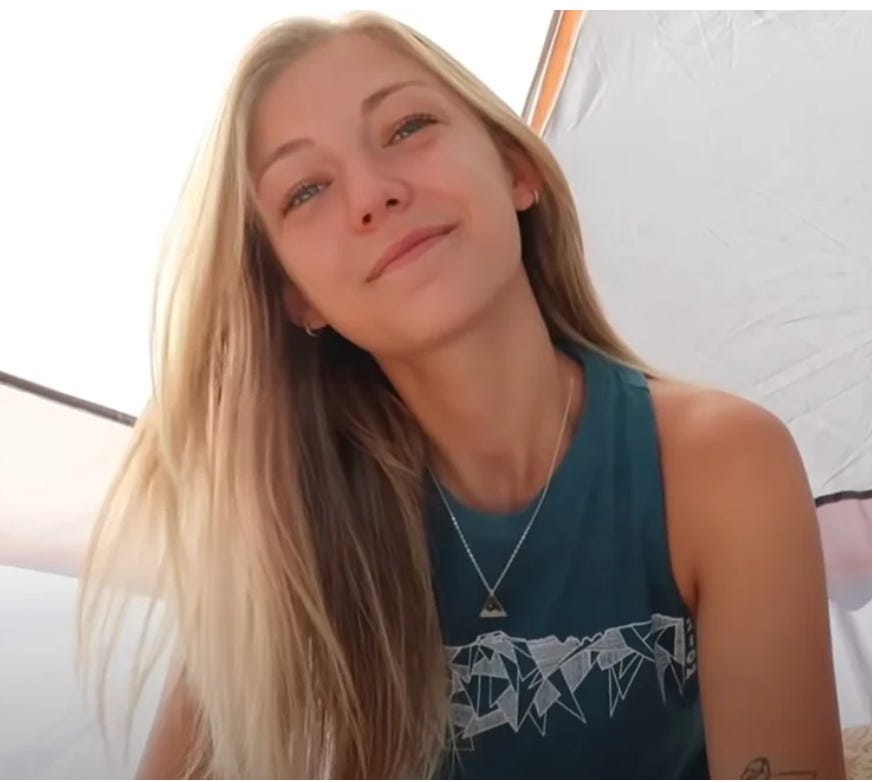
Gabby Petito was twenty-two years old when she was murdered by her fiancé Brian Laundrie. Gabby’s murder was predictable and preventable. It was part of an escalating pattern of violence and it should have never been allowed to happen.
Gabby was a daughter, sister, artist, traveler, and creator. She was a free spirit who loved travel, art, and nature. She was just beginning her life as a vanlife travel vlogger, and she created the YouTube channel Nomadic Statik to document her travels. Her family writes that her smile could fill a room, and that she was a wonderful big sister, the oldest of six.
Weeks before Gabby was murdered, she was alive, afraid, and the violence was happening in plain sight of the public.
Unbeknownst to all but her close friend, Gabby had already been choked and strangled by Brian Laundrie. That was the marker. By the time of her death, the warning sign the research describes was no longer a prediction. It was a documented part of her history.
A 911 caller reported seeing Brian Laundrie hitting her in the face in public view in Moab Utah. When police responded, Gabby was visibly distressed and had obvious markings of physical violence on her face from exactly what the 911 caller had reported seeing.
The state did not treat that moment as a lethality-risk moment. The violence was reframed as conflict. The danger was minimized. Gabby’s distress became part of the story the system told itself about why no one had to act.
Weeks later, Gabby was strangled to death by Brian Laundrie.
Her murder was predictable and preventable. It was a failure to see what was visible in plain sight. And it was a failure to respond in ways the system itself required. As Gabby’s mother Nichole Schmidt has said, if the appropriate steps had been taken, Gabby would still be alive today.
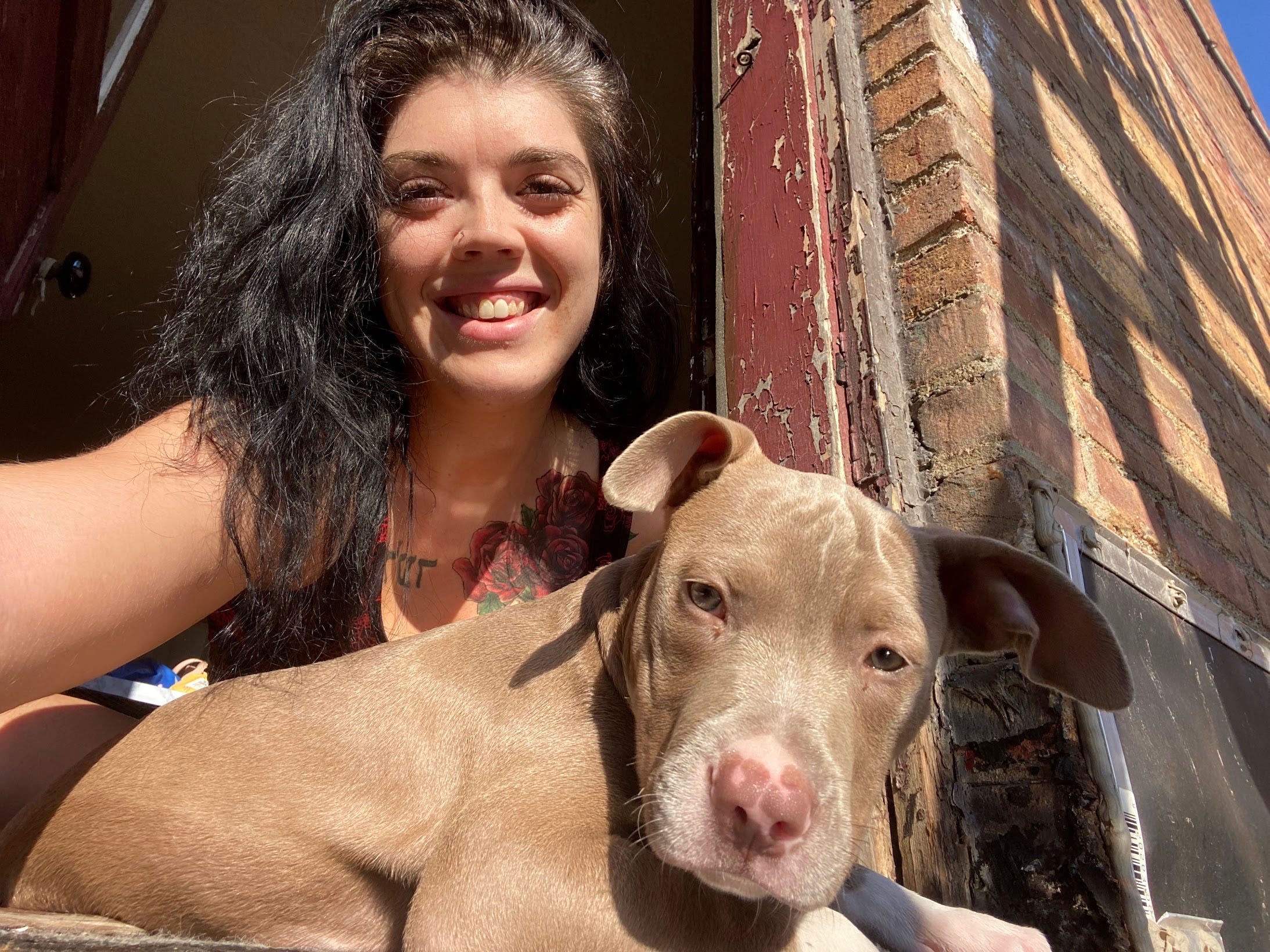
The Gabby Petito Foundation was born from Gabby’s family’s grief and the decision to turn tragedy into purpose. The Foundation works to bring domestic violence and missing persons issues to the forefront of public attention, to support survivors and families, and to equip communities and first responders with tools, training, and resources.
You can watch a video about Gabby’s story here.
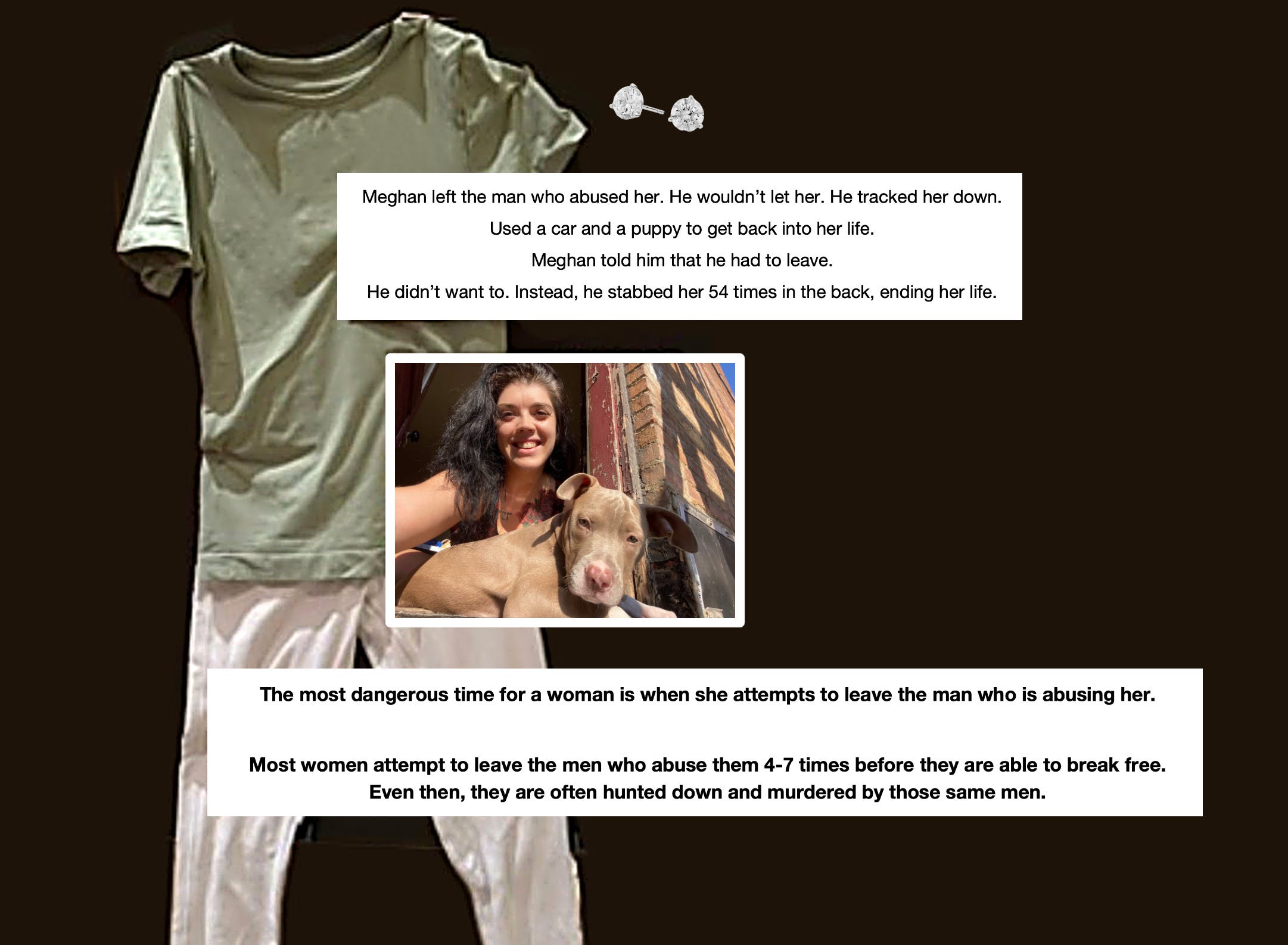
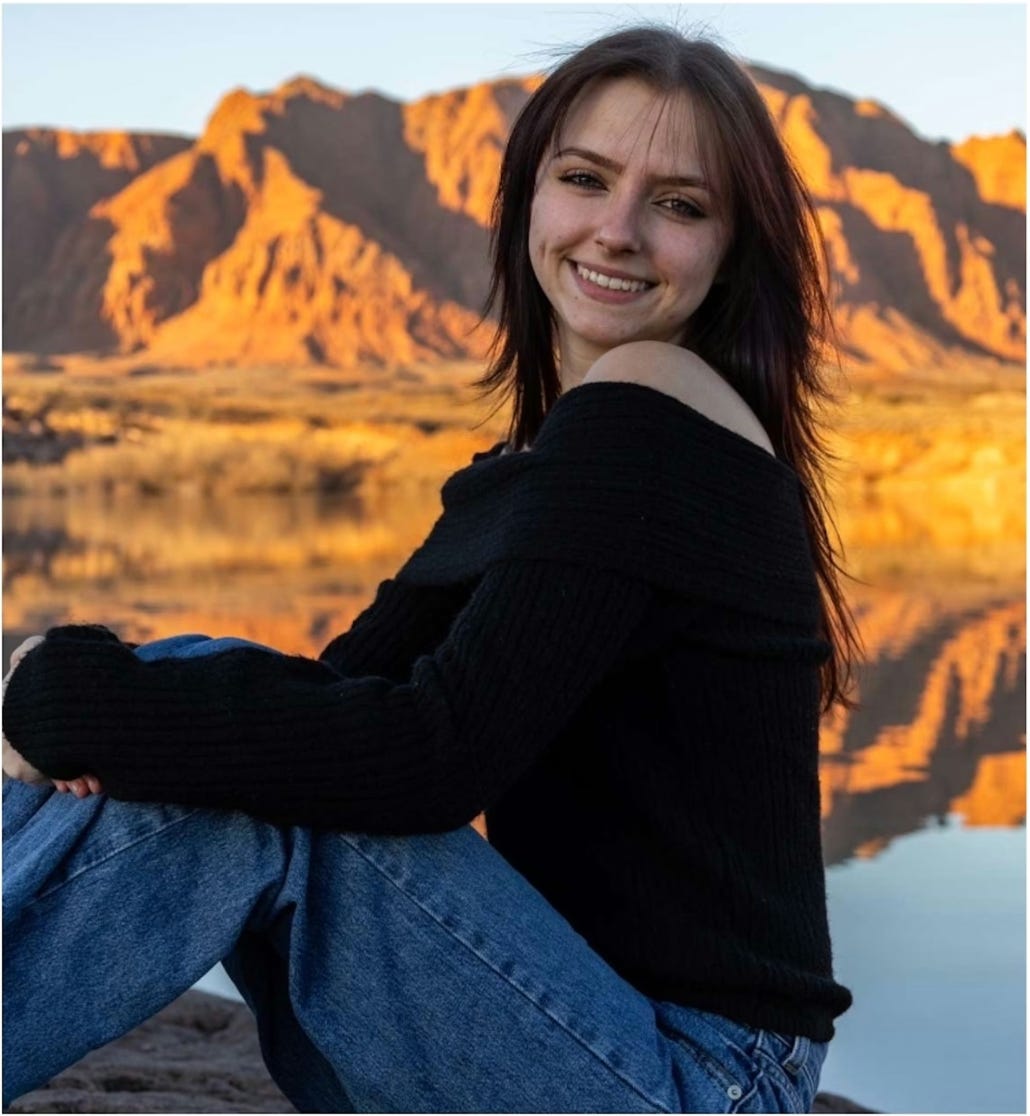
Meghan Kiefer was murdered on October 23, 2021, just 7 weeks after Gabby was murdered.
Meghan loved sunrises, sunsets, animals, food, babies, her family, and the people around her. Her mother writes that Meghan “loved without end” and wanted to help others even when she could not help herself.
That morning, Meghan texted her mother that she was trying to get him to leave, and he was being difficult. She did not want to call the police. Hours later, she told her mother he was leaving, but he was angry because he had nowhere to go and no money. It was their last conversation.
The man who murdered Meghan was a violent offender with a history of abuse, including strangulation and assaults—offenses identified in the lethality section in this post. His violence predictably escalated to murder.
That is one of the central inversions this exhibit names. The woman is asked why she did not leave. But sometimes it is the man who refuses to leave. It is the man who refuses to leave her alone.
Meghan left the man who abused her. He would not let her. He tracked her down. He used a car and a puppy to get back into her life. Meghan told him he had to leave. He did not want to. Instead, he stabbed her 54 times in the back, ending her life.
In coercive control, even gestures that look like tenderness are weaponized as tools of access, manipulation, and harm. A puppy isn’t just a puppy. In the hands of a perpetrator, it is a weapon.
The most dangerous time for a woman is when she attempts to leave the man who is abusing her. Most women attempt to leave the men who abuse them 4–7 times before they are able to break free. Even then, they are often hunted down and murdered by those same men.
You can watch a video about Meghan’s story here.
Macey Dawn Bradshaw was twenty years old when she was murdered on December 16, 2025.
Macey was sweet, easy-going, compassionate, playful, and deeply loved. She had bright, beautiful eyes and an infectious smile. She loved hunting and fishing. She loved Alaska, her happy place. She was a gifted artist. She loved animals, especially her beloved older cat, Anubis. She was her sister Taylor’s “ride or die,” and she was, in her family’s words, daddy’s little girl.
In the last year of her life, Macey had entered a season of happiness and contentment. She had her own place. She had a job. She had a car. She was proud of what she was building. She was beginning to feel independent in her world.
And still, he would not let go. The pattern was visible: threats of self-harm, monitoring, stalking, fear of a gun, escalation, separation, and murder-suicide. Macey tried to leave. Her family helped her leave. She moved away. She came home. She built a life.
On the morning she was killed, Macey called her father, Justin. Her ex-boyfriend was outside her apartment, and she was afraid. She asked her dad to come scare him away. Her father turned around and drove to her. He was there in less than four minutes. It was still not soon enough.
As he reached for the door, he heard two gunshots. Inside, he found Macey and her ex-boyfriend with gunshot wounds. Macey was still alive. She asked her father to help her. She told him she was going to be sick and needed to get on the floor.
First responders later found duct tape and zip ties on him, according to the family. That matters. Because this was not simply a murder-suicide. It was the endpoint of escalating danger. It was coercive control, stalking, fear, a gun, and a man who would not let go.
Macey had feared he might kill her and then kill himself. Her family had tried to help her. She had tried to build a life. Still, he came back for her.
Her father reached her in minutes. The violence was faster. The question is not why she did not leave. Macey did leave. The question is why he was still able to reach her. And why he was able to end her life.
You can read more about Macey’s story here.
Cynthia Ann Hanegan Mitchell was murdered on October 10, 1974, by Michael Hart, a violent criminal and arsonist who was incarcerated and had been placed on work release and allowed unfettered access to the community. Hart walked off his work release, tracked Cynthia down in her home, and raped and murdered her in front of her two young children. My husband was five years old at the time. Cynthia was his mother.
Her children brought a wrongful death action against the State of Utah. They argued that the state had been negligent in allowing a dangerous inmate into the community without adequate safeguards. Hart’s dangerousness was known, legible, and already documented. But no one warned Cynthia. No one called the police.
And when her children tried to ask whether her death could have been prevented, the Utah Supreme Court held that the claim was barred by governmental immunity. With that, Cynthia Ann Hanegan Mitchell’s death became legally unreviewable.
The family could not even present evidence to a jury. This is why her board belongs here, too. Because the abandonment of women is lethal, and the protection of systems that fail them is part of the same architecture.
Cynthia’s case and Gabby’s case sit more than fifty years apart. The names changed. The pattern did not. The failures did not.
You can read more about the case of Epting v. State here.
These stories are not isolated tragedies. They are preventable murders. They are records. And they reveal patterns.
They show what happens when the culture keeps asking why women do not leave instead of asking why abusive men keep being allowed to follow, stalk, threaten, manipulate, harm, and kill them. They show what happens when men do not leave. They show what happens when men refuse to let go. They show what happens when systems treat danger as conflict, fear as confusion, coercive control as relationship trouble, and preventable murder as something no one could have seen coming.
The boards use photographs, clothing, objects, poetry, testimony, legal records, 911 calls, bodycam footage, and data to make the structure visible. They are not memorials only. They are evidence. They show how violence is made predictable, how danger becomes legible, and how systems still fail to act even when the warning signs are already there.
This is public, documentary, and evidentiary art. It refuses aesthetic consolation. It treats objects, names, clothing, photographs, testimony, legal records, and the lived archive as part of the record. It insists that the question itself must be challenged. Because when we ask the wrong questions, we end up with the wrong answers.
The first storyboards—Gabby, Meghan, Macey, Jennifer + Keira, and Cynthia—are only the start.
This exhibit documents the violence that prevents women from leaving the men who abuse them, the violence that follows women after they do leave, and the lethal consequences of pretending that leaving is simply a matter of choice. Because the question was always wrong. The question we should be asking is not why she did not leave. The question we need to be asking is what made leaving so dangerous.
The systems charged with protection must stop failing victims and then calling those failures unforeseeable. They must stop mistaking victims for perpetrators, inverting the reality of this violence. They must stop believing that our credibility is defined by the limits of their imagination. They must stop mistaking coercive control for conflict, stalking for heartbreak, threats for emotion, choking and strangulation for “rough sex,” patterns for isolated incidents, guns for a private matter, threats against children and animals for “drama,” and the murder of women and children for something no one could have seen coming.
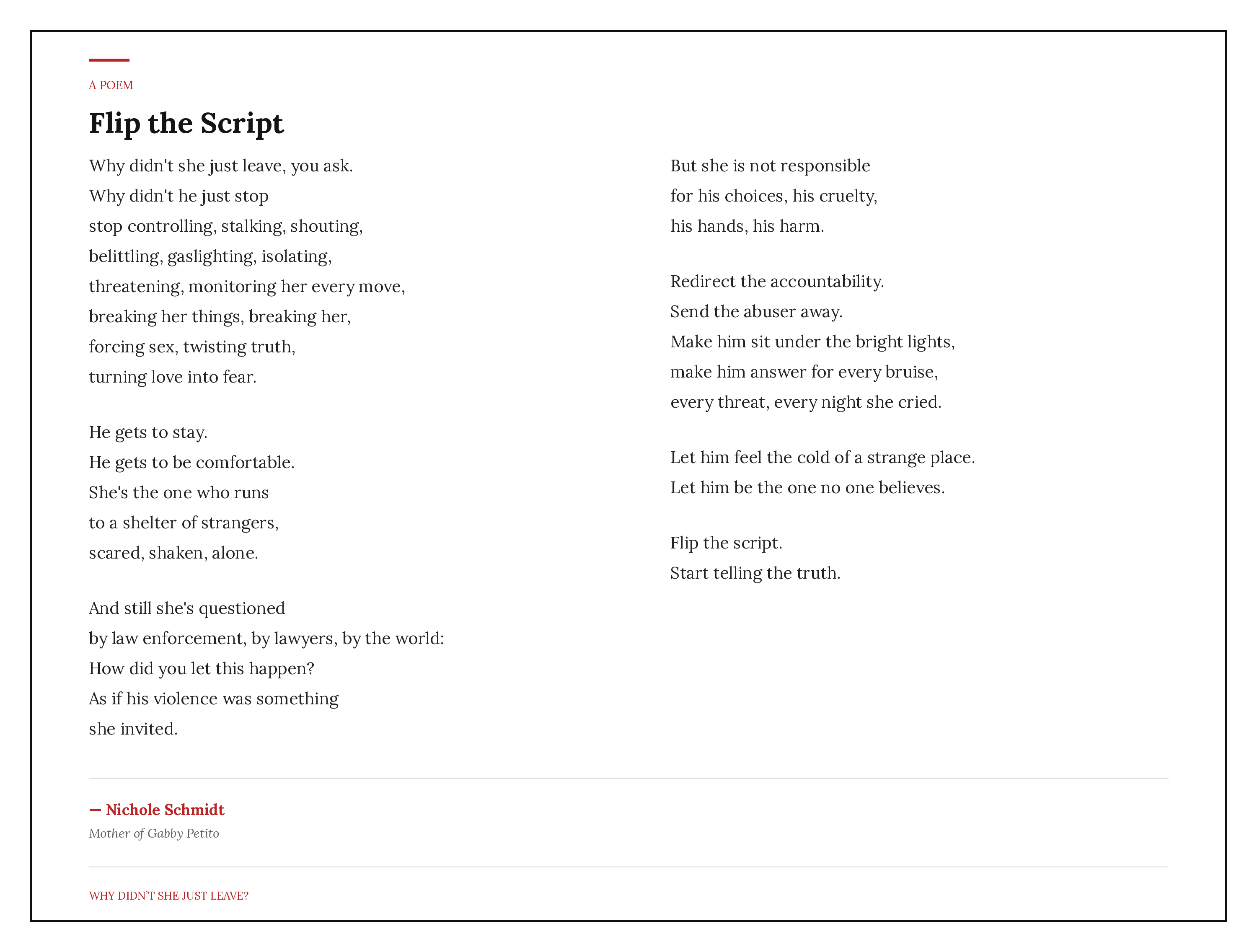
We can see it. The record is already there. And it is clear. This exhibit asks us to stop looking away. And, in the words of Gabby’s mom Nichole Schmidt, to flip the script and start telling the truth.
If you or someone you know has been affected by sexual violence, you are not alone. Please reach out to RAINN at 800-656-HOPE or visit rainn.org.
For intimate partner violence support, contact the U.S. National Domestic Violence Hotline at 1-800-799-SAFE or visit thehotline.org.
Comments
Nothing yet. Say the first thing.
Sign in to join the conversation.