
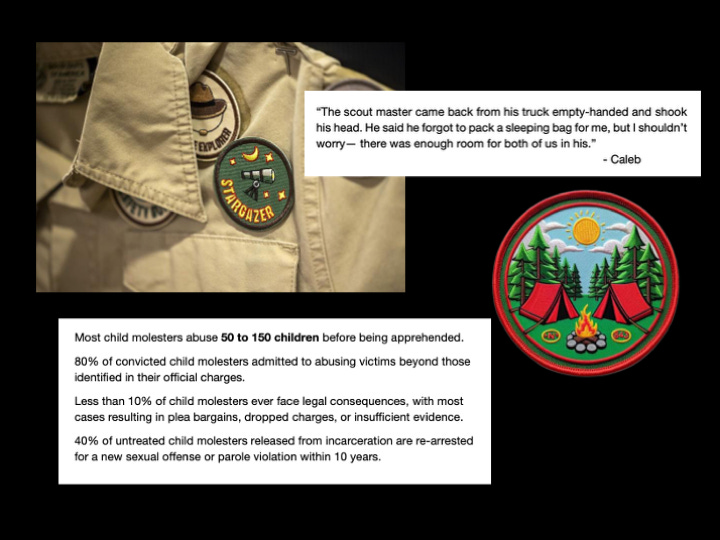
About this WWYW Storyboard
Caleb was a child in scouting when a scout master used the conditions of a camping trip to gain access to him. The patches displayed in this storyboard—Stargazer, Explorer, Picnic Master—are not just artifacts of youth achievements. They serve as documentation of time away from home. Of children sent off for overnight stays with trusted adults. The uniform that signalled trust to Caleb’s parents was the same uniform that signalled authority to Caleb. That dual function—trust outward, authority inward—is the mechanism leveraged for grooming.
Scouting, in all of its iterations and forms, is not incidental to this storyboard. It is part of the structure. National and international clubs for children, organized around mentorship, character formation, and adult-led activity, have for more than a century extended adult access to children, managed the credibility of the adults to whom that access was granted, and protected the authority of those adults when it should have protected the children themselves. The names of the organizations vary. The badges, the troops, the councils, the lodges, the patrols, the rank structures, and the uniforms may vary. The architecture does not. Each becomes a grooming environment. Each extends access, manages credibility, and protects authority.
The quote on this board names something the previous storyboards in this series have not yet named directly: grooming does not always operate through language. It can operate through manufactured circumstances. The scout master did not forget the sleeping bag. He performed forgetting. The shake of the head, the empty hands, the offered solution—each was a constructed beat in a sequence designed to deliver a child into a confined space with a predator and to frame that delivery as care. “I shouldn’t worry” is not reassurance. It is instruction. The child is being told, in advance, how to interpret what is about to be done to him.
It is not only children who are groomed. Adults are groomed. Entire families are groomed. Even communities are groomed. Institutions are groomed into extending trust, overlooking warning signs, and protecting the credibility of the perpetrator. The conditions of access that made Caleb’s harm possible were not produced in a single moment beside a truck. They were produced over time, through the ordinary social architecture of scouting itself. Caleb’s parents were groomed by the uniform, by the meetings, by the badges and ceremonies and pledges, by the language of duty and honor and trustworthiness, by the visible presence of other parents who had also extended trust. The community was groomed by the civic respectability scouting confers on the men who lead it—the assumption that a man who volunteers his time to mentor boys is, by virtue of that volunteering, a man who can be trusted with boys. The institution itself was groomed by its own internal narrative: that the program is the protection, that the structure is the safeguard, that the uniform is the credential. None of this is incidental to what happened to Caleb. All of it is part of the conditions of access. The grooming of the parents, the community, and the institution is what made the grooming of the child possible. And the grooming itself is part of the violence.
This is protective inversion in its fully operational form. The institution’s credibility created the opening. The institution’s structure of adult-leader authority maintained it. And the institution’s reputational interest is what makes disclosure dangerous and consequence rare. The shield that should face outward toward the child is turned inward to protect the adult, the troop, and the institution itself. Caleb’s testimony does what institutional records cannot. It names the moment a child standing beside a truck, in a uniform, with no sleeping bag, was made to believe: that we would be safe.
What the Data Reveal
To date, nearly 100,000 claims have been made about child sexual abuse in scouting. And we know this number underestimates the actual number of children abused. The Boy Scouts of America (BSA) sexual abuse settlement is a $2.46 billion agreement established to compensate more than 82,000 survivors of childhood sexual abuse. The BSA’s internal records identified 7,819 suspected abusers documented between 1944 and 2016 alone.
Most child molesters abuse between 50 and 150 children before being apprehended. BSA’s internal records identified 7,819 suspected abusers. Taken together, this further reinforces the belief by many that the number of BSA victims far exceeds 82,000 and is more likely to be between 390,950 and 1,172,850.
80% of convicted child molesters admitted to abusing victims beyond those identified in their official charges. Fewer than 10% of child molesters ever face legal consequence. Most cases end in plea bargains, dropped charges, or insufficient evidence. 40% of untreated child molesters released from incarceration are re-arrested for a new sexual offence or parole violation within 10 years. The serial nature of child sexual offending is documented, persistent, and known to the institutions that house perpetrators. The CDC reports that 90% of child sexual abuse is perpetrated by someone known and trusted by the child or the child’s family.
What puts children in scouting environments most at risk is not unknown. It is well documented, and not only by survivor advocates. It is documented by the institutions themselves. Scouting America’s own Youth Protection training materials identify the higher-risk situations explicitly: overnight hotel stays, overnight tenting and camping, situations involving group latrine and shower facilities, less-structured environments, and secluded areas in regular meeting places.
And yet, even those operating at the very highest levels of oversight mis-state and grossly misconstrue what is actually happening. Take for example the words of Kenneth Lanning, an FBI agent specifically tasked with understanding these patterns. Lanning put it this way:
“A skilled pedophile who can get children into a situation where they must change clothing or stay with him overnight will almost always succeed in seducing them.”
Make no mistake about what is actually happening here: this is linguistic laundering by the very systems tasked with oversight. Notice the linguistic move and what it accomplishes: by using the word "seduction," the system subtly shifts the burden of responsibility, suggesting a collaborative or romantic process rather than what it actually is. Abuse is not seduction. It is not tempting or attractive to a child. It is predatory grooming and coercive control by an adult in a position of authority for the purpose of committing sexual abuse against a child. Calling it seduction implies choice. Seduction implies voluntariness. Seduction implies romance. None of those things apply here.
The institution knows the truth. In fact, it has known it for decades. The conditions of risk are not a mystery to scouting organizations. They are often part of their internal training documents.
There is a second timeline running alongside the institutional one. The institution knows the risk when the child is 11. The survivor, on average, does not disclose until he is 42. Research on disclosure among former scouts identifies an average age of first abuse between 11 and 12 years old, and an average age of disclosure between 42 to 52. The average delay between the abuse and the disclosure is roughly 29 years. In broader child sexual abuse research, over half of survivors do not disclose until after the age of 50, and only about 1 in 5 victims tell anyone while they are still children.
The reasons for the delays are documented and consistent. Fear of reprisal. Fear of disbelief. The intense guilt and self-blame produced by systematic grooming, which take decades to process. And the additional weight—in cases of institutional abuse—of pressure to protect the reputation of the organization in which the harm occurred. The thirty-year silence is not incidental. It is part of the architecture. It is what makes the harm survivable for the institution. It is what allows the next child to be groomed in the same uniform, on the same overnight trip, by the next man whose volunteering has been read as evidence of trustworthiness.
The pattern across youth-serving organizations is consistent. Child sexual abuse thrives in isolation. It thrives in one-on-one access between adults and children. It thrives away from home, away from parents, away from mandated reporters. It thrives in overnight settings, in changing and bathing situations, in transportation alone with a single adult, and in the unstructured and unsupervised time around the official program. It thrives in environments where adult authority is structurally unquestioned and where the institution’s reputational interest in the adult is greater than its reputational interest in the child. Scouting environments—across all their iterations and forms, in every organization that uses overnight camping, mentorship pairing, and adult-led trips as core programmatic features—sit precisely inside that risk profile. The scout master coming back to a child empty-handed beside a truck at the start of an overnight trip is not an aberration. It is the predictable use of a known high-risk situation by a man who has almost certainly done this before.
What we also know is that a significant number of cases go unreported. Many perpetrators never face legal consequence. The institutions in which these patterns unfold—scouting organizations, youth clubs, churches, elite medical institutions inside universities, elite sports organizations, schools, and law enforcement—have, across decades, repeatedly demonstrated that internal handling, quiet reassignment, and reputational management are the default response.
These are not outliers. They are exemplars of a structure we already know.
The architecture of impunity is not a metaphor. It is what the data describe. And it is what Caleb’s testimony, displayed beside it, makes legible.
Support is Available
If you or someone you know has been affected by sexual violence, you are not alone.
Please reach out to RAINN at 800-656-HOPE or visit rainn.org.
Comments
Nothing yet. Say the first thing.
Sign in to join the conversation.