
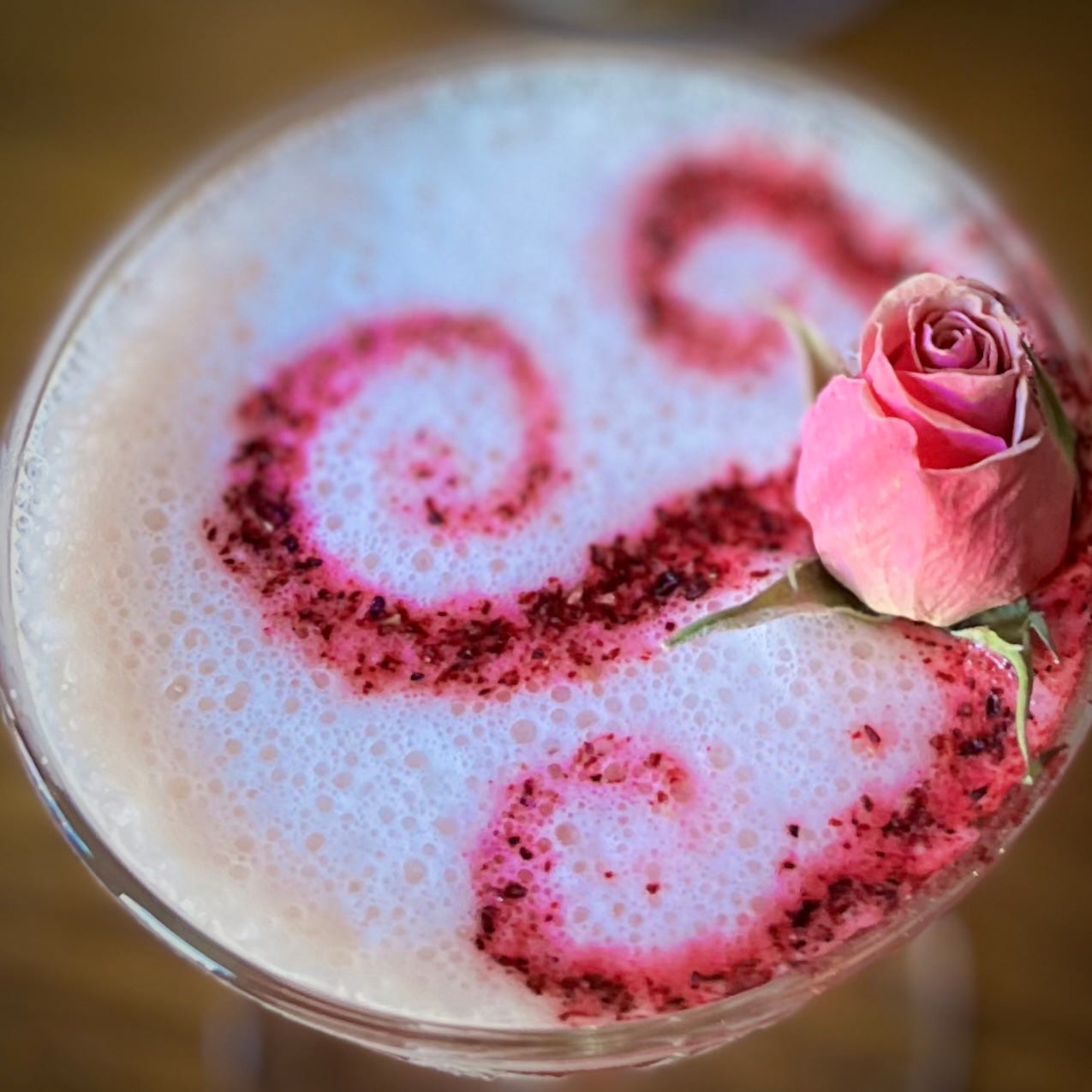
Just as light is both wave and particle, grief is tsunami and raindrop. Avalanche and snowflake. Noise and signal .
A rotisserie chicken is a study in sadness. A cauliflower crust pizza, a diorama of hell.
The dishwasher consumes your forks. None of your black socks match.
Welcome to widowhood, Year Three.
My husband died in April 2023, a year after he was diagnosed with Stage 4 lung cancer. We were married forty-three years. While memories of him have softened in some places, they’ve sharpened in others. Almost daily, I find myself stunned by some small remembered sweetness, or an unresolved hurt. Sometimes I’m ambushed by a longing so intense I need to stand still, eyes closed, waiting for it to subside.
With no one around to perform cognitive-behavioral interventions, most days begin with a furious recitation of my inadequacies. Mary, you are so stupid. What’s wrong with you. You forgot to (return, empty, clean, fix, buy) X. The house is a disaster. What’s wrong, what’s wrong, what’s wrong with you. Sometimes the voice harangues me all day. It gets worse. Expletives. I’m shouting. The neighbors will hear. I can’t stop. I would stop if you were here, I tell myself, and it’s possible that I would.
There are moments of joyful surprise. I open a door, flip the switch, and think, How thoughtful of him to put a light in the closet.
But when the bulb burns out, my anger turns outward. I search the basement. No replacements. Why didn’t he buy a ten-year supply of them, and batteries for all these devices? Why three remotes to work the TV and suddenly all of them are dead? I can’t find the power cord. Not for this iPad, or for that one, how many iPads did he leave behind? Dozens of cords. Where did he hide the one he knew I’d need?
When rage is exhausted, sorrow steps in. After three years of loops and spins, I have landed in the same place where I began.
As the surviving spouse, I’m in charge of the narrative. But grief is an untrustworthy collaborator. It pulls out one memory at a time, examines it, returns it to the darkness. Themes, frames, representative moments: are my choices fair, my edits respectful of his memory, or face-saving and cowardly? Am I trespassing, or in denial? There has to be some inviolable connection at the heart of a marriage that lasted more than four decades.
That time in the Boundary Waters Wilderness when the map misled us into a bog. Up to our waists in muck, we unpacked our gear, ready to leave everything behind as we slid our canoe ahead. Hours later, we emerged to find the real portage, twenty feet away. Had the map been correct, it would have taken us no more than fifteen minutes to haul our packs and canoe over the same distance.
Those nights I worked late and came home to find he’d made dinner for me and left it in the fridge before going to bed. Such tenderness in the gesture, in the imagination and variety of those meals. Always beautifully plated, at a time when I could not see beyond ugliness.
If we’d taken the other path, would we have learned our mutual language of survival?
If he had not fed me, would I still be alive?
You get through the first year. The grief is intense, but you survive. Manage. People admire the way you process your loss. You are holding up. Showing up. The house is tidy, within reasonable parameters. The yard isn’t crying out for Roundup. Not yet. Thistles and thorns come later.
At the beginning of the second year, things are going well. You quit therapy — a mistake that doesn’t manifest itself until two Thanksgivings later, when things go from delay to disarray to mortification. Worse, a new genre: you’ve invented slapstick-horror dinner theatre. What else can you call it when you’re so disorganized that a cheese tray and a bowl of glazed pecans become the meal itself and not its bookends?
You wonder if people are a little afraid of you. If you should be afraid of yourself.
The doctor diagnoses vertigo. Mentions rocks in your head; you freak out until you realize he’s joking. Calcium crystals in your ear shifted and sent you spinning like a top into the ER.
Ear crystals? Sixty-nine years on this planet, and that’s news to you. The cure is to crank your head five ways from Sunday to move them back into place. A maneuver half chiropractic and half Exorcist, it looks medieval but it’s a miracle. You can do it at home with a YouTube video and no co-pay.
The woman — you — who scrubs the bathtub and sends thank-you notes goes missing; gradually or suddenly, you don’t know. No Mary alerts blare from your phone. Every so often, you get out the Clorox and spray the grout. It hits you that the word grout carries within it grubby, grime, grim, grit, gray, grave. What else? You reach for the OED and search for cognates —
No. Get a grip. You’ve gone dirt-blind and are trying to turn mildew into literary inquiry. The world doesn’t work that way.
Except that in your new life as a full-time writer, it does. It’s a brave and thrilling new world. Compost is essential to growth.
Mail, including dozens of unread New Yorkers, lies in sloppy stacks throughout the house. In the kitchen, three picnic coolers and a plastic Halloween pumpkin crowd the butcher’s table, narrowing the path to the door. Here’s the Dutch oven that fell too close to your feet, more than once. We won’t talk about it. All toes survived. Just put it away, for God’s sake.
Back to the living room. Even though it’s March, the house is still decorated for Christmas. The tree, covered with ornaments. Nutcrackers all over. Stockings, wreaths. Garlands. The porcelain village. And because you abandoned the job, storage boxes are piled up where the Christmas presents should have been but were not, because you didn’t buy any.
You need to see a therapist. Next week, or sooner. To do so, you will have to get a referral from a primary care physician. On the Medicare website, you find one who can get you in tomorrow.
For the first time in three years, you exhale.
Mini, my 22-year-old cat, still blesses the earth with her existence. Last summer, her health declined. Night blindness made her frantic in the full territory of the house. She bumped into walls and furniture, fell on the steps. We moved, together, into assisted living in my daughter’s old room. With a small, familiar perimeter and stepped arrangements of footstools and pillows, she feels safe. I feel less alone.
With spring approaching, I trade the duvet for a light blanket. It folds around us in gray velvet wrinkles, like one of those improbable dog breeds the audience loves but will never take best in show.
I draw my knees up beneath the covers, creating a blanket fort. I’m trying to find a comfortable way to rest my laptop on the slope of my thighs but it turns out that there is none. I move her to one side and straighten my legs.
Life with Mini is a series of contortions and negotiations. So is writing. I could untangle myself and move to my downstairs study. Sitting in a decent chair with a desk at the proper height would be better for my back. But I’d be beyond the limit of her awareness, past the vanishing point at the center of her universe. I can’t bear her pacing, her cries when she can’t find her way out of a corner.
Across the room is a wall of bookshelves. I stare at the spines with their familiar titles. Thanks to The Seven Basic Plots, I don’t need to leave home to find a new one. Five copies of Mrs. Dalloway. Should I move them to different rooms? Separate them, like quarreling children?
The night ends in judgment and hesitation, as I mentally sort reference books. Does an imprint’s pedigree matter? Or is The Oxford American Writer’s Thesaurus a kind of slow Labradoodle that might benefit from placement on a lower shelf?
We leap into Daylight Savings Time. An hour vanishes. I drop my collection of pointless questions into it before it disappears.
I learn a practice called One Good Thing. Every day I write down one good thing. It can be something that happened that day. Something I see, hear, feel, taste, discover or remember on that particular day. Just one.
Here’s yesterday’s Good Thing:
I get to eat sautéed kale five nights in a row, and call it dessert.
You’d think I would have taken more pictures of him, especially during those last days when he was in hospice.
Views of a frozen courtyard through the window of his room.
A late winter storm: ice-covered twigs.
A screenshot of a poem by Pablo Neruda. The poem, “Keeping Quiet,” begins:
Now we will count to twelve / And we will all keep still
It ends:
Now I’ll count up to twelve / And you keep quiet and I will go.
I am keeping still. He is gone.
His final haircut, a few gray strands before his post-chemo hair grew in, dark and curly. I could have saved some in an envelope.
I scroll through the few photos he posted on Facebook. None, not even his profile, are of him. I delete Facebook.
Mini’s appetite is still robust. That’s why I’m spending another Saturday night in the pet supply aisle at Menards.
I lift a jug of fresh-scent, lightweight — in some other atmosphere, perhaps — kitty litter into the cart. And feel immensely tired.
I head over to the grocery section. Two cans of soup. Off-brand tortilla chips. Half a pint of half-and-half could be a line rejected by a tunesmith of those clever ditties from the golden age of radio. Peanut, peanut butter: actual song lyric. I round the corner to toiletries and remember I’m out of dental floss.
A dozen cans of Salmon Supper and a double roll of paper towels. Everything feels twice as heavy when I place it on the belt as it did when I took it from the shelf. I grab a few extra plastic bags to line the wastebasket. Mini is still using her litterbox. Good girl, Mini.
I’m an old woman who lives in an old house and sleeps with her very old cat. Is there anything sadder?
Well, yes. In addition to all that, I’m someone who buys dental floss at Menards.
In Hokusai’s famous image, boats are swallowed by an enormous wave. Mount Fuji stands placidly in the distance.
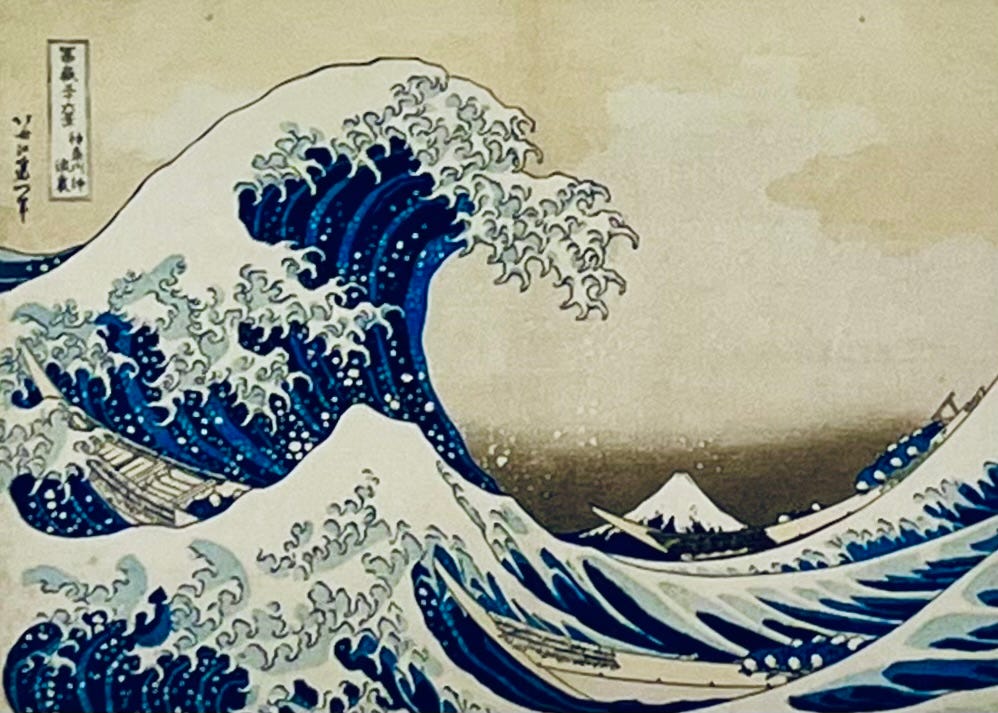
Hokusai used the same method to create a series of flowers. In this one, the poppy’s trajectory is the same as the wave’s.

Today’s One Good Thing:
All motion is forward motion.
A noise. I look at my watch. 3:25 a.m. I’ve fallen asleep, again, in my clothes. Eyes half-shut and bleary, I squint in the direction of the sound.
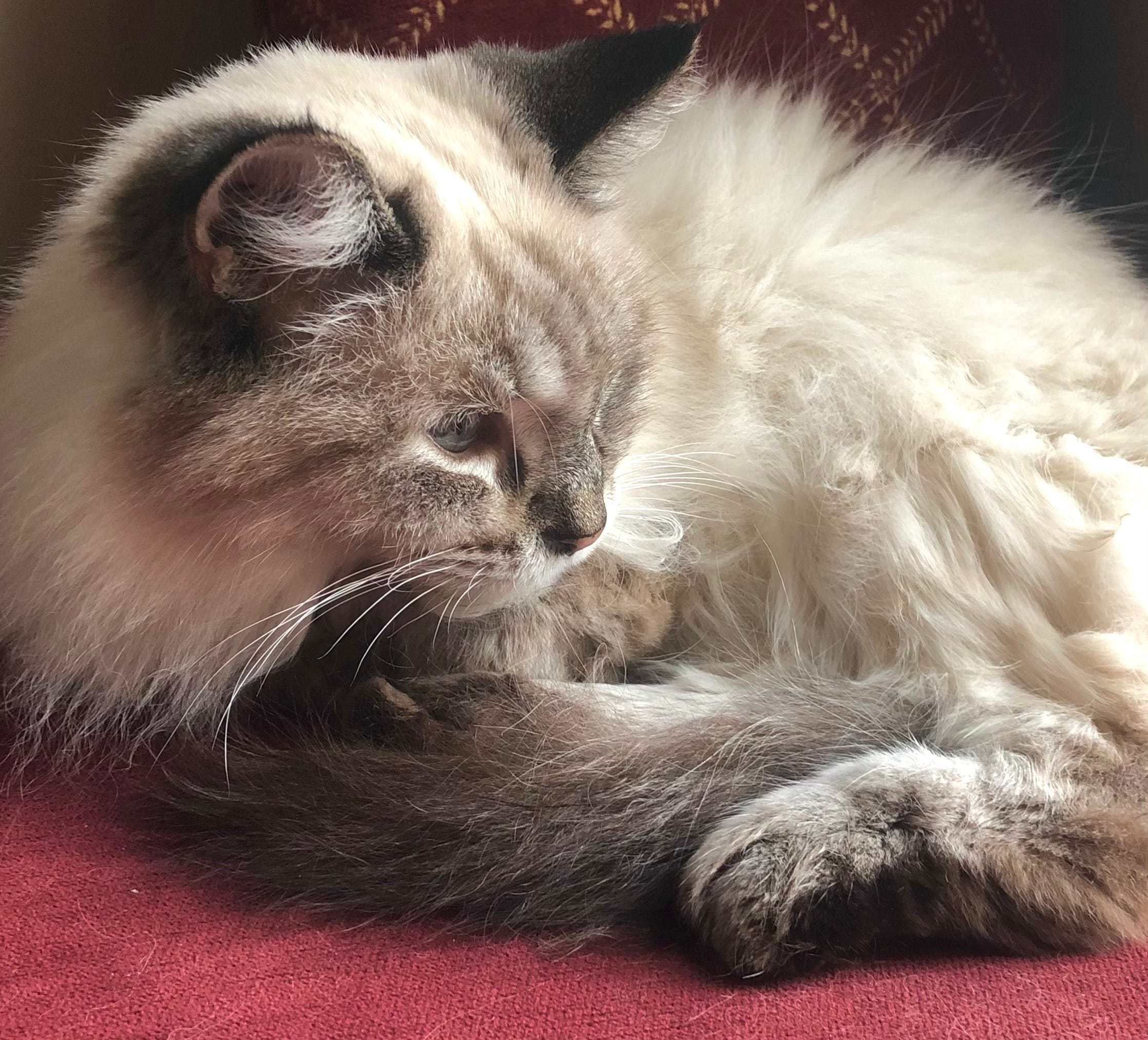
Mini. On the floor, pacing in a tight circle. Jaw set, eyes fixed, gait relentless, my 22-year-old cat winds herself around a heartbreaking spiral of decline. She veers into a wall and pees on the hardwood floor.
I lift her out of the way, grab a towel, and drop it in the spreading puddle.
“Sweetie, it’s okay.” I place her on the bed, covering her with the throw. As I stroke and massage her neck, her breath eases into the even cadence of sleep. I fetch a rag and disinfectant.
I find the energy to brush my teeth and pull on pajamas. I search Google, again. Every result comes with the same stern directive: Call the vet.
My list of reasons to avoid calling the vet: Today she’s eating. Drinking. Using the litterbox. Not in visible pain. She’s immortal!
It’s true. I have been to the edge with her more times than I can count.
When the time comes — and Mini will tell me when — I’ll summon the doula. Eased by potions and in peace, Mini —
I will keep quiet, and she will go.
Downstairs in the living room, the Christmas tree lights alternate, flashing between white and colored bulbs. As Year Four approaches, the house throbs to life.
No matter the amount of time that has passed, grieving is hard. With so many of us facing new and difficult choices, even though the year has barely begun, I’m offering 25% off annual subscriptions through March 31, to finish off the first quarter of 2025. That’s $37.50 instead of $50, the price of a good book and two lattes. (I recommend chai or matcha. You know how I feel about PSL.) If you’ve been enjoying these posts for awhile, please consider upgrading. You will be locked in at that rate forever.
Here’s what one recent paying subscriber had to say:
I very much enjoy the depth and thoughtfulness you bring. But also your humour - the spoonful of sugar that helps the medicine go down. Your use of metaphor and imagery are… chef’s kiss! I am only sorry you don’t have a book I could binge read. Write one please! ~ Geeta
If you value stories that speak from the heart, think about joining Geeta in supporting Writer, interrupted. Help keep award-winning, independent publishing alive. And yes, Geeta, I am working hard on not one book, but three!
Not ready to commit? There’s also a monthly option. You can unsubscribe at any time.
One more thing?
Thank you, dear readers, for making these challenging years the best of my life. I would not have made it through without you. I am forever grateful.
~ Mary xo
Comments
Nothing yet. Say the first thing.
Sign in to join the conversation.