
A big welcome to all new subscribers! More than two hundred of you have joined in the past month. Writer, interrupted is a community of nearly 6,000 readers who’ve opened their hearts and inboxes to me. I’m honored — and humbled — that you’re here.
Mary
It is a privilege of aging to rearrange time.
No longer an arrow or a flat circle or a giant weight over my head, time is a shape-shifter. A palimpsest: layer over layer of memories. I lie in bed half-awake, soothing an infant to sleep. The following morning — or 37 years later — that same sweet boy calls to wish me a happy 70th birthday.
I stand at an altar on a day in July, sweat running down the back of my wedding dress. Three minutes later, snow swirling outside a hospice on an April night, I sit with the lifeless body of my husband of 43 years.
There are no false starts.
Grief is one way we grow.
As a native Minnesotan, I grew up understanding life as a series of spokes branching out from a central hub: weather. Blizzards, thunderstorms, heat, humidity, flash floods and hard frosts dictated our activities. The state high school hockey tournament snowstorm hit on schedule during the third week of March. We took our family vacations in August, when my dad’s ragweed allergy flared. From November through April, the smell of wet wool filled the entryway as scarves and mittens sizzled on the radiator. Lilacs bloomed at the end of May; mock oranges and plum trees breathed their scents into the night air during the first week of June.
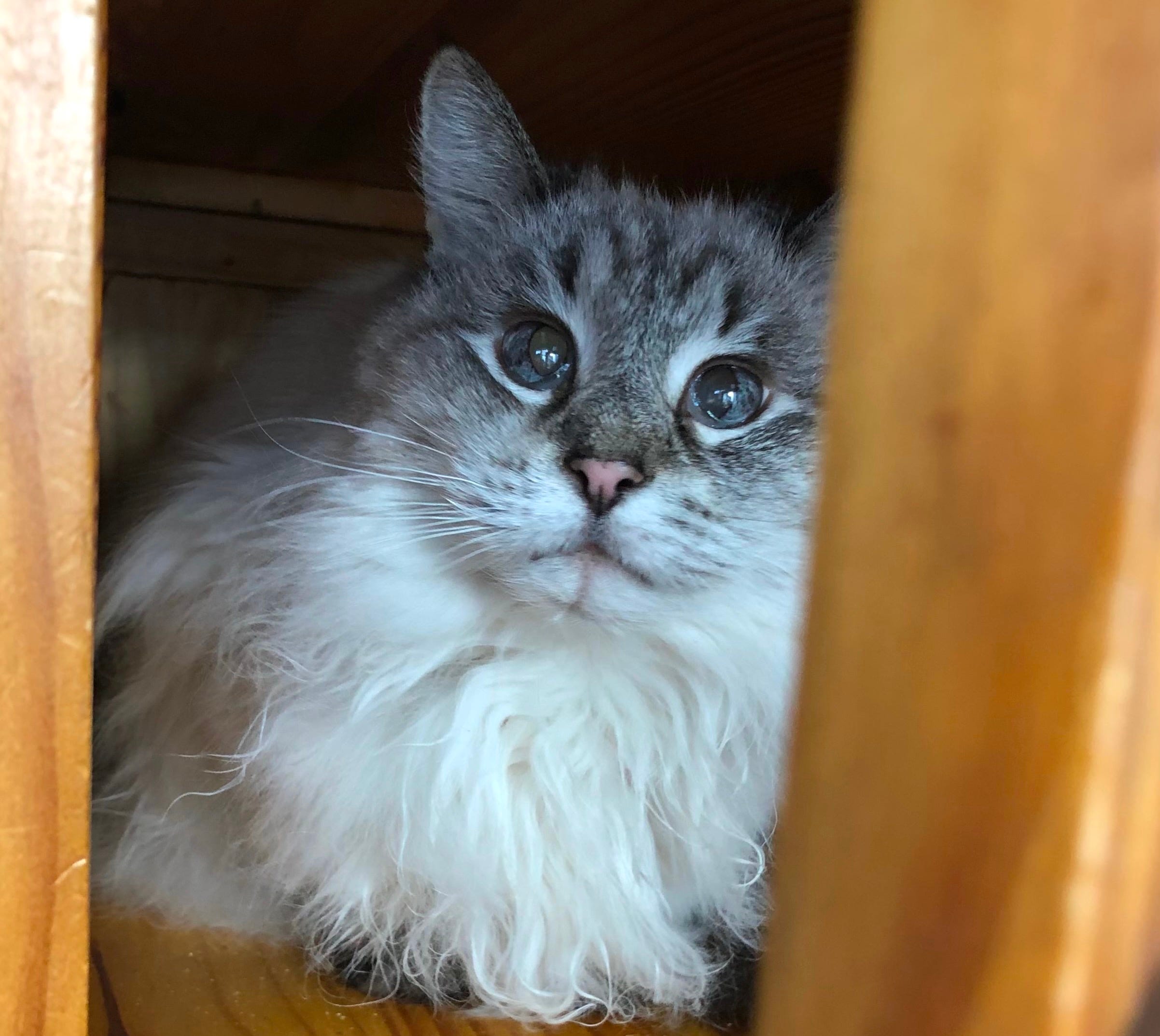
This year is different. Between the Ides of March (heavy snow) and April 17 (hail and tornados) the temperatures rose into the eighties, fell below zero, and boomeranged in between. Forsythia bloomed. I turned seventy. A bird hopped across the porch roof in front of the window where my very old cat was seated. Mini noted, for the last time, the first robin of spring.
It’s Saturday, the twenty-first of March, the day after the vernal equinox. I’m sitting with my neighbors in a loose arrangement of chairs spilling out from Brian and Rebecca’s garage into the alley. At ten in the morning, the temperature’s already reached 75 degrees. That’s 79 degrees warmer than the previous Monday. Spring in Minnesota is not what it used to be.
A clamoring overhead: the trumpet-rattle calls of a squadron of sandhill cranes. Their flight path is taking them west, toward the Mississippi River, a small course correction in the return to whatever migration group they’re part of. This way, over here, now I see them, what’s the rush?
On the ground, we’re holding our own forum. There’s the roast-your-own-beans delegation, the homemade ginger-beer contingent, the maple syrup caucus.
“It’s perfect weather for the sap to rise.”
Ralph brings up pictures on his phone. Rennet jugs — his forty acres are in Wisconsin, famous for its cheese — collect the clear liquid, and an arterial network of blue plastic tubes siphons it to restaurant steam table pans. He and his wife Cindy carry them to a stock watering tub set over a wood fire.
“We brought home two gallons of syrup last week. From fifty of sap.”
I live among folks who bring a surge of generative energy to the world. They make, harvest, build, imagine, organize, knit, purl. My current skill set does not extend much beyond loading the dishwasher properly. I stand, so abruptly that I splash lukewarm coffee onto my jeans.
“Gotta get home to Mini,” I say. “It’s been years since I fed her.”
I hurry out before anyone asks how she’d doing. Within days, she will let me know that it’s time to summon the vet.
Sunday, March 15. I’m in the sunroom looking out at twelve inches of fresh snow when the doorbell rings.
At three in the afternoon, I’m still in my bathrobe. This isn’t unusual for me. But as I’m never sure how others will react, I hesitate. After the second ring, I wait thirty seconds, then peek out the bow window of the sunroom. Someone walks away from the door. A child, bearing a snow shovel. I set down my coffee and hurry to intercept her.
“Hi there!” I call. She turns. Squints at me from across the softly drifted front steps.
“Is it okay if I shovel your sidewalk for ten dollars?” Her voice has the confidence of someone who’s earned many Girl Scout cookie badges.
She’s about eleven. The snow isn’t heart-attack heavy, but it’s dense. Wet. For ten dollars, I should put on my coat and boots and join her. Let her think she’s the one doing the actual shoveling. Invite her in for hot chocolate.
But I’ve finished off the Swiss Miss, scraping the last of it from the container to make a tan gruel that tasted like sweetened chalk. To get dressed seems pointless. Changing from one pair of pajamas to another has become my winter clothing rotation. I won’t badger her with questions about school, the thing grownups ask about when they’re done with exclaiming over how big you’ve grown. This sturdy child is the size Nature intended her to be; she’s Nature’s business, not yours.
I sprint upstairs. Ten dollars is all the cash I have, or I would give her more. She folds the bill and zips it into her jacket pocket. Fifteen minutes later, my sidewalk is the cleanest on the block, and I’m still in my bathrobe. The girl has moved on. Her unhurried pace tells me that she will always find the right tools to make her way in life.
As I return to my seat in the sunroom, my heart lurches.
It was on a day like this, almost exactly three years ago, that I tried to clear a path for my husband’s wheelchair. On the morning he left our home to enter hospice, a similar amount of snow had fallen. My black puffer coat flared open like a crow’s wings as I sobbed, flailing, my face swollen with tears. The dull blade of my old shovel didn't crack the layer of frozen slush against the pavement.
Two angels appeared out of nowhere. Rebecca put her arms around me in a tight embrace.
“Mary, we’ll do this,” she murmured. “Go be with your husband.”
Brian was already at work, moving slabs of snow, leaving nothing behind on the concrete.
“Go,” Rebecca whispered. “He needs you.”
I went. Back indoors, I crouched next to the wheelchair that was useless in our old house, with its stairs and angles and the upstairs corridor to narrow for people to pass each other. We cried together until my brother arrived. He’d driven four hours that morning to help with our final, hardest move.
Monday, March 16. Overnight, the temperature drops to minus four. The streets are fully plowed but icy as I drive the two miles to the office of my therapist, who I’m seeing for the first time.
Diana appears to be roughly ten years older than me. Because my birthday’s approaching, that would put her at — wait, eighty? She could die, send me reeling into another loss, three years after my husband’s death. Maybe I should rethink this, find someone younger.
Instead of, How many drinks do you consume in a week? she says, Any concerns about alcohol? I tell her no. I like her phrasing; it doesn’t require math or induce shame.
She refrains from asking What do you hope to accomplish in therapy? That’s the kind of question that — along with the job interviewer’s Where do you see yourself in five years? and the hairdresser’s Do you need any product today? — that make me want to excuse myself from human interaction until my singed neurons heal.
We don’t discuss EMDR, CBT, DBT, C-PTSD, or whether I think we’re a good fit. My preferred treatment modality is talking; we’re a good fit, because she’s listening. I make an appointment for the following week.
We stand. As she shows me to the door, she asks again. So, you think your main issue is grief?
I don’t know how to answer.
Saturday, March 28. No Kings Day. The country’s flagship rally is taking place on the grounds of the Minnesota state capitol. A few days before my seventieth birthday, I am going to my first political demonstration.
At ten a.m., my son parks in front of the house. His wife and mother-in-law are with him. We walk three blocks to the bus shelter, and watch five packed buses pass us by. After half an hour, a driver sees us — two old women clutching their millennial progeny for support — pulls over, and stops. We climb in.
It’s not like a Tokyo train. But for the reserved denizens of the Twin Cities, who have to suck in their guts and pull their children close, it’s a bit friendlier than usual.
The driver drops us at the edge of a crowd that organizers will later estimate at two hundred thousand. We move by inches under a brilliant sky. Someone raises an arm, pointing, calling. Look at the eagles!
In a convergence of symbol and meaning so perfect it seems staged, two bald eagles are indeed soaring overhead. After a minute, they’re gone.
Are they migrating, like the cranes? I’ve seen giant eagle’s nests along the riverbanks near my house and in the Boundary Waters, close to the Canadian border. In Minnesota, land of 10,000 lakes and the headwaters of the Great River, you are never far from an eagle.
My eyes fill with tears. This gathering has been blessed. Following a winter of occupation by our own government; of masked thugs and teargas; of five-year-old Liam in his bunny hat, taken by ICE and deported, it feels like a cleansing. After the killings of Alex Pretti and Renee Good, it feels as if a message has been sent: Go forth, holding them in your heart.
One hand-lettered sign reads It’s So Bad, Even the Introverts Are Here. We are a few feet behind its bearer, who — true to the placard’s sentiment — raises and lowers it so quickly, I can’t get a picture. When Bruce Springsteen takes the stage, I lift my phone. Tilting it to capture bare tree branches and the capitol dome instead of the heads in front of me, I record the Boss singing “Streets of Minneapolis.”
We leave on a bus with enough room to sit comfortably together. At home, I pull out my phone. For the ages, I think, hoping I’ve at least gotten the sound. I press the replay button.
What I’ve captured is a three-second view of a stranger’s coat and boots, and some dead grass. I hear my “Ope, sorry,” as I apologize to the ground. When I held up the phone a second time, I’d forgotten to hit record.
Two days earlier, March 26.
Mini purrs with the bliss of a blind kitten as I cradle her head. She rubs her face against my hand with hard, insistent pushes. Her teeth are slightly bared as she seeks the mother who never nursed her. I’ve withheld that part of her origin story, not wanting her to know that she was the runt, the one deemed too tiny to survive. Mini. Though she be but little, she is fierce. She will follow Titania and Tybalt, two cats who preceded her, into a midsummer night’s afterlife.
The softest blanket. The A-frame shelter of my bent legs. Pillows and footstools arranged on the floor to help her navigate the front bedroom. All winter, we slept together in the narrow daybed that was my daughter’s. Before that, she curled against me every night in the bed my husband left when he moved to hospice three years ago.
She slips from my arms and resumes spinning. That is the word for the tight circles of her pacing, something she’s been doing now for days. Maybe even a couple of weeks. Minimizing this symptom of neurological decline, I’ve been repeating a desperate mantra. She’s eating. Drinking. Still uses the footstools, the cushions, the litterbox!
But she’s peed on the floor a few times. Fallen more than once. I wake at three a.m. not knowing how long her gaze has been fixed so intently as she winds her way around, tethered to some invisible post.
Suddenly, she stops. Calm as a Buddha, she faces the wall. I move forward and press my hands against her sides. Her purr is resonant and even. We sit, unmoving, for five minutes. Then she brushes against my arm as she makes her way to a cushion, lies down with paws together in front of her chest, and closes her eyes.
If you’ve had to say goodbye to an animal who loved as fiercely and tenderly as Mini, you know the wordless communication that passes between you at the end. I thank her for the nights she waited at the door for me to come home, hollowed out by a job I hated. For the pandas — of course they weren’t stuffed! Of course each one was not the previous one! — she brought, yowling and trilling loudly enough to wake the neighbors. I thank her for staying with me, so I would not be alone on this earth.
She tells me it’s time. That I will be okay.
I stand. Mindful of her awareness, I tiptoe downstairs and pull up the Final Journey website. Pictures, profiles, names. Which vet is available today?
Renee.
Like Renee Good. I’ve found the right person
“I can be there by three,” she says. “I have everything we need. She won’t feel any pain.”
Upstairs again, I lift my companion onto the bed. Kneeling by her side, I croon into her ear. You are my Mini, my only Mini, You make me happy when skies are gray.
The vibration in her throat has grown faint. My voice breaks.
Please don’t take my sunshine away.
How do you deal with the hard things in life? You know: the grief that feels overwhelming, but can be the wellspring of a new life. Letting go of beloved companions, when you desperately want them to stay. Reaching a milestone — birthday, anniversary, retirement — and finding it more complicated than you thought it would be. Tell me about it in the Comments.
I’d love it if you hit the heart button. Share online. The restack ♻️ button will help get this post in front of more eyes.
If you’ve been enjoying Writer, interrupted for a while, please consider becoming a paying subscriber. Although everything I write is currently free to read, paid subscriptions allow me to bring you my best work. It’s my birthday month! Through April 30, new annual subscribers receive 25% off, forever. Help keep award-winning independent publishing alive.
Comments
Nothing yet. Say the first thing.
Sign in to join the conversation.