
Wild ginger had a simple and immediate message for me. “Stay close to the dirt,” they said. I was kneeling on the forest floor, peering under their leaves when I received these words, and I have been pondering them for several days now.
I love moist, crumbly, dark earth—to breathe in its rich, earthy, life-giving aroma that comes from mycelium, decomposing leaves, microbes, decaying trees, and all the beings who have given their life back to the Earth. Nothing calms my nerves and makes me feel as happy as running my hands through living dirt.
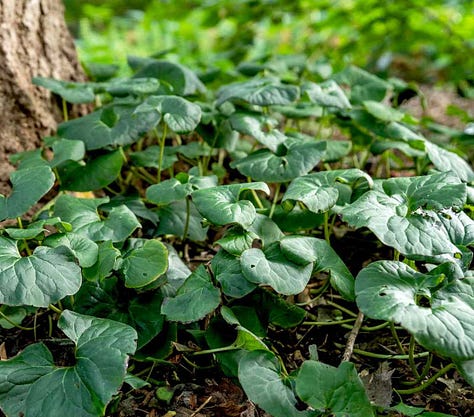
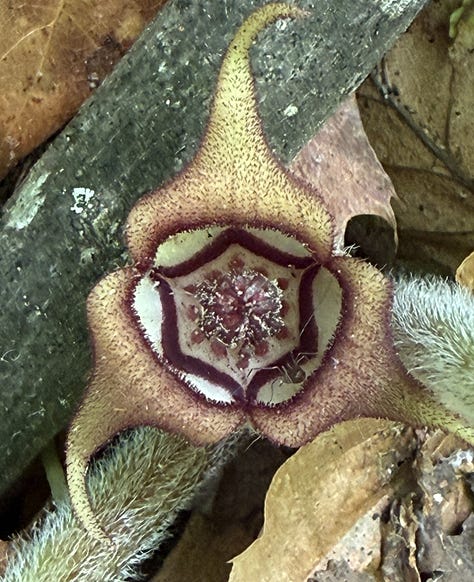
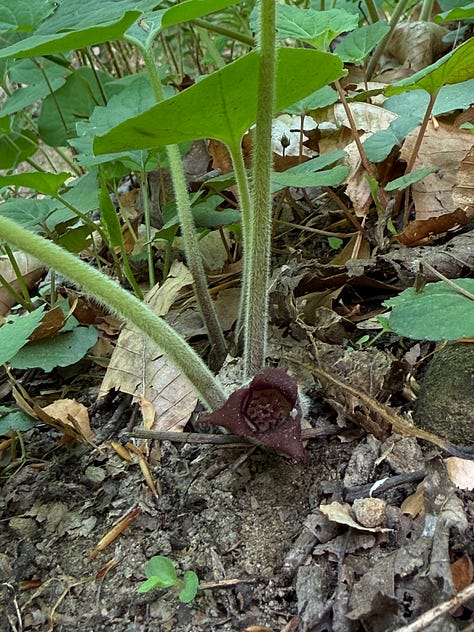
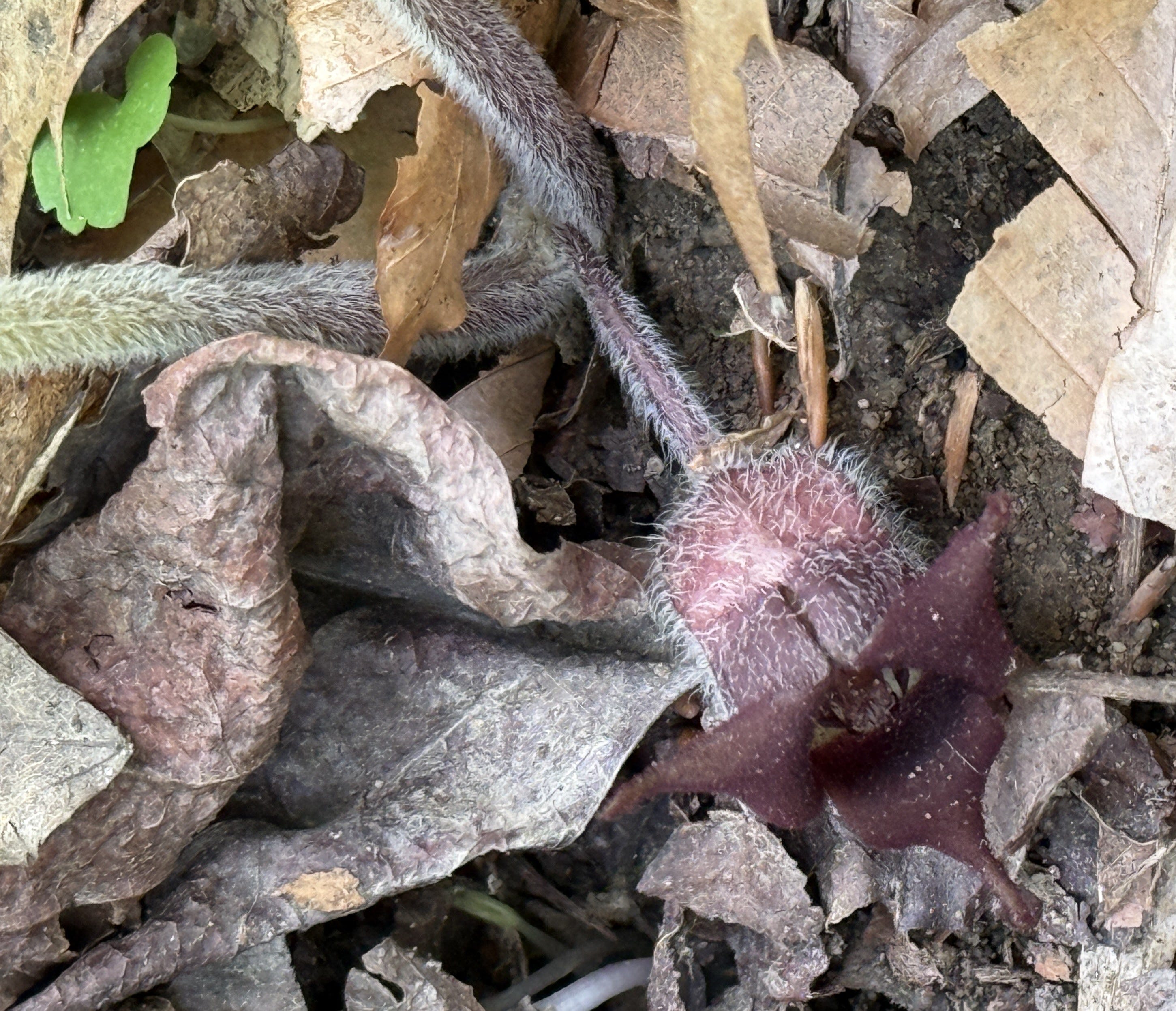
Wild ginger lives close to this dirt, spreading their rhizomes and sending up two shiny, dark green, heart-shaped leaves in early spring that grow to three to six inches across. They hover just over the leaf litter on the forest floor, often in large mature colonies. Where their two leaf stalks emerge from the dirt, a single small maroon flower emerges that lays on the ground under the leaf litter. Often described as a “little brown jug,” it is a vessel less than an inch wide, laying on its side on the forest floor with three graceful, pointed lobes that curve backward. Covered in dense white hair on the outside, a gaze inside reveals a world of white and maroon geometric beauty, holding a ring of stamens.
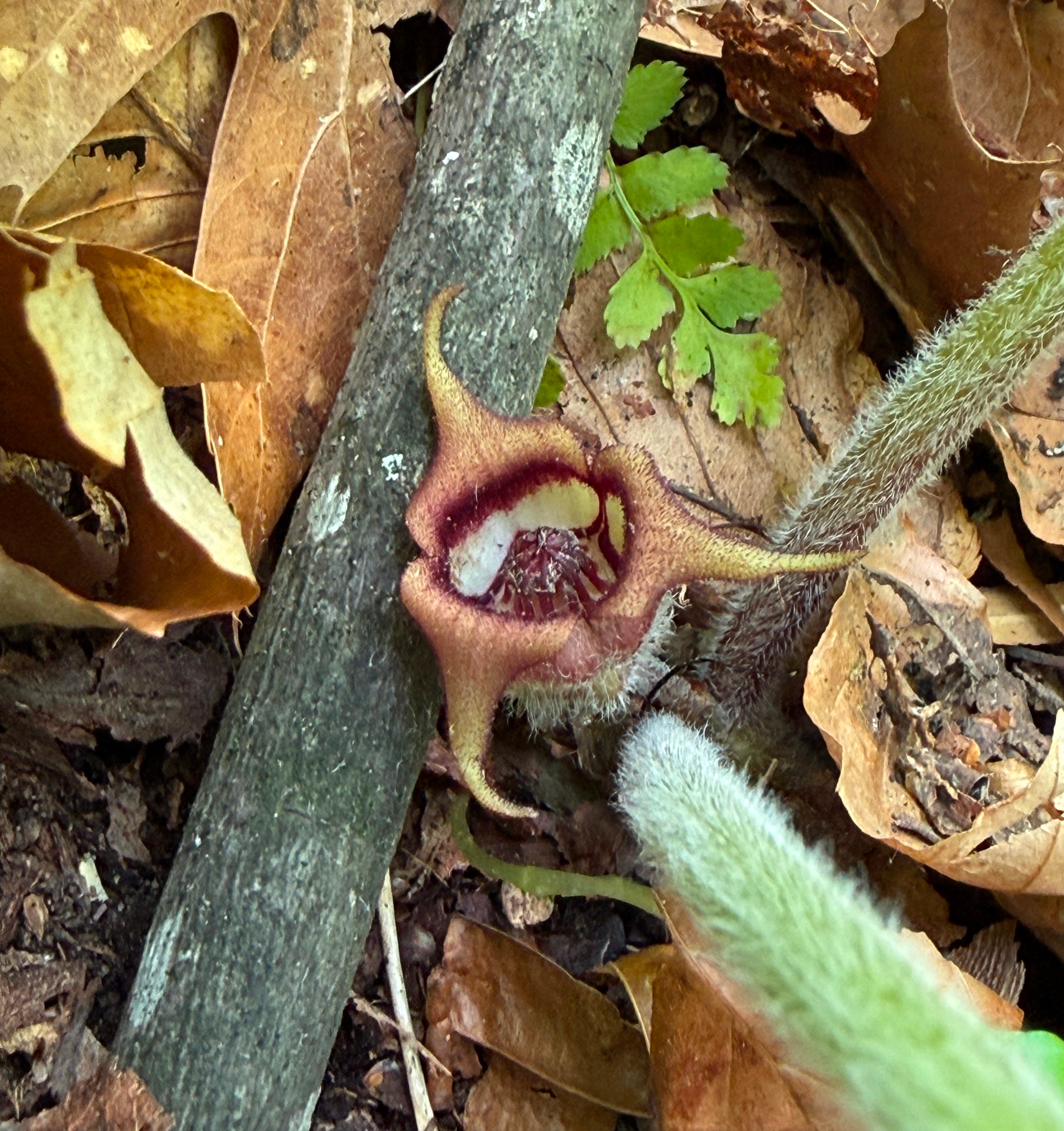
Most flowers hold themselves up high to be visible to the passing bees and other pollinators, but these wild ginger flowers prefer to be next to the dirt, protected under the leaves, where they attract ground-dwelling flies and fungus gnats. Interestingly though, while they offer the opportunity for cross pollination when they first open their flowers, the majority of the time they rely primarily on self-fertilization that happens later if no insects show up, and they produce seeds just as effectively this way. When their seeds ripen, each one has a fatty, nutrient rich attachment called an elaiosome, to attract ants who carry their seeds back to their nests, where they eat the tasty snack and discard the seed into a waste pile perfect for new ginger plants to sprout.
Native to North America, wild ginger earns its name from their aromatic underground stems, or rhizomes that have a spicy, citrusy scent and flavor that strongly resembles the tropical ginger used in cooking. The leaves also release this fragrance when crushed or bruised. While Indigenous peoples used the roots in cooking and medicines, it is strongly recommended now not to consume them because they contain a known toxin that can cause kidney damage.
When I am kneeling on the forest floor, rooting under those heart-shaped leaves to peer into the heart of this unassuming little flower, I find myself slowing down even more than I do in the presence of most other flowers. So small, in a world of their own, they call me to join them down here on the ground, at this edge between the air we live in, and the generative miracles of the dirt that support us, literally and figuratively.
Scientists still do not understand all the complexities of dirt, of soil, of humus, and how it generates life. They also like to say soil is a living ecosystem, and dirt is “dead” soil that has been displaced from its context. But to me the word dirt is primordial—what I hold in my hand and what gives life. For me, using the word dirt is to hold the truth that life comes from the dead, from all the beings composted into the dirt.
Living above the dirt, it is easy to take the dirt for granted, to underestimate its complexity, to forget to honor and revere not just the whole Earth, but each handful of dirt as sacred. The dark matter beneath our feet is home to fifty-nine percent of all species on Earth. Ninety-nine percent of the bacterial species and sixty-three percent of the fungal species in dirt have never been classified, and their life cycles are so intricately intertwined that they cannot be reproduced in a lab. These are complexities that are truly humbling, and what the wild ginger is especially passionate about teaching me, when they invite us to peer into the mouth of their unique flowers. “Stay close to the dirt,” I hear them say over and over.
Indeed, we would do well to be more humble as a species—and being closer to the dirt is a good place to start. In fact, the word “humble” has its primary root in the Latin word humus, meaning “earth” or “soil.” It entered English through the Latin word humilis, which literally translates to “on the ground” or “low to the earth.” Not to mention that the word “human” comes from this same root. We literally came from the Earth, from the dirt, and our word for ourselves even holds this truth.
Human hubris—the thinking that we are special, believing we are the only ones who have feelings or consciousness, that we are entitled to rule the animals and plants and use the Earth as a resource—these are the roots of the deeply dangerous egocentric mindsets that have separated us from the rest of our living Earth for millennia, and imperil our futures. A ten-thousand-year misguided experiment in agriculture and civilization has gone awry because we forgot how to live close to the dirt, forgot how to call in the wisdom of our plant and animal elders, and have forgotten how to revere the Earth as sacred. It is time to remember.
I am so grateful to this beautiful and humble plant, the wild ginger, for their simple wisdom that is such deep guidance. For reminding this landlubber being, that the dirt is where life begins. For their heart-shaped leaves that call me to look deeper into my own heart. My body knows, far more intimately than my mind, that having my hands in the dirt is where I belong.
Mary Porter Kerns is the author of the forthcoming book, The Flowers Are Speaking: Listening to Nature’s Ancient Wisdom (Tarcher-Penguin Group, April 2027) that is an intimate journey into the entwined evolution of flowers and human beings—weaving together science, history, stories, and earth-based mysticism to offer a radical vision of how we can best reconnect with the intelligence of plants and the ancient guidance of the earth. In fall of 2022 she self-published the first edition of her oracle cards, also called The Flowers Are Speaking, that sold out in three months.
Her highly acclaimed workshops teach participants how to experience the flowers as she does through their own senses, intuition and imagination.

Thanks for reading The Flowers Are Speaking! Subscribe for free to receive new posts and support my work.
Comments
Nothing yet. Say the first thing.
Sign in to join the conversation.