
There are plants that never apologize for taking up space. In a culture that celebrates bigger as though it were always better, pokeweed grows big and wild because that is who they are—as they have been for millions of years, without trying to be better than any of their neighbors. Pokeweed grows anew each spring from their huge roots, and suddenly it seems, by midsummer, we find them towering over us.

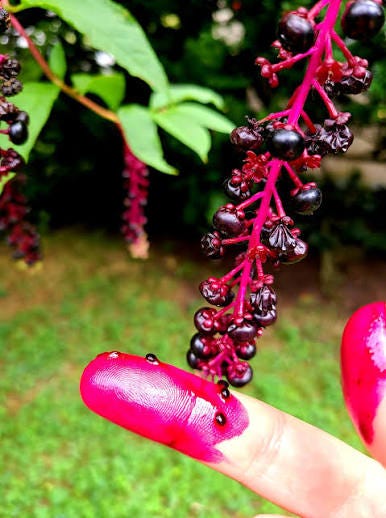

I’ve always been drawn to these exuberant plants with their deep red stems and luscious, dark purple berries. I remember as a child getting my fingers stained purplish red from squishing them, though I don’t think I ever tasted one because I remember being told they are highly poisonous and we could not eat them. But I am equally sure it was hard to resist squeezing those shiny, juicy, richly colored beads!
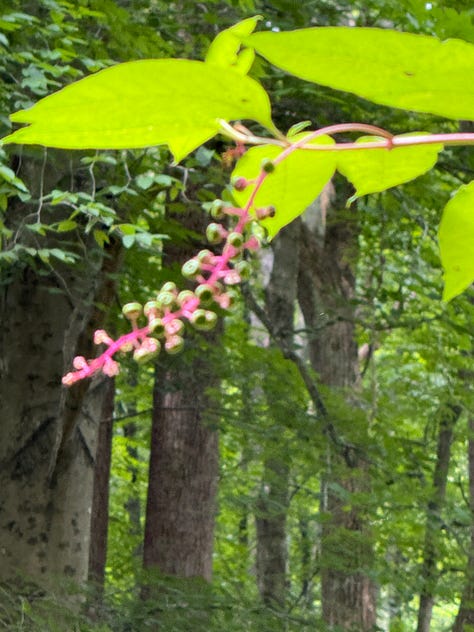
Deep summer in Appalachia is the peak time of year for plants that grow big to reach for the sky, and pokeweed in particular is well known for their lush growth, easily becoming six to ten feet tall, with their stalk and wide-reaching stems steadily turning deeper shades of purplish red as they flower and their berries swell and ripen. Often overlooked before the berries turn purple, their small white flowers encircle small green buds, and are already dangling on long stems, preparing to carry the weight of the berries as they ripen.
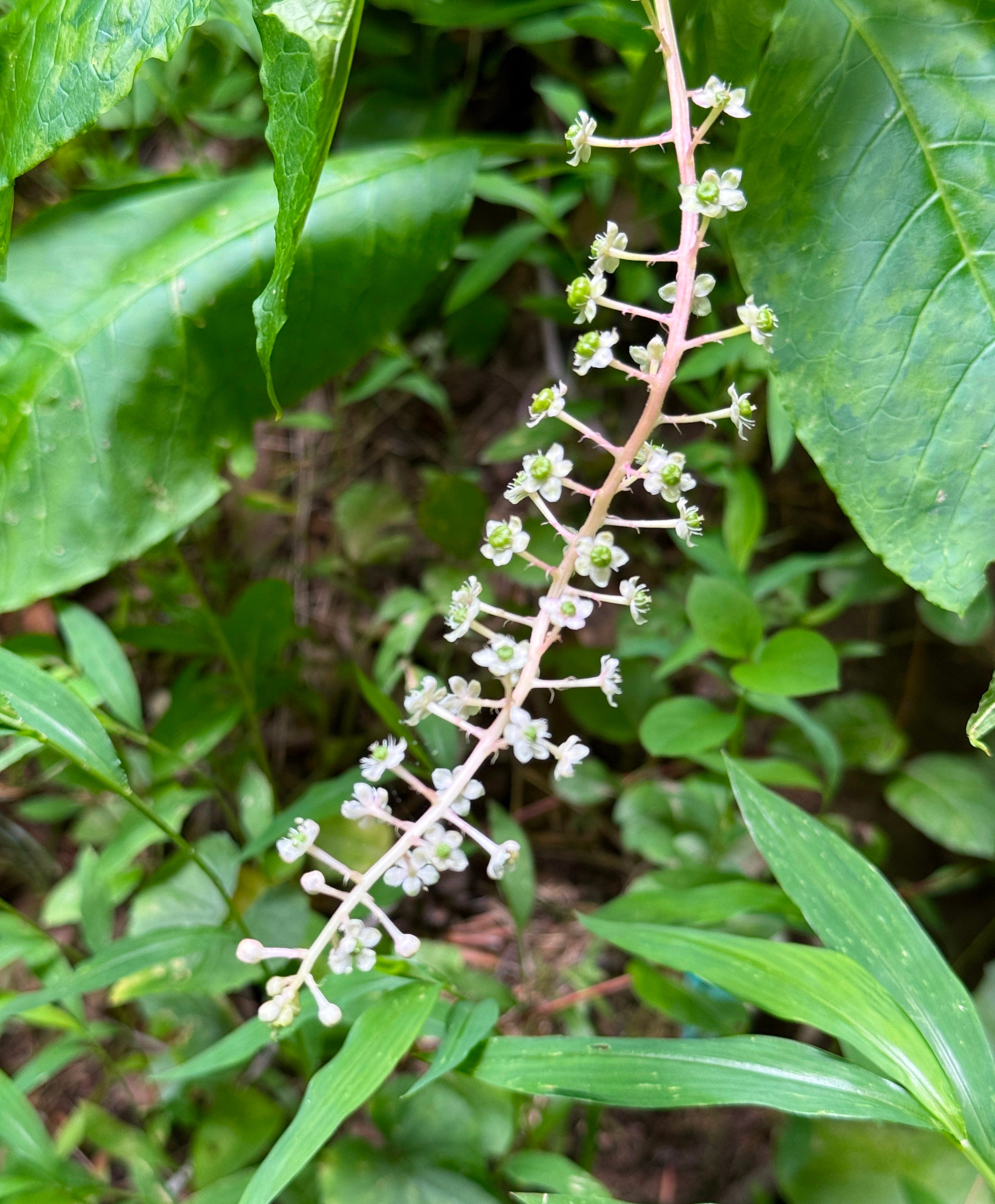
Color has always pulled me, and perhaps that is why I love knowing pokeweed was once used to make ink. The vibrant magenta/fuchsia/purple of the berry juice and their stems are so enticing, so it is still hard for me to really believe they are not edible, especially because over thirty species of birds relish them. Evidently the seed itself is highly toxic, but not the fruit, and when the birds swallow them whole, their stomachs only dissolve the outer fruit.
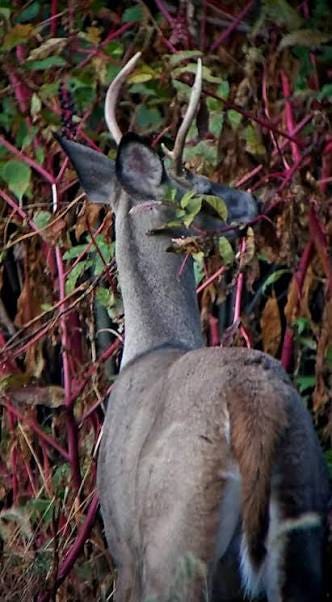
Pokeweed also produces massive amounts of nectar and pollen, making them a vital banquet for many bees, wasps, beetles, hoverflies, and even hummingbirds, in the heat of summer when other spring wildflowers have faded. In addition, deer, bears, and other native North American wildlife that have evolved with the pokeweed, eat their berries, having developed an immunity to the toxin. Deer even graze heavily on the leaves and stems that are highly toxic to us. This immunity does not extend to our domesticated animals, like horses, cows, and sheep, however. It is poison to them just as it is to us, because neither our domesticated animals nor most of us share the long evolutionary relationship with pokeweed that many native North American species do. Plants and animals coevolve and adapt to one another in countless ways over immense stretches of time, while newcomers often have not yet formed compatible relationships.

Although pokeweeds are big here in Appalachia, they have a lot of even larger, truly huge relatives in the tropics. Evolving about 20 million years ago in a much warmer climate, today only 3 of the 65 family members have adapted to survive in our temperate climates. No wonder our American pokeweed looks big and loud and colorful, like so many tropical plants do. Perhaps their extravagant growth still carries the memory of those ancient tropical ancestors.
Standing beneath a large pokeweed in late July, I could feel how comfortable they were taking up the space they needed. Almost lazily, extending themselves in whatever direction felt most spacious. And rather than feeling small in comparison, I felt their exuberance giving me permission to stretch my arms wide too, and to become fully myself, to trust who I am. They knew more than I did how much I needed to hear this, as I prepare to usher my book—the flowers’ book really—into the world next spring.
Today, I asked Pokeweed, “How does it feel to be the big plant in the meadow?” And they said to me, “Come, be juicy with us; let’s share our aliveness together! We reach for the sun, dangling our fruit for all to see, and invite those we have known the longest to feast freely with us. Follow our juice to color your life, to unleash your own passion. Let our radiant purple flow through your veins, feed your soul and call you to the dance of life. Trust the shape of your becoming and take the space you need.”
Big for the pokeweed is simply who they are, and they are inviting us to be who we are. No more, no less.
Mary Porter Kerns is the author of the forthcoming book, The Flowers Are Speaking: Listening to Nature’s Ancient Wisdom (Tarcher-Penguin Group, March 2027) that is an intimate journey into the entwined evolution of flowers and human beings—weaving together science, history, stories, and earth-based mysticism to offer a radical vision of how we can best reconnect with the intelligence of plants and the ancient guidance of the earth. In fall of 2022 she self-published the first edition of her oracle cards, also called The Flowers Are Speaking, that sold out in three months.
Her highly acclaimed workshops teach participants how to experience the flowers as she does through their own senses, intuition and imagination.

Comments
Nothing yet. Say the first thing.
Sign in to join the conversation.