
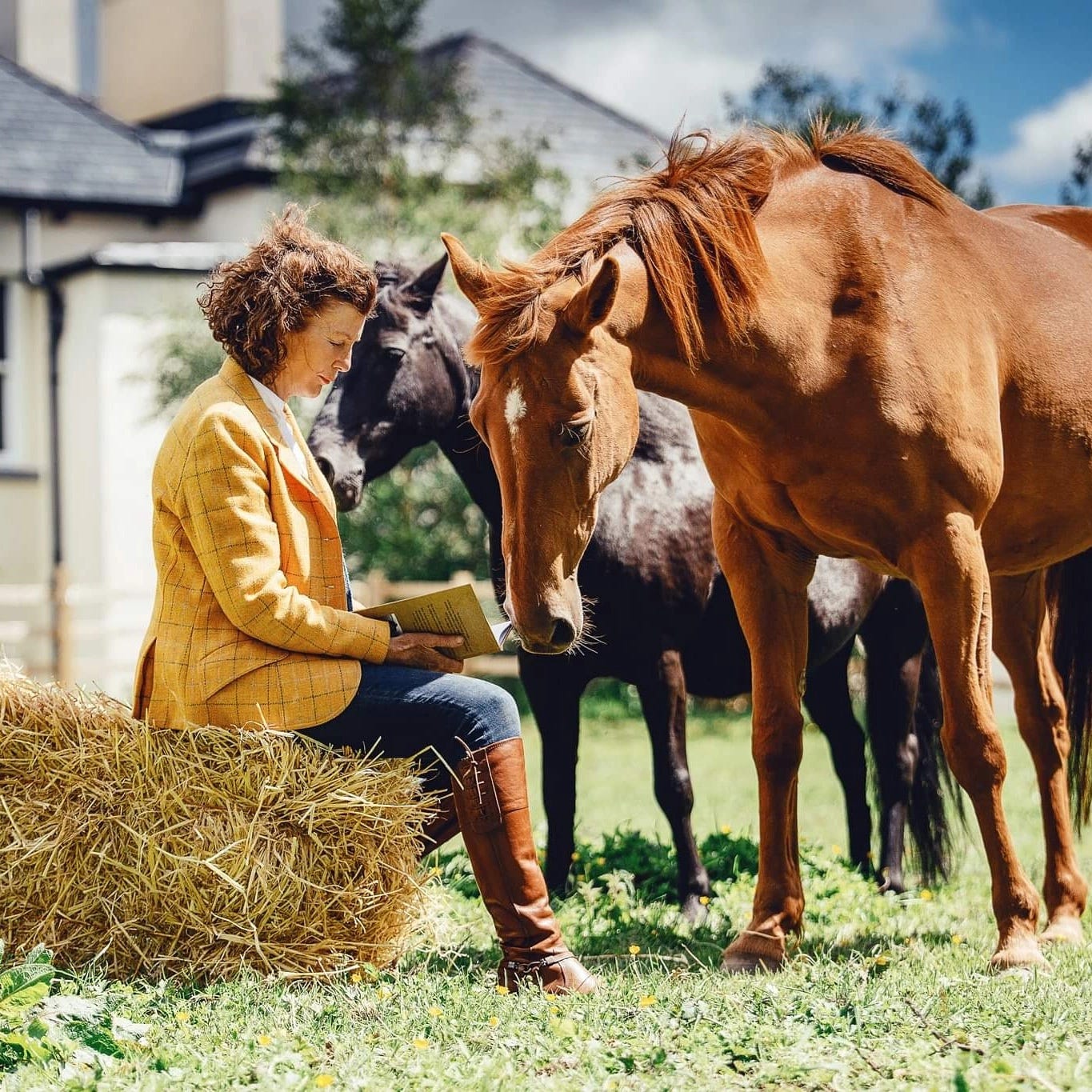
People often ask me why I work with horses with no halters, lead ropes, or harnesses. The answer is not that I am totally against them. There is a place for different approaches to horsemanship.
I choose to work with horses at liberty because I want them to have choice. If horses are in equine-assisted learning sessions in a field or arena, I want them to choose whether to come closer or not. Equally, if they or one of them walks away, I trust that too.
That trust was not always part of my life.
The first time I sat on a horse, I was two years old. Every summer I rode at my aunt’s farm and, by the age of twelve, I had my own pony. Like many riders of my generation, I was immersed in traditional horsemanship with bits, bridles, halters, harnesses for hunting, showing, and competition. I loved my horses, yet I rarely questioned the methods that I had been taught.
Many years later, a mentor made a comment that changed the course of my life.
“When you put a halter on a horse, you change the relationship dynamic with it”
I reflected deeply on this and thought. Her comment was not a criticism. It was an invitation to look beyond technique that I had taken for granted and into the nature of relationship itself. I found myself smiling when asking myself”
“What kind of relationship would I have if I handcuffed a friend and said, ‘Come, we are going shopping or for lunch’?”
From that day on, I asked different questions. Not How do I get a horse to stay? and more, who is this horse when it is completely free to choose?
That question and similar ones have shaped how I work today.
When I facilitate equine-assisted learning, the horses are free. There are no halters, no lead ropes and nothing holding them beside me or beside the person they are working with. They are free to come close, to stand at a distance or to walk away altogether. Repeatedly, something remarkable happens.
Over the years I have witnessed the same pattern time and again. A horse will choose to be with a particular person. Sometimes they stand together. Sometimes they move together and touch. Other times they share close space in silent presence. When the learning and connection seem complete, the horse walks away.
They stay or move not because I ask them to or because they have lost interest. It is as if somehow, they know. After witnessing this countless times, I no longer dismiss it as coincidence and trust more fully this equine wisdom and intelligence that has been on this earth much longer than I.
The horse is not my assistant; it is a partner, a co- facilitator. My role is not to manage every interaction or orchestrate every moment. My role is to create a safe, respectful space and holding and to trust the horse to bring what only the horse can bring. Of course clients learn how to be safe around them and how to create and respect boundaries for themselves and the horses.
More often than I can share or explain here , the horse perceives something before I do. They respond to a person’s presence rather than their words, to authenticity rather than performance, to what is happening beneath the surface rather than what is being presented.
Recently in a session, the horse walked away, and immediately the client said, “ The horse does not like me “
“Is it true?” I asked, “That the horse does not like you ?“
“Could it be that it likes the tuft of grass over there or moved away for another reason?”
Later she reflected that she does this with people too. She sees their actions as a reflection on her when it may have nothing to do with her. She gave an example of when a friend does not respond to a text or call in her time frame, she can easily think that the friend does not like her anymore. I have also seen so many similar examples with teenagers. It is interesting to track where this emerges with the person, and it is really never about the other and, in this case, about the horse.
Working this way has changed my understanding of freedom. I have come to see how often we mistake control for safety. How tightly we hold on because we fear what might happen if we let go. Yet every time I step into the field with untethered horses, I am reminded that genuine relationship cannot be forced. It cannot be manipulated. It cannot be dominated. It can only be invited.
I have realized that our greatest fear is that when we let go of controlling, demanding, or manipulating, we fear abandonment, that others will leave, that we will be forgotten. I have seen that when we go into that fear, stay with it with awareness and breath, that something magical wells up - a reservoir of the love and healing that we are longing for and looking for. From that rich place we can more easily allow life to come and go and know that it is always towards us and that real love never leaves.
Perhaps that is the deeper invitation the horses offer all of us.
Not simply to notice whether the horse is untethered, but to ask ourselves:
Where in your life do you feel tethered, held back by fear, perfectionism, old patterns or the need to stay in control?
What story about yourself that keeps you tied down, in your relationships or your work, is ready to be released so that something more free and authentic can emerge?
What would living with more permission and freedom look like for you? What other choices do you have?
Perhaps the greatest gift the horses offer us is not teaching us how to be with them, but reminding us what it means to be truly free, when we are first willing to give them and others that freedom too.
If you’re curious about what the horses might reveal about the places where you feel held back and limited, I invite you to book a conversation with me. We can explore what freedom, choice, and wholehearted living could look like for you.
Book a conversation here: https://maryberkery.com/contact-mary-berkery/
No posts
Comments
Nothing yet. Say the first thing.
Sign in to join the conversation.