
Mount Vernon, New York, and Vancouver, British Columbia → Ladner, British Columbia.
Helen doesn’t waste words.
She never signs a surname, never explains herself, and even asks Annie to send her skirt to Vancouver if someone should be heading out that way. She needs it to go fishing, of course.
I like her already.
Our little wooden chocolate box has given up two more postcards, and this time they aren't from a stranger passing through with kind regards.
Helen feels different.
Helen feels close enough to send love to everyone at home, close enough to leave a black skirt behind, close enough to write as though their conversation had simply paused for a moment, not for a hundred years.
There is Annie again, too, and we’ve learned something new about her. On the West Point postcard she is addressed as Miss Annie L. Browne — a small detail, but the first real clue about her life. At the time, she was most likely unmarried. We also have a middle initial. ‘L’
Were Annie and Helen sisters? Cousins? Lifelong friends? Whatever the answer, each postcard draws them a little further out of the shadows. They are becoming less like names in fading ink and more like people whose lives briefly brush up against ours.
So, once again, I follow the clues.
Research Notes
Postcard (a)
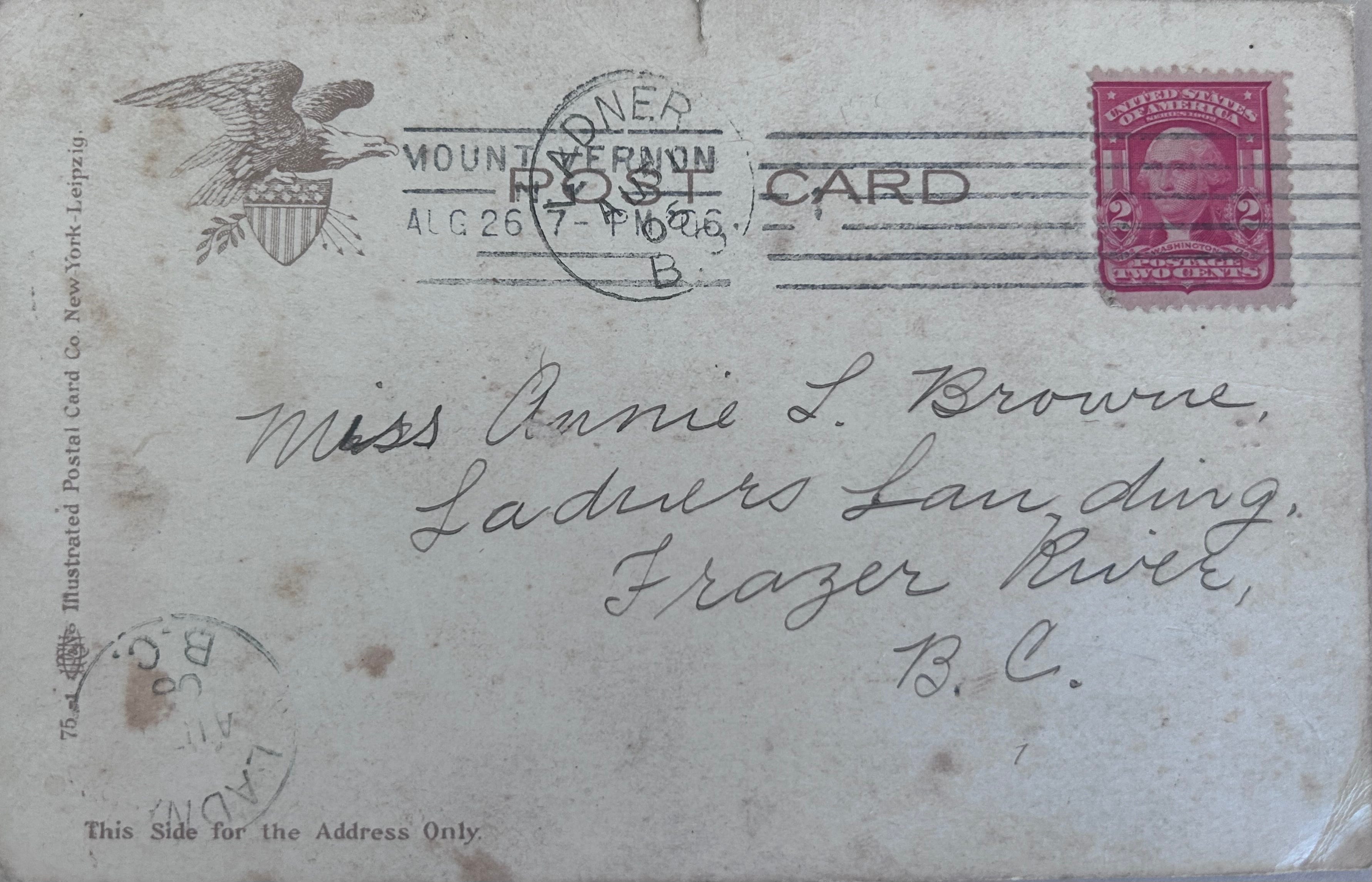
Date mailed: August 26, 1906
Place mailed: Mount Vernon, New York, U.S.A.
Recipient: Miss Annie L. Browne
Card type: Private Post Card
Postage: Two-cent United States stamp
Postmark(s):
Mount Vernon, New York
August 26, 1906
7:00 p.m. (appears to read “7 PM”)
Two Ladner, B.C., receiving postmarks are visible on the card, although the dates are too faint to read with certainty.
It was addressed to: Miss Annie L. Browne (notice the last name is spelled differently from the previous postcards), Ladner’s Landing, Frazer River, B.C.
First Impressions
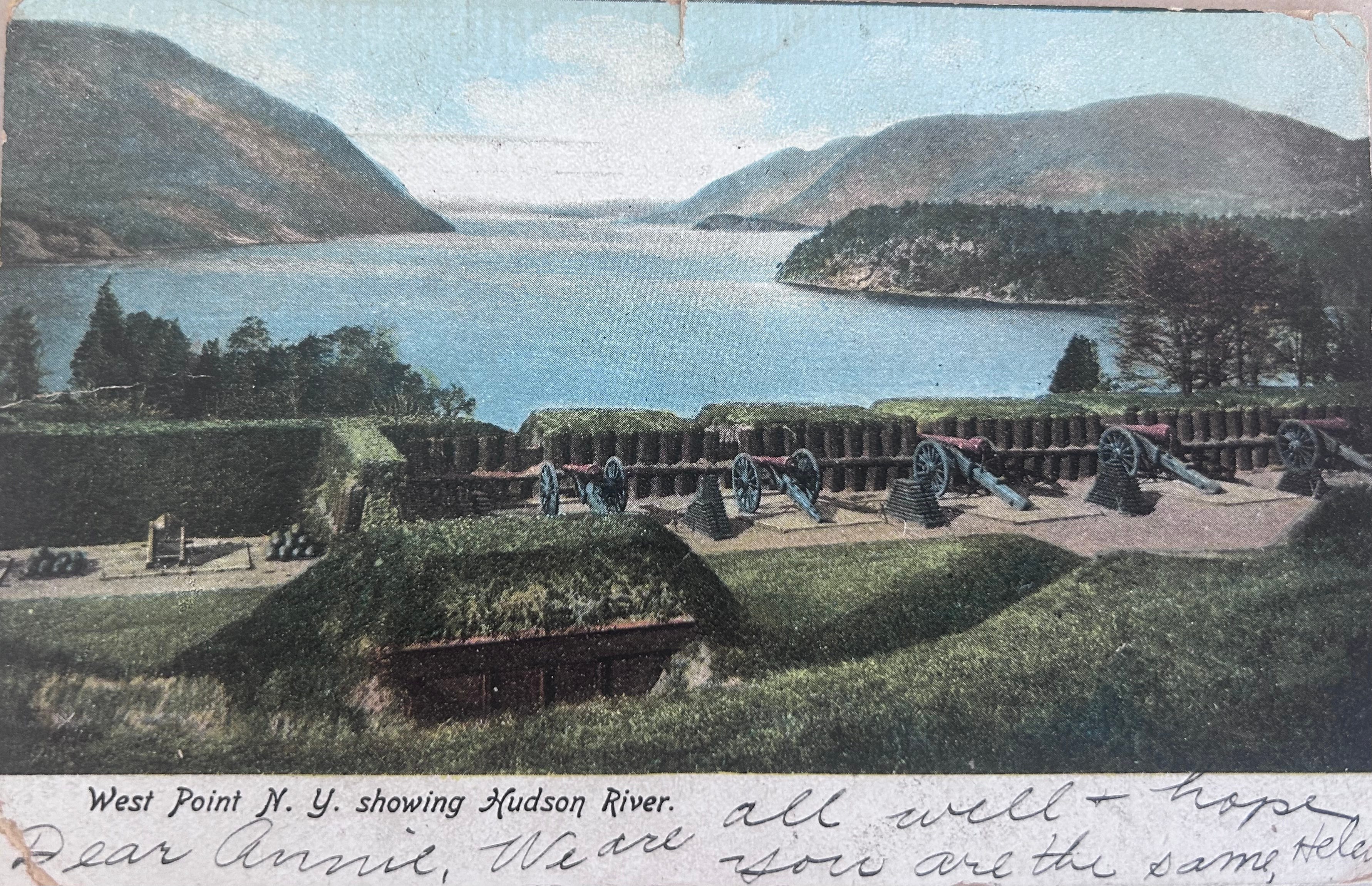
The front shows a broad view of the Hudson River at West Point, New York — heavy cannons lined along a stone embankment, wooded hills rising across the water, a small steamboat trailing smoke downriver. Peaceful and purposeful at once, exactly the kind of view for which West Point is famous.
Printed caption: “West Point N.Y. showing Hudson River.”
It’s an odd choice to send a young woman in Ladner. Why was Helen visiting Mount Vernon, New York? Did the view simply catch her eye or did it mean something only she and Annie understood? The postcard raises more questions than it answers — and before we even get to the writing, the postcard itself has a story. Along the left margin runs a publisher’s line: 75. Illustrated Postal Card Co., New York–Leipzig. The “75” is almost certainly a catalogue number. The company was American, but before the First World War it was common for U.S. publishers to have their cards printed in Germany, then regarded as the finest colour-lithography houses in the world.
So before Helen ever bought this postcard — before she wrote a single word, before it crossed North America to reach Annie in Ladner — this little postcard itself had already crossed an ocean. Turns out postcards have journeys too.
I will admit: I did not expect to spend an evening tracing the printing history of a postcard about cannons. And yet, here we are.
The Message
Complete handwritten message:
Dear Annie, We are all well & hope you are the same.
(The final line is faint, but this appears to be the complete message.)
Signature: Helen
It’s the shortest message in the collection so far, and it tells us more than its few words let on. Helen doesn’t explain who she is. She doesn’t need to. Their relationship is already established. No surname, no formal introduction, just familiarity. Who are the “we”? Family? Friends? A husband? Fellow travellers? She assumes Annie already knows, and that assumption is doing a lot of quiet work.
The Handwriting
Neat, confident, easy to read — someone accustomed to writing by hand, even in a hurry. She addresses Annie as Miss Annie L. Browne, with an e, a spelling worth flagging as the series goes on.
There’s a small but telling detail in the address: Helen spells the river “Frazer,” not the modern “Fraser.” It’s an easy detail to dismiss as a slip, but it’s actually more historically apt than it looks. The river was named for Simon Fraser, the North West Company explorer who traveled its length in 1808 (believing at the time that he was on the Columbia River) It wasn’t until the mistake became clear that fellow explorer David Thompson named it in Fraser’s honour. Fraser himself never referred to it as “the Fraser River” in his own journals; the name was given to him, not by him. Spellings like “Frazer” and “Frasier” circulated alongside “Fraser” for decades afterward, particularly in local and everyday usage, so Helen’s spelling reads less like an error and more like a period-accurate quirk.
Long before any of these European names attached to it, the river was known to the peoples along its banks by other names — Sto:lo (meaning, People of the River.) in Halq’eméylem, and further up river, Lhtakoh (rivers within one another) in Dakelh. Those names predate Fraser’s expedition by generations, a reminder that “discovery” here meant a European name layered onto a place that already had one.
Ladner’s Landing was the original name for the settlement that grew up around the Government Wharf — the postal and transportation hub of the district before the town we know today took shape. In 1906, it was the only correct address to use.
Postcard (b)
Date mailed: Unknown
Place mailed: Unknown, although the message suggests Helen was in Vancouver when she wrote it.
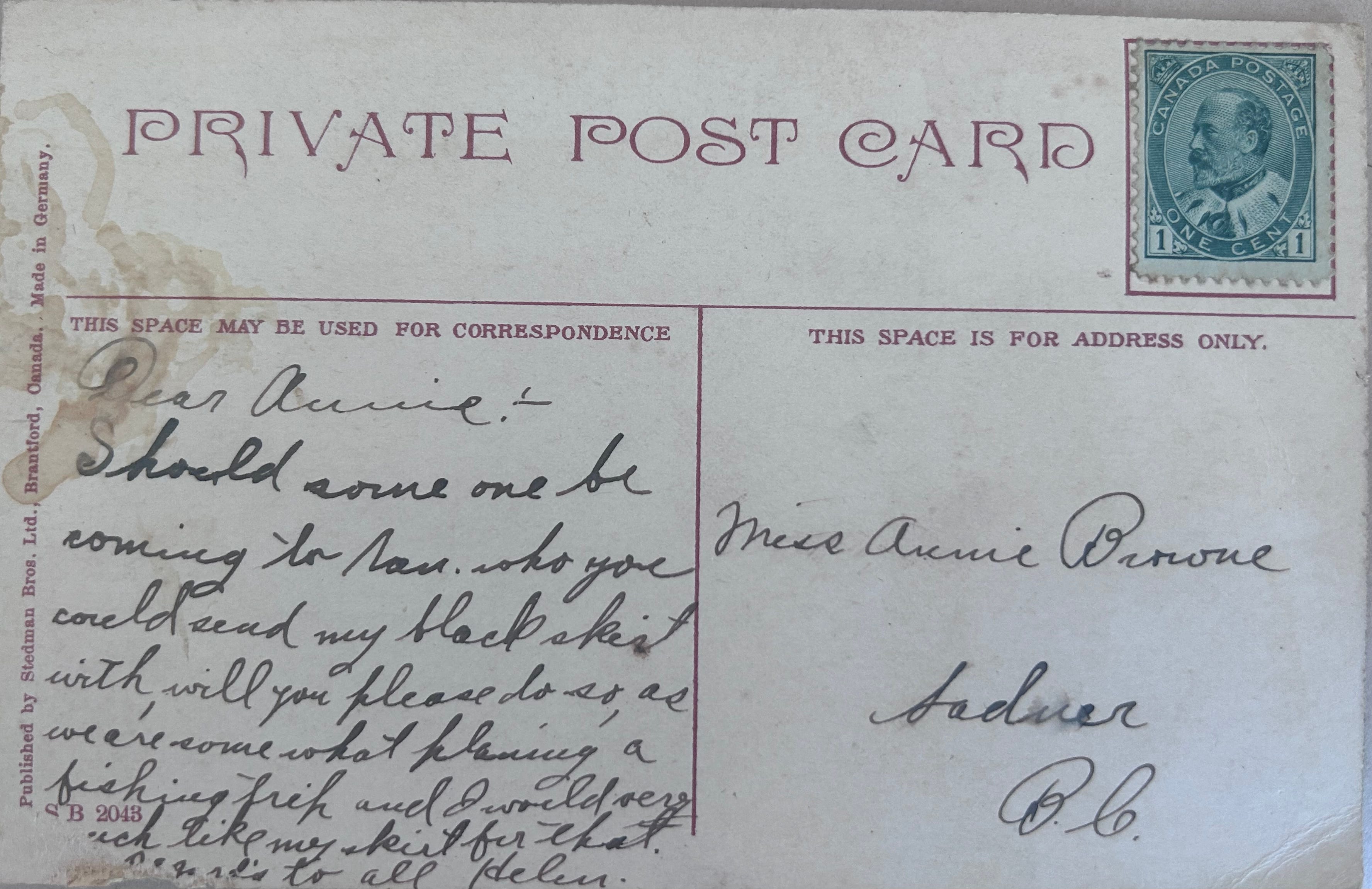
Recipient: Miss Annie Browne (spelled differently yet again)
Card type: Private Post Card
Postage: One-cent Canadian King Edward VII stamp
Postmark(s): None visible
Addressed to: Ladner B.C.
The stamp is still attached, but there’s no cancellation mark to help date or place it.
The Message
Complete handwritten message:
Dear Annie:— Should some one be coming to Van. who you could send my black skirt with, will you please do so, as we are somewhat planning a fishing trip and I would very much like my skirt for that. Love to all,
Signature: Helen
This is my favourite postcard in the collection so far — not because of what it says, but because of how ordinary it is. Helen wants her skirt back. That’s it. That’s the whole letter. “Some one” is written as two words; “Van.” is almost certainly Vancouver.
I can picture her perfectly: standing on some shoreline, fishing rod in hand, irritated that her favourite skirt got left behind at Annie’s house the last time she visited her. In the early 1900s, women wore skirts or long dresses outdoors even to go fishing — it was simply what you wore. One sentence, and suddenly Helen is a real person worrying about fashion and real laundry logistics, not just a name in a box.
First Impressions
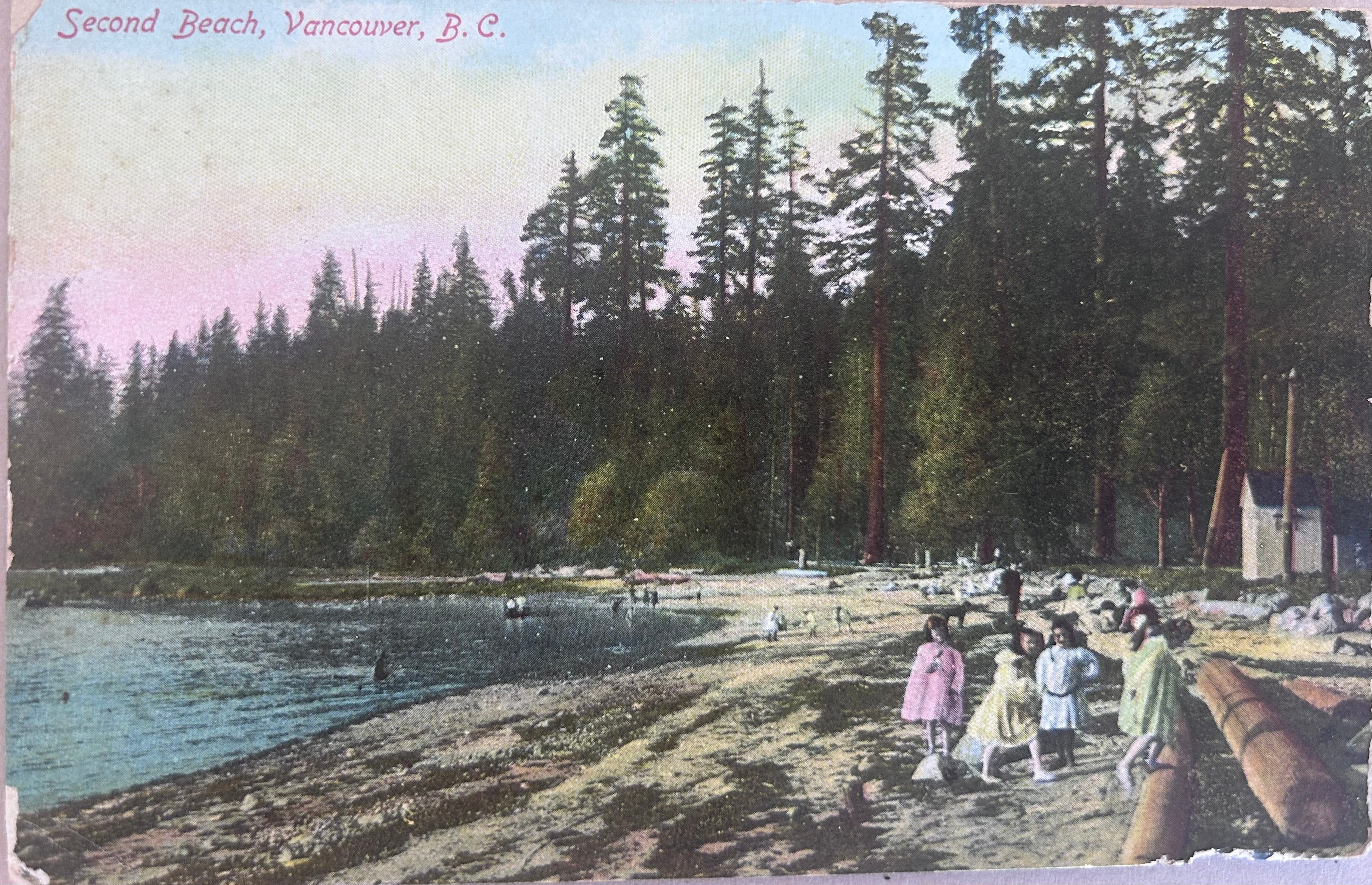
The front of the postcard shows Second Beach in Vancouver, long before it became the beach we’d recognize today without crowds, bicycles, volleyball nets. The postcard shows the beach surrounded by towering Douglas firs, a curve of shoreline, a few women and children in long coats near the water’s edge, and a couple of logs washed up on the sand.
Printed caption: “Second Beach, Vancouver, B.C.”
Maybe Helen just wanted to show off the view. Maybe it was a place they'd been together. We can only guess, but the postcard has its own journey too. The publisher's imprint reads Stedman Bros. Ltd., Brantford, Canada. Made in Germany. Once again, the postcard had travelled farther than the message itself. Printed in Germany for a Canadian publisher before finding its way back across the Atlantic, it eventually carried Helen's ordinary request a few dozen kilometres up the Fraser to Annie. Quite a trip for a picture of a beach.
The stamp itself is another little mystery. There is no visible postmark at all. Struck too lightly to survive? Missed the canceller altogether? No way to know. Whatever happened, it reached Annie anyway, and ended up tucked in the chocolate box with the rest. That mystery stays open. Darn it.
A World Away
Only 30 kilometres separated Annie and Helen when this postcard was written. Helen was living in Vancouver, a young, growing city, walking to the beach past streetcars and cedar stands. Annie lived in a farming and fishing community on the Fraser, where salmon canneries and riverboats set the pace of daily life. No telephones to speak of. Postcards like this one were the fast, cheap way people stayed in each other’s lives. It’s easy to imagine Annie reading the request, smiling, and packing up the skirt and arranging for someone to take it into Vancouver on their next trip before the ink was even dry on her reply. You wouldn’t want to keep someone waiting when there’s a fishing trip on the line.
This week’s Unanswered Questions
Postcard (a)
Is Annie L. Browne the same person as Annie L. Brown?
Which spelling of her surname was correct?
Who was Helen, and what was her relationship to Annie?
Who did Helen mean when she wrote, “We are all well”?
Why was Helen in Mount Vernon, New York, in August 1906?
Postcard (b)
Was Helen living in Vancouver when she wrote the Second Beach postcard, or was she visiting?
Where was she planning to go fishing?
Did Annie send the black skirt in time?
The Larger Mystery
How are E. S. Brown, S. Brown, and Annie L. Brown or Browne related?
And why did this particular collection of postcards survive when so many others were lost?
Somewhere out there, someone probably knows exactly who Helen was. For now, all I know is that one August afternoon in 1906 she wanted her black skirt back in time for a fishing trip. Oddly enough, after 120 years, that feels like enough to remember her by.
I gently close the lid on the little wooden chocolate box, wondering whose voice will be waiting for me the next time I open it.
Cast of Characters
A running list of the people who have appeared in the series so far.
Postcard No. 1 — Kindest Regards
Annie Brown — Recipient of Postcard No. 1. Addressed simply as “Annie Brown,” alongside S. Brown. First appearance: No. 1.
S. Brown — Co-recipient of Postcard No. 1, alongside Annie Brown. First appearance: No. 1.
R. W. Fleming — Sender of Postcard No. 1 from Victoria, British Columbia. Nothing further is known about him yet. First appearance: No. 1.
Postcard No. 2 — A Happy New Year
E. S. Brown — Recipient of Postcard No. 2 in Ladner, British Columbia. His relationship to Annie L. Brown and S. Brown has not yet been confirmed. First appearance: No. 2.
Marshall Smith — Sender of Postcard No. 2 from Los Angeles, California. His signature may read “M. Marshall M. Smith,” but this remains unconfirmed. Nothing further is known about him yet. First appearance: No. 2.
Postcards No. 3 and 4 — Helen
Annie L. Browne — Recipient of both postcards from Helen. On the 1906 postcard, her surname is written as “Browne” rather than “Brown,” and she is addressed as “Miss Annie L. Browne.” Whether this was the correct spelling or simply a variation remains unknown. I assume this is the same Annie Brown that first appeared in postcard No. 1.
Helen — Sender of both postcards. She appears to have shared a close and familiar relationship with Annie. In one postcard she reports that everyone is well; in the other she asks Annie to send her black skirt because she needs it to go fishing. Her surname and her relationship to Annie are still unknown. First appearance: No. 3.
Next week, in our series of near misses: all aboard the Empress of India.
We have a delightful postcard of the CPR S.S. Empress of India, steaming out of Vancouver, B.C., smokestacks going full tilt. We meet a gal named Gussie, and she seems to be missing Annie at every turn.
I am researching this collection as an interested amateur—not as a historian, but as a writer trying to follow the small clues these postcards have left behind.
If I have overlooked something, please msg me
Sources
The details in this entry, especially around Ladner's Landing and the river's original names, are drawn from the following sources:"
Fraser River Lodge — “Our Local Indigenous Community” fraserriverlodge.com/lodge/our-local-indigenous-community States that this stretch of the river “is known by local indigenous peoples as ‘Sto:lo’ in the Halq’emeylem language of the area.”
Wikipedia / Alchetron — “Fraser River” en.wikipedia.org/wiki/Fraser_River Notes the river’s name in the Halqemeylem language “is Sto:lo, often seen archaically as Staulo.” The same entry states the “name in the Dakelh language is Lhtakoh.”
Wikipedia — “Lhtako” en.wikipedia.org/wiki/Lhtako Explains the Lhtako Dene Nation “takes its name from Lhtakoh, the name in the Carrier language for the Fraser River.”
Infogalactic — “Dakelh” infogalactic.com/info/Dakelh Glosses the term further, noting Dakelh territory along the “Fraser River (Lhtakoh - ‘rivers within one another’).”
Comments
Nothing yet. Say the first thing.
Sign in to join the conversation.