
Los Angeles, California → Ladner, British Columbia
December 1905
A box this small shouldn’t hold this much. And yet the little wooden chocolate box keeps giving up its secrets.
A New Year’s greeting, six words long, was never meant to last. It was meant to be read once, folded into a pocket, and forgotten. Instead, it has survived, permanent now, in a way its author never intended.
When I bought the box in an antique store more than ten years ago, I had no idea what I was carrying home. I liked the box itself. Its worn wood, its age, the sense that it had already belonged to other hands. The postcards inside felt almost incidental.
They do not feel incidental anymore.
Someone had saved them. Then someone else had saved them. Houses were emptied, belongings were divided, and decisions were made about what mattered and what did not. Somehow, this small collection escaped the fate of so many old family papers. It was not thrown away. It was not lost to damp, fire, or indifference.
It waited.
And then, one day, I found it.
Inside were dozens of postcards written during the early years of the twentieth century, most of them addressed to one family in Ladner, British Columbia. Some travelled only a few miles. Others crossed countries. None of the messages are particularly grand. They speak of visits, greetings, weather, illness, affection, the ordinary things people say when they assume their words will be read once and then forgotten.
But these words were not forgotten.
These postcards once belonged to people who mattered deeply to someone. They laughed, worried, travelled, worked, celebrated the New Year, and kept in touch with the people they loved. More than a century later, they matter to me, too.
Perhaps that’s all any of us really hope for—that someone remembers we were here.
Postcard No. 2, the second-oldest card in the box, was mailed from Los Angeles, California, on December 28, 1905, at approximately 2:30 in the afternoon.
It was addressed to:
Mr. E. S. Brown
Ladner, British Columbia
Even that gives me pause.
Who was E. S. Brown? A man, presumably, because of the “Mr.” (but I have already learned not to trust every assumption too quickly). Was E. S. Brown related to Annie Brown, whose name appears elsewhere in the collection? Was E. S. Brown the same person as the mysterious S. Brown from Postcard No. 1?
At this point, I do not know.
The front of the postcard shows a colourful California scene: tall date palms, flower beds, and a wide blue sky. Along the bottom is the printed caption:
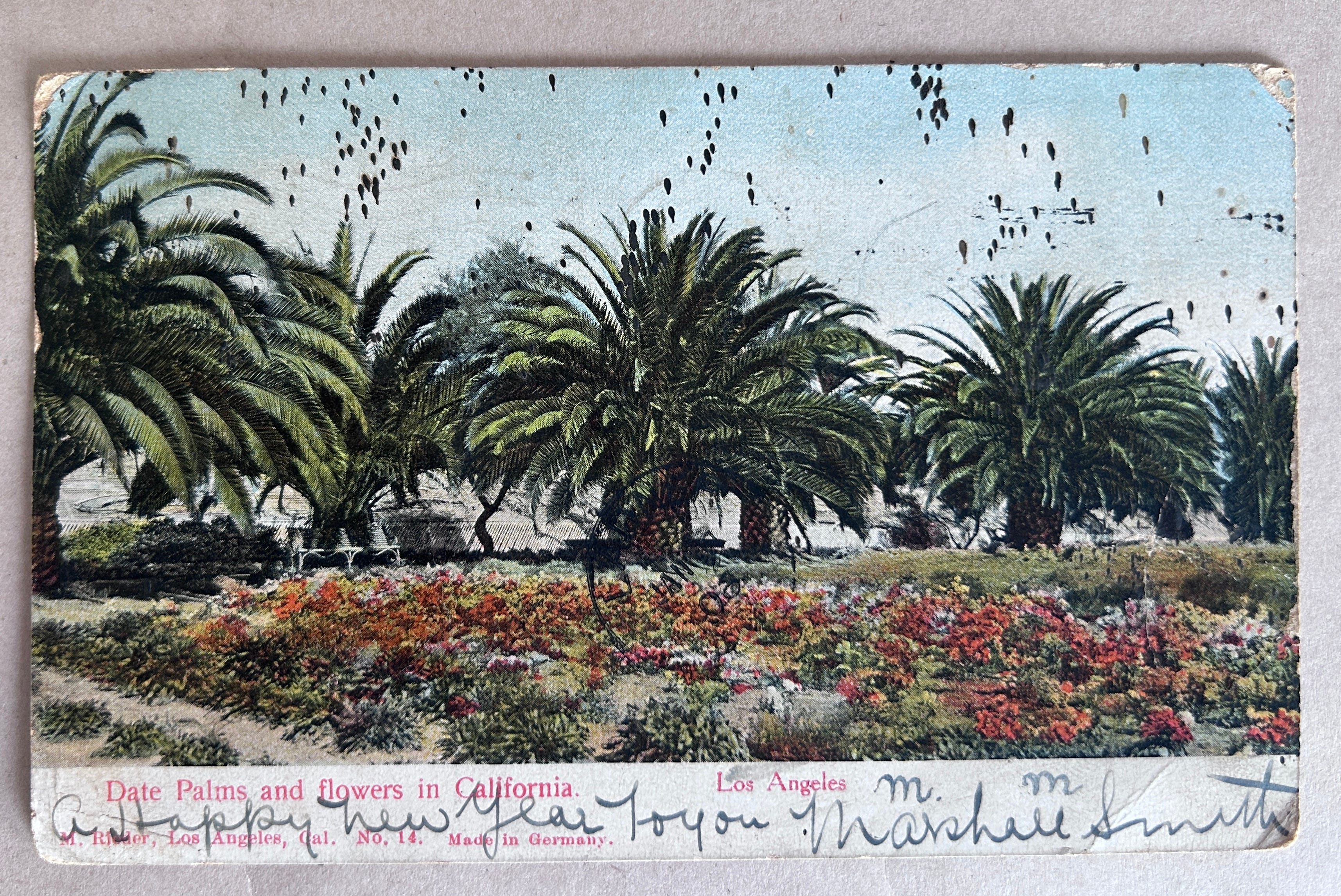
“Date Palms and Flowers in California. Los Angeles.”
It is the kind of image meant to make California feel almost unreal—warm, lush, bright, and far removed from a wet December in the Fraser River delta.
When I researched the image, I discovered it was a popular postcard view in the early 1900s, most likely depicting South Park in Los Angeles
I imagine the card standing in a rack among dozens of others and I wonder why Marshall Smith chose this one?
Perhaps the palms seemed exotic and warm compared to the weather in Canada during the winter. Perhaps the gardens captured the Los Angeles he wanted to share. Or perhaps it was simply the nicest postcard left in the display.
We will never know.
At the time, postcard backs were reserved entirely for the address, leaving only a narrow white strip beneath the picture for a message. Into that small space, the sender wrote six words, then signed his name.
Happy New Year to you.
Marshall Smith.
That was all.
No family news. No explanation.
Only a greeting.
There is something strangely moving about that restraint, whether or not it was earned. Perhaps six words were enough because the people involved already knew the rest: who Marshall was, why he was away, what connected him to the Brown family. Or perhaps six words were simply all that Marshall Smith had to give, and Mr. E. S. Brown was left, like us, filling in the gaps himself.
Even the signature refuses to make things easy.
At first glance, it appears to read simply “Marshall Smith.” But the longer I look at it, the less certain I become. There are additional strokes worked into the handwriting—perhaps an “M.” before the name, perhaps another initial tucked into the flourish. It might read “M. Marshall M. Smith.”
Or it might not.
Old handwriting has a way of changing the longer you look at it. A line that looks obvious in the morning becomes doubtful by afternoon. A flourish becomes a letter. A letter becomes a flourish again.
For now, I am calling him Marshall Smith and allowing the rest to remain unresolved.
At first, I didn’t think there was much to discover here. I was wrong.
The card was published by M. Rieder of Los Angeles and printed in Germany, where many of the finest colour lithographic postcards of the period were produced. A one-cent Benjamin Franklin stamp carried it into the American postal system. From there, the postcard passed through hands we will never know. It travelled in mailbags, railway cars, perhaps aboard a steamer for part of the route, crossed an international border, and eventually arrived in a small farming settlement on the Fraser River.
When Marshall Smith wrote his greeting, the Municipality of Delta had existed for only twenty-six years, and the village of Ladner was still young. Life revolved around farming, fishing, the river, the weather, and the changing seasons.
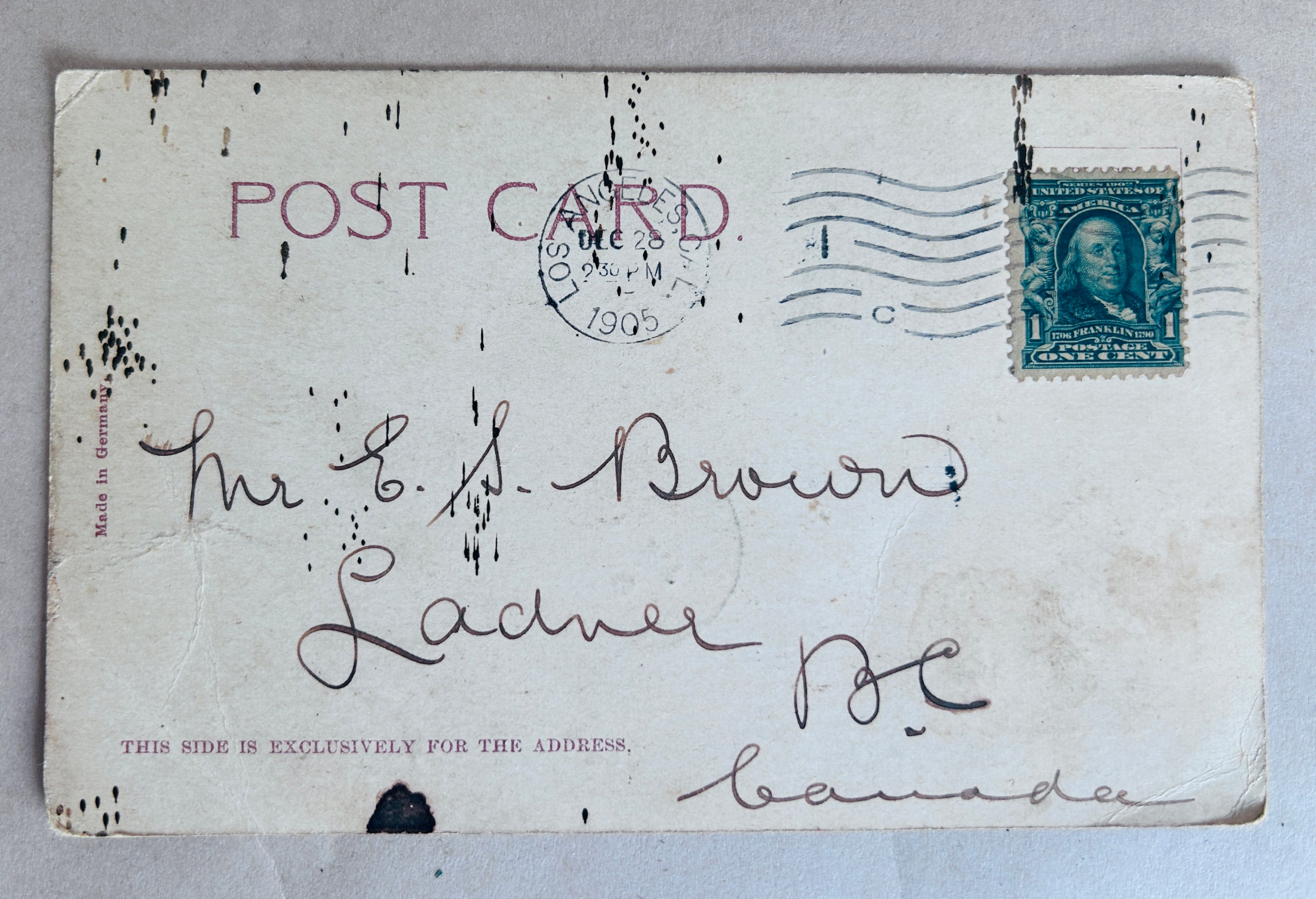
The postcard was addressed simply to "Mr. E. S. Brown, Ladner, British Columbia." There was no street address or house number. That caught my attention. Canada did not introduce rural mail delivery until 1908, so in 1905 the postcard was likely collected at the Ladner post office rather than delivered to a rural home. Ladner was a small community, and perhaps the postmaster knew exactly which E. S. Brown was meant
Steamers and other river vessels carried passengers, freight, and mail between communities. The surrounding fields produced potatoes, hay, vegetables, and dairy products. Winter rains settled over the delta while families visited neighbours, attended church and community gatherings, read The Delta Times, and kept in touch through letters and postcards.
Christmas had passed only a few days earlier. If Marshall Smith hoped his greeting would arrive in time for the New Year, he would have needed to mail it before the calendar turned. Whether that was his intention, I can’t know—but the timing makes me wonder.
The year’s work was largely finished. The harvest was in. Another winter had begun. Somewhere in Ladner, E. S. Brown was preparing to enter 1906.
Telephones had already been invented, but they were still uncommon in many rural homes. Radio had not yet become part of everyday life. News travelled through newspapers, telegrams, conversations, and the mail.
The mail mattered because relationships mattered. A postcard was a small way of saying, “I’m thinking of you.”
Meanwhile, Los Angeles was expanding rapidly. Railways carried visitors into Southern California, neighbourhoods spread outward, and the city was selling an image of itself to the rest of North America: sunshine, gardens, palm trees, and possibility.
The postcard in my hands helped sell that promise.
Somewhere in that growing city, Marshall Smith wrote his greeting, addressed it to E. S. Brown, placed a one-cent stamp in the corner, and dropped it into a mailbox.
I wonder whether he gave it another thought.
I wonder whether E. S. Brown smiled when it arrived.
I wonder whether he wrote back.
Did the postcard remain in the Brown family for decades? Did a grown grandchild eventually inherit it, only to face the difficult task of clearing a parent’s home after a death? Was it tucked into a box marked “old papers,” carried to an estate sale, and eventually placed inside the little wooden chocolate box?
This is the part that stays with me.
Marshall Smith could not have imagined that more than 120 years later, someone would still be holding his postcard, studying the shape of his handwriting and trying to understand the relationships hidden behind six ordinary words.
Neither, I suspect, could E. S. Brown.
The message is brief.
The journey is over.
The mystery remains.
Next week, another postcard brings Annie L. Brown into sharper focus. For the first time, the box begins to reveal something about the family itself .
A new postcard from the box arrives every week.
Date mailed: December 28, 1905
Place mailed: Los Angeles, California
Time: Approximately 2:30 p.m.
Date received: Unknown; no Ladner receiving postmark is visible
Recipient: Mr. E. S. Brown, Ladner, British Columbia
Sender: Marshall Smith; signature may read “M. Marshall M. Smith,” but this remains unconfirmed
Card type: Post Card
Publisher: M. Rieder, Los Angeles
Printed in: Germany
Image: Date Palms and Flowers in California, Los Angeles. Comparing the image to historical photographs of South Park's famous palm-lined promenade (a nineteen-acre park in South Los Angeles established in 1899, and once celebrated for its double row of Canary Island date palms and Mexican fan palms) the scene appears to match, or at least to have been taken at the same location. Source
Postage: One-cent Benjamin Franklin USA stamp
The name M. Rieder appears in small pink lettering near the bottom of the postcard. At first, it seems like nothing more than a printer’s mark.
But there was a person behind it.
Michael Rieder was born in Philadelphia in 1868, the child of immigrants from Baden, in what would soon become Germany. He worked first as a book dealer and appears to have arrived in Los Angeles during the real estate boom of the late 1880s, when the city was expanding and reinventing itself at remarkable speed.
Before postcards, Rieder sold books. He later branched into souvenir albums, photographic playing cards, stereographic views, and other popular forms of visual ephemera.
Eventually, he became one of the more prolific publishers of California postcards.
His catalogue included orchards, farms, growing towns, adobe buildings, gardens, and palm-lined boulevards—the images that helped create the world’s idea of Southern California.
Like many American postcard publishers of the period, Rieder sent his images to Germany, whose printers were renowned for their colour lithographic work. That is how a postcard published in Los Angeles came to carry the words “Made in Germany” on its reverse.
This particular postcard is numbered 14, suggesting that it belonged to a much larger series. Other surviving Rieder postcards carry numbers in the thousands, pointing to a publishing operation of considerable scale. Some later cards were marked “M. Rieder, Publ., Los Angeles, Cal. and Leipzig,” suggesting that he eventually formalized his publishing arrangements in Germany.
Rieder’s catalogue also reflected some of the uglier assumptions of its time. Certain cards relied on stereotyped and condescending portrayals that are uncomfortable to view now. This postcard does not—it is simply an idealized picture of flowers and palm trees—but that larger history is worth acknowledging, particularly if more of his cards appear in the box.
For now, I keep returning to something smaller.
A man left Philadelphia, travelled west, and built a business selling images of a city that was busy imagining its own future.
One of those images eventually carried a six-word New Year’s greeting north to Ladner.
And somehow, it survived.
The historical background for this article was drawn from a combination of primary and secondary sources, including:
The postcard itself, including its postmark, stamp, publisher’s imprint, and handwritten message.
United States Postal Service and National Postal Museum resources on postal delivery, early twentieth-century postcard rates and Benjamin Franklin definitive stamps.
Statistics Canada – Historical Year Book: The Post Office (rural mail delivery introduced in 1908). Stats Canada
Historical information on Michael Rieder, California postcard publisher, from postcard and ephemera reference sources.
Historical records on the Municipality of Delta and the early community of Ladner, British Columbia.
British Columbia local histories describing transportation, farming, and daily life in the Fraser River delta during the early 1900s.
Contemporary newspaper archives and historical publications relating to Southern California and Los Angeles in 1905.
Any interpretation, speculation, or unanswered questions are my own and are included to invite further research and discussion.
A running list of the people who have appeared in the series so far.
Annie L. Brown — Recipient of Postcard No. 1. Addressed simply as “Annie Brown,” alongside S. Brown. First appearance: No. 1.
S. Brown — Co-recipient of Postcard No. 1, alongside Annie Brown. First appearance: No. 1.
R. W. Fleming — Sender of Postcard No. 1 from Victoria, British Columbia. Nothing further is known about him yet. First appearance: No. 1.
E. S. Brown — Recipient of Postcard No. 2 in Ladner, British Columbia. His relationship to Annie L. Brown and S. Brown has not yet been confirmed. First appearance: No. 2.
Marshall Smith — Sender of Postcard No. 2 from Los Angeles, California. His signature may read “M. Marshall M. Smith,” but this remains unconfirmed. Nothing further is known about him yet. First appearance: No. 2.
Is E. S. Brown married to S. Brown or is E. S. Brown the same person as S. Brown?
How are E. S. Brown, S. Brown, and Annie L. Brown related?
Why is Annie identified by her full given name while the other Browns are addressed only by their initials?
Who was Marshall Smith, and what brought him to Los Angeles in December 1905?
Who was R. W. Fleming? Did he live in Victoria, or was he simply passing through?
How did Marshall Smith and R. W. Fleming come to know the Brown family?
And why did this particular collection of postcards survive when so many others were lost?
I am researching this collection as an interested amateur—not as a historian, but as a writer trying to follow the small clues these postcards have left behind.
If I have made an error, misread a name, or overlooked something, I would genuinely like to know.
For more on Mary Ann Burrows, please visit
Comments
Nothing yet. Say the first thing.
Sign in to join the conversation.