
Leonardo was famous, or perhaps infamous, for taking months to complete a painting—if indeed he did complete it. Some say this is the reason there are so few Leonardo paintings extant. Whether that’s true or not, he did leave quite a bit of time between layers of paint. He felt that il discorso mentale, the mental conversation, was more important than the actual painting. The extra time gave him the mental space to reflect on the details—what to include, what to exclude, and how the elements might fit together to make a unified whole. To Leonardo, an artist didn’t learn to paint. He painted to learn.
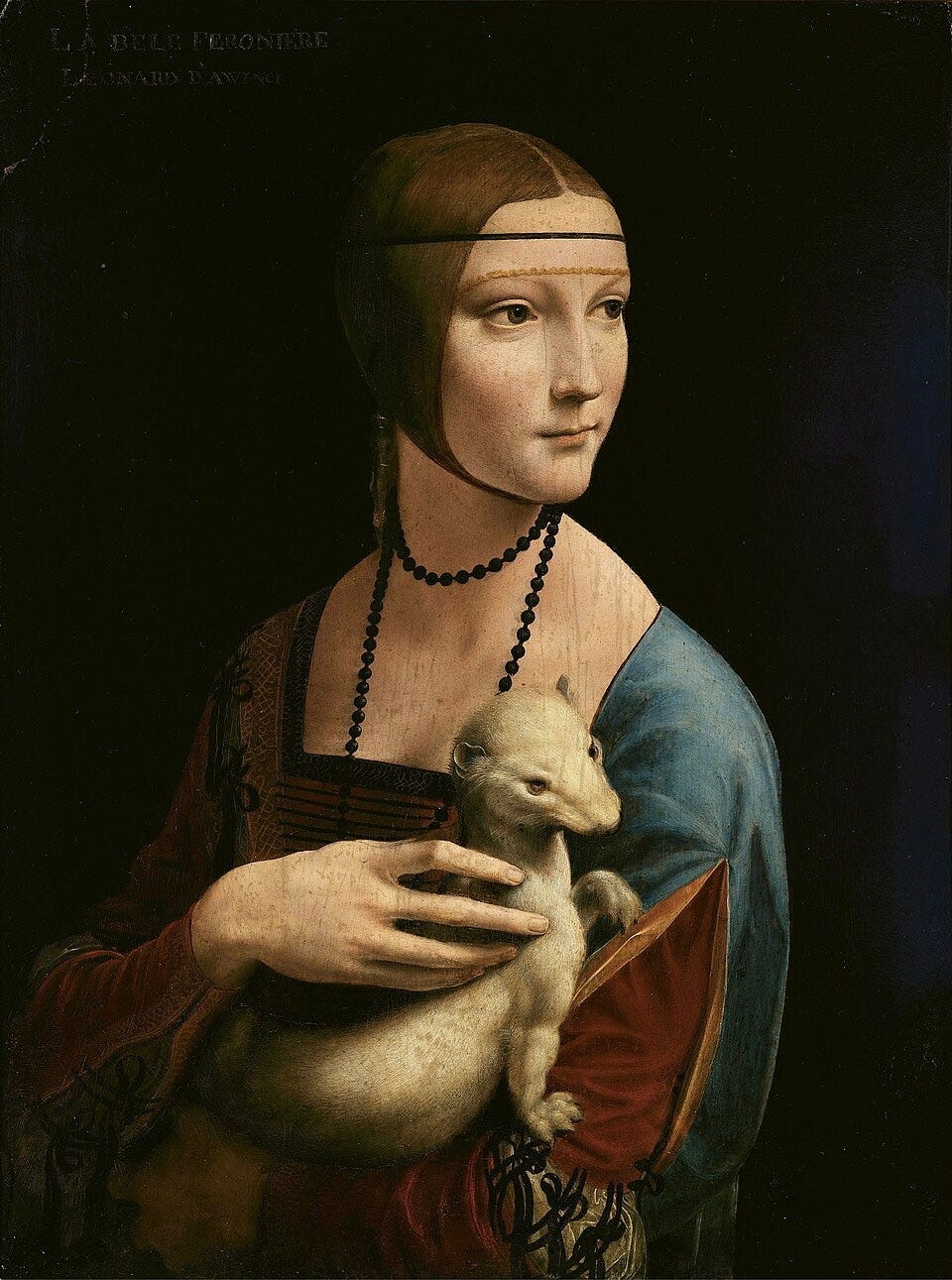
This intimacy with craft would have been foreign to the ancient Greeks, who looked down on hand skills as dirty and degrading, a kind of manual labor fit only for the lower classes. Plato’s elaborate taxonomy of human knowledge made no reference whatsoever to craft. To our present-day misfortune, Plato’s way of thinking has had a much greater influence on our education models than Leonardo’s. Today we hold academic schools in high regard, while placing trade schools on a much lower tier. What Leonardo understood is that imagination without experience is weak. Originality without craft, to a Renaissance artisan, would have seemed like marriage without sex—lofty but Platonic.
Creativity is more than imagination. It’s imagination coupled with craft. It’s the metaskill of making. It envisions, embodies, elaborates. It develops, shapes, solves. It advances, iterates, proves. Note the lack of passive verbs in this list. Making is action. Unless you’re willing to get your hands dirty, your imagination will remain unrealized and uninformed.
Learning theorist Donald Schön took the idea of discorso mentale to a new level of understanding in his 1983 book, The Reflective Practitioner. He called craft knowledge “reflection-in-action,” the result of thinking while doing. As the maker shapes an object or a situation according to an initial vision, the situation “talks back,” and the maker responds to the backtalk. Our spontaneous reactions don’t always work out, so we keep trying until we succeed. Schön believed that the starting point for reflection-in-action was “knowing-in-action,” a dynamic way of knowing that stands in stark contrast to the kind of static knowledge we’re taught in school.
Hungarian physicist Leó Szilárd, who conceived of the nuclear chain reaction in 1933, posed a simple question: Can we know all about the world without changing it? No, he finally said. Knowledge must come from action if it’s to be deep enough and rich enough to drive lasting change. We can’t reshape the world without a little trial and error.
Reflection-in-action goes a long way towards describing what we mean when we speak of a practioner’s artistry. It’s a capacity to combine thinking and doing in the middle of performing, often under stress, “while the train is running.” We find this type of performance on the athletic field, where coaches literally coach their players to higher levels of skill, or in the music conservatory where performers, conductors, and composers use deliberate practice to stretch their musical muscles. We also find it in the clinic, the office, the lab, the studio, the shop—any place in which mentoring and apprenticeship are modes of learning.
The way designers approach a problem is to feel their way towards a solution, akin to how an athlete decides her next move. The decision is made more with the body than the mind. Only after a direction begins to feel right does the designer try to imagine specific aesthetics to make it tangible, visible, and functional.
Growing up in Denmark, Anders Warming loved to wash and polish his parents cars. He’d trace their subtle curves with his hands, marveling at the seamless progression of forms, one flowing into another, each in perfect harmony with the whole. “I touched them so many times that I could close my eyes and draw them,” he later said. One of these cars was a mineral-blue Mini 850, a precursor of the new Minis he would end up designing for BMW in 2011.

Anders Warming doesn’t start a new design by going straight to CAD software. He also steers clear of verbal descriptions and PowerPoint presentations. Instead, he draws. He may make hundreds of sketches before even looking at a screen. “You probably need 90 sketches just to get warm, and after that, you’re really in the flow. You’re transcending the paper.” He compares it to perfecting your serve so you can win at Wimbledon. “Maybe the 151st is the one.”
All too often, says Julia Cameron in The Artist’s Way, “we try to push, pull, outline, and control our ideas instead of letting them grow organically. The creative process is one of surrender, not control.” By letting go our fears of looking foolish or wasting time, sketching or doodling can take us where we might not ordinarily go. Our experience with the subject we’re drawing, or the idea we’re pursuing, will be direct, undiluted, and free from the strictures imposed by our egos.
The concept of letting go is a theme running through all the creative disciplines. In design, sketching is the mother of invention. In science it’s the experiment; in business it’s the whiteboard diagram; in writing it’s the rough draft; in acting it’s the run-through; in inventing it’s the prototype; in jazz it’s jamming. Miles Davis once said: “Do not fear mistakes—there are none.” Every step or misstep is provisional or correctable, a mini-lesson in the practice room of mastery. You go in not knowing so you can come out knowing.
Comments
Nothing yet. Say the first thing.
Sign in to join the conversation.