
Remember the movie with Bill Murray? The protagonist is forced to repeat the same day until he finally gets it right. He tries everything: manipulation, hedonism, theft, seduction, even suicide. Nothing works until he moves beyond his usual repertoire of cheap tricks and selfish tactics and realizes the only way out is up. He becomes more helpful to the townspeople—changing tires, saving children, helping old people. He even acquires new skills in jazz piano, ice sculpture, and chiropractic medicine. When at last he achieves the perfect day, he wins the girl and breaks the endless loop of repetition.
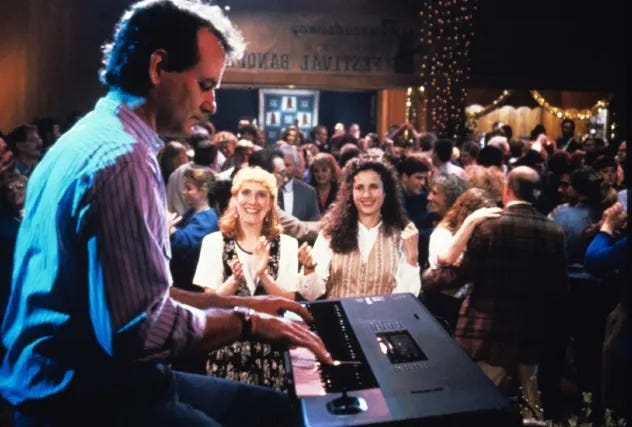
The experience of Groundhog Day is not unlike the experience of creativity. There are two main stages in innovation: 1) getting the right idea (dreaming), and 2) getting the idea right (making). As in Groundhog Day, getting the idea right is an iterative process. It doesn’t happen overnight or in a sudden flash. It takes trial and error, aesthetic tinkering, and learning in action.
How many promising ideas have died after birth due to poor execution? I’d hazard a guess that the number is well over 50 percent. We’ll never know, since they tend to disappear so quickly from the scene. A few which have stuck around long enough to notice are the Ford Edsel (died 1959), the movie Ishtar (died 1987), the Excite online network (died 2004), and the Bush-era Vision for Space Exploration program (died 2010).
And beyond this, how many innovations have managed to succeed temporarily, only to fall by the wayside as competitors out-designed the original idea? The Betamax videotape format comes to mind (eclipsed by VHS), the Honda Insight (beat out by Toyota’s Prius), and the BlackBerry smartphone (outclassed by Apple’s iPhone). All of these are cases in which a first-mover advantage couldn’t save a half-hearted execution.
Finally, how many of today’s “successes” are vulnerable to more designful competitors? I’ll nominate Facebook, Ryanair, Radio Shack, HTC, Breville, Taco Bell, Oreck, Safeway, Hewlett-Packard, and Amtrak, just for starters. What seems to be missing in these organizations is a lack of sophistication about customer experience. You can see it more clearly when you compare them side by side with offerings from Pinterest, Southwest Airlines, Samsung, Nespresso, In-N-Out Burger, Dyson, Whole Foods, IBM, and TGV. The superior customer experience delivered by these brands is the direct result of design.
“The details aren’t the details,” said designer Charles Eames. “They make the product.” Eames’s every creative decision grew from “a tight and painful discipline” that brought him to grips with the most prosaic and minute problems. He obsessed about the way two different materials came together, and if they failed to provide a good aesthetic fit, he rejected them. “The connections, the connections, the connections.”

Composer Philip Glass has a similar concern for integrity in his music. During an interview with his cousin, Ira Glass, he explained that one of the problems that occupied his attention early on was how to “collapse form and content into one condition, rather than pouring the content into a chosen form.” In other words, instead of first selecting a musical genre and then “filling” it with his own music, he preferred to develop the format and the music together, creating a mutually supportive fit without regard to existing genres. It’s easy to imagine a musician sitting in on a blues or folk performance without having heard the song before. It’s harder to imagine a musician joining in on a quirky German Lied or a French mélodie. And it’s impossible to imagine anyone sitting in on a new Philip Glass composition. By focusing on the fit instead of the genre, Glass has been able to get outside these categories and create unique musical forms and experiences.
You could dismiss this kind of attention to detail by saying, “Well, Philip Glass is a genius.” But the same general process that makes Glass a genius is open to you, too, whether you’re a business person, engineer, entrepreneur, student, designer, teacher, or supply chain manager. It just takes a willingness to learn through successive layers of effort. Alison Gopnik, a psychologist and author of The Philosophical Baby, explains it this way: “You come to make better decisions by making not-so-good decisions and then correcting them. You get to be a good planner by making plans, implementing them and seeing the results again and again.” To improve, you have to constantly push yourself beyond your limits, then pay attention to what trips you up.
In design circles this is known as fast failing. The successive drawings, models, and prototypes that designers make are not designed to be perfect solutions. They’re designed to illuminate the problem, and in the process hone their intuition. In fact, the best designers are those who can keep the project liquid—allowing more iterations and more interaction among collaborators.
Undoubtedly, one of the world’s finest examples of creative collaboration was the making of the King James Bible, first published 400 years ago. It took the work of 54 scholars and clergymen, organized into six nine-man teams called “companies,” meeting over a period of seven years. Since they worked in successive iterations, sharing back and forth as they went, they were able to keep the project in a liquid state while they fashioned one of the purest masterpieces in the history of English prose.
When the project is physical, like a product or a movie or a building, sometimes the biggest challenge is to keep the gestural feeling of the original drawings alive as you work through the iterative process. One way to accomplish this feat is to work physically as long as possible, making mockups, acting out stories, or building models instead of heading straight to the computer.
The temptation in design is the same as in Groundhog Day. To look for the quick answer, skip the tedious effort, go right to the gratification of closure. But that would defeat the whole purpose of the exercise. Making, if it’s to be meaningful, is a journey to your best self. If you want more, pay more. The effort to imbue objects with integrity is the reason some things are more valuable than others.
Comments
Nothing yet. Say the first thing.
Sign in to join the conversation.