
The no-process process (see Chapter 35) is not a license to play around endlessly, any more than the standard process is a license to do mediocre work on time. If the goal is excellence, you have to finish, and you have to do great work. This begs the question, What is great work? How do you know when you’re finished? Here are ten simple tests:
1. Is it surprising? Will it scare some people? Does it challenge notions of what’s normal? Did it reframe the problem? Did you learn something new in the process? The heart of innovation is novelty. So if your solution doesn’t disrupt expectations, it has little chance of disrupting a category, a marketplace, or an industry.
2. Does it have fitness for duty? Does it fill the “answer-shaped hole”? Is there a good match between what it is and what it does? Is it economical to produce, launch, maintain, and use? Does the solution seem inevitable? Billy Baldwin, one of the last century’s most influential interior designers, believed that nothing was in good taste unless it suited its purpose. “What’s practical is beautiful,” he said.
3. Are the underlying assumptions true? Which ones must be correct for the outcome to be a success? Is there a way to test the assumptions using the prototype? If the assumptions prove untrue, in what ways must the solution change?
4. Does it have a clear focus? Is it single-minded? Is there a key subject, a central theme, or a main benefit to anchor the proposed solution to its purpose? If it seems like it’s trying to satisfy too many goals, or too many people, go back to the drawing board.
5. Are the elements in harmony? Are they in the right balance? Is each one necessary? Do they create a unified whole? Is it beautiful? When the choir is singing together, it should sound bigger and richer than the number of singers would suggest.
6. Will the right people love it? Will it inspire loyalty? Will it attract talent to your mission? If you try to please everyone, you’ll end up pleasing no one. If you please the wrong people while leaving the right ones unmoved, you may wish you had done a little testing before going public. Henry Ford didn’t believe in testing, and found out too late that the 1958 Edsel was a car without a market.
7. Is it courageous? Even testing won’t take all the risk out of innovation. At some point you’ll need to stick your neck out. Luckily, most people admire risk taking, which is why so many bold ideas have managed to attract fanatic followings. Courage reads as authenticity to most people.
8. Is it valuable beyond the near and now? Does it link up with other great ideas? Will it provide a platform for further innovation? Does it take other people into consideration—not just you and your company, but your customers and society at large? Does it accept responsibility for future consequences?
9. Does it have depth? Does it connect on more than one level? Does it appeal not only to people’s senses, but to their rational minds, their emotions, their associations, their sense of identity?
10. Is it as simple as it should be? Have you eliminated all the unnecessary features, buttons, and colors? Stripped away the excess flourishes, surfaces, and angles? Removed gratuitous scenes, chapters, and symbols? Cut out extra steps, operations, and costs? This is not to say you need to strip out all the quirky details, but that any quirkiness should pull its weight.
How much simplifying is right? It’s a question of informed intuition; you need to develop an eye for it. The best way to teach your intuition how to judge simplicity—and aesthetics in general—is the same way everyone makes good judgments. You compare. You consider the merits of one feature, or one solution, relative to another. You weigh the pros and cons, turning it in your hand to look at it from every angle. Without the ability to compare, you’re floating in the fog.
Think of comparison as the “eye test” of aesthetic judgment. When you visit the optometrist to get your vision checked, you view the eye chart on the wall through a phoropter, a futuristic-looking machine that lets the doctor switch lenses in and out to find the optimum correction for each eye. With every change of lens he’ll ask, “Which looks sharper, this one...or this one?” Just when you think the letter Z looks pretty sharp, the next lens makes it look even sharper. Without the benefit of comparison, you’d probably end up with a suboptimal pair of glasses.
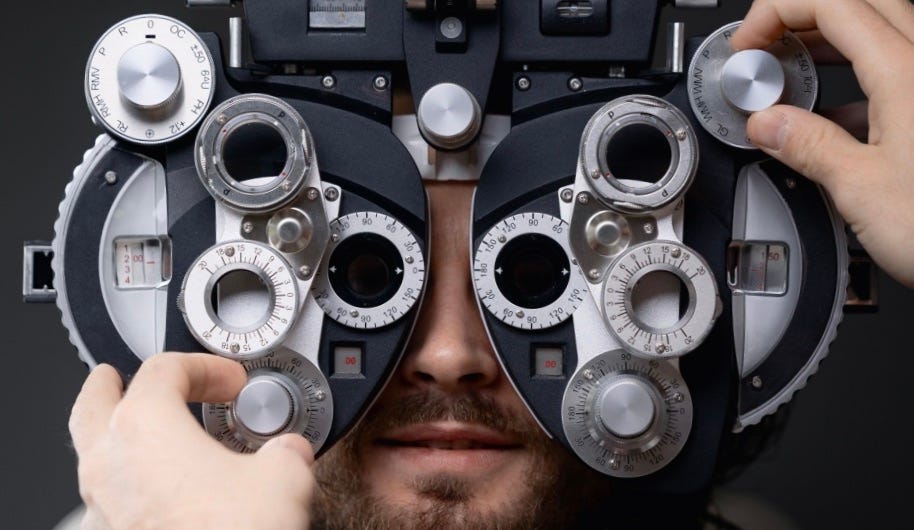
Most of us, given enough time and enough choices, will select for better aesthetics. But we don’t always have enough time or enough choices. We need to make decisions on the fly, without sufficient context.
What gives professionals their value is experience—they’ve worked through so many situations that they’ve developed a repertoire of aesthetic choices. They don’t need as much time because they’ve already put in their time. The relevant options are hardwired into memory.
Comments
Nothing yet. Say the first thing.
Sign in to join the conversation.