
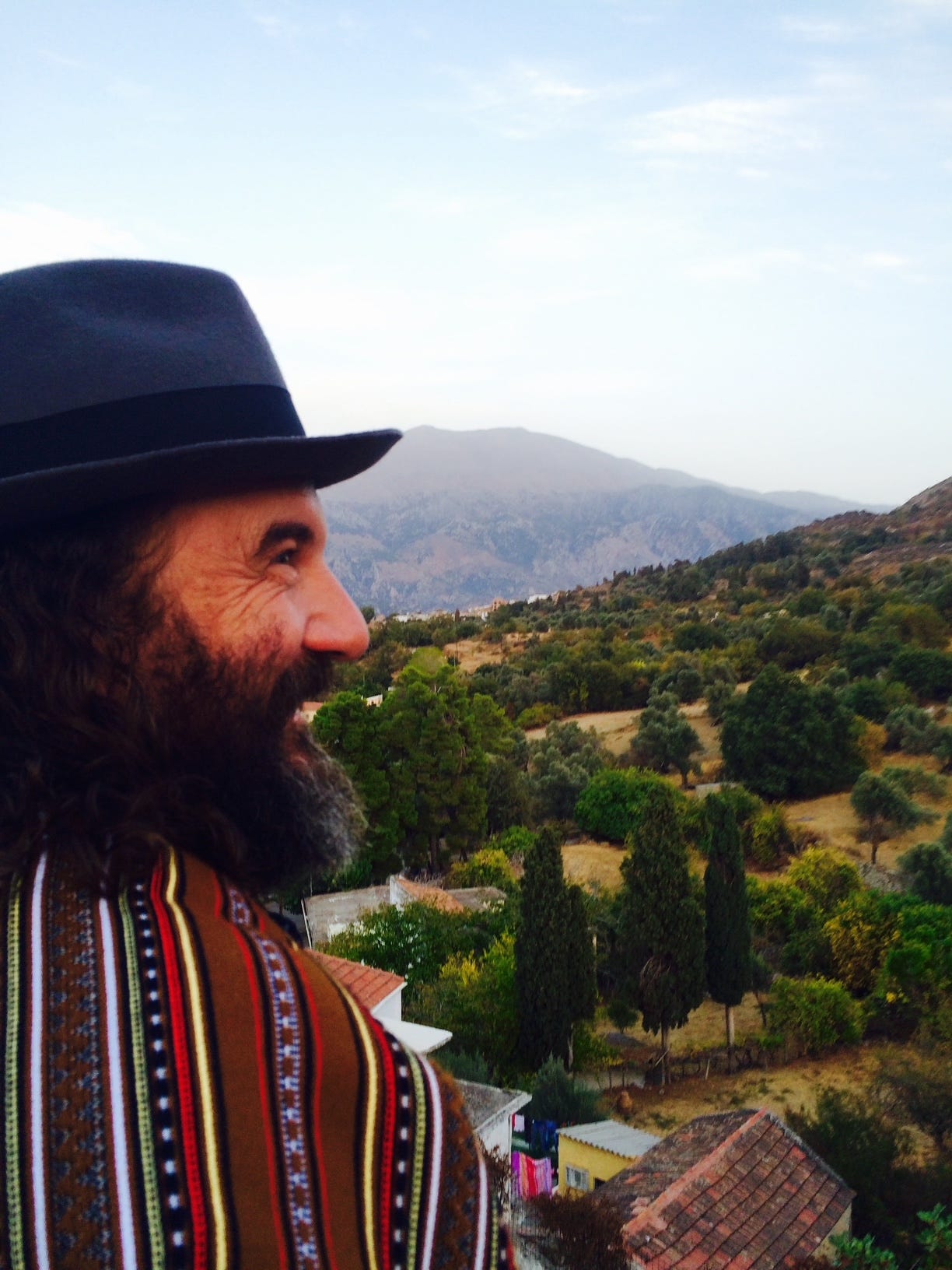
Embarking on the story, Crete, 2016
Look After Your Own Imagining
We seem to have entered a rather mythic kind of summer: raised temperatures, the month-long fever dream that was the World Cup, and now literally everywhere I turn is Christopher Nolan’s new version of The Odyssey.
Have I seen it? No, not yet, but there’s a kind of crushing inevitability to sloping into an IMAX cinema and surrendering.
Reports of the movie seem all over the shop. I read a Christian reviewer saying it was a disaster because (funnily enough) they’d taken all the inherent paganness out of the story, and much of its mythic sensuality. Odysseus rather cleaned up and flattened out. Lost his mojo (Odysseus without an idea is barely Odysseus). And not enough gods! and where’s Nausicaa and Queen Arete?
I have no idea as I haven’t seen it, so don’t shoot the messenger. Do let me know what you think if you’ve seen it.
So why do I say surrender?
Well, there’s a hard-earned version of that story that’s been living in my imagination and on my tongue for over a decade now. A version that took many months to learn and found its debut over a five-day telling on the island of Crete back in 2016. It lives in me, not in the widescreen panorama of whatever is waiting in that Plymouth cinema, but in a furtive, exploratory journey into one of the greatest stories we have. When you’ve been through that strange initiation you want to protect its bespokeness. I’m sure you have similar examples in your own life.
It began on long drives from Devon to Norfolk listening to lectures on the story with my then ten-year-old daughter. We both got swept up in the liveliness of the tale, and its twists and turns. It was a point in our lives we were both feeling pretty shipwrecked, so without ever mentioning it there would have been a few mirrors being held up.
We both had a Nostos, a kind of profound longing for home, for our rocky Ithaca. It was common for friends to be dismissive of Odysseus, but we always felt he was fighting for his life and needed every bit of wiliness at his disposal. Every time Odysseus seemed to get near Ithaca, or us home, a wind would come and blow us back out to sea.
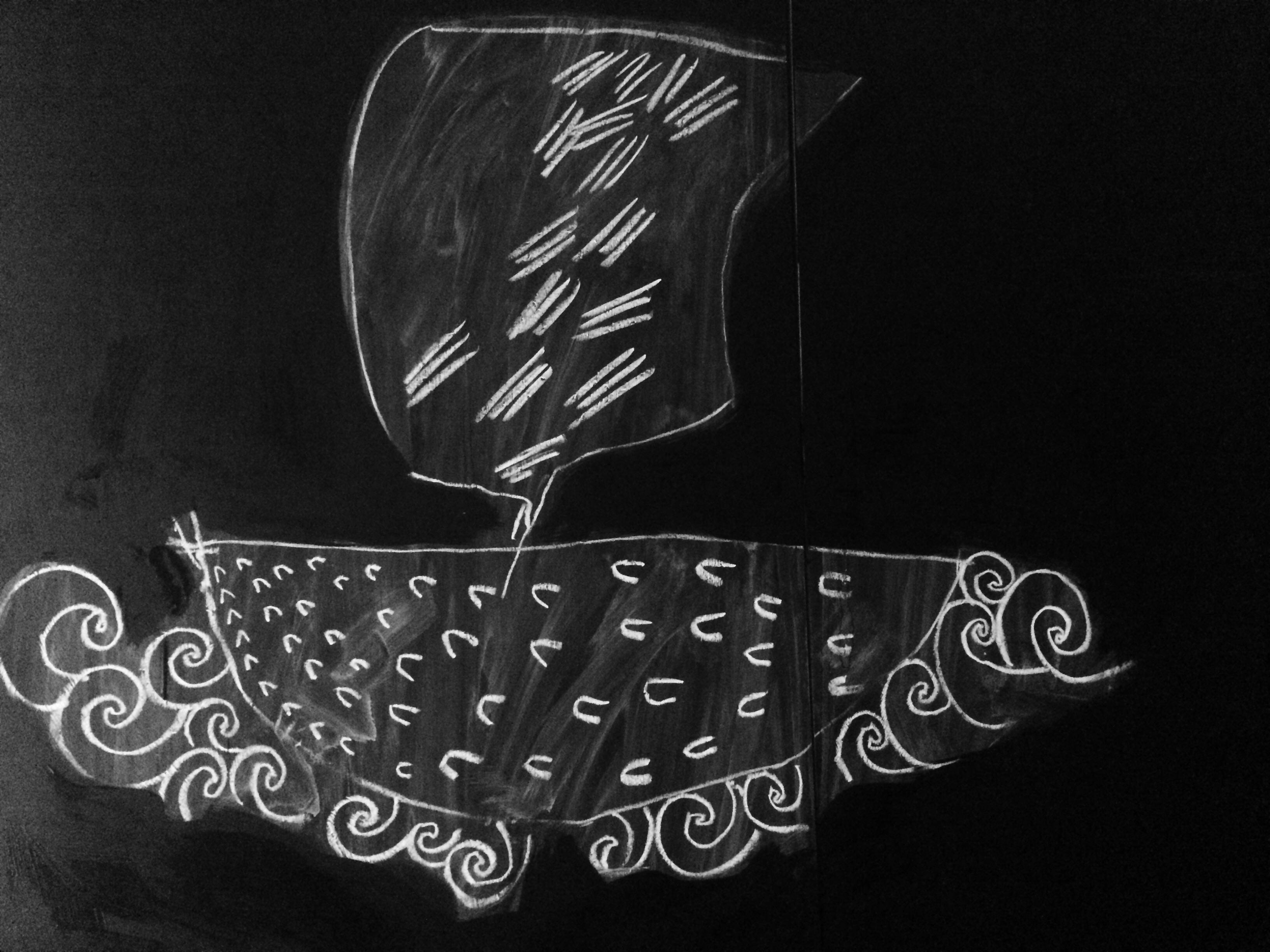
I started with drawings: chalk on blackboard
The Odyssey didn’t provoke a hard journey in my own life, didn’t somehow ‘create’ it, but it was an extraordinary companion for a life experience that came of its own, hellbent volition. That story gave us something to travel in together. It gave us a language for some very hard things. We knew when we’d spent too long with the lotus eaters, when life had turned us to pigs, when we were stuck between a serpent and a whirlpool. But it also gave us hope, humour, doggedness. We loved Nausicaa, and Elpenor, Argus, and all sorts of lesser known characters.
Years later I’d share a stage and teach a class with Madeline Miller and her bestseller Circe. But that was all far away. Right now it was the two of us driving through the rain, holding onto a bit of timber as the sea swirled. Dulcie went onto to study Classics and knows the story far better than I do. When I watched her graduate from film school in Bristol a couple of weeks ago I thought my heart was just about going to burst.
Learning A Story That Big and Well Known
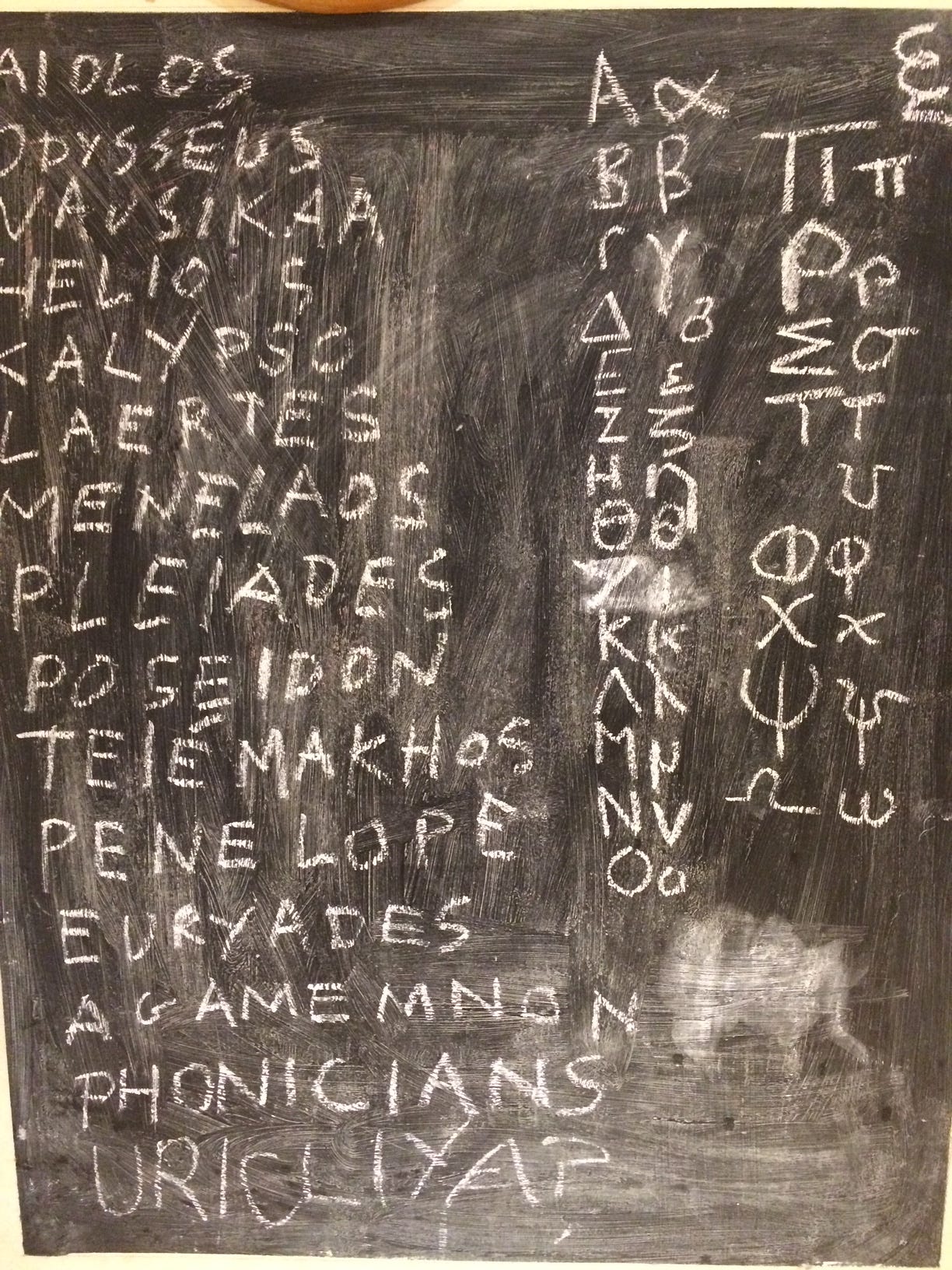
The Hard Yards Of Memorising
Imagining is precious. It takes a certain kind of work. Even if it’s just stick-people rustling around your head like a kid’s sketch it’s worth taking seriously. I don’t quite ‘know’ what King Arthur or the Red Bead Woman look like exactly, but I can feel their general shape and character. It would be disastrous if I described them too vividly in a storytelling. That’s the invitation for your imagination to meet mine in the meadow of the story. That’s how all this began. We gathered round a fire and someone started talking and we all started dream-thinking into their words.
With The Odyssey I had to change the structure of the poem. I began before even The Iliad (briefly) and then evolved into a more A-Z type narrative than the lovely bounding about Homer does. It proved complex enough without beginning two thirds of the way through. Once I had done all the reading, all the study, all the memorising of names, at some point I just had to give myself up to how the story was opening up in my storytelling head.
Homer had given me the matter of the story, but the sense of the tale, that’s where the storyteller displays their wit and pathos.
It takes a while before a story can really stand up and walk. You tentatively weave one scene next to another and the whole thing collapses. The Odyssey is just so long you just have to set out and hope for the best. Only in the telling is there sufficient adrenalin for your imagination to start realising what it wants to say about any particular episode. You run the terrible risk of just reporting rather stiffly what happened next: ‘They came to an island.’ You have to make some executive decisions about which island to describe and which not.
By the time Odysseus comes to the Cyclops, he and his man are wealthy, they can trade rather than attack. When I listened to a recording of myself telling the scene, I described them as if they were wandering around wanting to practice their new manners and looking to buy some artisan cheese from the charming one-eyed giant. This makeover doesn’t last for long. All that humour only occurred in the moment of delivery, it wouldn’t have occurred to me ahead of time.
On the recording I can hear the use of humour to get us through the more episodic and highly mythological chapters. It disarms the sense that we’ve heard it all before. It breaks up any sense of plod. Those lively spirits fall away as we journey further, and the really profound area of feeling is mostly waiting when Odysseus finally returns to Ithaca. Not as a conquering hero but disguised as a kind of derelict. The pathos gathers, soul replaces spirit, and we enter the incredible, chess-game reunion of Penelope and her decades-absent husband.
I walked countless miles of Dartmoor speaking the story, slept with it tucked under my wing, took any opportunity anywhere to tell it in small morsels to hungry beaks. At some point I was properly dream-thinking it (or thought by it) and then and only then was I ready to travel to Crete.
Comments
Nothing yet. Say the first thing.
Sign in to join the conversation.