
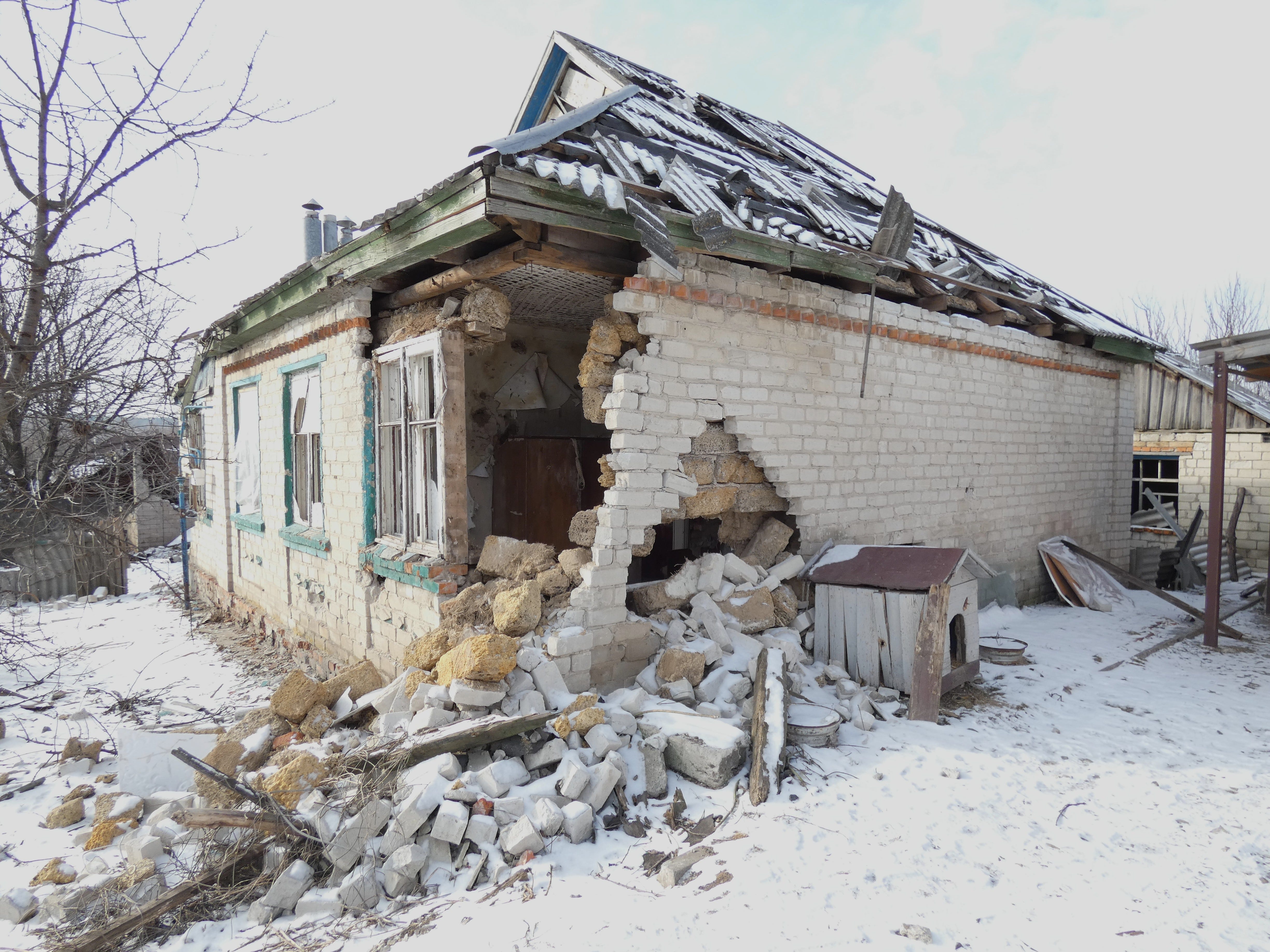
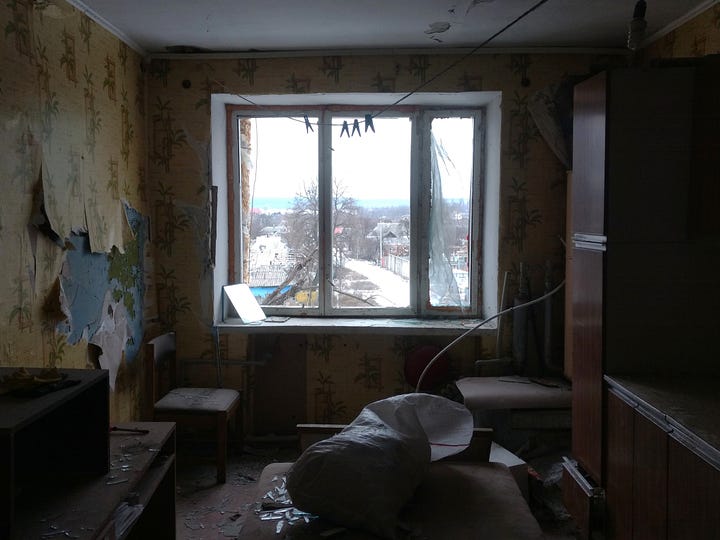
Russian shelling destroyed a home in Petropavlivka, a village in eastern Ukraine seized by invading forces. (c. Martin Kuz)
The city of Enerhodar nestles on the eastern edge of the Dnipro River in an area of southern Ukraine under Russian occupation. As the crow flies, the nearest point of land controlled by the Ukrainian military lies on the opposite bank 5 miles away. As a wartime reality, the nearest point of entry into free Ukraine for the city’s captive residents lies 1,200 miles away.
Russian authorities in occupied regions of the south and east force Ukrainian citizens to endure a winding, dayslong journey through Russia and Belarus to reach Ukrainian-held territory. They travel by bus at a cost of $300 to $400USD — a daunting sum for the pensioners who make up two-thirds of the passengers — on a route that traverses a series of “filtration” checkpoints within Russia. At each one, officers with the FSB, the state security service, harass them with interrogations, document reviews and luggage inspections, turning many away on grounds ranging from technical to fictional.
Those permitted to complete the trip reenter Ukraine from Belarus through a border crossing in the northwestern village of Domanove. All crossings between the two countries — as between Ukraine and Russia — are officially closed; the Domanove checkpoint serves as a one-way humanitarian exception for Ukrainians from the annexed regions. They cover the last mile on foot, lugging their suitcases past anti-tank barriers to return to the country they never wanted to leave.
Aid workers greet the travelers, who receive a small one-off cash payment, a SIM kit for a Ukrainian cell provider and a few other essentials. From Domanove, most catch buses to the city of Kovel, 45 miles south, where a pair of churches serve as short-term transit oases. The spaces offer hot meals and beds, and if needed, parish volunteers assist them with purchasing train or bus tickets to their next destination — typically the homes of relatives elsewhere in Ukraine.
I visited both churches on a clear fall day and met a handful of the 10,600 people from occupied Ukraine who passed through the Domanove crossing last year. Nikolai Dubenuk, 73, had arrived from Enerhodar the previous afternoon following a three-day, two-night trip. He felt his mood lifting as he breathed free in his homeland for the first time since early 2022.
“There you’re just trying to exist from day to day,” he told me as we sat outside the church where he spent the night. “Here I feel happy, joyful, light.” Lean and white-haired, and wearing a short-sleeved plaid shirt, jeans and sandals, Nikolai looked 10 years younger than his age. He credited his good physical health to consuming 4 gallons of honey a year. He had found nothing to ease the mental burdens of living under Russian rule in the city he helped shape.
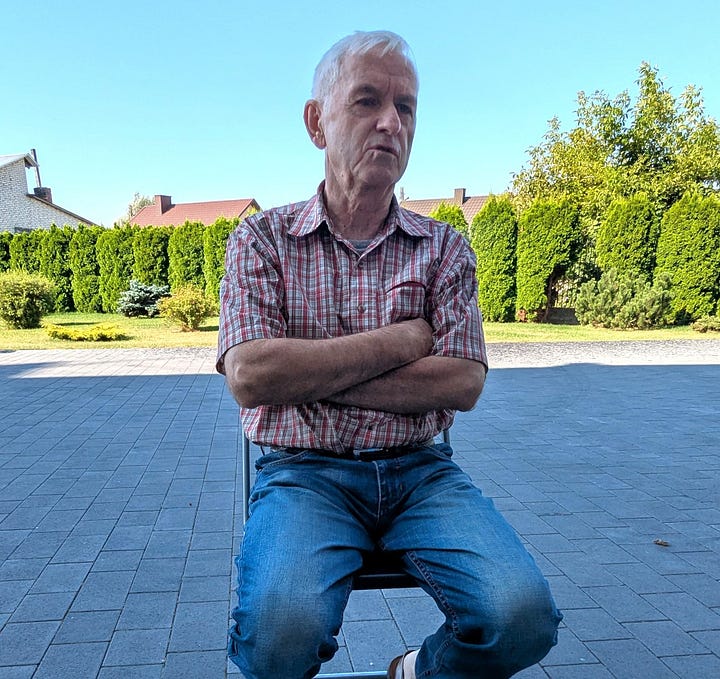
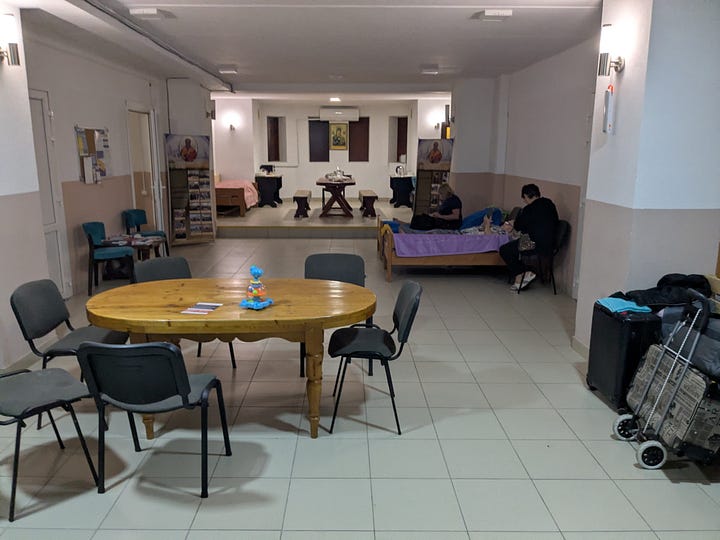
Left: Nikolai Dubenuk, 73, traveled 1,200 miles by bus from the occupied southern city of Enerhodar to reach Ukrainian-held territory. Right: A church in the northwestern city of Kovel serves as a transit oasis for people who make the long journey from the occupied regions. (c. Martin Kuz)
In 1979, Nikolai, then in his mid-20s, moved from central Ukraine to Enerhodar, established nine years earlier to provide housing for workers building a thermal power plant beside the Dnipro. The city’s name, which roughly translates as “gift of energy,” gained added relevance in 1980 when construction started on the adjacent Zaporizhzhia nuclear power facility, drawing new waves of workers and young families.
Nikolai joined the planning agency that mapped out the city’s expansion, and he and his wife, Olena, bought a home six blocks from the nuclear plant. In time, Enerhodar’s population topped 50,000, and the couple played their small part, raising two daughters who later gave them four grandchildren. He expected his retirement years to unfurl with predictable tranquility in the city that, like his family, had grown up around him.
The Russians demolished that future. In March 2022, less than two weeks into the full-scale invasion, enemy troops routed the civilian resistance in Enerhodar — the Ukrainian military lacked a presence in the area — and seized the city and its power plants. Nikolai’s daughters and their children escaped abroad in the following weeks. The next year, with doctors and pharmacists scarce, he lost Olena to illness, an uncounted casualty of war.
As in other cities and villages that Russian forces control, the occupation has drained Enerhodar of its people and purpose. The population has fallen below 15,000, and neither power facility generates the “gift of energy.” (U.N. regulators warn that Russia’s sporadic targeting and chronic neglect of the nuclear plant — Europe’s largest — risks a catastrophe for the continent.) Basic municipal services continue to deteriorate and most schools, medical clinics, service businesses, retail shops and grocery stores remain closed.
The city’s withering coincides with the occupiers erasing evidence of Ukraine from daily life. The ruble has replaced the hryvnia and Russian flags fly atop government buildings. Billboards urge young men to join the Russian military and schools impose a curriculum that emphasizes loyalty to Moscow and distrust of Kyiv. The same dual messaging dominates the Russian state television and radio broadcasts that have supplanted Ukrainian programming.
In Enerhodar and across the annexed regions, seniors account for the majority of residents, unwilling to surrender their homes or unable to leave for financial or health reasons. The occupying authorities subject Ukrainians to house searches and require them to obtain Russian passports to retain their property while allowing Russian settlers to lay claim to abandoned dwellings.
The creeping Russification, carried out under perpetual FSB surveillance, fosters a culture of suspicion that discourages even longtime neighbors from trading opinions about the invaders for fear of arrest and imprisonment. A sense of suffocation — coupled with a desire to reunite with family, the difficulty of collecting Ukrainian pensions and a dire shortage of health care resources — pushes residents to attempt the long trip to Domanove.
“You see the Russian troops and officials and you have unpleasant thoughts,” Nikolai said. “But you can’t say anything.” His disdain for them in the daytime mutates into rage after nightfall. “That’s when you hear them shelling Ukraine — my country.”
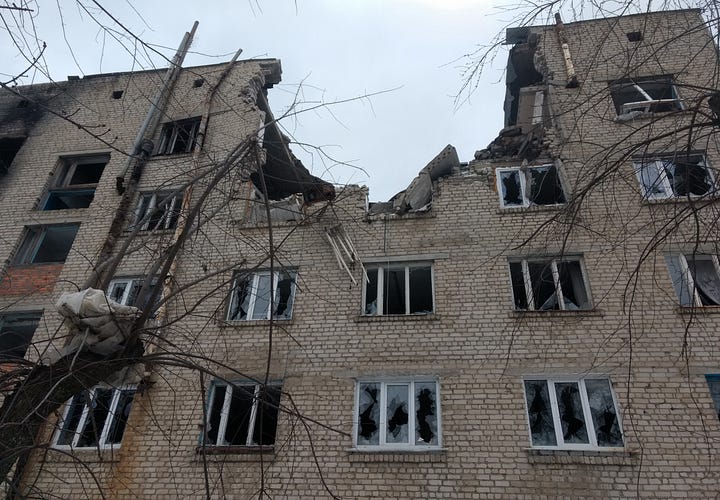
An apartment building destroyed by Russian shelling stands empty in the village of Staryi Saltiv in eastern Ukraine. (c. Martin Kuz)
The absence of Ukrainian troops in Enerhodar at the war’s outset spared the city from the destruction that has hollowed out vast swaths of the annexed territories. The devastation in cities and villages that Nikolai glimpsed during the bus ride to Domanove reaffirmed for him that Russia’s past seeks to recolonize Ukraine’s present.
Born in 1952, seven years after World War II, he learned from his parents and grandparents about the horrors that Joseph Stalin inflicted on the country for three decades until his death in 1953. Nikolai peered through the bus windows at the tableau of ruins wrought by another Russian dictator, Vladimir Putin, and pondered the dark days of Ukrainians living in bondage to Moscow during the Soviet era.
When the USSR imploded in 1991, Ukraine gained independence, reclaiming the land that belonged to its people. Nikolai believed that the Kremlin’s revived imperialist fantasies, no matter how vivid for Putin and his lieutenants, would end with history repeating. “The Soviet Union was much more powerful than Russia is now and eventually fell down,” he said. “The same will happen again, and then Ukrainians will come back to their homes.”
Many will find only rubble — a sight familiar to the hundreds of thousands of people returning to their towns and cities in Iran and Lebanon amid parallel ceasefires in the U.S.-Israel war against the two countries. The massive American-Israeli bombing campaign has reduced entire suburban neighborhoods and square city blocks to ashes, and Donald Trump and Benjamin Netanyahu appear willing — and eager, in Netanyahu’s case — to resume the killing at any moment. Yet the reverse migration of Iranians and Lebanese attests to the call of the land, a silent song louder than the deafening sounds of war, an irresistible beckoning that binds soul to soil.
“Even if my home is destroyed, I will stay on the land,” one man told The New York Times last week as he headed toward his village in southern Lebanon after the truce with Israel took effect. “I just want to be back.”
Polls show that a similar yearning to live free in their own country prevails among the 3.5 million Ukrainians languishing under Russian occupation. (The invasion has displaced another 9.6 million people.) Such sentiments make obvious sense to anyone not named JD Vance.
The U.S. vice president earlier this month belittled the fitful talks between Ukraine and Russia to end the war as “haggling… over a few square kilometers of territory.” Here’s a brief primer to help him grasp the stakes of that “haggling” for Ukraine: Territories are not merely land. Territories are people. Giving up land means giving up people who don’t want to be given up, you smug jackass.
Later in the day that we met, Nikolai boarded a train in Kovel bound for the city of Vinnytsia in central Ukraine, where he would stay with relatives for a short time. He intended to travel from there to Poland before proceeding to Austria to visit one daughter and to Germany to visit the other. He looked forward to the reunion with his children and grandkids — “and seeing the Alps,” he said with a smile.
He turned serious again. “But I won’t move there. Ukraine is home. This land is ours.”
Etc.
— Vance made his “haggling” remark during a visit to Hungary, where he stumped for fellow fascist Viktor Orban, who was seeking a sixth term as prime minister. Since December, Orban had blocked a $106 billion loan from the European Union to Ukraine, a financial infusion that Kyiv desperately needs to shore up its economy and military. Orban lost in a landslide two weeks ago — proving once again that whatever Vance touches always turns to dust — and today the EU gave preliminary approval to the loan.
— Ukraine has served — tragically and against its will — as the setting for the future of warfare. But the country’s ingenuity and resourcefulness in producing drones and other unmanned weaponry has enabled its army to stave off a much larger enemy force. The Times carried a story on that subject a couple of days ago that makes clear it won’t be long before Terminator 2: Judgment Day is regarded as a documentary.
— My sincere thanks for reading. If you’re a free subscriber and find Reporting on Ukraine worth your time, please consider upgrading to paid. You can also support my coverage here. Thank you.
Comments
Nothing yet. Say the first thing.
Sign in to join the conversation.