
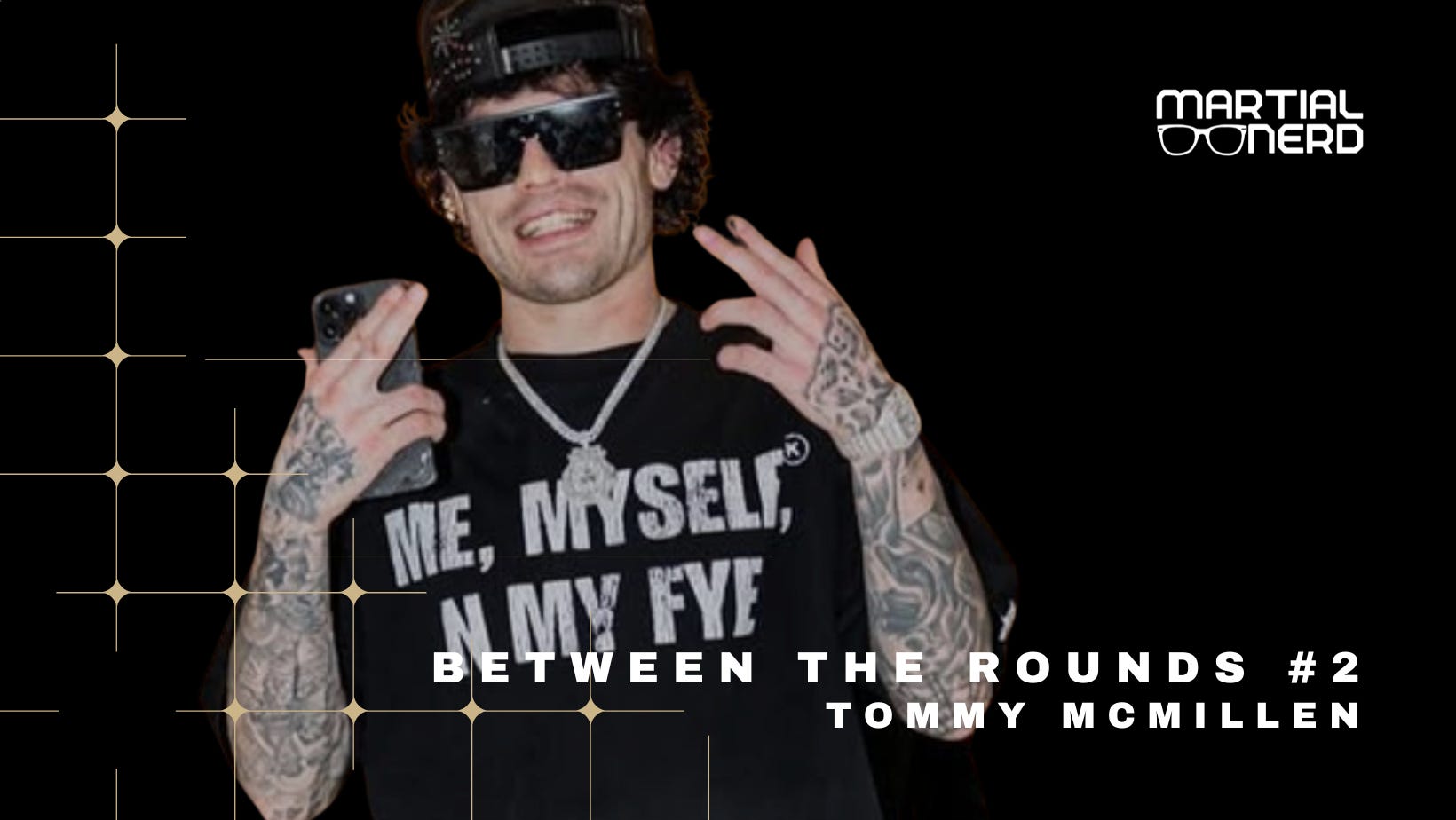
Daniel Cormier called Tommy McMillen a promoter's dream Saturday night in Oklahoma City. The crowd loved it. McMillen loved it.
Nobody stopped to ask what it actually means.
What the Compliment Is Really Saying
A promoter's dream isn't a fighter the promotion built. It's a fighter who built themselves.
McMillen walked into the UFC with a personality, a finishing instinct, and a recognizable identity. He declared himself the “third Diaz brother” after breaking Nate Diaz's record for most significant strikes in a three-round fight. He trains with Sean O'Malley. He talks like someone who has never second-guessed himself in public. Two UFC fights. Two performance bonuses. Eleven and zero.
None of that is the UFC's work. That's Tommy “Gun” McMillen's work.
When Cormier calls him a promoter's dream, what he's really saying is: this fighter does our job for us. The story is already written. The IP (or intellectual property, meaning the identity, the audience, the brand he built) already exists.
The UFC just has to put him in front of a camera and stay out of the way.
This Isn't Laziness. It's Strategy.
Here's what combat sports media critics get wrong about the UFC's marketing machine.
They assume the UFC is supposed to be in the business of developing fighters into brands from scratch. They're not. And they never were.
Developing a fighter's story from zero is expensive, slow, and risky. You invest in someone's narrative and they lose twice, get injured, or turn out to be impossible to work with off camera. The return on that investment is unpredictable at best.
Sourcing fighters who already have a built-in audience, a defined personality, and transferable IP? That's just better risk management.
The Contender Series is the clearest proof of this. It isn't a development program. It's a scouting pipeline. Dana White is watching fighters who have already built local and regional followings and selecting the ones whose IP travels. McMillen came through Contender Series. O'Malley came through Contender Series. Prates came through Contender Series.
That's not accidental. That's a system designed to find promoter's dreams before they cost the promotion anything to develop.
The Pattern Is Hiding In Plain Sight
Look at every UFC star of the last decade with a mainstream crossover following.
Conor McGregor built his persona in Cage Warriors before the UFC ever heard of him. Ronda Rousey was already a cultural moment before Dana White admitted women belonged in the Octagon. O'Malley had a following, an aesthetic, and a content identity before his Contender Series appearance made him a prospect.
The UFC didn't create any of these stories. It acquired the rights to amplify them.
That's a billion dollar business built almost entirely on other people's IP. And it works because most fighters (and most people in their corner) don't understand what's happening.
What This Means For Everyone Else
The fighters who understand this model are the ones who win.
Not just in terms of getting signed. In terms of leverage, longevity, and what happens to their brand when the UFC relationship ends.
If you arrived as a finished product with your own audience, your own story, and your own IP, you leave with those things too. The UFC amplified your brand. It didn't create you. That's a fundamentally different negotiating position than a fighter whose entire identity was built inside the promotion's ecosystem.
McMillen understands this instinctively. Whether he knows it or not, every interview, every post-fight declaration, every moment he chooses to be exactly himself in public is an asset he owns, not the UFC.
Start telling your story before you need the promotion to showcase it. The UFC isn’t looking for raw material.
It's looking for finished products to point a camera at and add to a numbered event poster.
No posts
Comments
Nothing yet. Say the first thing.
Sign in to join the conversation.