
Rest in peace, Tatiana Schlossberg, whose death was announced on December 30, 2025. Her brave essay in the New Yorker this year inspired much of this post.
One recent morning, when I finished The Bee Sting, a 600-plus-page novel by Paul Murray, my immediate reaction was I hate this! I’ll never read another book by him again!
Then I wanted to numb myself, to head downstairs to our comfy purple couch in front of the big-screen TV and rewatch Gilmore Girls episodes. That TV series from the early 2000s involves fairy-tale Stars Hollow, Connecticut, with its town meetings where everyone shows up in person and a “town troubadour.” The young mother and her precocious daughter at the center are both named Lorelai, a Gilmore name down the generations evoking a Germanic siren who lures sailors onto the rocks.1
So here I am, aping some of Paul Murray’s narrative digressions, still tempted to watch more Gilmore Girls but knowing after my kneejerk flinch that his novel is a tour de force. What I hated was the end, which, at least metaphorically, is the end of everything. The novel comes to an abrupt halt, shutting off all the rampant subjectivity expressed in it — the raw inner life of various characters, especially the four family members at its core who literally race to their doom.
When I began this piece, I didn’t intend to write about The Bee Sting, let alone an old TV show. The novel is one of several weighty and wonderful books I’ve read lately, yet my initial idea was to highlight Tatiana Schlossberg’s New Yorker essay about facing her own death. I’ll get to her moving essay, which speaks to my concerns about personal storytelling and generative AI. But as it turns out, The Bee Sting feels connected, too, especially in the flawed subjectivity of its characters.
The best human writing is flawed, I think, or unpredictable. Yet Murray’s novel conveys more than natural authenticity in human thought. Writing like this, be it fiction or nonfiction, challenges just how much any of us control the narrative.
I’ve recently signed a contract for a book about generative AI’s impact on self-expression, a happy thing for me. Yet as I consider what I’ll be writing next year, I have to fight off a sense of futility. I wonder why I need to make the case at all for humans writing their own stories. We’re the ones who live the events we describe. I shouldn’t need to argue for the value of our own subjectivity, but I think I do.
The digital-media emphasis on productivity and speed is muscling out everything else in discussions of the written word, as if there’s nothing better humans can accomplish than machine logic. Of course there is. Raffi Krikorian, Chief Technology Officer of Mozilla, makes this point in his 2025 Atlantic piece “The Validation Machines.” He calls today’s internet “a slick concierge” that “speaks in soothing statements and offers a frictionless and flattering experience. This has stripped us of something profoundly human: the joy of exploring and questioning.”
The thing is, writers and artists are stubborn. I’m stubborn enough to believe another textbook might make a difference to some readers, that it’s worth the effort, especially if other writers also keep countering business hype about what AI will do for humanity. First-person nonfiction, in particular, offers an increasingly fragile promise to readers regarding who the “I” behind the words is, but it’s a promise worth keeping.
Some of the best examples of writing that transcend AI generation are by authors reporting on their own situations. They make clear to readers what their personal stake in observing events is, even from the vantage of a famous family.
In Tatiana Schlossberg’s “A Battle With My Blood,” there’s no doubt what’s at stake for this 35-year-old author, a former New York Times environmental journalist. She learned she had leukemia in an unexpected way: immediately after the birth of her second child in May 2024, when her blood counts looked odd to her doctor. Schlossberg is also the daughter of Caroline Kennedy and the granddaughter of President John F. Kennedy. The New Yorker published her essay digitally on the anniversary of JFK’s assassination (November 22). Here’s how she starts:
“When you are dying, at least in my limited experience, you start remembering everything. Images come in flashes—people and places and stray conversations—and refuse to stop. I see my best friend from elementary school as we make a mud pie in her back yard, top it with candles and a tiny American flag, and watch, in panic, as the flag catches fire. I see my college boyfriend, wearing boat shoes a few days after a record-breaking snowstorm, slipping and falling into a slush puddle. I want to break up with him, so I laugh until I can’t breathe.
“Maybe my brain is replaying my life now because I have a terminal diagnosis, and all these memories will be lost. Maybe it’s because I don’t have much time to make new ones, and some part of me is sifting through the sands.”
After Schlossberg’s elegiac opening about the inevitable loss of particular memories, she narrates the course of her treatment over the months, the pain and absurdity, the deep sadness as realization sinks in. But how she wrestles with realizing she’s dying is the surprising nugget, along with her ability to convey first-person experience in a fashion that doesn’t feel sugar-coated.
Many other writers have lauded Schlossberg for her bravery; letters to the editor in the New York Times about her piece indicate its impact on readers. This kind of first-person nonfiction is close to my heart, although at least one friend warned me it would be a “hard read.” I steered clear for a few days, and when I did read it, I cried at the end. Yet this didn’t feel hard to take in. Instead, Schlossberg offered grace, the kind of deep, exploratory knowledge of self I find the best proof of humanity.
What reading her essay did require of me was a quiet moment with my first cup of coffee so that I didn’t rush from the emotions it raised to the next digital input. I’m not just talking about finding time to read a lot of words. I needed to focus my attention on the most serious aspects of life and death, a practice I fear we’re losing in the rush to create “frictionless” AI content. I worry not only about the skittish attention of readers. If people believe a bot can do it all for them, I’m concerned too many of us will lose the inner resources necessary to write so personally.
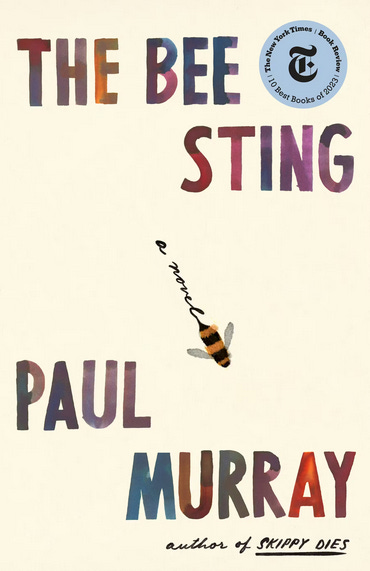
As The Bee Sting conveys in its fictional depiction of internal monologue, the ability to combine rationality with emotion demands far more discipline than most people have. In this sense, the entire novel is an artificial construction, one whose authorial presence emerges in the way the story is told rather than through a nonfictional “I.” Yet the tension between raw subjectivity and control over the way personal experience is presented to readers is the quality I look for in essay writing, too.
So. As Murray’s Irish characters sometimes toss off. You said it, so. The events in his novel are patched together in sections conveyed from different character perspectives, although not in first-person memoir style. (In the last section, rapidly shifting perspectives are laid out as in a play.) In a small town hours from Dublin, lacking any Stars Hollow quaintness, the marriage of Dickie and Imelda Barnes disintegrates along with the economic recession. Their daughter and son — teenage Cass and twelve-year-old PJ, respectively — struggle with their own feelings of isolation.2
The subjectivity of each character is constrained by what they don’t know and will likely never know about the others. (The story told about the “bee” that stung Imelda on her wedding day, the supposed reason she kept her face veiled, is one of many family fictions.) This is the classic disconnect between parents and children. But in The Bee Sting, the adult characters also spin stories to explain themselves, and keep shifting those stories, until more of the nastiness or gaping pain below is revealed.
That’s the situation for all us humans, really. Our hope comes in connecting with each other, catching a few inner glimpses anyway, as Murray implies, but we seem to do everything possible to numb or trick or lie to ourselves about reality.
The looming threat of climate change hangs over his novel, heightened by a raging storm in a dark, dark forest, the feeling of doom that prickles from the first page roaring into Shakespearean force by the end. A survivalist helping Dickie to “future-proof” a bunker in the woods is often referred to as looking like a troll or having a demonic sheep’s gaze. Another recurring motif is an old story of fairies who seduce travelers off the road with an artificially glowing feast under a hill.
As in the best personal essays, The Bee Sting presents the internal landscape of its characters almost to the point of dissociation, in some sections employing the second-person voice: “You ought to be worried about him but there isn’t room in your head Your mind is like one big pile of Jenga bricks and if it gets one good prod the whole thing will come tumbling down” (Imelda, complete with missing punctuation). Or they’re mired in competing stories, as Dickie is with his self-justifications:
“You don’t know if you believe them yourself; you have a suspicion that it no longer matters what you believe, that the story has taken on a life of its own and will follow its path to the end, with or without you.”
So. You said it, so. Writing has always been a means to tap what I don’t know, to come up with something I didn’t expect, as well as to inform readers about what I’ve discovered. It is both these things. But first comes the messy, dark forest of self, branches whipping across bare skin, until there’s a light to follow out of the storm.
Dumping raw feelings on readers is rarely revelatory or explanatory. Schlossberg’s nonfiction piece is deeply felt but also reportorial. She skillfully switches her stance and tone throughout, connecting the personal assault of being so ill with the universal assault on U.S. healthcare launched by her cousin “Bobby” — RFK Jr.:
“I watched from my hospital bed as Bobby, in the face of logic and common sense, was confirmed for the position [U.S. Secretary of Health and Human Services], despite never having worked in medicine, public health, or the government.
“Suddenly, the health-care system on which I relied felt strained, shaky. Doctors and scientists at Columbia, including George, didn’t know if they would be able to continue their research, or even have jobs.”
The details matter: her husband George is a doctor; her sister donates stem cells for a blood transfusion that smell like “canned tomato soup.” The singular experience of this writer demonstrates the harm done to us all by disastrous government policy. It’s a great example of what I call first-person journalism, which makes the biases of the observing “I” clear. Rather than undercutting credibility, a personal lens can be more convincing to readers who no longer trust traditional news sources.
It’s quite possible an AI system could help pin down the factual information about rare leukemia presented in Schlossberg’s essay or even unearth “memories” of a very public family. AI can be an excellent research tool, and Schlossberg or her editors might have used it this way; many journalists do now. I’d never argue that writers don’t benefit from help from editors or fact-checkers or peer readers.
Yet help is different from collaboration or artificial fabrication. There’s a basic difference between formulaic presentation of information and genuine self-expression — a difference the business leaders cheering on AI seem to willfully misunderstand.3
I keep returning to the smell of tomato soup. The way humans remember is personal. What individual writers remember or retain is also personal, and a story feels honest because of very specific observations of being alive. My uniqueness as a human being doesn’t turn up as the most likely next token in a sequence of words mined from the internet. It comes from my mistakes and mishaps, the stories that can’t be condensed or constrained. Sometimes they falter, like life, the stories undone.
I love human self-expression because it is so changeable and various and overflowing and unbalanced. When prompted, a large language model can tap some of what I’ve written in digital space, simulating what I’ve said before, but that’s only a piece of myself in the past. We live forward in time. I keep writing and remembering and rethinking, and much as I might want to, I don’t control everything that follows.
Writing with an “I” starts somewhere, but the beginning shouldn’t be what a bot spits out. It should be whatever mess of memories and ideas spill forth in a first draft you write yourself. That’s how this essay sputtered into being, and it’s my first rule for writers now. Your “I” should come from you and not be simulated by a machine.
We’re all influenced by others and the media we take in, from poetry by Sylvia Plath (Cass in The Bee Sting) to the video game Black Dawn (her brother PJ). I’m disturbed by how easily people become mired in deep wells of misinformation and paranoid belief. Figuring out what’s true has become the communication problem of our time.
But the flip side is human bumbling, slowly realized intention, imperfection, connection — and the sui generis quality of art, in which it’s hard to imagine anyone else using words just like this. Early on in The Bee Sting, in the midst of a tricky sexual situation, Cass recalls what a boyfriend once told her “about how the past hung in the present like smoke in the air, like vapour trails, fading out slowly”:
“She hadn’t understood it then but now for a moment it seemed she could see it, literally: Uncle Frank, lying burning in a blue meadow, her mother embedded in the glass windows of the church, coloured light streaming from her body. She saw herself too, a schoolgirl, wrongness buzzing within her like a bee trapped in a veil, clutching on to her best friend’s hand. Tonight would go too, fade away, like white plumes of chemicals into the blue. Her heart let out a sad mewl of grief, as if she were dissolving into the shadows, or the shadows were in her, eating her from the inside out.”
Death is inevitable, that abrupt end to internal chattering, “dissolving into the shadows.” But we can pause on the way to notice life. There’s synchronicity in many of the books and movies and TV shows swirling in my mind now, which includes a recent viewing of Hamnet — a film with almost unbearable pauses to witness grief; undulating trees with a life force of their own; the artifice of a Shakespeare play that channels raw feeling into art, even those trees painted on a set backdrop.
Artifice and subjectivity, creation and internal raving. In another version of this essay, I began with my melancholy mood on Thanksgiving, recalling the memorials I’d gone to this year. Yet my sadness was overlaid with warmth. A week before, close to the day Tatiana Schlossberg’s essay first published — and the anniversary of her grandfather’s death — the crescent moon glimpsed at sunset made me gasp aloud with awe.
If I think of anything that’s precious to me as a writer, of messy humanity in general, it’s this. The thisness of me. Of you. Of us, following our lights out of the storm.
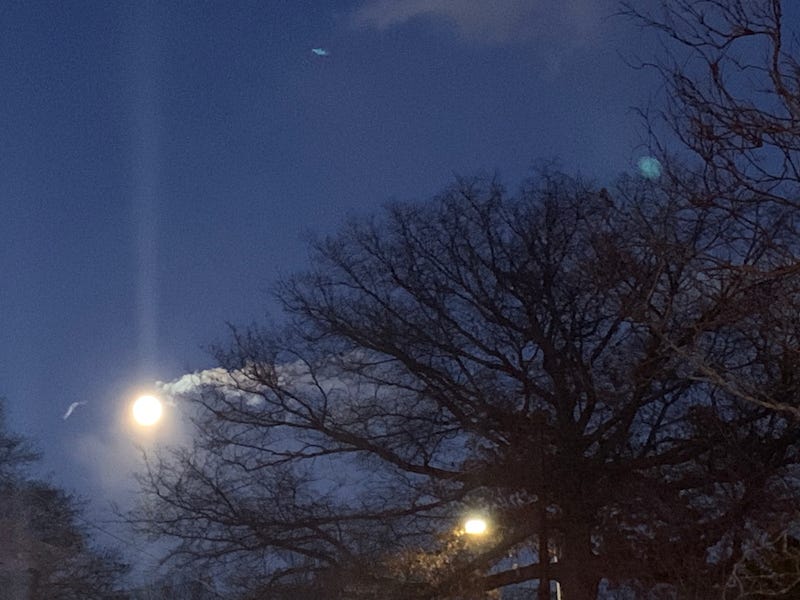
Thanks to my friend sanford t rose for permission to feature his photos here.
Lorelai Gilmore’s name might also come from a Yale alumnus’ obsession with Heinrich Heine and Goëthe, a sly nod to elite Ivy pretentiousness in Gilmore Girls. The Amy Sherman-Palladino series is a gentle satire, full of snappy dialogue, including (just for example), offhand references to a “Tennessee Williams Look-a-Like Contest” as a town fundraiser. That’s from the standout Season 3 episode “They Shoot Gilmores, Don’t They?”
Comments
Nothing yet. Say the first thing.
Sign in to join the conversation.