
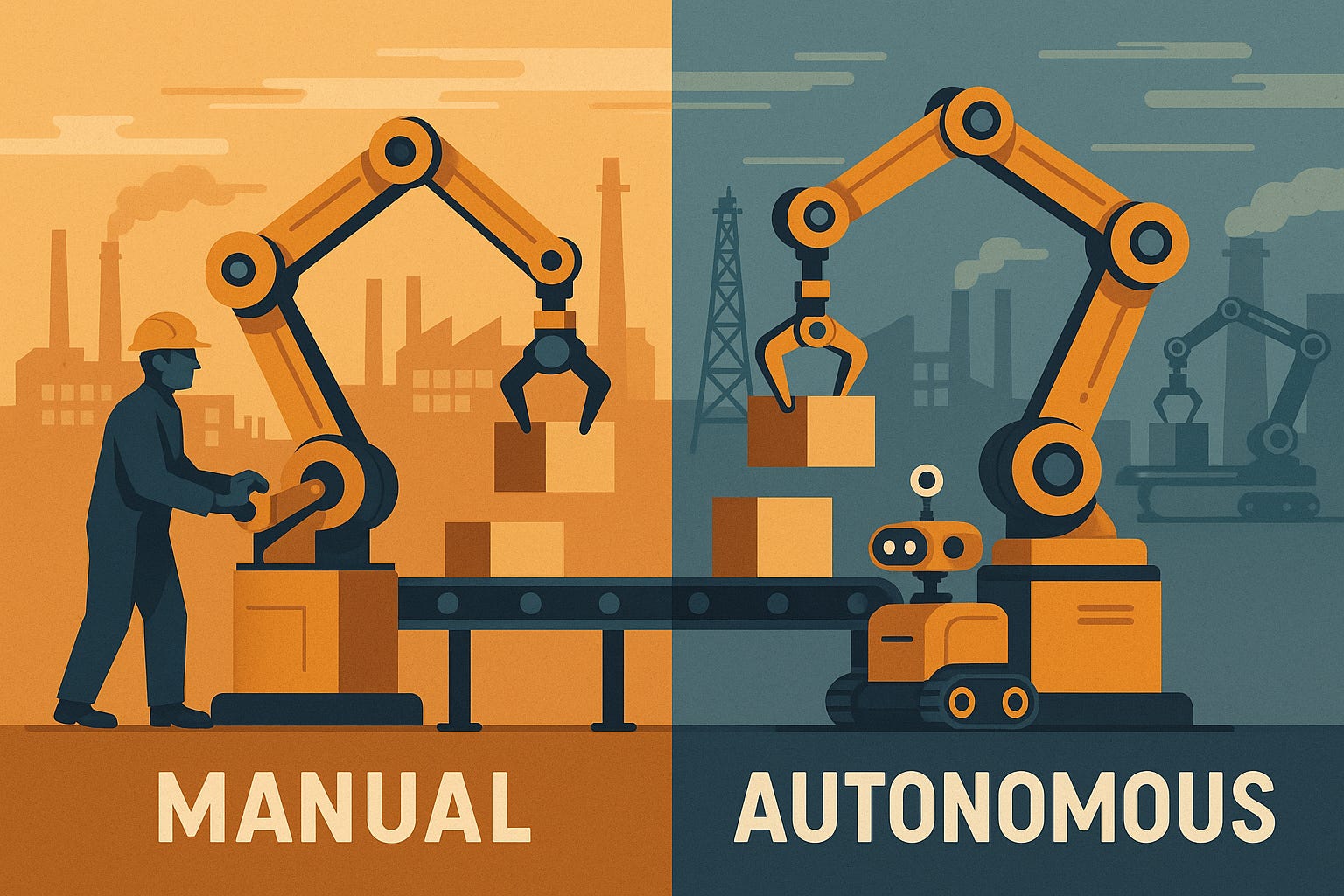
For more than sixty years, robotics has been a promise rather than a reality in U.S. manufacturing. Ever since GM installed the first robots in 1961, adoption has been slow. Despite decades of investment, only about 8% of firms use robots today, according to the National Science Foundation. High costs and rigid technology made widespread deployment impractical. But with advances in AI, sensors, and workflow design—alongside supportive policy and shifting attitudes—we believe the U.S. industrial base is on the brink of massive disruption. For investors, this is a generational opportunity.
Historically, robots were inflexible. They performed single tasks well, but even minor workflow changes could disrupt entire production lines. Unlike humans, robots could not adapt dynamically, creating engineering and coordination challenges. Integration was expensive—often four to six times the cost of the robots themselves—limiting adoption to high-volume industries like automotive and electronics.
Today, breakthroughs in AI and sensors allow robots to understand context, adjust to real-time changes, and work collaboratively across tasks. Integration costs are falling sharply, opening the door for medium-sized manufacturers and industries previously shut out from automation.
The last comparable step-change in industrial technology came in the 1950s, when jet engines modernized transportation. Robotics, by contrast, has only delivered incremental gains—until now. We are at the tipping point of true industrial disruption, one that will accelerate faster and reshape more sectors than any past transformation.
The reason automation hasn’t spread more broadly lies in product design. Most products today are designed for human assembly, with robots filling only the simplest roles. In cars, for example, robots typically weld or handle exterior parts, but humans must step in for complex, confined tasks.
By contrast, the semiconductor industry has long operated at the nanometer scale—where robotic precision is not optional but essential. Transistors today are 3–5 nanometers, compared with a human hair at 80,000–100,000 nanometers wide. Chip design begins with what robots can manufacture, then adapts the product accordingly. This robot-first philosophy leads to fundamentally different economics. Imagine redesigning a car door not for convenient human manufacturing, but to maximize robotic efficiency—that shift changes the entire production model.
Chinese electronics giant Xiaomi exemplifies this future. Originally a phone maker, Xiaomi launched its EV division in 2021. Today, it produces ~80,000 cars per quarter with 27% gross margins. Its factory, producing 280,000 cars annually, employs just 1,200 people.
By comparison, Tesla’s Shanghai plant—its most advanced—has capacity for one million cars, employs ~20,000 workers, and operates at ~25% margins. Detroit incumbents lag even farther behind on automation, GM and Ford car margins of 10% reflect the lag.
The productivity gap is staggering: Xiaomi makes 4.5x more cars per employee than Tesla. The conclusion is clear—robotics-first design delivers higher margins, lower labor intensity, and greater scalability.
Xiaomi, Tesla, and SpaceX offer a glimpse into the coming wave of creative destruction. Legacy industries are vulnerable to robotics-first entrants. Entrepreneurs who build from scratch, unencumbered by legacy processes, can rapidly outcompete incumbents. For investors, the risk profile is highly attractive: these ventures target existing markets with proven demand, making them less binary than typical software or AI bets. The incumbents are too big, too slow, and too locked into old ways to adapt quickly.
We are entering a robotics-driven reindustrialization. Just as jet engines redefined transportation, adaptive automation will redefine manufacturing. The winners will be those who design with robots in mind from the start—and the funds that back them early will capture the outsized returns from this historic transition.
Comments
Nothing yet. Say the first thing.
Sign in to join the conversation.